

You open a group chat and a friend replies with just “ISK.” Is it a typo? A currency? Slang you somehow missed? If you’ve ever paused mid-scroll to ask yourself what does ISK mean in text, you’re in good company, because those three letters can point in very different directions.
People search for this one because it isn’t like LOL or BRB, where everyone agrees on the meaning. ISK shows up in text messages, Snapchat chats, TikTok comments, Instagram DMs, and gaming servers, and each place can read it a little differently. It also happens to be a real currency code, which adds to the mix-up.
This guide gives you the most common slang reading, the other meanings, and where the term came from, and it shows how to use it and reply to it. You’ll also see real examples from school, work, and everyday chats, so you can read ISK correctly the next time it lands in your inbox.
Quick answer: ISK is a texting abbreviation. In casual chats it is often read as “I should know,” a way to say you have been there or feel you ought to know. It has no single official slang meaning, though, and it is also the currency code for the Icelandic króna, so context decides.
ISK Meaning in Text: The Short Version
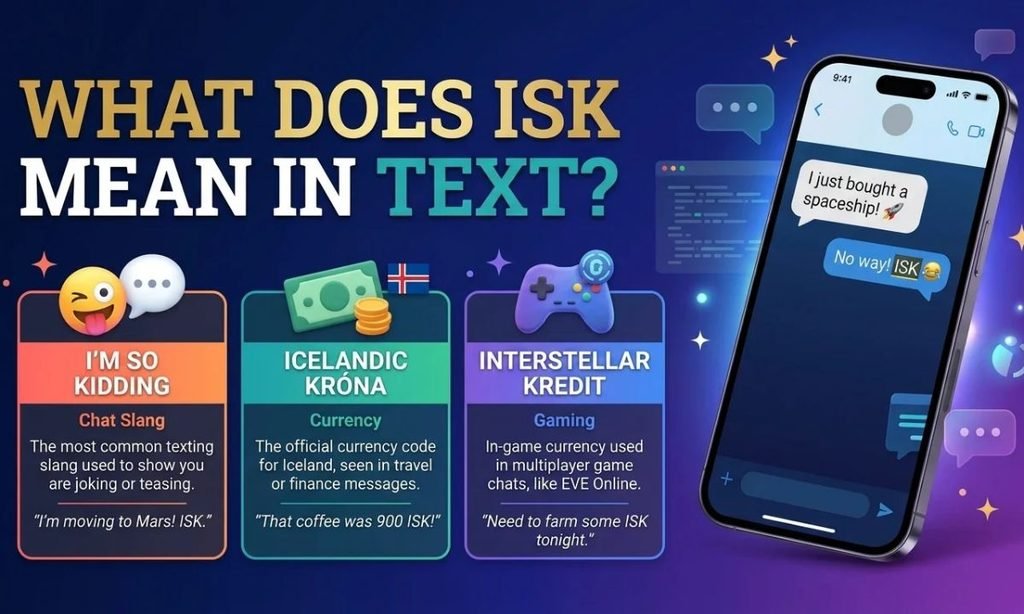
ISK is a texting shortcut. People type it when they feel they already understand something, or when they feel they ought to. The full form is short and the basic definition is simple: “I should know.” It’s casual slang, and you’ll mostly spot it in chats, comments, and captions.
The tone depends on the situation, so the meaning is situation-dependent too. Sent to a friend, it can sound relaxed and a bit playful. Sent to a boss, it could land badly. In the group threads I’ve watched, it almost never needs a long explanation, but it does need a little context.
One honest caveat belongs here. “I should know” is the reading you’ll see most often for casual slang, but ISK has no universally accepted definition the way LOL does. Treat that expansion as the most likely guess in a chat, not a rule you can count on every time.
What Does “I Should Know” Actually Mean?
The phrase carries two slightly different feelings, and the same three letters can express either one.
The first is experience. The message says, “I’ve been through this, so I understand.” Picture someone who survived the same bad job you just complained about. They reply “ISK,” and you both know they’ve lived it.
The second is self-aware regret. The message says, “I really should know this, but I don’t.” A tired student who forgot a deadline might use it that way. So might a friend who is forgetting yet another birthday and knows it.
Context decides which one you’re reading. So what does it actually mean? Whichever feeling the rest of the message supports. If the sentence before it describes a shared struggle, it’s experience. If it describes a slip-up, it’s regret.
Why ISK Has No Single Fixed Meaning
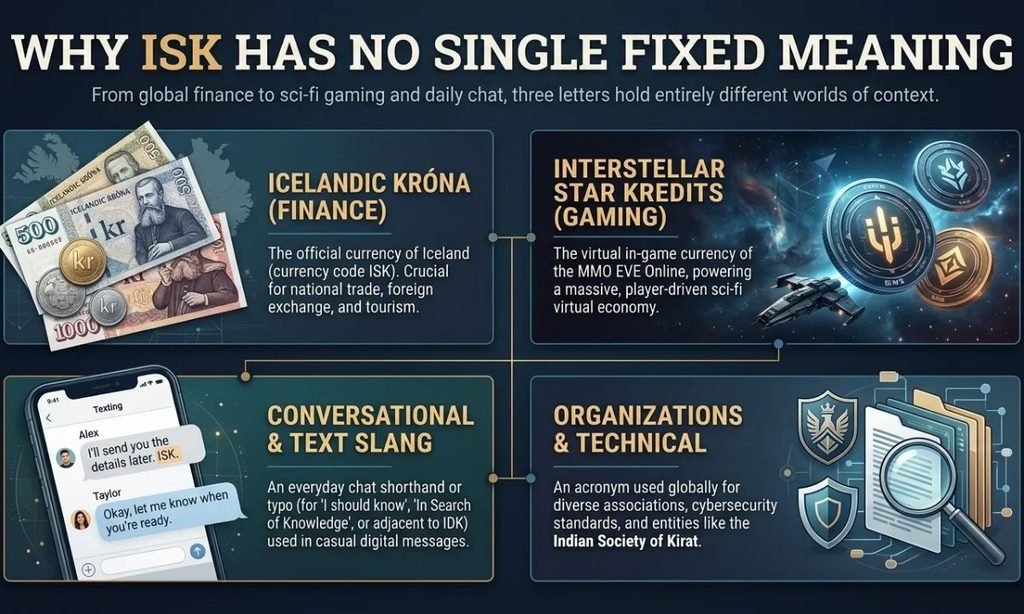
Compare ISK with LOL (“Laugh Out Loud”) or BRB (“Be Right Back”). Those have meanings nearly everyone agrees on. ISK is relatively uncommon, so no universally accepted slang definition has formed around it. Its meaning often depends on the group, community, or platform where it’s used.
That’s why I can’t pin down its meaning from three letters alone. I need the ongoing conversation. A message like this shows the problem:
Alex: I’ll send you the details later. ISK.
Taylor: Okay, let me know when you’re ready.
Nothing in that exchange defines ISK, and that’s the point. The abbreviation is understood only through the conversation around it. Slang lives in the people using it, not in a dictionary, and a friend group can settle on a shared reading that outsiders never see written down.
Anyone who tells you ISK has exactly one meaning in every chat is guessing. The honest answer is that it’s a context-dependent abbreviation.
Why Context Matters More Than the Letters
Many internet abbreviations carry multiple meanings, and ISK is a good example. Before you assume anything, run through a few quick questions:
- Is this a casual text message?
- Is the conversation about gaming, money, or travel?
- Is it happening on social media?
- Does the sender usually write in slang?
- What platform are you on?
Answering these usually makes the meaning clearer. I run through them in my head almost automatically now. A friend texting about a rough week points to the slang reading. Someone comparing hotel prices in Reykjavik points to money.
The platform gives clues too. A gaming forum and a finance website will use ISK very differently, so look at where you found it before you decide what it means.
Where Did ISK Come From?
The origin is murkier than most slang, so here is what’s known and what isn’t.
How It Began
Texting slang grew out of the habit of shortening common phrases, like IDK, IMO, and BRB. ISK follows the same pattern. It compresses three words into three letters for quicker typing.
How It Changed
It started as a plain shortcut. Over time, people added humor, sarcasm, and self-teasing, so one abbreviation now stretches across confidence, embarrassment, and shared experience. That flexibility is also why the tone can be hard to read without context.
What Nobody Can Prove
Nobody has documented who first used ISK as slang. Some sites claim it stands for “I should know,” and that reading is common in casual chats, but I haven’t found solid evidence that settles the origin. Any firm claim about exactly where it started is debated at best, and an exact origin story is usually a guess dressed up as fact.
There’s also a separate meaning with a clear history. ISK is the official currency code for the Icelandic króna. That use has no link to slang, even though the letters are identical.
Where You’ll See ISK Online
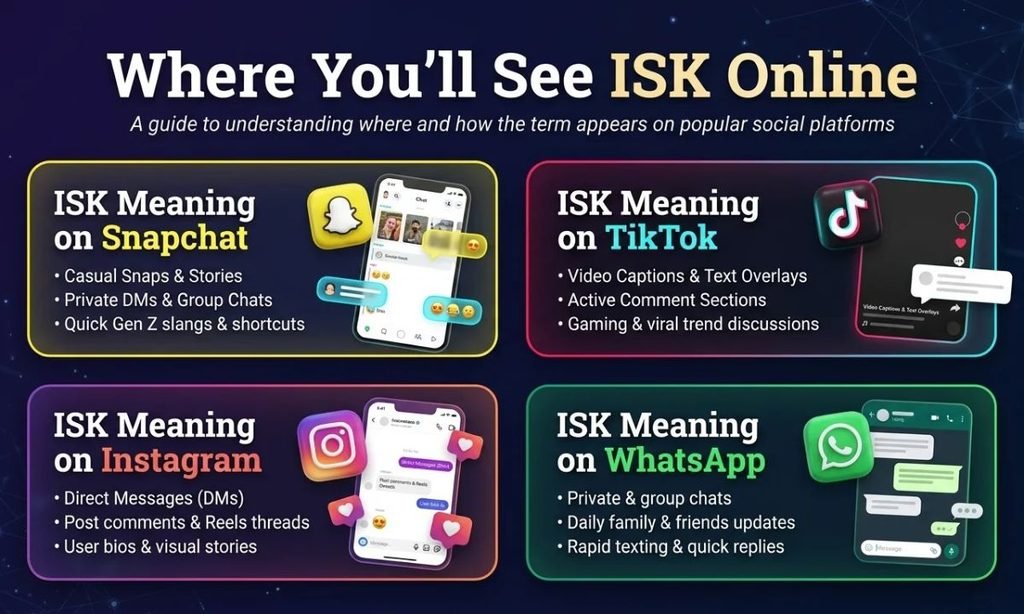
Start with a quick glance. In text messages and personal chats, ISK works as a casual texting abbreviation in casual conversations. On Snapchat it turns up in chats and private messages. On TikTok it shows up in comments and captions, and on Instagram in DMs and comments. Gaming brings in-game currency in some games, and finance brings the króna, so money and banking talk is another home for it.
You could call it an informal abbreviation, or a mix of slang and abbreviation, depending on the room. Common usage varies that much.
ISK isn’t among the most frequently used internet acronyms. You may still run into it on messaging platforms and social media platforms, right next to more familiar abbreviations. Here is how it tends to play out on each one.
ISK Meaning on Snapchat
Abbreviations are used here to save time, so people shorten phrases and invent new ones all the time. ISK depends entirely on the discussion. In an informal friend group, an outsider usually understands it only after someone explains. Usually that’s all it takes.
Friend 1: Did you see what happened today? ISK.
Friend 2: Yeah, I couldn’t believe it either.
ISK Meaning on TikTok
Comments move quickly on TikTok, and users frequently create new abbreviations. Some turn popular inside specific communities before spreading more widely. If you see ISK in a comment section, read the surrounding comments, look at the video’s topic, and check whether the creator explains it anywhere. Captions are worth a glance too.
ISK Meaning on Instagram
ISK can appear in Direct Messages (DMs), Story replies, post comments, and group chats. No single definition applies to every conversation. I’d treat any lone definition you read online with some suspicion, including the ones in this guide.
ISK Meaning on WhatsApp
Chats here run between friends, classmates, coworkers, and family members. When one of the participants writes ISK, I interpret it from the previous messages, the relationship between the people, and the topic being discussed. These are personal conversations, which helps. If you’re unsure, asking is the safest move, and a request for clarification is perfectly acceptable.
ISK Meaning on Discord
Servers grow their own terminology. In gaming communities and hobby communities, ISK may take a community-specific meaning that differs from general internet slang. A server built around one game may read it another way than a friend group on Snapchat. I always consider the server’s topic before assuming anything, because a group’s own terminology develops fast.
ISK Meaning on Facebook Messenger
Messenger combines personal conversations and group conversations. Just like WhatsApp or Instagram, ISK relies on context here and has no fixed internet definition. The same quick look at the thread usually clears it up.
What Else Can ISK Mean?
Does ISK have multiple meanings? Yes, and that’s the main reason people search for it. Several interpretations exist, and which one applies depends on where it appears. These are the most common.
Internet Slang or Chat Abbreviation
In casual messaging, ISK works as a shorthand expression inside friend groups or online communities. As covered above, “I should know” is the usual reading, though no accepted slang definition exists. You have to rely on the conversation and the intended meaning.
The Icelandic Króna
This is the one meaning I’d call certain. ISO 4217 lists ISK as the code for the Icelandic krón , the national currency of Iceland, and it is the official currency code. It has nothing to do with internet slang.
Outside of texting, finance is where you’ll meet it. A hotel in Iceland might cost 25,000 ISK per night. If a conversation is about travel, prices, or Iceland, ISK probably means the króna. Otherwise, assume slang.
Gaming Communities
Some online games use ISK as an in-game currency, with a whole economy system behind it. EVE Online is the example I know best. If the conversation involves trading or virtual items, this is often the correct interpretation.
Industry-Specific Meanings
Professions and organizations sometimes use ISK as an internal abbreviation. You might see it in technical documents, company communications, academic papers, or industry reports. Those uses are unrelated to texting and depend entirely on the field being discussed. Acronyms and terms like these rarely carry over into everyday chat.
Typos and Wrong Guesses
Two more mix-ups are worth knowing. Some people type ISK by accident when they meant IDK, since the letters sit close together on a phone keyboard. Others guess that ISK means “I seek,” but that isn’t a standard texting meaning. Stick with “I should know” for slang unless the context clearly says otherwise.
How People Use ISK in Texting
ISK works best as a quick reaction. It’s short enough to drop into a fast conversation without slowing it down, which is why it skews toward rapid back-and-forth.
The Typical Pattern
Most people attach it to the end of a statement:
“That group project was a nightmare, ISK.”
It tells the reader you’re speaking from experience. The statement before it does most of the work, and ISK adds the “I’ve been there” flavor.
Using ISK Alone
It can also stand by itself. A friend says, “Mondays are brutal.” You reply with a single word: “ISK.” That says, “I get it, I’ve lived it too.”
I use it this way more than any other, because the message it answers supplies the meaning. The catch is that a standalone ISK sent out of nowhere can confuse readers. Pair it with a statement or reply to something specific.
Real-Life ISK Examples From Everyday Chats
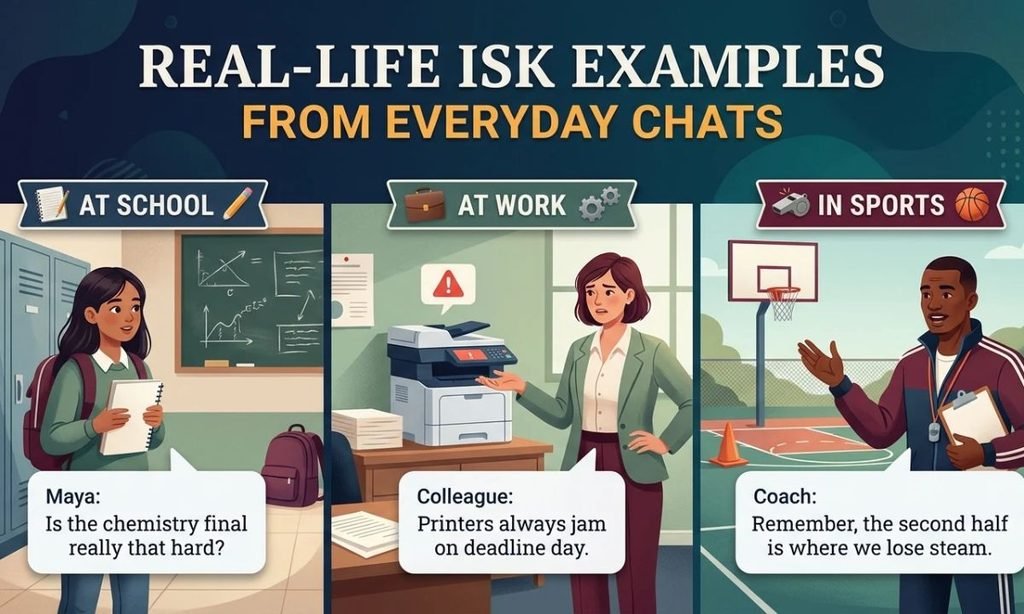
These short conversations show the range better than a definition does.
At School
Maya: “Is the chemistry final really that hard?”
Zane: “ISK, I barely passed it last year 😅”
Meaning: Zane speaks from experience.
At Work
Colleague: “Printers always jam on deadline day.”
You: “ISK. Every single time.”
Meaning: you’ve lived this problem too. This is a friendly use between coworkers. It’s best kept to casual chat threads, not formal messages.
In Sports
Coach: “Remember, the second half is where we lose steam.”
Player: “ISK, I’m the one who gets tired first 😂”
Meaning: the player admits something they should be aware of.
In Relationships
Friend: “Forgetting an anniversary is a disaster.”
You: “ISK. I did it once 😬”
Meaning: you know because you made the mistake yourself.
Humorous Use
Friend: “You said you’d stop ordering takeout.”
You: “ISK 🍕”
Meaning: you know you should, and you’re laughing about it.
ISK in Real Sentences
Examples show the different contexts better than any definition. Here is how the same three letters behave across four settings.
- Casual chat: “I wasn’t sure what you meant by ISK, so I asked for clarification.”
- Social media: “Someone commented ISK on my TikTok video, but I couldn’t tell what they meant.”
- Finance: “We exchanged dollars for ISK before visiting Iceland.”
- Gaming: “You’ll need more ISK before you can buy that spaceship.”
A few more exchanges from group chats and comment threads show how people sort it out:
Emma: Everyone keeps saying ISK in the group chat.
Olivia: Ask them what they mean. It could have different meanings.
Jake: I found ISK in the comments.
Ryan: Read the replies. Someone may have explained it.
Sarah: Do you know what ISK means on Snapchat?
Lily: It depends on the conversation.
Chris: Our trip costs 120,000 ISK.
Ben: That’s the Icelandic currency, right?
Jordan: I finally earned enough ISK. Time to upgrade equipment.
That last one is clearly in-game currency, not internet slang.
What ISK Says About the Writer
Using it can hint at a few personality traits, though I wouldn’t read too much into one message.
It can signal confidence. Someone who types ISK often wants to show they’ve done their homework or lived through the thing.
It can signal humor. Many people use it to tease themselves, which makes the message feel friendly and relaxed.
It can signal experience. It quietly says, “I’ve been there, you can trust me on this one.”
ISK Meaning Quick View
Here is the slang reading at a glance:
| Item | Details |
| Full form | I should know |
| Main meaning | Experience or self-aware awareness |
| Tone | Casual, confident, or playful |
| Common platforms | Snapchat, TikTok, Instagram, Discord |
| Formal use | Not recommended |
| Other meaning | Icelandic króna (currency code) |
And here is how the meaning shifts by setting:
| Where you see it | Likely meaning | Typical use |
| Text messages | Context-dependent abbreviation | Casual conversations |
| Snapchat | Internet slang | Chats and private messages |
| TikTok | Slang or abbreviation | Comments and captions |
| Informal abbreviation | DMs and comments | |
| Casual texting abbreviation | Personal chats | |
| Gaming | In-game currency (some games) | Gaming communities |
| Finance | Icelandic króna | Currency and banking |
How ISK Is Used Today in 2026
Short replies dominate modern chats, from voice-note captions to meme comments. ISK fits that rhythm because it’s quick and easy to read. It turns up in the same places other short forms do.
Here’s a modern example. A comment says, “Wireless earbuds always die at the worst time.” The reply: “ISK, mine quit mid-call yesterday 🎧”
One more. A post says, “Working from home sounds relaxing.” The reply: “ISK 😂 the dog barks all day.”
Is it still popular? It’s still seen in comments, DMs, and gaming chats, though it’s less famous than IDK or IMO. How common it feels depends on the community you’re in.
ISK vs Similar Text Abbreviations
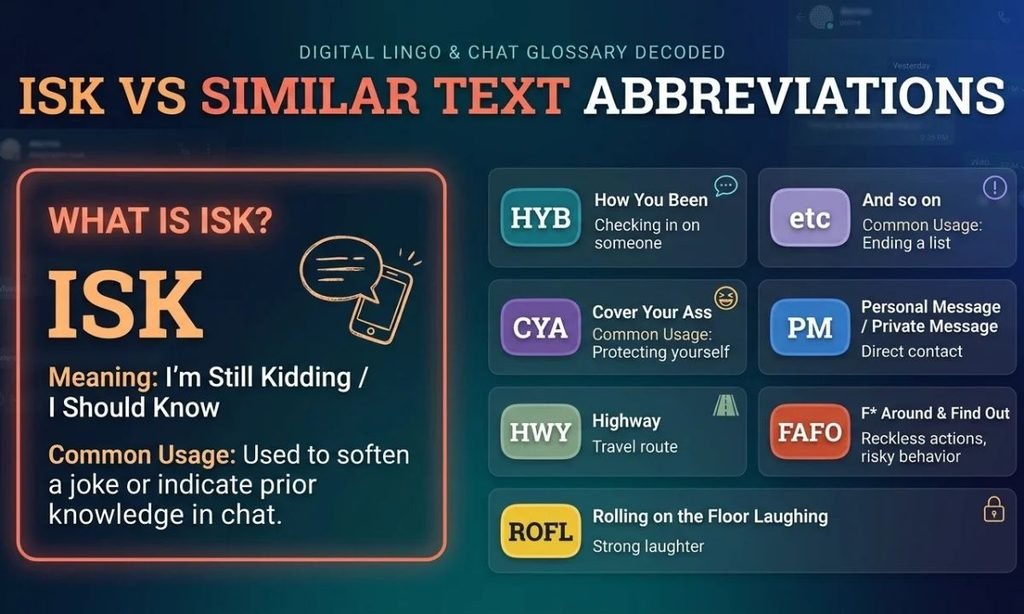
I compare ISK to other abbreviations mostly to show how unusual it is. Most of these have a fixed meaning. ISK doesn’t, and that’s the key difference.
| Abbreviation | Meaning | Common usage |
| HYB | How You Been | Checking in on someone |
| etc | And so on | Ending a list |
| CYA | Cover Your Ass | Protecting yourself |
| PM | Personal Message or Private Message | Direct contact |
| HWY | Highway | Travel route |
| FAFO | F* Around and Find Out | Reckless actions, risky behavior |
| ROFL | Rolling on the Floor Laughing | Strong laughter |
| NS | Not Sure | Don’t know something |
| W | Win | Celebrating success |
A quick note on tone: a few entries, like CYA and FAFO, are crude in formal or professional settings. They’re fine among friends and a bad idea in a work email. ISK is milder, but it’s still informal slang. If you want more abbreviations to decode, check out OT meaning in text.
ISK vs IKR
They look similar, but they’re different things. IKR is a widely recognized internet slang term meaning “I Know, Right?” People use it to agree.
Friend: That movie was amazing.
You: IKR!
ISK shouldn’t be automatically read the same way.
ISK vs IDK
IDK means “I Don’t Know,” as in “IDK what time they’re arriving.” It has a fixed meaning. ISK means “I should know” in slang, so the two express opposite ideas. They sound alike, and a typo can turn one into the other. One suggests awareness or experience, while the other admits a gap.
ISK vs IMO
IMO means “In My Opinion,” as in “IMO, that’s the best phone for the price.” It shares a view and has a universally accepted definition. ISK points to experience or awareness instead of an opinion.
ISK vs TBH
TBH is “To Be Honest,” as in “TBH, I didn’t enjoy the movie.” Unlike TBH, ISK isn’t standardized across online platforms.
Is ISK Rude, Friendly, or Sarcastic?
By itself, ISK is neither rude nor friendly. The tone comes from the message around it. I’ve seen it land as friendly in DMs and dry in comments, and the same goes for story replies and captions. The surrounding discussion decides how a community reads it.
Usually it’s friendly or playful. Sarcasm is where it gets tricky. If someone says, “You’re always late,” and you answer “ISK,” you may be joking, admitting guilt, or brushing it off. Without an emoji, it can feel dry.
Add an emoji if you want the tone to stay light 🙂. The text alone may be read either way, so watch your tone.
How Different Generations Use ISK
Teenagers use it most in group chats, comments, and gaming.
Young adults reach for it for dry humor and relatable posts.
Older adults use it less often, so spelling it out avoids confusion. If you’re texting a parent or an older coworker, write “I should know” and skip the guesswork.
ISK in Online Communities
You’ll spot ISK in fan groups, study servers, and hobby forums. In these spaces, it often marks a shared experience, like a tough boss fight or a hard exam. Online communities build their own habits, so I’d rather read a few messages than assume.
The reading can differ between groups. A study server might use it for “I should know this, I’m behind.” A gaming group might use it for in-game money. Same letters, different room.
When Is It Right to Use ISK?
Use it when you’re chatting casually and the other person will understand it. Texting friends, group chats, and social media comments and replies all work. So does joking about your own habits.
Skip it in work emails, school essays, and formal messages. It’s informal slang, so write “I should know” in professional emails, school work, and formal assignments. Unless you’re discussing the Icelandic currency or an industry-specific topic, ISK doesn’t belong in formal business communication. If someone could misunderstand it, write the full phrase.
Quick Checklist
Before you send it, ask yourself four things. Is the chat casual? Will the reader understand slang? Is the context clear? Is the tone friendly? If you answered yes to all four, go ahead.
Benefits and Drawbacks
ISK saves time, sounds natural in casual chats, shows experience or humor, and helps you connect with friends.
The drawbacks are real, though. It can confuse people who don’t know the slang, sounds out of place in formal settings, and can be mistaken for IDK or the currency code.
Common Mistakes When Using ISK
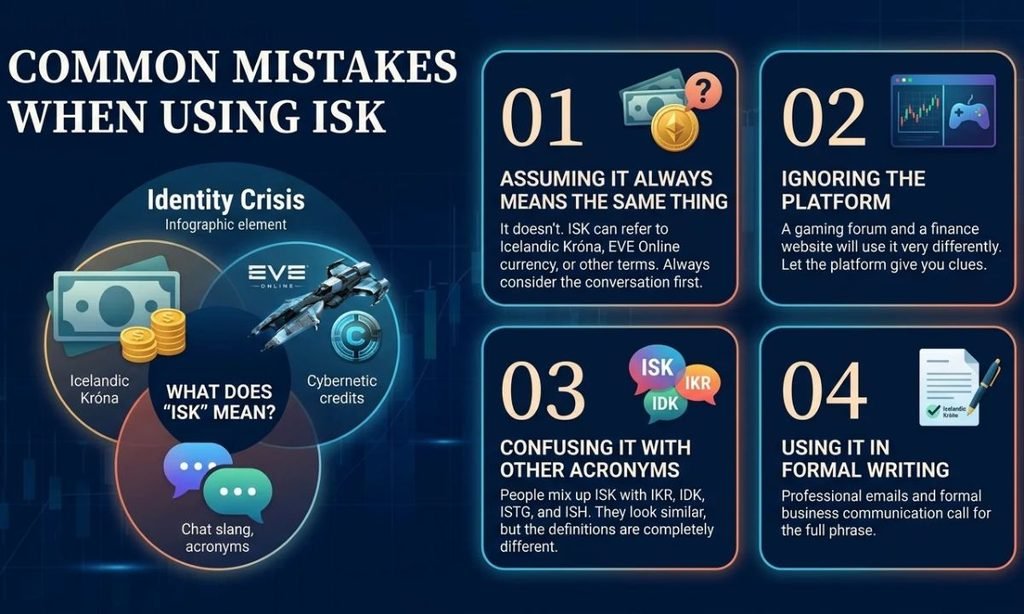
Most problems come from a handful of habits.
- Assuming ISK always means the same thing. It doesn’t. Always consider the conversation first.
- Ignoring the platform. A gaming forum and a finance website will use it very differently, and the platform gives you clues.
- Confusing it with other acronyms. People mix up ISK with IKR, IDK, ISTG, and ISH. They look alike, but the definitions differ.
- Using it in formal writing. Professional emails and formal business communication call for the full phrase.
- Using it without context. A standalone ISK sent out of nowhere can confuse readers.
- Mixing it up with currency. If the topic is travel, prices, or Iceland, it’s probably the króna.
- Assuming “I seek.” That isn’t a standard texting meaning.
A workplace mix-up is the easiest one to picture. Imagine a manager reading “ISK” in a project update from a coworker who meant it casually. Without context, it could look like a typo, a currency, or an inside joke. A quick full-phrase rewrite avoids the whole thing.
How to Reply to ISK
If you understand the meaning, respond naturally. Keep the chat moving with a simple follow-up:
- “Same here, honestly.”
- “Wait, what happened?”
- “Then you know the struggle 😄”
Here are two longer examples:
Friend: ISK, that’s exactly what happened.
You: I know, it surprised me too.
Friend: I’ll explain later. ISK.
You: No problem. I’ll wait.
If you’re unsure, a polite question works fine. Try “Sorry, what does ISK mean here?” or “I’ve seen it before, but I’m not familiar with it in this context.” Those natural responses beat the alternative, which is guessing at a word you can’t read. There’s nothing wrong with asking, and asking politely prevents misunderstanding. If you can, mention what you did understand so the other person can fill the gap.
Why Do People Like Short Forms Like ISK?
Short forms save typing time. They add personality, and they build shared language among friends. They also suit small phone screens, which is a bigger factor than people admit. ISK sits in the same family as IDK, IMO, and BRB, trading a few extra letters for speed and a little attitude. Other short forms work the same way, like PWHP meaning in text
Is ISK a Slang Word, and How Do You Say It?
Not exactly. ISK is an abbreviation that functions as slang in some places, but it has no standardized slang meaning. There’s no single expansion in texting. Outside slang, it’s the currency code for the Icelandic króna, and it can also work as an industry-specific acronym.
As for pronunciation, people say the letters one by one: “I-S-K.” It isn’t pronounced as a single word.
Pro Tips for Reading ISK Correctly
These habits help whenever you hit an unfamiliar abbreviation:
- Read the entire conversation before interpreting it.
- Consider the platform, the topic, and the sender.
- Don’t rely on a single online definition, including this one.
- Ask when it isn’t clear.
- Remember that internet slang changes over time.
- Learn similar abbreviations so the next unfamiliar one is easier to place.
Building those skills pays off well beyond ISK.Most confusing abbreviations get easier once you’ve learned to check context first. A good one to practice on is BYI meaning in text.
Quick Practice for Beginners
Read this reply: “Late-night snacking is a trap. ISK 🍫”
What does it mean? The writer knows from personal experience, and they’re joking about it. Now try writing your own sentence with ISK once, then check whether the tone matches your intent. That’s the fastest practice I know.
Keep It Casual, Keep It Clear
ISK is a small abbreviation that carries a lot of tone. It can sound experienced, funny, or a little embarrassed, depending on who types it and where. When someone asks what does ISK mean in text, the most accurate answer is “usually ‘I should know,’ unless the context says money or gaming.”
Whenever you see it, take a moment and look at who sent the message, where it was used, and what the conversation is about. That tells you whether you’re looking at slang, the króna, or an in-game currency.
If you want to use it yourself, keep it casual and give it context. Add an emoji when you want the tone to stay light, and write out “I should know” when the message matters. It’s a small habit, and it keeps your meaning clear and easy to catch.
FAQs
What does ISK mean in text?
ISK is most often read as “I should know” in casual chats. It has no single official slang meaning, so the surrounding messages decide how to read it.
What does ISK stand for?
In slang, it usually stands for “I should know.” Outside texting, ISK is the ISO 4217 currency code for the Icelandic króna.
Is ISK a real slang term or just a typo?
It’s a real abbreviation, but it’s less common than IDK or IMO. Some people also type it by accident when they mean IDK, since the letters sit close together on a phone keyboard.
What does ISK mean on Snapchat, TikTok, and Instagram?
On all three, it usually carries the casual “I should know” or “I’ve been there” feeling. It shows up in chats, comments, captions, and DMs. Check the rest of the thread to confirm.
What does ISK mean in a text from a girl or a guy?
Gender doesn’t change the meaning. It usually means they relate to what you said or feel they should know something. Tone and the previous message tell you whether they’re joking or being serious.
What is the difference between ISK and IDK?
ISK usually means “I should know,” while IDK means “I don’t know.” They sound alike but express opposite ideas. A single typo can flip the message.
Does ISK mean money?
Yes, in the right context. ISK is the official code for the Icelandic króna, so travel and price talk points to currency. Some games, like EVE Online, also use ISK as in-game money.
How do I reply when someone texts ISK?
If it fits the conversation, try “Same here, honestly” or “Wait, what happened?” If you’re unsure, ask “What do you mean by ISK?” Asking is perfectly fine.
Is it okay to use ISK in a work email or school essay?
No. ISK is informal slang and can confuse readers. Write “I should know” or the full phrase in professional and academic writing.
How do you pronounce ISK?
People say the letters one by one: “I-S-K.” It isn’t pronounced as a single word.
Who invented the slang ISK, and where did it come from?
Nobody has documented who first used it. It likely follows the same habit that gave us IDK, IMO, and BRB: shortening common phrases for faster typing. Any exact origin story is a guess.
Is ISK still popular in 2026?
It’s still seen in comments, DMs, and gaming chats, though it’s less famous than IDK or IMO. How common it feels depends on the community you’re in.
