

You’re halfway through a group chat about weekend plans when someone drops a single message: “WTH.” No punctuation, no explanation. If you’ve ever stared at that and wondered what mood it carries, you’re asking about the wth meaning in text, and the answer is shorter than you’d expect.
People search for it because three letters can hide a lot of feeling. The same message can be anger, joy, or plain confusion, and with no tone of voice to help, it’s easy to misread. You’ll see it in text messages, group chats, comment sections, Snapchat replies, and workplace channels, usually right after something unexpected happened.
This guide explains what WTH stands for, how it’s used on different apps and by different people, and what it means in languages like Urdu and Bengali. You’ll also get real examples, the mistakes to avoid, and a look at lookalikes such as WTF, WTV, and WFH.
Short answer: WTH stands for “What the Hell,” and some people read it as “What the Heck.” It’s an informal text abbreviation that signals surprise, confusion, disbelief, or frustration. The sender is usually reacting to something unexpected rather than asking a literal question, and the exact feeling depends on the conversation around it.
What Does WTH Stand For?
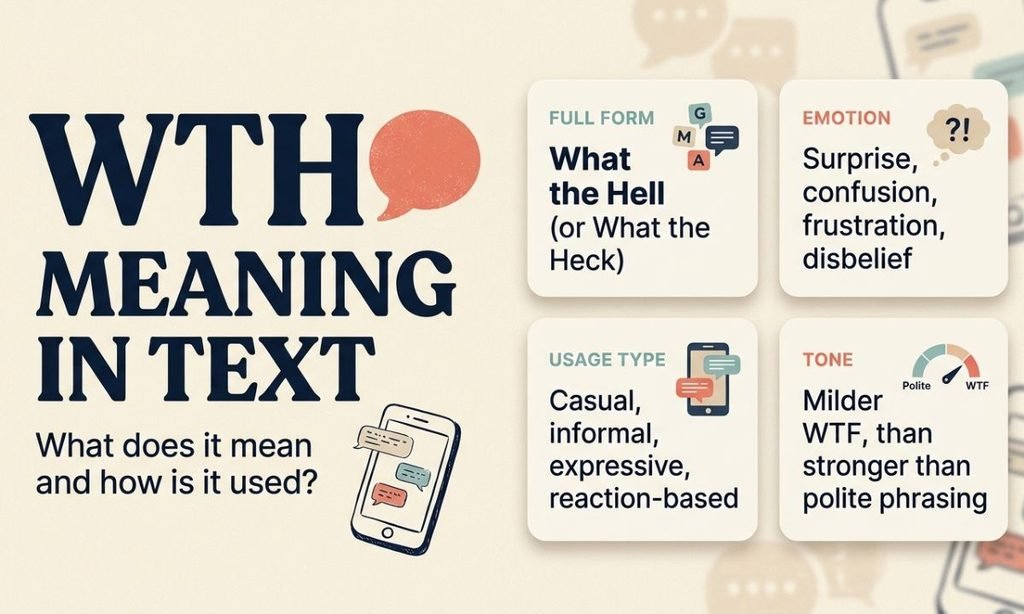
WTH usually stands for What the Hell. Plenty of people read the H as Heck instead, and since the letters never say which, both readings circulate in texts, chats, and social media conversations. The Heck version sounds gentler, so people often pick it around parents, teachers, or anyone they’d rather not swear near. The Hell version sits closer to its stronger sibling, WTF, though WTH is still the milder of the two.
Strictly speaking, it’s an initialism, because you say the letters one by one. Most people just call it an acronym or an abbreviation, and nobody will correct you. Whatever the label, it’s an informal expression built for quick messages. Here’s the snapshot:
| Term | WTH |
| Full form | What the Hell (or What the Heck) |
| Emotion | Surprise, confusion, frustration, disbelief |
| Usage type | Casual, informal, expressive, reaction-based |
| Tone | Milder than WTF, stronger than polite phrasing |
What Is the Basic Meaning of WTH?
At its core, WTH is an interjection: a burst of feeling more than a full sentence. Ask what it means and the honest answer depends on the situation. The exact emotion lives in the words around it.
It can carry surprise, anger, confusion, disbelief, or frustration, usually in reaction to something unexpected or hard to make sense of. It can also behave like a question. “WTH is going on?” really wants an answer. “WTH! You won?” is joy in disguise. “WTH is wrong with this app?” is irritation aimed at a screen. “WTH? You actually did that?” is amazed disbelief.
Notice that none of those examples changed the three letters. Only the surrounding words did. That’s the whole trick of understanding this slang term.
Why Do People Use WTH in Texting?
Typing the full phrase takes longer, and mid-chat nobody wants that. Three letters let you react instantly without breaking the flow of the conversation. It’s part of a bigger pattern: people want to get an emotion across fast, so they shrink the whole reaction into something you can fire off in a second.
It’s also a milder version of stronger expressions. Most people don’t find it offensive, though a few still do. In my experience, users like it because it feels like internet slang rather than swearing, and that small difference matters more than people admit.
There’s a psychological side too, and this is my own read, not a lab result. When something unexpected hits, the reaction comes first and the explanation comes later. A short slang term lets you release the feeling before you’ve worked out what you think. In digital communication, where nobody sees your face, that shortcut does a lot of work.
It’s quick to type, easy to understand, and surprisingly expressive. It also keeps a chat lively, because the other person gets a real reaction instead of silence. That’s why it has stayed popular: the need to react in seconds never went away.
If you enjoy decoding short forms, our guides on UT, MW, and NF meaning in text work the same way. You can also check the GL meaning in text guide for another everyday abbreviation.
Where Did WTH Come From?
Nobody can point to the exact origin of WTH, and I’d be wary of anyone who claims to. The phrase “what the hell” is far older than texting. The abbreviation most likely grew out of early internet chat rooms and SMS messaging, where character limits pushed people to shorten phrases, save space, and save time. Its first use is debated.
Mobile texting turned that habit into an everyday one, and social media platforms made WTH even more common as it spread from app to app. It grew up alongside other abbreviations. Today it’s a permanent part of internet slang culture, widely recognized and rarely explained.
Is WTH Used Worldwide?
Mostly yes. It started in English-speaking communities, then spread through the internet to people in many countries. Non-native English speakers pick it up from online content, and many understand it even if they’d never say “what the hell” out loud.
Usage and popularity vary by place, but it works as a near-universal online expression. Even people who barely speak English often recognize it on sight.
How Is WTH Used in Texting and Chat?
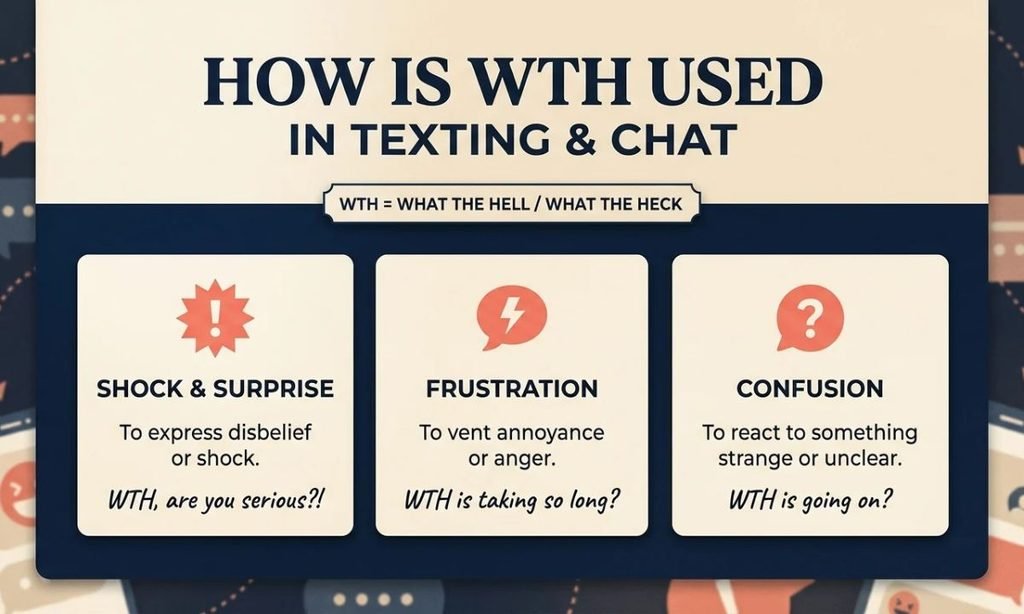
You’ll find WTH in personal messages, group chats, social media comments, and online discussions. People use it to react quickly to something unexpected, surprising, or confusing. Friends use it jokingly about as often as they use it angrily, so the tone isn’t always negative. A funny story gets a WTH, and so does good news.
WTH in Text Messages
In a text, the wth meaning in text usually points to a quick reaction instead of a longer sentence. Say a friend cancels plans an hour before you were supposed to meet. Your WTH carries mild frustration, maybe a little disbelief, and a follow-up like “Why didn’t you tell me?” does the real explaining.
In another thread, the very same WTH might show surprise and excitement, like when a friend announces a promotion. Or it can be pure confusion over a message that makes no sense. Often the friend simply replies with the story, and that’s the whole exchange.
WTH in Chat
The meaning in chat is the same as in text: informal slang, a casual expression, whether it lands in a group thread or a private one. Picture this: a friend writes, “I accidentally deleted our photos.” You answer, “WTH happened?” Here the abbreviation is a blend of shock and a real wish to know.
It isn’t necessarily angry. People who live in chat read it as a jolt of surprise, and the sender may just be buying a second before asking the real question.
WTH in Texting vs. Real Life
The difference between texting and real-life conversations comes down to the medium. In a text message, WTH is short, written, convenient, and faster than typing the full phrase. In spoken, face-to-face conversations, almost nobody says the letters aloud, except as a joke. You’d say “What the hell is going on?” and let your face do half the work.
Abbreviations like this were designed for screens, so they’re less common when people talk. The meaning matches across both settings, but the form changes. Language adapts to its medium, and a typed “WTH is going on?” is far more common than anyone saying it out loud.
WTH Meaning on Social Media and Messaging Apps
The wth meaning on social media can show up in comments, captions, direct messages, and replies, usually under videos, posts, or breaking news. Users often type it while reacting to whatever is being discussed. “WTH am I watching?” signals confusion at something unusual. “WTH! That’s incredible!” signals excitement. Under a shocking news story, the same letters carry a heavier mood.
The meaning depends on the post. I’ve seen identical comments under a prank video and a disaster report, and nobody mistook one for the other.
Snapchat, WhatsApp, Instagram, and TikTok all use WTH the same way, so the basic meaning barely changes between apps. These platforms encourage quick reactions and short messages, so the abbreviation fits right in. What changes is the setting, not the sense. In personal conversations it’s a way to show feeling to someone who knows you well. In a public comment section it’s closer to a shrug.
WTH Meaning on Snapchat
On Snapchat, WTH leans toward playful surprise. A friend opens one of your Snaps, sees something unexpected, and replies. For example, you send a strange photo and get back “WTH 😂”.
The emoji tells you the mood is laughter, not anger. Without it, you could reply by asking what they meant, or send a quick explanation. Reactions on this app come fast, so the answer usually arrives before you’ve closed the app.
WTH Meaning on WhatsApp
On WhatsApp, WTH is common among friends discussing plans or sharing news. A friend writes, “The meeting starts at 6 a.m.” You reply, “WTH? That’s so early!”
Here it works as an emotional reaction to the early hour, and the abbreviation adds emphasis. Sometimes it’s simply asking why. In a busy group, the responses pile up within seconds, and casual conversations move at exactly that speed.
WTH Meaning on Instagram and TikTok
On Instagram and TikTok, the feeling ranges from humor to genuine confusion. Someone might comment “WTH did I just watch?” under a strange video, or just “WTH!” under an unexpected photo.
It often appears next to laughing emojis. Creators may drop it into captions, and fans use it in direct messages and replies. The same comment under a cooking video and a car crash would feel completely different, which is why the content around it carries the meaning.
WTH Meaning From a Guy, Girl, or Woman
The basic definition stays the same no matter who sends it. Gender doesn’t give the abbreviation a special meaning. Instead, look at the people involved, their relationship, and details like punctuation and emojis. Those clues reveal the intended tone better than anything else.
WTH Meaning From a Guy
A guy uses WTH as the same reaction to whatever surprises, confuses, or frustrates him. If plans suddenly change, he might text, “WTH? What happened?” Most likely that shows surprise or confusion rather than anger.
If he’s a romantic interest, it doesn’t automatically suggest anything deeper. The rest of the conversation holds the useful clues, so read those before you read into the three letters.
WTH Meaning From a Girl
A girl may use WTH to express surprise, disbelief, confusion, or playful frustration. Say you text, “I forgot my own birthday,” and she replies, “WTH 😂”. The laughing emoji makes it humorous, not hostile.
Take the emoji away and the tone can feel more serious, and punctuation shifts it again. Always check what happened before the message. That context settles it.
WTH Meaning From a Woman
It works the same way. A woman uses the abbreviation in the same casual way anyone else does. After receiving surprising information or seeing something unusual, she might write, “WTH did you just send me?” That could express shock or amusement.
The surrounding conversation usually tells you which. Don’t read too much into three letters.
WTH Meaning in Urdu, Bengali, and Other Languages
WTH comes from English internet slang, so it isn’t a native abbreviation in any other language. Still, people who speak Urdu, Bengali, or other languages often use it inside English-language chats. When it’s translated, the goal is to keep the emotion (surprise, confusion, anger) rather than the letters. The exact wording can change a lot, and a translator will offer phrases that match the feeling, not identical phrases.
WTH Meaning in Urdu
The wth meaning in Urdu is best understood through phrases. “WTH is going on?” can be rendered as یہ کیا ہو رہا ہے؟ and a shorter “WTH?” as یہ کیا ہے؟
If WTH stands for What the Hell, the translation can feel stronger. If it stands for What the Heck, it may feel slightly softer. So the emotional reaction is best understood through the speaker’s tone and the situation, and the best translation follows that tone.
WTH Meaning in Bengali
In Bengali, WTH often keeps its English slang meaning, the way many languages borrow slang. Speakers keep the three letters and fit them into a Bengali sentence.
The translated meaning depends on the sentence around it: a surprised reaction, an angry response, disbelief, confusion, or frustration, each in different wording. Context matters here too, and explaining the situation to the other person helps when a message is unclear.
How Context Changes the Meaning of WTH
Three letters can communicate completely different emotions. “WTH! You actually won?” is surprise. “WTH is happening?” is confusion. “WTH is wrong with this?” is frustration. “WTH? You sold it?” is disbelief. “WTH, let’s try it!” is pure playfulness. Drop each line into separate conversations and they read like different phrases. The meaning depends heavily on context, and no dictionary entry can replace that.
A few everyday scenarios make it concrete. When something unexpected happens, it signals surprise. When a message makes no sense, it signals confusion. Stuck on a delayed flight, it turns into annoyance. When a story is too wild, it becomes disbelief. And if the situation is odd or funny, it can sound playful.
Here are more situations I run into constantly:
- Someone gets unexpected news about a job: pure shock.
- Plans suddenly change an hour before dinner: frustration.
- A document vanishes after a technical glitch: confusion with a side of anger.
- A friend sends a strange meme: humor.
A coworker who texts “WTH” after a server crash wants help, not a joke, so ask what broke. Respond to the feeling, not just the letters.
Is WTH Positive or Negative?
Neither, by default. It can be positive in a funny moment, like reacting to a friend’s amazing news. In neutral situations it’s just surprise, and in frustrating ones it leans negative.
It becomes negative when the tone turns sharp. At its core, it’s a simple reaction, and the mood comes from everything around it.
How Punctuation and Emojis Change WTH
How it’s written can change its meaning. “WTH.” feels cold. “WTH?!” feels wild. “wth…” trails off into worry. Even lowercase “wth” can read friendlier than capitals, though the core meaning stays the same either way.
Emojis stack on top and shift the mood further. WTH with a laughing emoji gets a lighter tone, while a bare WTH can read flat or even cold. Written text strips out voice, so these small variations do the work your tone of voice would do out loud.
WTH Meaning at Work, School, and in Schedules
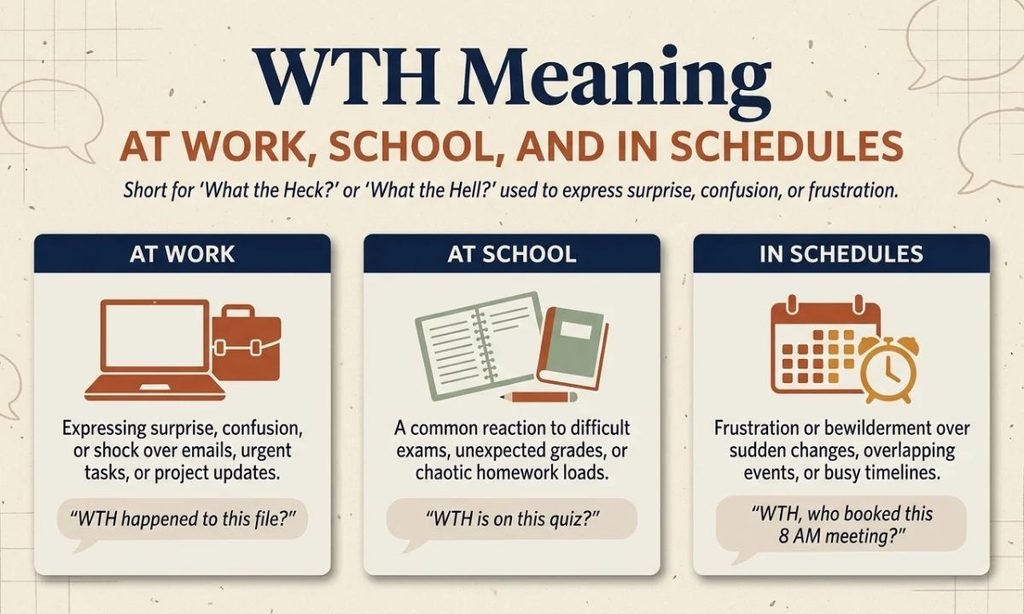
It’s the same slang term everywhere. It can appear in a workplace chat, a school group, or a schedule thread, mostly in informal conversations. Some other abbreviations look similar, so the situation around the message helps you tell what the sender intended. A quick look at the sentence usually settles it.
WTH Meaning at Work
Coworkers who share an informal relationship may use it in casual chats. For example, “WTH happened to the meeting link?” is perfectly normal between teammates who joke around.
Formal emails, client communication, and official documents call for clearer language. It isn’t suitable for every professional setting, and I still catch myself deleting it before I hit send.
WTH Meaning in School
In school, it shows up in group chats and text messages. Students use it, and teenagers especially treat it as everyday slang with friends: “WTH is this homework?”
It communicates a mood fast in casual conversations. It doesn’t belong in school assignments, which stay formal. Slang remains informal, even when everyone in the room uses it.
WTH Meaning in a Schedule
Around schedules, WTH expresses surprise or frustration at an unexpected change. Someone writes, “Class moved to 7 a.m.” The reply: “WTH?”
The abbreviation isn’t describing the schedule. It’s reacting to it, and the feeling is clearly about the change.
More WTH Text Examples
Real conversations show emotion better than definitions do. A slang expression with only three letters can fit a surprising number of everyday situations, and the same one can carry different feelings.
Casual texts between friends: “WTH are you doing?” “WTH happened?” “WTH is this new update?” “WTH are we eating tonight?” “WTH happened to our plans?” Each one is quick, casual, and needs no more than a sentence in reply.
Funny and surprised: A friend writes, “I wore two different shoes today.” You answer, “WTH 😂”. It’s unusual, funny, and nobody is angry. Another friend says, “I just won free concert tickets!” and you reply, “WTH! Seriously?” The reaction highlights surprise and excitement. It can also add drama when someone wants to play up the humor, so it doesn’t necessarily show anger at all.
Everyday exchanges:
Person A: “The restaurant closed five minutes ago.”
Person B: “WTH! We just got here!”
Person A: “I finished the whole project overnight.”
Person B: “WTH? How?”
Person A: “Let’s skip the usual plan.”
Person B: “WTH, let’s do it.”
WTH fits naturally in each, and each carries a slightly different emotion. Context decides the intended meaning every time.
Is WTH a Bad Word? Is It Rude?
It isn’t usually considered extremely offensive. It comes from What the Hell, a phrase that works as mild swearing, and What the Heck is the softer cousin. Merriam-Webster lists “the hell” as informal and impolite, a way to make a question or statement more forceful, and even uses “What the hell is going on?” as an example. With close friends it’s informal and fine. In a professional setting it can sound mildly rude or even inappropriate, so formal contexts can treat it as crude.
Can WTH Sound Rude?
Yes, when it’s aimed at a person. “WTH is wrong with you?” is aggressive and confrontational. “WTH! That’s amazing!” feels much lighter.
The words around it, the overall tone, and the punctuation all change how the message lands. Even a lone question mark can tip it either way. When in doubt, read the room.
When to Use WTH and When to Avoid It
When It’s Appropriate
It works best in relaxed, informal settings: with friends and familiar contacts, in social media conversations, and in casual texting. It’s also common anywhere online where the mood is easygoing, as long as the other person already knows your tone. Friends can use it freely, and it can even sound funny with the right emoji.
When to Avoid It
Skip it in business emails, academic work, formal emails, official messages, and professional documents. It’s too casual there, and a recipient may read it as impatience or disrespect, which makes you look unprofessional. In any professional setting, full phrases are the safer choice.
With someone you don’t know well, such as a new client or a distant relative, a more neutral phrase works better. “What happened?” says the same thing without the edge.
Common Mistakes When Using WTH
Most mistakes come down to tone and context. A few come up again and again:
- Using it in formal writing. A workplace mistake that’s easy to make: slang in a client email reads as inappropriate.
- Overusing it. Repeated WTHs lose their punch, and you stop sounding surprised and start sounding bored.
- Misreading the emotion. The same three letters carry different feelings, so a confused WTH can get read as anger.
- Ignoring the setting. Used in the wrong context, it lands badly. In the right one, nobody blinks.
To avoid mix-ups, check the tone before you send. It sounds simple, but people forget.
How to Reply When Someone Texts WTH
Match your answer to the situation. Someone who sends WTH is usually confused or surprised, and they probably want clarification or more details.
If there’s a real problem, give the facts. If they’re reacting to news, offer a quick explanation. If the tone is playful, play along. A friend who feels surprised mostly wants to know what’s going on, so start by explaining what happened or asking what threw them.
WTH vs. Similar Abbreviations and Slang
Short forms that look alike cause real mix-ups, and in fast conversations a confusing swap is easy to make. Knowing the differences helps you avoid awkward replies and recognize what someone means. Other slang terms overlap with WTH, but none is a perfect swap.
WTH vs. WTF
Both express surprise, confusion, disbelief, or frustration. WTF is the vulgar, stronger version, while WTH has a softer tone with less profanity, and What the Heck sits softer still. That’s why WTH usually suits casual situations better. WTF can land badly in a group chat with mixed company. The structure is identical, and only the last letter changes the temperature.
WTH vs. WTV
These look like a typo apart, but they serve different purposes. WTV commonly means Whatever and shows indifference: “WTV, I don’t care.” WTH expresses confusion, surprise, or frustration: “WTH happened?” One is a shrug and the other is a raised eyebrow.
WTH vs. WFH
On a phone keyboard, this mix-up is easy. WFH means Work From Home and covers office arrangements, while WTH is slang for What the Hell or What the Heck. The conversation makes it obvious. Someone who uses WFH is talking about their desk at home, not reacting to anything.
WTH vs. Other Common Text Abbreviations
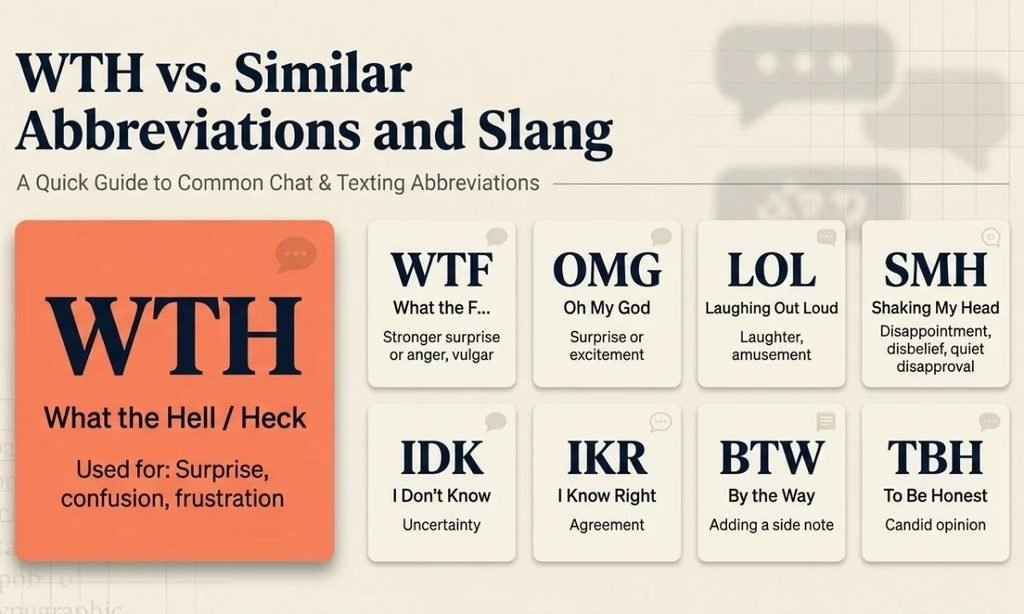
| Abbreviation | Full form | What it usually shows |
| WTH | What the Hell / Heck | Surprise, confusion, frustration |
| WTF | What the F… | Stronger surprise or anger, vulgar |
| OMG | Oh My God | Surprise or excitement |
| LOL | Laughing Out Loud | Laughter, amusement |
| SMH | Shaking My Head | Disappointment, disbelief, quiet disapproval |
| IDK | I Don’t Know | Uncertainty |
| IKR | I Know Right | Agreement |
| BTW | By the Way | Adding a side note |
| TBH | To Be Honest | Candid opinion |
“What the heck” is the neutral phrase of the bunch. WTH is milder than WTF and often the safer choice, and it’s generally acceptable in most casual chats. Knowing where each one sits on the scale makes WTH easier to place.
WTH Variations: WTHH, WTHF, WTHG, WTHD, and WTHU
Online, people sometimes stretch WTH with extra letters for a stronger or more dramatic reaction. Unlike standard WTH, these variations don’t have universally accepted definitions, and an unusual version can mean different things in different corners of the internet. Check the surrounding message before you decide.
| Variation | Likely meaning | Notes |
| WTHH | Extended WTH with an extra H | Emphasis; usually intense surprise or disbelief, as in “WTHH?!” |
| WTHF | WTH with an added F | Stronger, more vulgar; no fixed interpretation |
| WTHG, WTHD | Less common community variations | No widely recognized meaning; surrounding words are the best clue |
| WTHU | Uncommon variation | No universally accepted definition; check the full message |
The core idea of WTHH remains What the Hell or What the Heck, with a bigger reaction on top. For WTHF, tone matters, and it doesn’t always have a fixed meaning because abbreviations vary between communities. WTHG and WTHD are murky, and some users invent them for a particular joke inside their own conversations. For WTHU, the meaning can vary with how the sender intended it. If it’s still unclear, ask the person directly.
Quick Takeaway
The wth meaning in text is simple: it usually means What the Hell, or What the Heck, and it carries surprise, confusion, disbelief, or frustration. On Snapchat, WhatsApp, Instagram, TikTok, and other social platforms, and in everyday chats, it works best in casual conversations. Keep it out of formal situations.
The feeling can shift slightly because tone depends on the situation. Check the surrounding words and the context to find the intended emotion without guessing. Understanding who sent it, and whether it’s rude or just texting slang, is what makes casual messages easier to read. So what does WTH mean? A reaction. Friends get it freely, and your boss’s inbox should stay slang-free.
FAQs
What does WTH mean in text?
WTH usually stands for “What the Hell.” Some people read it as “What the Heck.”
It shows surprise, confusion, disbelief, or frustration.
What does WTH stand for?
It stands for “What the Hell,” or the softer “What the Heck.” The letters don’t say which, so both readings are common.
It’s an informal abbreviation, usually called an initialism.
Is WTH a bad word?
It isn’t usually considered extremely offensive. It comes from mild swearing, so it can sound slightly rude in formal settings.
Among friends, most people treat it as casual slang.
Is WTH rude?
It depends on the tone. “WTH is wrong with you?” sounds aggressive, while “WTH! That’s amazing!” sounds light.
The words around it, punctuation, and emojis decide how it lands.
What does WTH mean from a guy or a girl?
The meaning is the same no matter who sends it. It usually signals surprise, confusion, or mild frustration.
Check the earlier messages and any emojis to read the tone.
What does WTH mean on Snapchat, WhatsApp, Instagram, and TikTok?
It means the same thing on every platform: a quick reaction to something unexpected.
On Snapchat and TikTok it often leans playful, especially with a laughing emoji.
What is the difference between WTH and WTF?
WTF is the stronger, vulgar version. WTH has a softer tone and less profanity.
That makes WTH the safer choice in casual chats with mixed company.
How do you reply when someone texts WTH?
Match the situation. If they’re confused or upset, explain what happened or give more details.
If they’re joking, play along.
Can I use WTH at work or in school?
Avoid it in formal emails, client messages, and assignments, where it can look unprofessional.
Close coworkers and friends may use it in casual chats.
What does WTH mean in Urdu?
It’s often understood as یہ کیا ہو رہا ہے؟ or یہ کیا ہے؟, depending on the situation.
Urdu speakers translate the emotion, since the abbreviation itself comes from English slang.
Is WTH the same as WFH or WTV?
No. WFH means Work From Home, and WTV usually means Whatever.
WTH is the one that shows surprise or frustration.
What do WTHH, WTHF, and WTHU mean?
WTHH is WTH with extra emphasis. WTHF is a stronger, more vulgar variation.
WTHU and similar versions have no widely accepted meaning, so check the surrounding message.
