


If you searched “solfege meaning” hoping for a quick answer, here it is: solfège is a method of naming musical notes using syllables — do, re, mi, fa, sol, la, ti — instead of letters like C, D, E. It’s how singers learn to read music without a piano in front of them.
That’s the textbook version. But here’s what most articles on this topic won’t tell you: a huge number of people typing “solfege meaning” into Google aren’t actually thinking about The Sound of Music. They’re thinking about “solfeggio frequencies,” the 528Hz healing-tone trend all over YouTube and Spotify. Those two things sound almost identical. They are not the same thing. Almost nobody explains that clearly, and it’s probably why you’re still a little confused even after reading three other articles on this.
(It’s the same story with a lot of these “meaning” searches — two unrelated things get tangled together because they sound alike or show up in the same feeds. We ran into the same issue untangling what PTSO actually means in text and slang.)
Let’s fix that, along with everything else the standard explanations skip over.
So What Does Solfège Actually Mean, Word by Word?
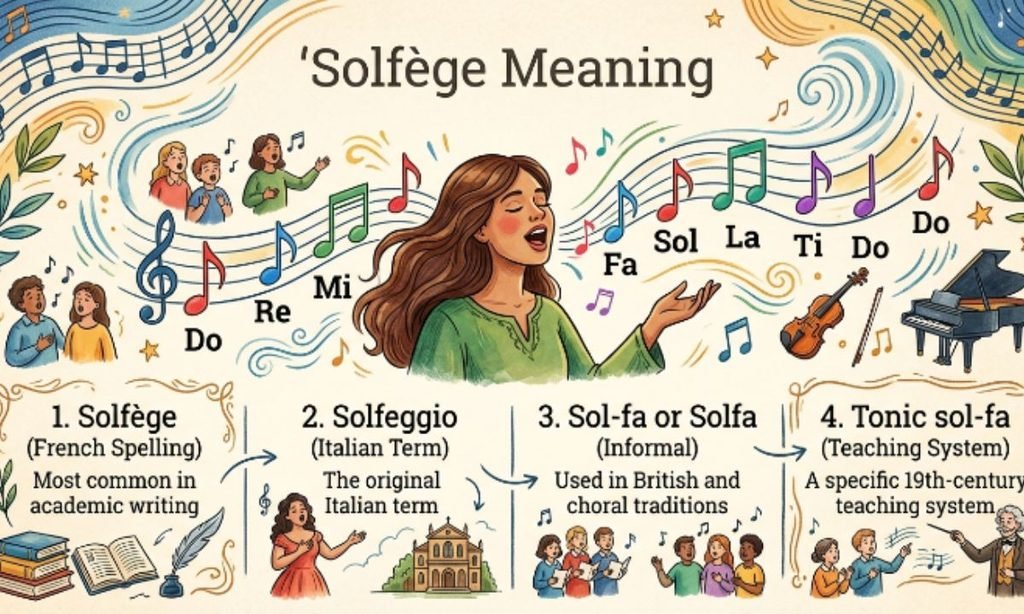
The word itself comes from French, borrowed from the Italian solfeggio. Break it down and it’s really just two syllables mashed together: sol and fa — two of the note names — plus the ending -eggio, which basically means “a method of.” So solfège literally translates to something like “the sol-fa method.”(You can check the etymology yourself in Merriam-Webster’s entry — it traces the exact same French-from-Italian path.)
That’s it. No mysticism, no hidden code. It’s a naming convention, the same way “alphabet” comes from alpha and beta.
You’ll also see it spelled a few different ways depending on where you learned music:
- Solfège — the French spelling, with the accent mark, most common in academic writing
- Solfeggio — the original Italian term
- Sol-fa or solfa — informal, especially in British and choral traditions
- Tonic sol-fa — a specific 19th-century teaching system built on the same idea
They all point to the same core concept. The spelling just tells you which country’s music tradition someone learned from.
The Solfège Syllables, Laid Out Simply
Here’s the full set most American music teachers use today:
| Syllable | Scale Degree | Function |
| Do | 1st | The “home” note, called the tonic |
| Re | 2nd | Leads gently toward Mi |
| Mi | 3rd | Defines whether a scale feels major or minor |
| Fa | 4th | Creates tension, wants to resolve to Mi |
| Sol (or So) | 5th | The dominant, strong and stable |
| La | 6th | Soft, often feels wistful |
| Ti (or Si) | 7th | The “leading tone,” pulls strongly back to Do |
Sing them in order — do, re, mi, fa, sol, la, ti, do — and you’ve sung a major scale. That’s the entire system in one sentence.
Why “Ti” Instead of “Si”?
Quick trivia most articles skip: the original syllable was si, not ti. An English music educator named Sarah Glover changed it in the 1800s so that every syllable would start with a different letter (making it easier to abbreviate on paper as d-r-m-f-s-l-t-d). Continental Europe still uses “si” today. So if you’ve heard both versions and assumed one was wrong, neither is — they’re regional variants of the same idea.
Solfège vs. “Solfeggio Frequencies”: Clearing Up the Confusion

This is the part almost every other guide leaves out, and it’s probably the reason you’re still here.
“Solfeggio frequencies” refer to a set of specific sound frequencies — 396Hz, 417Hz, 528Hz, and so on — that got popular through wellness and meditation content, with claims about healing, DNA repair, or emotional balance. They borrow the word solfeggio and loosely connect it to the historical solfège syllables, but the actual math and the claims behind them don’t come from real music theory or verified history.
Musical solfège, the thing you’re actually asking about, is a teaching tool. It has no frequency of its own — “Do” isn’t 528Hz, it’s whatever note is your starting pitch. It’s used in choirs, conservatories, and school music programs across the U.S. every single day, and its history is well documented back to the 11th century.
Here’s the side-by-side so you’re never confused again:
| Solfège (Music Education) | “Solfeggio Frequencies” (Wellness Trend) | |
| What it is | A syllable system for singing notes | A set of specific audio frequencies |
| Origin | 11th-century monk, Guido of Arezzo | Modern wellness/spiritual movement |
| Used by | Singers, choir directors, music teachers | Meditation apps, sound-bath practitioners |
| Backed by | Centuries of pedagogical use | Disputed, largely anecdotal claims |
| Has a fixed pitch? | No — moves depending on the key | Yes — fixed Hz values |
If you landed here because of a meditation video, that’s a completely different rabbit hole. If you landed here because someone said “sing your do-re-mi’s,” you’re in the right place, and the rest of this guide is for you.
Where the System Actually Came From
Around the year 1000, an Italian Benedictine monk named Guido of Arezzo was frustrated. Singers in his monastery took years to memorize chants by ear, because there was no efficient way to teach pitch relationships. So he grabbed a well-known hymn to St. John the Baptist and noticed something: each line started on a note one step higher than the last.
He took the first syllable of each line — Ut, Re, Mi, Fa, Sol, La — and used them to teach singers where each note sat relative to the others. That six-note pattern was called a hexachord, and it spread across European music education almost immediately, because it worked.
A few centuries later, “Ut” was swapped for the easier-to-sing “Do” (most sources credit Italian musicologist Giovanni Battista Doni — conveniently, also a nice nod to his own name). “Ti” was added later to complete the seven-note scale we use today.
So when someone tells you solfège is “just a kids’ song from a musical,” you can tell them it’s actually one of the oldest continuously used teaching methods in Western education — older than sheet music notation as we know it.
Fixed Do vs. Movable Do: The Debate Nobody Fully Explains
Almost every solfège article mentions this distinction, but most rush through it. It genuinely trips people up, so let’s slow down.
Fixed Do treats the syllables exactly like letter names. Do is always C. Re is always D. No matter what key a piece is in, those labels never move. This is standard in France, Italy, Spain, and much of Asia.
Movable Do treats the syllables as relationships, not fixed pitches. Do is always the tonic — the “home base” — of whatever key you’re in. In C major, Do is C. In F major, Do is F. In E-flat major, Do is E-flat. This is the dominant system in the U.S., UK, and most of Northern Europe, largely because of its use in the popular Kodály music education method.
| Fixed Do | Movable Do | |
| Do always equals | C | The tonic of the current key |
| Best for | Absolute pitch training, sight-reading in one key system | Understanding harmony and transposing by ear |
| Common in | France, Italy, Spain, parts of Asia | USA, UK, Hungary (Kodály method) |
| Downside | Doesn’t teach relative pitch relationships | Requires knowing the key before you start |
Neither one is “more correct.” They solve different problems. If you’re trying to develop perfect pitch, fixed do makes sense. If you’re trying to understand why a chord progression feels the way it does, movable do is far more useful — which is why it’s the version taught in most American classrooms.
Solfège vs. Scale Degree Numbers vs. the Nashville Number System
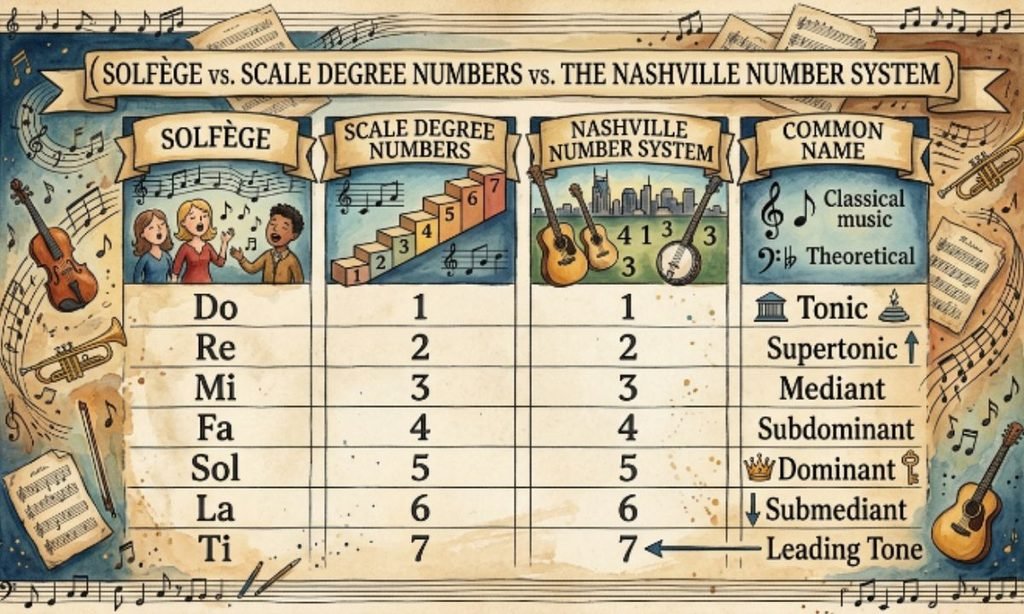
Here’s a genuinely useful comparison you won’t find spelled out clearly anywhere else, and it matters if you’re a guitarist, songwriter, or self-taught musician who’s run into all three systems and wondered if they’re interchangeable. They basically are — solfège just uses syllables instead of numbers.
| Solfège | Scale Degree | Nashville Number | Common Name |
| Do | 1 | 1 | Tonic |
| Re | 2 | 2 | Supertonic |
| Mi | 3 | 3 | Mediant |
| Fa | 4 | 4 | Subdominant |
| Sol | 5 | 5 | Dominant |
| La | 6 | 6 | Submediant |
| Ti | 7 | 7 | Leading Tone |
If a Nashville session musician says “go to the 4 chord,” that’s the same instruction as a choir director saying “sing Fa.” Same concept, different professions, different vocabulary. Knowing this makes it much easier to talk to musicians from a different background than yours.
Does Anyone Actually Use Solfège Today?
Yes — more than you’d guess. It shows up in places that have nothing to do with formal music school:
- Choir rehearsals, where sight-singing a new piece is dramatically faster with syllables than with note names
- Film and TV scoring classes, where composers train their ear to identify intervals instantly
- Elementary music education, through the Kodály method, which uses solfège hand signs to teach pitch to young kids
- Jazz improvisation training, where some teachers use movable do to help students “hear” chord changes before they play them
- A cappella groups, since there’s no instrument to reference pitch from
If you’ve ever watched a conductor use hand signals while a choir sings — palm flat and low for Do, a fist for Ti — that’s the Curwen hand sign system, developed alongside tonic sol-fa in the 1800s specifically to give each syllable a physical shape kids could remember.
A Simple Way to Start Using Solfège Yourself
Most guides stop at explaining the theory. Here’s how to actually practice it, starting today, with nothing but your voice.
- Pick any starting note that’s comfortable to sing. That note is your Do. Don’t worry about matching a piano exactly at first.
- Sing up the scale slowly: do, re, mi, fa, sol, la, ti, do. Don’t rush the half-steps between mi–fa and ti–do; those two spots feel noticeably tighter than the others.
- Play a simple, familiar melody on an instrument — “Happy Birthday” or “Twinkle Twinkle” work well — one note at a time, and try to sing the correct syllable for each note before you play it.
- Once that’s comfortable, try it in a different key. If you’re using movable do, the syllables should feel identical even though the actual notes have changed. That’s the whole point of the system.
- Add hand signs if you’re a visual learner. Even adults find this helps memory stick faster than syllables alone.
Expect this to feel slow and slightly awkward for the first week. That’s completely normal — you’re training your ear to hear relationships between notes, not just absolute pitches, and that’s a genuinely different skill from anything most casual listening builds.
Common Mistakes People Make When Learning Solfège

- Mixing fixed and movable do without realizing it. If your teacher uses one system and a YouTube video uses the other, you’ll get confused fast. Pick one system and stick with it until it’s second nature.
- Assuming solfège only applies to singing. It works for any instrument — pianists and guitarists use it constantly for ear training, not just vocalists.
- Trying to memorize the syllables instead of hearing them. The goal isn’t reciting do-re-mi like an alphabet. It’s connecting each syllable to how that note actually sounds and feels against the tonic.
- Confusing it with solfeggio healing frequencies, as covered above — worth repeating because it’s genuinely the most common mix-up.
Final Thoughts
Solfège meaning, at its simplest, is just a smarter way of naming notes — one built around relationships instead of fixed letters. It’s not a healing frequency, it’s not just a movie song, and it’s definitely not too academic to bother with if you’re a hobbyist musician.
If you take one thing from this: don’t just memorize do-re-mi-fa-sol-la-ti-do as a string of syllables. Sing them. Notice how Ti practically begs to resolve back to Do, and how Fa feels like it wants to fall to Mi. Once you feel that pull, the syllables stop being trivia and start being a genuinely useful tool you’ll keep using for as long as you make music.
FAQs
What does solfège mean in music?
Solfège means a system of naming musical notes using syllables — do, re, mi, fa, sol, la, and ti — instead of letters like C, D, E. It helps singers and musicians learn pitch relationships and sight-sing melodies without an instrument.
What is the origin of the word solfège?
The word solfège comes from French, borrowed from the Italian solfeggio, which combines two note names, “sol” and “fa,” with a suffix meaning “method.” It essentially translates to “the sol-fa method.”
Is solfège the same as solfeggio frequencies?
No. Solfège is a music education system for naming notes, while “solfeggio frequencies” refer to specific Hz values used in wellness and meditation content. They share a similar name but have completely different origins and purposes.
What is the difference between fixed do and movable do?
In fixed do, “Do” always represents the pitch C, no matter the key. In movable do, “Do” represents the tonic of whatever key you’re playing in, so it shifts from song to song.
Why is “ti” sometimes called “si”?
“Si” was the original solfège syllable, still used in much of continental Europe. English music educator Sarah Glover changed it to “ti” in the 1800s so every syllable would start with a different letter.
Who invented the solfège system?
Guido of Arezzo, an Italian monk, created the earliest version around the 11th century. He used syllables from a Latin hymn to help choir singers learn chants faster without written notation.
Do you need to read sheet music to use solfège?
No. Solfège was originally designed for singers who couldn’t read notated music at all. It works purely by ear, which is why it’s still used for sight-singing and ear training today.
How is solfège different from scale degree numbers?
They represent the same thing in different formats. Do, re, mi, fa, sol, la, ti correspond directly to scale degrees 1 through 7, similar to how the Nashville Number System labels chords by number instead of syllable.
