

Your friend sends a photo of a parking ticket with the message “wait tf is this??” and you stop for a second. Is it anger, a joke, or something you missed? That quick moment of doubt is exactly why people look up the TF meaning in text.
You’ll see TF in group chats, comment sections, TikTok captions and Snapchat replies. It confuses people because it’s only two letters, it looks mild, and it means something totally different on a bank statement, a school worksheet or a medical chart.
Here you’ll learn what TF means in everyday texting, where it came from, how it differs from WTF, and how to reply to it. You’ll also see its other meanings in money, science, business and school, so you can read it correctly anywhere.
TF means “the f*ck.” In a text message it’s a short, censored swear used as an intensifier. It usually sits inside a question, like “what tf is that?”, to show shock, confusion, disbelief or annoyance. It’s informal slang, and it can read as crude in professional or formal settings.
What Does TF Mean in Text?
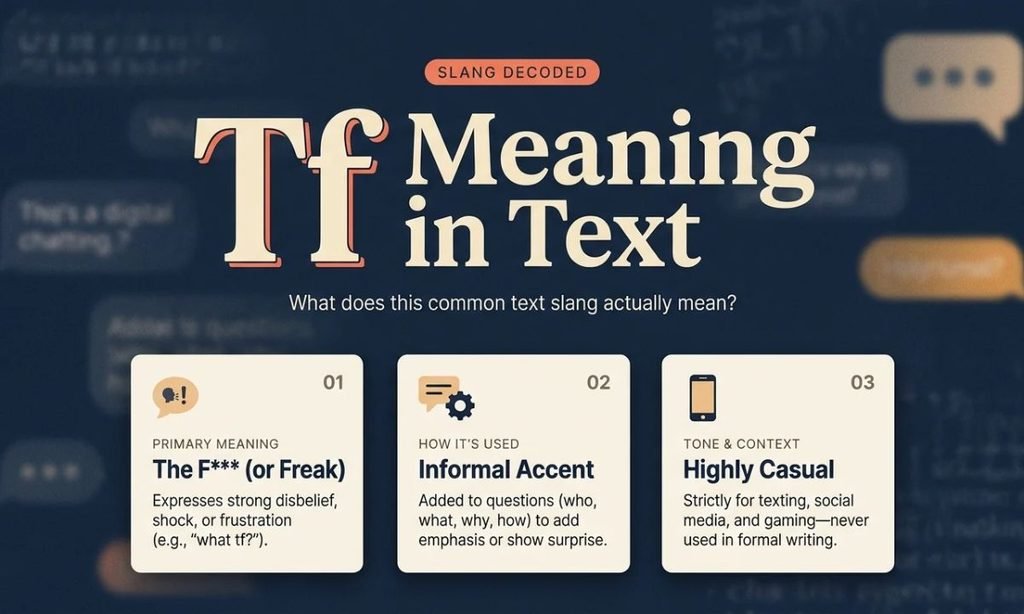
In text message threads across the United States, TF is an intensifier that stands in for “the f*ck.” It’s internet slang, and you’ll spot it most in a group chat, where someone reacts to a news article with two lowercase letters and a question mark.
TF is an expression of emotion more than a phrase with a fixed definition. The feeling could be shock, confusion, disbelief or annoyance, and the words around it tell you which. It works like seasoning. Take it out and the sentence still makes sense. Leave it in and the reaction hits harder.
Compare “What is that?”, a plain query, with “What TF is that?” The second is the same question with the volume turned up, and the sender wants to demand clarity.
I see it most when people react to a sudden event or a bizarre object: a confusing noise outside, something scary on the road, a package nobody ordered. The tone shifts with sentence context, which is why it gets misinterpreted. Reading slang markers like this takes some digital literacy, and people without it often mistake surprise for anger.
TF rarely stands alone. It’s an embedded phrase that sits inside a larger question and attaches to question words: “what tf,” “why tf,” “how tf,” “who tf,” “tf is this,” “tf happened here.” It also shows up in frustrated rants, like “I don’t know tf you’re talking about.” Linguists would call it an intensifier in informal register, or a sentence modifier: it adds emphasis and tone but no new information. It’s casual language, and an abbreviation most people type without thinking.
TF Full Form and What It Stands For
The full form is “the fck,” sometimes written “The F” with the asterisk covering the swear. Expanding the abbreviation is the easy part. The catch is polysemy: TF is an acronym whose meaning changes with the platform and community, so disambiguation takes contextual awareness.
In text messages and social media, it stands for the swear and nothing more, as in “What TF is going on?” or “Why TF did you do that?” Outside slang it can mean timeframe, transfer function and plenty else, which you’ll find further down.
Does TF Mean Something Different From a Guy or a Girl?
No. It means the same thing regardless of gender. TF is a universal intensifier, so a guy or a girl sends it when something shocks, annoys or surprises them. What changes the reading is intent and the emotion behind the message, not who typed it.
Where Does TF Come From?
Nobody can name the person who first typed TF, and the origin is debated. The swear word behind it has been in English for centuries. The abbreviation is much younger and belongs to texting culture, where tiny phone keyboards made typing full sentences a chore and every extra letter costs time.
Most people who follow language evolution treat TF as a trimmed version of WTF. WTF likely began in early chat rooms and SMS texting, where short forms saved space and let people type quickly. Many slang write-ups place TF’s popularity in the early 2010s on Twitter and Vine, where brevity mattered, and it has stayed a staple of internet slang since. I can’t say whether it started in one place or popped up in several, and I haven’t seen a source that settles it.
Why did it stick? Swearing in writing feels different from swearing out loud. Spoken, the word can sound aggressive. Typed in full, it looks heavier than it sounds. Two letters soften it. Platforms also run word filters, and a short form slips past more easily, though I can’t prove that drove adoption. People apply casual filters of their own too, trimming whatever feels too blunt on screen.
Memes and reaction culture did the rest. A caption under a weird video, a reply to some random news item, a reaction post in a busy comment section: “tf is this” became a go-to phrase because it fit anywhere confusing or ridiculous content turned up. Formal writing never took it in. It’s a clear case of informal writing in digital communication, where written and spoken language drift apart.
Common TF Meanings by Context
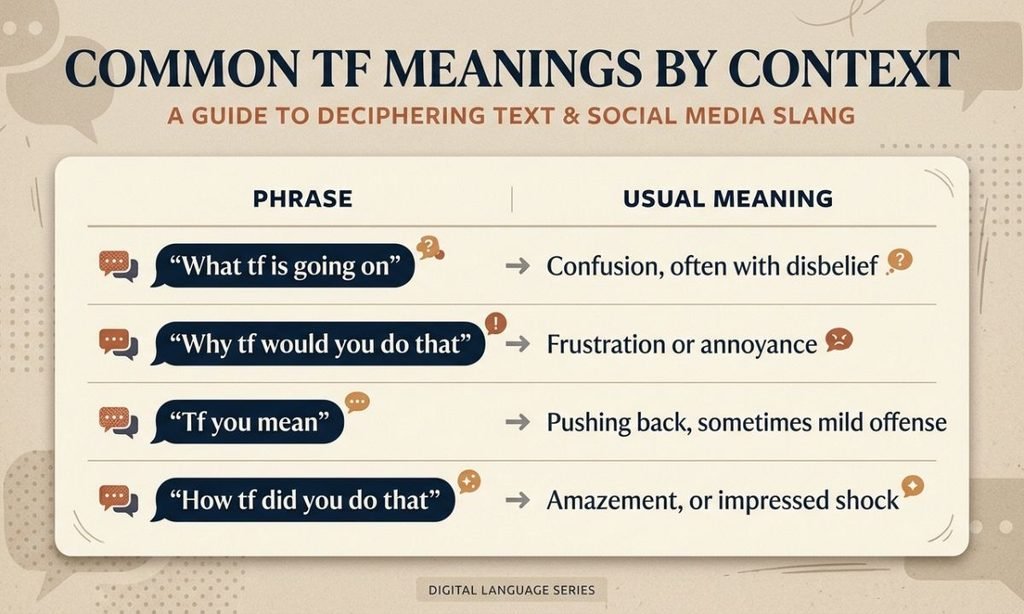
The underlying word never changes, but the meaning swings with the sentence around it. Here’s how the TF meaning in text shifts across typical phrases.
| Phrase | Usual meaning | Mood |
| “What tf is going on” | Confusion, often with disbelief | Puzzled |
| “Why tf would you do that” | Frustration or annoyance | Irritated |
| “Tf you mean” | Pushing back, sometimes mild offense | Defensive |
| “How tf did you do that” | Amazement, or impressed shock | Positive |
| “I don’t care tf” | Dismissive, pure don’t-care energy | Cold |
| “Shut tf up” | Playful between amused friends, or serious annoyance from someone upset | Depends on the speaker |
Pragmatics is the study of how context shapes meaning, and TF is a tidy example. The letters carry no sentiment on their own. The intent lives in the tone, which is why tone detection tools stumble on it and why sentence context matters more than the phrase itself. The emotional range is wide for something so short.
TF in Real Text Messages
Real sentences teach more than definitions. These are the kinds of messages I run into all the time in everyday American life.
A friend drops news in the group chat and someone answers, “wait tf, did they actually cancel the trip?” That’s a reaction from someone shaken. Under a confusing post, the same person might write “tf is happening in this video,” genuinely lost. Venting sounds like “why tf does my wifi only die during exams,” mild annoyance with some humor. “How tf did you get tickets that fast, teach me your ways” is the good-news version, a jolt of emotion with a lol right behind it. A sibling might get “tf you mean you ate my leftovers,” which runs hotter.
Mornings give plenty more. “How TF did I miss my alarm this morning?” is frustration aimed at yourself. After a loud crash, “What TF just happened?” is confusion and shock. “Why TF is traffic so bad in Houston today?” is frustration aimed at the world. And “that cat video was TF weird” is humorous disbelief, with TF sitting inside the sentence instead of leading it.
Take TF out of “did they actually cancel the trip” and you have a normal question. Put it back and the sentence goes from flat to charged. Same conversation, same words, extra emotion. NGL, short for “not gonna lie,” often turns up in the same threads, and our guide to “what does NGL mean in text” covers it.
How TF Is Used Across Social Media Platforms
Each social platform grows its own dialect. TF keeps a core meaning close to the swear everywhere, but usage is platform-specific and reflects the people on it. Social media language is an informal register, so context does most of the explaining. In plain texting and group chats, TF is a quick, reactive burst of feeling.
Snapchat and Instagram
Both are visual platforms, and TF there is shorthand for shock or absurdity. A friend posts a video of something strange happening in the neighborhood on their Story, and the most common reply is “TF??” with the doubled question marks doing half the work. Captions, comments, direct messages and replies all use it to highlight the situation without writing a full sentence.
It’s a fast reaction phrase: you see the clip, feel the jolt, reply. A message like “TF is happening?” signals shock, confusion or annoyance, and it can read as rude, even aggressive. In professional interactions, a polite alternative like “what is happening?” is safer.
TikTok
TikTok is a hub of high-energy reactions. Creators build reaction clips with on-screen text like “TF was he thinking?” and the audience answers in the comments. POV videos (short for Point of View) use TF as a prompt that sets up the viewer’s shock before the punchline.
People search “what does TF mean in text language” because they meet it in videos first. It works there through spoken language mirroring: surprised viewers naturally talk that way, so the written reaction matches their speech patterns. That mirroring drives engagement, since a comment feels like talking back.
Twitter/X, Discord and Gaming Chats
On Twitter/X it turns up in replies and quote-tweets reacting to news or other posts. Gaming chats and Discord use it for venting and hype: bad plays, lag, losses, frustration and impressive moves all get the same two letters.
TF Across Age Groups
Demographics are harder to pin down. From what I’ve seen, Gen Z uses it most freely, Millennials use it too and often lean on the older WTF, and older generations tend to type the full word or skip it. I can’t back that with numbers, so treat it as a pattern I’ve noticed, not data. Age group tends to set the habit more than the platform does.
TF vs WTF and Other Similar Slang
WTF is TF’s longer cousin, and the extra letter changes how it behaves. Here’s how TF compares with the terms it gets mixed up with.
| Term | Stands for | Emotional level and typical tone |
| TF | The f*ck | Mid-to-high; confusion and annoyance, woven into a sentence |
| WTF | What the f*ck | Strongest of the group; shock, works alone |
| WTH | What the hell | Moderate; a cleaner alternative |
| ISTG | I swear to God | Serious emphasis, can feel intense, often a threat or vow |
| STFU | Shut the f*ck up | Harsh or playful, depending on the friendship |
| IDK | I don’t know | Neutral, no swearing |
| SMH | Shaking my head | Disappointment or disapproval rather than shock |
The main split is standalone versus embedded. “WTF!” is an exclamation that can be sent alone, a complete thought. TF is a modular piece of slang you drop into any question, as in “What TF are you doing?” It sits inside the flow of a sentence and almost always needs words around it. In grammar terms, that’s exclamation versus intensifier.
So which should you pick? If the moment needs its full meaning on its own, WTF carries it. If you want a specific impact woven into a question, TF does it better. If you copy a comparison table from a slang site, you may find an “Export to Sheets” label stuck to it. That’s the page, not the slang.
For a standard reference, Dictionary.com lists WTF as a slang initialism for “what the f*ck,” used to show anger, impatience or surprise without spelling the word out. If WTH is the one you keep seeing, our guide to WTH meaning in text breaks it down.
Is TF a Bad Word?
Technically, yes, because it stands for a profanity. It’s mildly rude by default, and in casual U.S. culture it’s common, but it’s still considered NSFW (not safe for work) and out of place in formal or polite environments. As an abbreviation, it hides the word but not the meaning.
Whether it offends depends on who you’re talking to. Among close friends in everyday texting, it’s harmless and often funny. Send it to a stranger or someone you just met, and the same two letters can look sharp, confrontational, even hostile. Some people get annoyed or shocked by any profanity at all.
The profanity level is moderate because the censoring softens it, but it can still read as aggressive when aimed at a person (“why tf would you say that”) instead of a situation. Offensiveness comes down to tone and intent, and the same message can be playful or offensive. When you’re unsure, say what you mean directly, or leave it out.
When to Use TF and When to Skip It
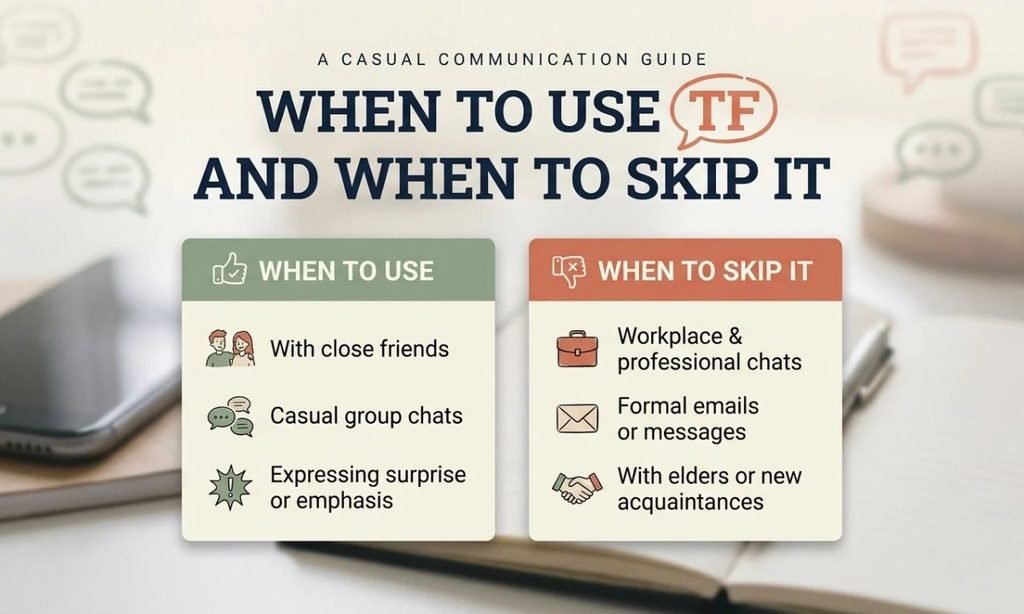
My rule of thumb is simple. Ask whether you could say out loud the full word in that room. If not, don’t type the shortened version.
TF fits casual digital spaces: close friends, group chats, memes, comments and casual posts. It’s good for venting, small annoying things, and anything surprising or funny. Keep it out of work emails, school assignments and formal writing. Censoring a curse word down to two letters makes it lighter, but it doesn’t make it clean. Even in 2026, common as it is, it can damage your professional image when used in the wrong place.
Register is the technical term. Formality, politeness and appropriateness all depend on audience awareness. There’s no one-size-fits-all rule, and the same message can be fine in one chat and a problem in the next.
Work and Business Settings
In workplace communication, slang slips in faster than people expect. I’ve seen it in Slack threads, including from teams in places like New York, and it usually gets noticed more than the sender thinks. When you’re emailing a client, stick to formal language. When you’re messaging a colleague about a project, even if you’re frustrated, TF is unprofessional.
If you’re confused, there’s a professional way to say so. Try “I am a bit unclear on this” or “Could you clarify?” Those alternatives express confusion without the edge and ask for clarification directly.
Elders and Strangers
With elders, new coworkers or strangers, reserve TF. In many parts of the United States, profanity-based slang sounds rude to people you don’t know well, no matter how casual your vibe feels. With friends and peers it’s fine once the rapport is established, and in casual online communities it’s often normal.
Watch the social cues. If someone swears first or shows interest in the same slang, you have your answer. The same goes for edgy shorthand like PMO, which has its own guide under “what does PMO mean in text.” Reading the room first is always safer.
How to Reply When Someone Sends TF
Your reply depends on how the TF was meant. Read the room, work out whether the sender is friendly, joking, frustrated or annoyed, and match the tone. A short conversational reply usually beats a long explanation, and a bit of de-escalation helps when things run hot.
If It’s Friendly or Joking
A playful roast or funny reaction deserves an informal reply. Keep it light. “lmaooo don’t judge me” works. So does “listen, it made sense at the time” or “okay that’s fair, my bad.” Nobody wants an essay when the whole thread is joking.
If It’s Frustrated or Annoyed
When someone upset sends TF, stay calm and give a direct reply. Say you understand, then explain: “I get why you’re annoyed, let me explain.” If you caused the problem, add a short apology: “sorry, that came out wrong, here’s what actually happened.” Or: “fair point, I should’ve said something sooner.” That mixes empathy with clarification. It’s not the moment for jokes, and a slightly more formal reply beats a meme.
If It’s Professional or Mixed Company
If TF lands in a work chat, the safest move is to not repeat it and reply normally in neutral language. Something like “Let me clarify what happened” does the job. Keep a professional register no matter what the other person used. Matching the tone is good advice almost everywhere else, but here you shouldn’t. And if you sent TF by accident, a one-line clarification is enough.
Common Mistakes When Using TF
Most slips come from three habits.
Capitalization
TF and tf don’t read the same. Uppercase feels louder and more urgent, while lowercase sounds muttered, closer to a shrug. Capitalization works as a tone marker and shifts the emphasis without changing a word.
Overuse
Put TF in every sentence and it loses impact. Worse, you start to look perpetually angry. When something truly baffling happens, you’ve got nothing louder left to say.
Wrong Context
Using it in a serious situation is the costliest mistake. Replying to someone who’s grieving with a TF-laced reaction is insensitive, even if you meant sympathy. A plain sentence would have avoided the misunderstanding.
Tips for Texting With TF in 2026
- Read the room. Be comfortable with casual profanity before you send it, and think about your audience. If you’d hesitate to say it out loud to this person, skip it.
- Put it after a question word. TF usually follows What, Who, Where, Why or How, as in “Where TF did you park?” In a Wh- question it sounds most natural and keeps the grammar clean.
- Pair it with an emoji when tone could go either way. 🤨 says you’re baffled. 😳 says you’re shocked. 😂 says it’s funny and you aren’t upset. If someone does seem upset, clarify in plain words.
- Save TF for moments that need it. Use it for impact, not as punctuation, and it keeps its punch.
Why People Use TF: The Psychology of Shorthand
Digital communication is a race for efficiency. Typing at the speed of thought, nobody wants to spell out a phrase when two letters will do. That’s linguistic economy, and it’s one of the oldest habits in fast writing.
There’s more to it than speed. “The f*ck” signals the size of a feeling, and shortening it keeps the signal while letting you vent without writing a paragraph. Small amounts of pressure, like slow Wi-Fi or a late bus, invite a quick release, and TF is the cheapest one available.
Belonging matters too. Using the same slang as your peers marks you as part of an in-group, and shared shorthand reinforces social bonds. I think that’s why people defend slang so hard when someone calls it lazy.
TF Meaning in Text in Hindi and Other Languages
TF has no direct literal translation in Hindi. It travels as an acronym, carried by Western media and movies, and American slang spreads easily to non-English speakers in a globalized world.
Hindi speakers tend to read it through two feelings: Gussa (गुस्सा), meaning anger, and Hairani (हैरानी), meaning surprise. Translation can’t carry the full force of the swear, but the acronym acts as a bridge and is globally recognized for strong reactions. Other languages treat it as a loanword and bend it to local habits. Interpretation depends on who’s reading, so the same letters can look natural in one chat and strange in another.
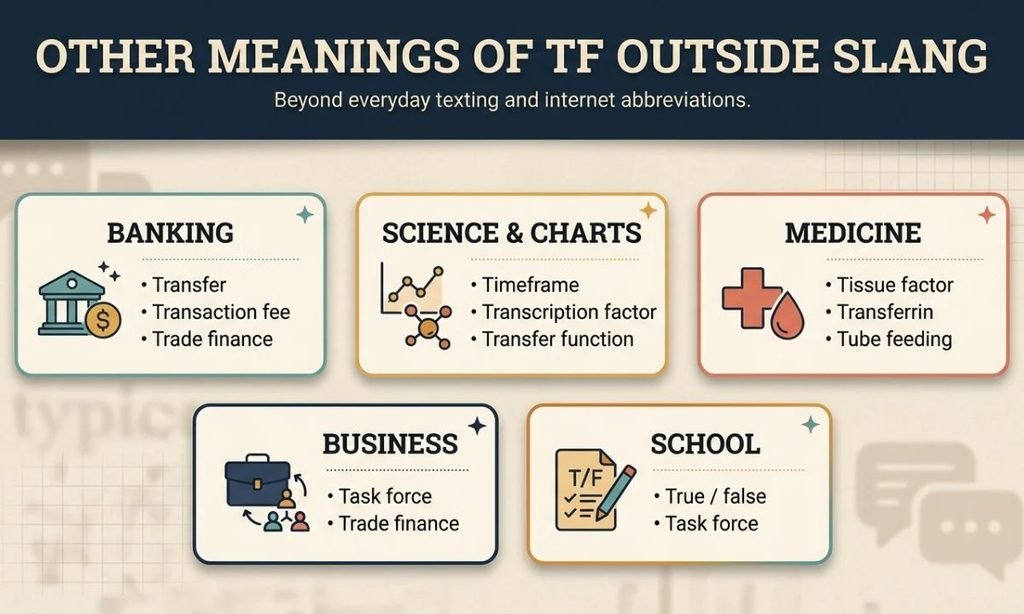
Other Meanings of TF Outside Slang
TF is a classic polysemous abbreviation. Here’s a quick map before the details.
| Setting | Common meanings | Where to look for clues |
| Banking | Transfer, transaction fee, trade finance | Statement, invoice, payment provider |
| Charts and science | Timeframe, transcription factor, transfer function | Legend, axis labels, chart title |
| Medicine | Tissue factor, transferrin, tube feeding, transcription factor | Clinical notes, lab reports |
| Business | Task force, trade finance | Internal documents, meetings |
| School | True/false, task force | Worksheet, timetable, instructions |
| Online communities | Transfeminine | Forums, identity discussions |
| Gaming, military, tech | Team Fortress, task force, a file label | The platform or codebase |
Money and Banking
In a bank or financial app, a line on a statement or invoice may read TF. Depending on the financial institution or payment provider, it can mean a transfer, a transaction fee or trade finance. It isn’t a currency code like USD or GBP. It’s institution-specific shorthand, usually defined in a reporting system or glossary.
The sentence around it helps. “The TF was completed yesterday” suggests a bank transfer. “Please check the TF on your statement” points to a fee, most likely a legitimate charge, though worth confirming. “Our company provides TF services” points to trade finance, meaning support for domestic and international trade. Check the amount, description and type of transaction, and if the statement looks unfamiliar, compare it with your internal records or payment record and contact the provider.
Charts and Science
On a chart, TF usually means timeframe. In trading charts, 1H TF is the one-hour timeframe, and a 15-minute TF means each candle covers fifteen minutes. On a candlestick chart, every candle or bar shows price over one period.
Biology uses it for transcription factor, a protein that binds DNA and drives regulation of gene expression. Engineering uses it for transfer function, the mathematical relationship between input and output in control systems. Check the legend, axis labels and chart title, plus units, measurement and time. “TF activity increased” probably means a transcription factor. “The TF response is shown below” probably means a transfer function. Technical reports and study-specific papers usually define it in the accompanying research.
Medicine
Tissue factor is the protein that starts blood clotting, central to coagulation and a regular topic in hematology. Transferrin carries iron through the bloodstream. Tube feeding delivers nutrition when a patient can’t swallow or eat by mouth. Transcription factor appears in genetics and molecular biology.
Sentences help: “TF plays a role in coagulation,” “The study investigated TF expression,” “The patient requires TF.” You’ll see all four in clinical notes, laboratory reports and medical research, and each facility keeps its own abbreviation list. If a record is ambiguous, ask the clinician or another healthcare professional instead of guessing from a diagnosis or treatment plan.
Business
A task force is a group pulled together for one project, as in “The company created a TF,” often led from a department or by the CEO. Trade finance covers financial products like payments, credit and risk cover, as in “Our bank provides TF solutions for exporters.”
A line like “Please explain the TF figure” could point at either, especially in a meeting about ROI. Shorthand saves time, but new employees and clients often can’t read internal terminology, and customer service teams field this question constantly. Define abbreviations the first time in internal documents and stick to clear language to avoid misunderstandings.
School
The most common school meaning is true/false: “Complete the TF section” on a test or worksheet means each answer is correct or incorrect. Another is task force: “The school formed a TF for student safety” points to teachers and administrators tackling a school issue. Timetables may list a “TF period,” and internal schedules may use it as subject-specific shorthand.
In science or mathematics instructions, TF is almost always true/false. In an administrative document or academic report, task force is likelier. If it’s still unclear, ask the teacher. Institutions use terminology differently, so guessing is risky.
Gender and Online Communities
In forums and online communities, TF can be short for transfeminine, an umbrella term for people whose sex assigned at birth was male and who identify with femininity. It can include trans female people, a transgender woman, and nonbinary people whose gender identity or expression leans feminine. Labels like these are personal.
“I’m exploring transfeminine identities” and “The discussion included TF experiences” show how it appears, usually as community-specific shorthand. In everyday texting, TF is almost always “the fuck.” When unsure, use the full term and follow a person’s preferred labels.
Gaming, Military, Tech and Fandom Uses
In the gaming community, Team Fortress has TF in its name. If you’re playing a video game and someone types in chat about the “room,” they may mean a Team Fortress server, not a swear. Military and organizational contexts use Task Force. TF can also show up in the name of a JSP or Java file as a project-specific label, though that’s a technical reference, not a standard term.
Too Funny exists in lighthearted reactions next to LMAO, but it’s less common and tied to a few circles. Without context, most people assume the profanity version. TFW stands for That Feeling When, and a few people shorten That Feeling to TF, though I’ve rarely seen it.
TXT is also the name of the group TOMORROW X TOGETHER, so a fan post may use TF as normal slang or as a group-specific abbreviation I can’t verify. Check the community discussion and the surrounding message. As for massage, there’s no universally accepted meaning. A clinic might use it on a menu or appointment form, so ask the provider.
Context breaks most ties. Arguing with a friend, it’s the swear. In a professional email about a project, it’s probably task force. Even a casual request, like asking a friend what’s going on, almost always means the swear version.
What Urban Dictionary Says About TF
Urban Dictionary treats TF as slang, and its entries agree on the main reading: the fuck, the same as WTF, which expands to what the fuck. As a user-generated slang resource, its definitions come from regular people in internet conversations, online communities and texting, so quality varies.
It’s handy for informal explanations and usage examples like “TF is going on?”, “Who TF told you that?”, “Why TF would you do that?” and “TF 😂”. These show emphasis, with profanity expressing feelings like confusion, surprise, annoyance, shock or frustration. Some entries add a specialized meaning, so expect variation.
A formal dictionary would give one line of slang expansion. Urban Dictionary captures tone better but not authority. Don’t cite it in formal messages, school assignments or professional communication, where it counts as a bad word.
TF Between Partners
Between partners, TF carries more emotional weight because more is at stake. In text messages from a partner it still means “the fuck,” but the emotional meaning ranges from confusion and surprise to frustration, disbelief and even suspicion.
“TF are you talking about?” signals a disagreement or misunderstanding. “TF happened last night?” could be playful, shocked or concerned, depending on the situation. “TF, why didn’t you tell me?” means they feel caught off guard and not informed, maybe upset, maybe angry. “What TF is going on between you two?” is confrontational and often points to jealous or dramatic energy.
A couple that’s comfortable with each other tends to keep it lighthearted. If your partner always writes like that, it’s texting style, not an attack. Read the full message and any emoji: a laughing one makes it playful, and none leaves it open. One annoyed message deserves a second read before you reply.
Where TF Is Headed
TF is digital shorthand for “the f*ck”: two characters that carry shock, hilarious disbelief or mild frustration. Read the rest of the message before assuming the worst. Often it’s just someone reacting out loud, and misreading the tone can start a fight over nothing.
In a digital-centric society, slang is one of the tools of fast, high-energy communication, and knowing how to use it is an advantage in modern life. Match your language to the person on the other end, and you bridge the gap between a friend, a boss and a stranger in the same day.
For more on the meanings behind the messages, stay informed on the latest shifts in slang at meaningfeed.com. Text keeps getting more expressive, and in 2026 the TF meaning in text still comes down to a small word doing a lot of emotional work.
FAQs
What does TF mean in text?
TF stands for “the f*ck.” It’s a censored swear used as an intensifier, usually inside a question like “what tf is that?” It shows shock, confusion, disbelief or annoyance.
What is the full form of TF in texting?
The full form is “the fck,” sometimes written “The F” with the asterisk covering the swear. It adds emphasis to a sentence and doesn’t stand for anything else in casual chat.
Is TF a bad word?
Technically yes, because it stands for a profanity. It’s common among friends in the US, but it’s considered NSFW (not safe for work). Skip it in formal or professional messages.
What is the difference between TF and WTF?
WTF (“what the f*ck”) can stand alone as a complete reaction. TF is usually part of a sentence, as in “why tf would you do that?” Both show strong emotion, but WTF is the stronger of the two.
Does TF mean something different from a guy or a girl?
No. TF means the same thing whoever sends it. The tone comes from the message and the situation, not the sender’s gender.
How do you reply when someone texts TF?
Match the tone. If they’re joking, keep it light, like “okay that’s fair, my bad.” If they’re upset, stay calm and explain. In a work chat, reply in neutral language without repeating it.
Is it okay to use TF at work or with older relatives?
Not usually. It reads as unprofessional in work emails and Slack, and many people find it rude. Try “Could you clarify?” or “I’m a bit unclear on this” instead.
Where did TF come from?
The exact origin is debated. Most people see it as a shortened form of WTF from early chat rooms and SMS texting. Many slang write-ups place its rise in the early 2010s on platforms like Twitter and Vine.
Can TF mean something other than the swear?
Yes. It can mean timeframe on trading charts, true/false on tests, or task force at work. In medicine it can mean tissue factor, transferrin or tube feeding. Banking uses it for transfer, fee or trade finance. Context tells you which.
Does TF mean “too funny”?
Rarely. “Too funny” is a less common reading used in a few casual circles. Without context, most people assume the profanity version.
What does TF mean on TikTok, Snapchat and Instagram?
It’s a quick reaction to something shocking or strange, often typed as “TF??” in comments, captions and replies. On TikTok it also appears in on-screen text and POV videos.
Does capitalization change what TF means?
The meaning stays the same, but the tone shifts. Uppercase “TF” feels louder and more urgent. Lowercase “tf” sounds more casual and muttered.
