

Picture a group chat where one friend writes “we hooked up” and two people read it completely differently. One hears a kiss, the other hears coffee, and a third assumes a whole night together. That confusion sits at the center of the hook up meaning, and it happens more often than you’d think.
People search this phrase because it shows up everywhere: text messages, dating app profiles, TikTok captions, teen dramas, and sometimes a coworker’s story. It confuses people because the speaker usually chooses not to say what happened. The vagueness is part of the appeal.
This article covers what the phrase means today, where it started, and how its meaning shifts depending on who says it and where. You’ll also see how it differs from similar terms, which myths to ignore, and how to avoid a few classic mistakes.
Answer Block: To hook up usually means two people casually connect in a romantic or physical way, with no promise of a relationship. The phrase is intentionally vague. It can mean kissing, a single night together, or something milder, and it can also mean helping someone out or connecting a device.
What Does “Hook Up” Mean?
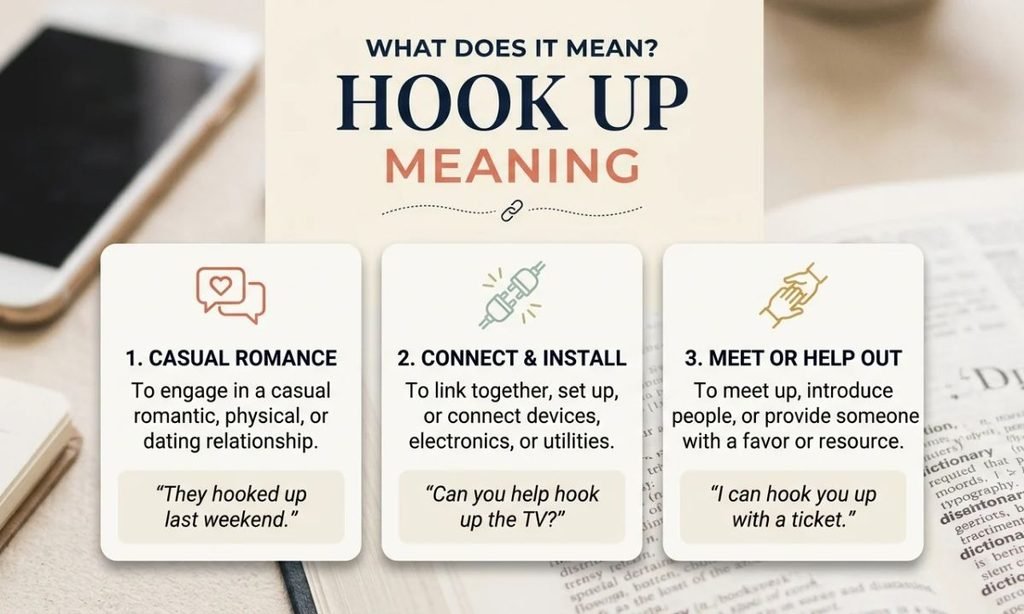
The core sense is casual. Two people met, something romantic or physical may have happened, and the speaker didn’t say what. It can refer to kissing, making out, casual dating, physical intimacy, or spending the night together. The phrase itself never tells you which.
It’s often used in a romantic or sexual way, but it also has a milder everyday use. Ask “did they hook up?” and you’re asking whether two people got romantic or intimate. Say “I hooked up with an old friend” and the listener has to decide between a casual meet-up and something romantic.
In most everyday conversation today, the phrase points to a casual, physical encounter, usually a one-time thing, with no promise of anything afterward. Whether it comes from a girl or a guy, “want to hook up?” usually suggests something casual and physical rather than a traditional date.
What the Phrase Signals (and What It Doesn’t)
It signals interest, not a plan. Say someone you’ve only just matched with sends “want to hook up?” They’re telling you they like the vibe. They aren’t telling you what they have in mind.
The rest depends on context: the app, the time of day, how the conversation has gone, and what the speaker actually intends. A kiss, a night together, or one drink that leads somewhere could all be on the table.
The reliable fix is to ask. A relaxed question like “what did you have in mind?” clears things up without killing the mood. A specific question beats a guess every time.
The Main Meanings of Hook Up, With Examples
The same two words do very different jobs. Context decides which one you’re hearing, and each of the four meanings below is common in American English.
Romantic or Physical
“Jake and Emma hooked up after the concert.” Most listeners hear that the two became involved, romantically or physically, so this is the default reading. “They hooked up at the party” is the classic relationship-talk line.
Still, nobody says how far it went after the concert. That gap is the point.
Meeting Someone Casually
“I hooked up with an old classmate for coffee” describes a plain, casual meeting. Nothing romantic is implied. This use is less common in modern slang, but it hasn’t disappeared. In my experience it comes mostly from older relatives.
Helping Someone Out
“Can you hook me up with cheap tickets?” is a request for help, and it’s completely non-romantic. So is “my friend hooked me up with free food” or “she hooked us up,” which can mean she introduced us or got us a deal. The help might be a favor or a discount. Nobody is falling in love.
“Hook me up with a job” works the same way: it simply means help me get something.
Connecting Devices
“Hook up the printer” or “hook up the speakers to the TV” is technology talk, a different world from dating. Linguists call one word with several linked senses polysemy, and “hook up” is a tidy example, because every sense is built on the idea of connecting.
Nobody gets confused by the helping and device uses, because the object gives the meaning away. The trouble starts when the object is a person.
Where Does the Phrase Hook Up Come From?
The root is physical. A hook fastens things, so “hook up” first meant attaching or connecting equipment, and a hookup was the wiring that linked everything together. By the early 1900s people were using it for wiring, equipment, and radio sets. That mechanical sense came first, which is why you can still hook up a speaker. You can see these older meanings listed alongside the slang sense in the Merriam-Webster entry for “hookup”.
The social sense grew out of that idea of connecting: getting people together, introducing them, meeting up. The sexual meaning is the youngest. Most accounts place its spread in American English in the late twentieth century, often tied to college campuses.
Exact dates are debated, and dictionaries don’t agree. Slang rarely leaves a clean paper trail, so be wary of anyone who gives you a precise year.
What’s less debated is why it caught on. For a long time, the word’s main use was fog. “We hooked up” could mean kissing at a bar or spending the night together, and that vagueness gave people room to avoid saying what they wanted. You could call it the euphemism era.
Hook Up Meaning in Texting and Dating Apps
Texting
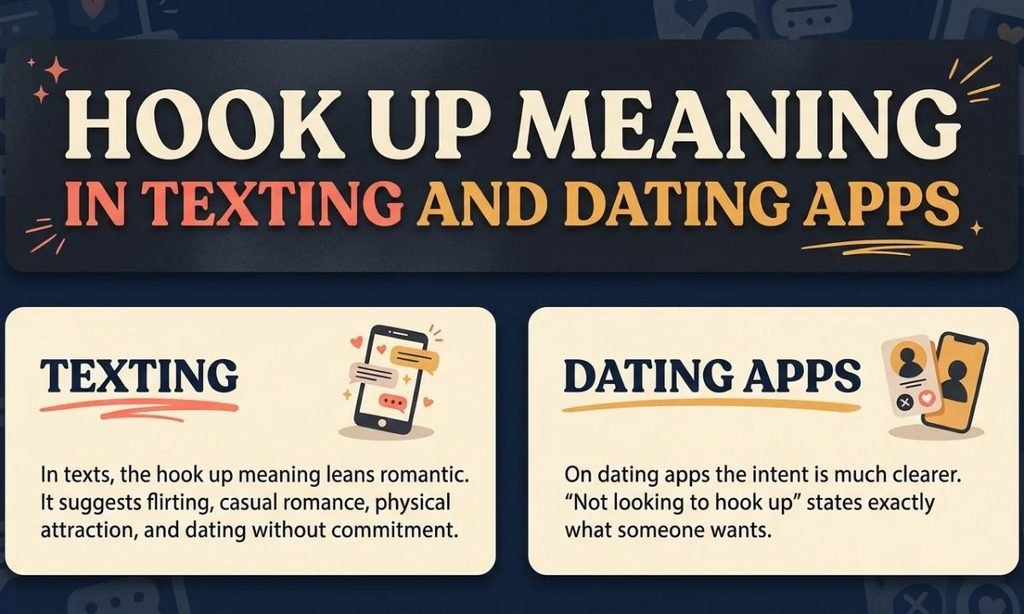
In texts, the hook up meaning leans romantic. It suggests flirting, casual romance, physical attraction, and dating without commitment. Texting slang is full of abbreviations like this, and if you’ve ever stared at a message wondering what an acronym meant, our guide to CBA meaning in text is a good example of how quickly these shorthand terms can confuse people. Tone often matters more than the words:
- “Are you two hooking up?” reads as gossip.
- “They’ve been hooking up for weeks” reads as confirmed.
- “I don’t do hookups” reads as a boundary.
In a text, the phrase usually points toward something romantic.
Dating Apps
On dating apps the intent is much clearer. “Not looking to hook up” states exactly what someone wants. The context is narrow and dating is the whole point, so the meaning is almost settled. It’s the best example of how setting narrows a word.
Social Media and TikTok
People use the phrase in gossip, memes, relationship posts, and story-time videos. A skull emoji 💀 usually shows up when the story is dramatic, like “my ex hooked up with my best friend.”
Another example: “Nobody knew they were hooking up.” That points to a secret romantic or physical relationship kept quiet. Platform slang rewards anyone who reads the whole caption.
On TikTok, the phrase ties closely to dating stories, relationship drama, secret crushes, and casual relationships. A POV where your best friend hooks up with your crush is a common format. “Hookup culture is exhausting” is another. The phrase feels deeply connected to how people talk online.
Movies and Everyday Talk
American movies and teen dramas lean on it constantly, and pop culture did a lot to spread it. English learners hear it often but don’t always understand it, because scripts keep the meaning vague on purpose.
In everyday spoken conversation among friends, it’s casual and informal. “They met at a party and hooked up” is a typical line.
Hookup Meaning in 2026: What a Hookup Looks Like Now
The meaning has sharpened. In a dating context today, a hookup usually refers to a single intimate encounter between two adults: mutually agreed, in person, casual, and named before anyone meets. What changed is honesty. More people state their intent in a profile or a first message instead of hiding in the fog.
I still hear the vague version in everyday talk, because habits last. But when the word appears on a dating app, the definition is usually tighter than it used to be.
A clean hookup has three traits, and missing one is how things go sideways:
- Mutual agreement on the format. Both people know what it is, and neither is privately hoping for more.
- It’s event-shaped. This person, this evening, this once. If it repeats, the format quietly shifts into something else.
- Adult, sober, opt-in consent at every step. Consent is said out loud, not assumed.
Hookup, Hookups, and Hooking Up
These word forms get used interchangeably, but they aren’t identical.
- A hookup (singular noun) is one event: a single intimate meet-up between two people.
- Hookups (plural) means multiple separate hookups. It can describe one person’s pattern over time or a scene, as in “the hookups at that party.”
- Hooking up (verb) is the act itself, and it’s the most ambiguous of the three. “We hooked up last weekend” could mean a kiss or a full hookup. Historically it covered everything in between.
When someone searches for “hookups meaning,” they’re usually asking about the cultural pattern, repeated casual encounters as a lifestyle. Hookup culture is the pattern. A hookup is the unit.
Common Mix-Ups About the Hook Up Meaning
Many people misunderstand the phrase because it’s vague by design. Three misconceptions come up again and again.
Does it always mean sex? No. Sometimes it only means kissing, flirting, or spending time together, and the meaning depends on context. Assuming sex is the quickest way to get it wrong.
Does it mean dating seriously? No. Hooking up implies something casual rather than committed. Couples who are dating seriously usually say so, with phrases like “seeing someone” or “together.”
Is it always romantic? Also no. Connecting devices, helping someone, and meeting casually are all valid uses. Romantic is the common reading, not the only one.
Hook Up vs. Similar Terms
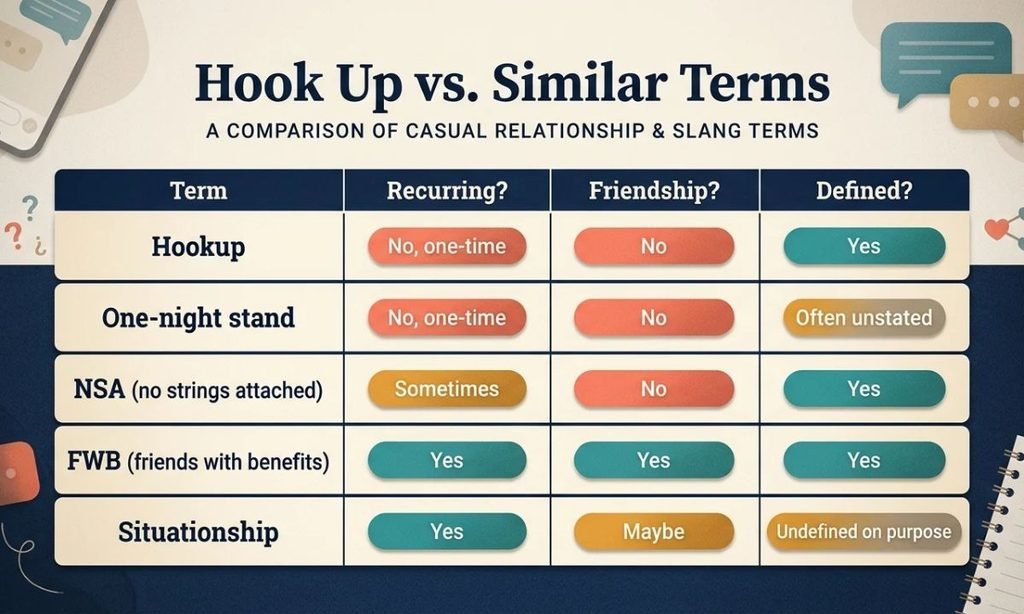
Part of the confusion comes from neighboring terms getting blurred. That blur is behind a lot of “we wanted different things” arguments. This table keeps them straight:
| Term | Recurring? | Friendship? | Defined? | Emotional weight |
| Hookup | No, one-time | No | Yes | Low |
| One-night stand | No, one-time | No | Often unstated | Low, sometimes regret |
| NSA (no strings attached) | Sometimes | No | Yes | Low by design |
| FWB (friends with benefits) | Yes | Yes | Yes | Moderate |
| Situationship | Yes | Maybe | Undefined on purpose | High |
Dating sits at the more serious end, meaning getting to know someone romantically. Seeing someone is medium seriousness: spending time together romantically. The talking stage is flirting before dating, an early phase with no label yet. So whether something is serious or casual isn’t a yes-or-no question. It’s a scale.
Hookup vs. One-Night Stand
The difference is subtle but real. A one-night stand is the older term. It has the same single-encounter shape, but the connotation is late, after-bar, somewhat random, and sometimes regretted.
A hookup is more deliberate. It’s planned earlier in the day, the intent is named in advance, and consent is settled before anyone is near an apartment. The shape is the same. The framing is sharper.
Hookup vs. NSA, FWB, and Situationship
The line between a hookup and NSA is repetition. A hookup is event-shaped, while NSA is pattern-shaped: once, or a dozen times, with no rule either way. Plenty of people repeat a partner and the format drifts into NSA without anyone announcing it. That’s fine as long as both people noticed.
FWB adds a friendship layer. You’d hang out anyway. A hookup isn’t building a friendship, because it’s a single meeting.
The situationship is the odd one out. It’s recurring, undefined on purpose, and carries the highest emotional weight of the group.
Is a Hookup the Same as Casual Sex?
Close, but not identical. Casual sex is the broader category. FWB, NSA, situationships, and hookups all sit inside it. A hookup is one specific shape of it, a single deliberate encounter. All hookups are casual sex, but not all casual sex is a hookup.
What Hookups Look Like in Practice
Definitions only go so far, so here are three composites. They’re illustrations, not real people, but they sit close to how hookups often happen.
A 32-year-old finishes a long day at the office and opens an app on the train home. She matches with someone whose profile says low effort, looking for tonight. They chat for twenty minutes and agree on a wine bar at 9 PM, both vaccinated and respectful, both clear it’s a one-time thing. One drink, then back to her place. The next morning: “this was great, take care.” Both go to work happy.
A 28-year-old is back from a six-month travel stint, in town for a month, and not trying to build a friend group or a relationship. He tags casual only, no follow-up, and matches with someone whose tags line up. Nobody is tricking anyone.
A 41-year-old, six months out of a divorce, doesn’t want a relationship or NSA, because NSA implies repetition. She wants one evening, nothing after. Her profile reads one-time meet-up only, healing, kind people only. She gets fewer matches, but the right ones.
They share a pattern: the format is stated in the first message, planned, and named in advance. Nobody is hoping it turns into something, and nobody goes home at 4 AM with regret. Modern hookups are often well organized and honest about what they are.
Myths About Hookup Culture
You’ve probably heard the story: nobody wants relationships anymore, dating is dead, and everyone is lonely. It’s mostly wrong, and the myths come in layers.
Myth 1: Hookup culture dominates. Most people cycle between casual phases and committed phases depending on what their life can support. Very few want only hookups forever.
Myth 2: It’s all young people. There’s no age cap. A big life change like a divorce sends plenty of people back to casual dating, because wanting connection without commitment doesn’t expire.
Myth 3: Hookups are damaging by default. The topic has been studied, and research tends to find that outcomes track clear consent and honest framing, not the format itself. Results run neutral or positive when people agree on what they’re doing. They run consistently negative when one person secretly hopes for more. The mismatch is the problem, not the format.
So are hookups bad for your mental health? It depends on honesty and consent. If you want a one-time meet-up and you’re getting one, you’re likely fine. If you want a relationship and you’re settling for hookups in the hope they’ll evolve, no tweak to the format fixes that.
Myth 4: Hookups replaced romance. Some turn into relationships. A hookup can be a prelude to something or a perfectly fine thing on its own. Both happen across different months of the same person’s life.
What changed isn’t that everyone got more casual. People stopped pretending. Hookup culture is the visible part of an honesty culture, where people say what they want instead of running it through three layers of deniability. To anyone who liked the deniability, that can look like moral collapse. I’d argue it’s the opposite.
Why People Use the Phrase (and Why It Got So Popular)
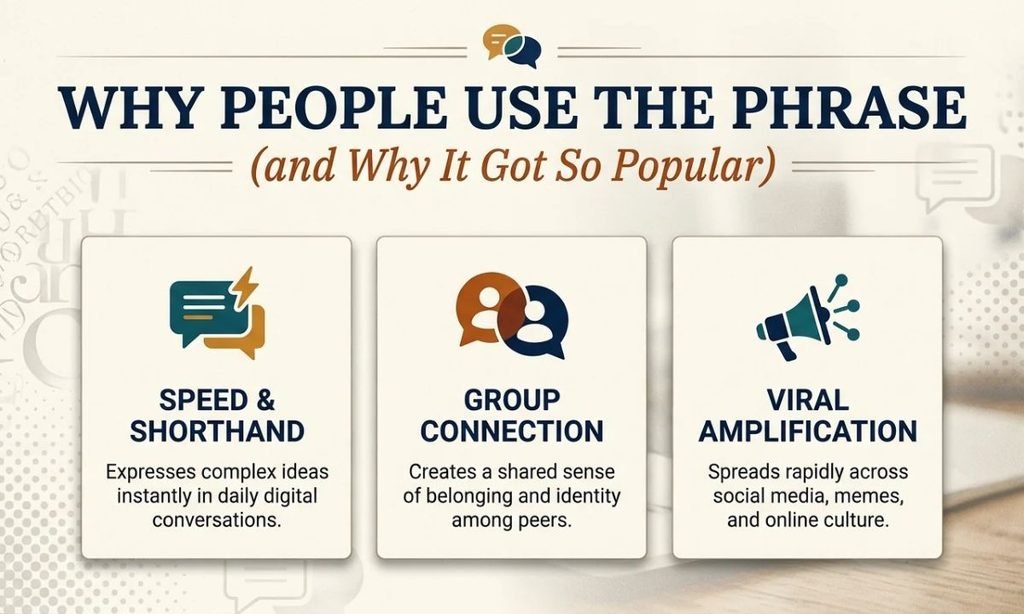
It’s casual, modern, less direct, and easy to say. Most of all, it’s vague. Instead of “we kissed and spent the night together,” people say “we hooked up.”
Spelling out exactly what happened takes effort and invites follow-up questions. So speakers stay vague and let the listener fill in the rest. It also sounds more discreet than it really is.
The rise of social media, dating apps, and internet slang made it extremely common. It lets people talk about relationships casually without sharing many details.
How Honest Hookups Work: Seven Rules
A hookup that works has rules, and one that hurts people skips them. The rules aren’t difficult. Treat them as practical guidance, not a lecture.
1. Name the format before you meet. Don’t show up to a “let’s see what happens” meet-up when you want a one-time hookup. Say it plainly, for example: “I’m looking for a one-time meet-up tonight. Are you?” It’s awkward for ten seconds and a lifesaver after that. The right person won’t be put off. They’ll be relieved.
2. Verify you’re meeting a real person. Ask for a real photo, a recent video call, or a verified profile, ideally all three. Decent apps have verification built in, but it falls on you to use it. It’s a small effort and worth it every time.
3. Meet in public first, even briefly. A 20-minute drink confirms chemistry, and other people see you. Skipping the public part is where many safety problems start. You don’t have to make it a date. Just spend fifteen minutes around other people before going somewhere private.
4. Tell a friend and share your location. Send a friend the time, the place, the person’s first name, and a photo, and share your live location. Your friend doesn’t need to do anything with it. Knowing someone has the details changes the math for you and for anyone with bad intentions. Many apps have a built-in version of this.
5. Don’t go in drunk. Coordinate sober, meet sober, and have the wine on-site if you both want it. Showing up three drinks deep is the move that fails, because consent gets fuzzy and so does judgment.
6. Treat the other person like a person. Casual doesn’t mean disposable. Don’t ghost, and don’t pretend it didn’t happen. A simple “this was good, take care” the next morning is enough.
7. End it cleanly. If it was a one-time thing, leave it as one. If you both want a second meet-up, say so out loud. The format has shifted closer to NSA, and you should both notice.
None of these rules are prudish. They all come down to clarity at every step.
Finding a Hookup Safely on Dating Apps
Most people find one on intent-tagging dating apps now, so the real question is how to pick a good app. Four features matter most:
- Intent-tagging. You should be able to write “one-time meet-up only” or “hookup, not just casual” in your profile. Finer tags filter for compatibility before the first message.
- Verified profiles. How seriously an app treats verification says a lot about its safety.
- Free messaging. When basic messaging sits behind a paywall, the app tends to favor people willing to pay to message anyone. Free messaging suggests messages come from real interest.
- Privacy. Hookup conversations are vulnerable, so screenshot and screen-recording protection should be standard, not a premium upgrade. If an app advertises disappearing photos, ask whether anything can be recovered.
Two practical checks help too. Anonymous sign-up is a plus, since you shouldn’t have to hand over your phone number or real name. And a great app with no nearby users is useless, so test it with your location before committing. A strong local user base matters more than a long feature list.
Some extras are nice to have. Pre-match messaging helps you stand out, since intent-flagged outreach lands differently than a swipe. A short voice note tells you more than a hundred swipes. A matching radius you can widen suits people who travel for work. Couples can search as a couple and stay open about it from the first message. You don’t need any extras to do this well, but the four key features are non-negotiable. For the wider picture, a guide like “How to Stay Safe on Dating Apps” is worth reading before you meet anyone.
What Should You Put in Your Profile?
Be specific. “One-time meet-up tonight” beats “casual,” and “looking for a hookup, not NSA” beats “open to anything.” Shared tags help, since a message that picks up on a tag you both listed beats a generic hello. Clarity attracts the right people, not more people.
As for timing, evenings tend to be busiest, so a new message is most likely to be seen then. Specific tags make a reply easier either way.
The Short Version for Tonight
If the definition is settled and the question is practical, here’s the whole method. Set your intent to what you actually mean, such as “hookup” or “tonight,” and filter for verified profiles and a tight radius. Someone across town is not a tonight plan.
Send a specific opener that names a time and a place, not just a compliment. Pick a public first stop, even for fifteen minutes, to see whether the person and the photos match. Tell a friend, stay sober enough to leave, and say the format out loud before anything happens.
If location is the real constraint, local density decides it, so check how many people are actually nearby before investing effort. A five-minute safety routine and some prep do more than any clever line.
Two follow-up guides pick up from here. One is the practical version: openers, timing, prep, and the five-minute safety routine for the evening itself. The other covers free hookup apps and how to tell a genuinely free app from a paywall wearing a free label. Read that one before you download anything.
When a Hookup Turns Into Something Else
Sometimes the one-time meet-up isn’t one-time. You both want to see each other again, and that’s fine, but it’s a format change, and someone has to say so.
The pattern that fails is the quiet one. You both want a second meet-up, neither of you says it, and you drift in undefined limbo for three weeks, hoping silently. You’ve accidentally built a situationship, easily the most-Googled and most emotionally expensive format going.
The pattern that works takes about five seconds: “I had a really good time, and I’d want to see you again, but I’m still looking for casual. Is that what you want too?” That one conversation saves three weeks. The silence is the awkward part, not the question.
Some hookups do become relationships. The success pattern is mutual and explicit, and the failure pattern is one person hoping while the other stays in the original format. The fix is always the same: say the thing.
When to Use “Hook Up” and When to Skip It
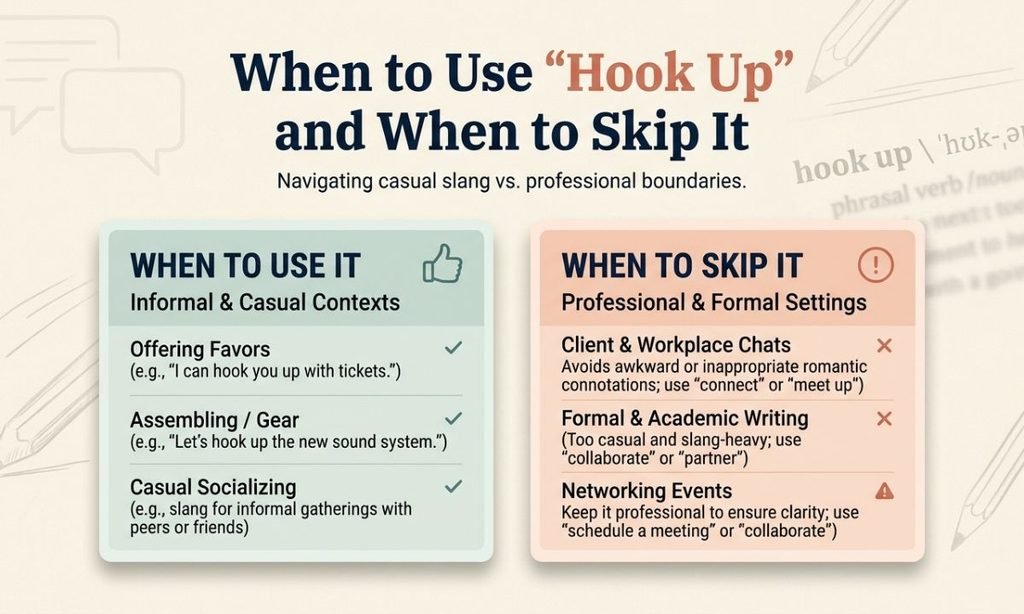
It works best among friends: casual texting, friend conversations, social media captions, dating discussions, or making sense of slang from a show. The register matches, so it’s appropriate.
Skip it in professional or formal settings. It can sound unclear, and around a boss it may sound inappropriate. “I hooked up with a client yesterday” will get you looks 😅. “I met with a client yesterday” won’t. That’s a register mismatch, and it’s a classic workplace mistake.
Is Hook Up a Bad Word?
Not necessarily. It’s informal slang, not a crude word. But because it touches dating and intimacy, some people find it too casual or even crude, depending on the setting or culture. Tone and audience matter more than the word itself. Read the room.
Tips for Using It Naturally
Understand the context before you speak. Ask yourself whether the conversation is casual and whether a clearer word would do better. If the phrase could land badly, try alternatives like met up, went out, dated, connected, kissed, or hung out.
In American English, “hook up” carries a stronger romantic meaning, and people in other countries may read it differently. Match your audience. If you’re unsure, say what you actually mean.
Reading the Hook Up Meaning Correctly
So, what does it mean? Most of the time in slang, it’s a casual romantic or physical connection between two people without a big label. In texting it’s usually the same, with some flirting attached. It can also mean helping someone, meeting casually, or connecting things. It’s informal, and you’ll mostly find it in casual conversation and online.
The word is never fully simple, because the meaning shifts with the setting. It can go from a kiss to a favor to a cable, and how clear it is depends on how much the speaker chose to say.
The key is knowing who is saying it, where, and how. Once you read the context, “hook up” gets much easier to understand. And if the context still leaves you guessing, do what works every time: ask.
FAQs
What does hook up mean in slang?
In slang, “hook up” usually means two people casually connect in a romantic or physical way, with no promise of a relationship. It can refer to anything from kissing to spending the night together. The speaker often keeps it vague on purpose.
What does it mean when a guy says “want to hook up?”
It usually signals casual, physical interest rather than an invitation to a traditional date. It tells you he likes the vibe, not exactly what he has in mind. Asking “what did you have in mind?” clears it up fast.
Does hook up always mean sex?
No. It can mean kissing, making out, flirting, or simply spending time together. Context, tone, and who is speaking decide how far the phrase goes.
What does hook up mean in texting?
In texts, it leans romantic and suggests casual flirting or physical attraction without commitment. “Are you two hooking up?” reads as gossip, while “I don’t do hookups” reads as a boundary. Tone often matters more than the words.
What does hook up mean on dating apps?
On dating apps, it almost always means a casual romantic or physical meet-up, often a one-time encounter. People often state it in their profile, as in “not looking to hook up.” The narrow setting makes the meaning much clearer than it is in everyday talk.
What is the difference between a hookup and a one-night stand?
Both are single encounters, but the framing differs. A hookup is usually planned earlier with the intent stated in advance. A one-night stand carries a more spontaneous, late-night, sometimes regretted feel.
What is the difference between a hookup and friends with benefits?
A hookup is typically a one-time meeting with no friendship involved. Friends with benefits is recurring and builds on an existing friendship. Both are casual, but FWB carries more emotional weight.
Does hook up have non-romantic meanings?
Yes. “Hook me up with tickets” means help me get something, and “hook up the printer” means connect it. These uses are completely non-romantic and still very common in American English.
Where did the phrase “hook up” come from?
It began as a mechanical term for attaching or connecting equipment, such as wiring and radio sets, by the early 1900s. The social sense of meeting or connecting grew from that idea. The sexual meaning is the newest and spread in American English in the late twentieth century.
Is hook up a bad word or inappropriate to say?
It’s informal slang rather than a crude word, but some people find it too casual or crude depending on the setting. It works well among friends and online. Avoid it at work, where “I hooked up with a client” can be badly misread.
What can I say instead of “hook up” in a professional setting?
Use clearer phrases like “met up,” “met with,” “connected,” or “got together.” For example, say “I met with a client yesterday” instead. When unsure, say exactly what you mean.
What does hookup culture mean?
Hookup culture refers to the broader pattern of repeated casual encounters as a lifestyle or social norm. A hookup is the single event, while hookup culture is the pattern. Research suggests outcomes depend more on clear consent and honest expectations than on the format itself.
How do you know if someone wants to hook up or date seriously?
Serious daters tend to use words like “seeing someone” or “together.” Someone who wants a hookup usually keeps things casual and avoids labels. The surest way to know is to ask directly.
Can a hookup turn into a relationship?
Yes, some do. It works best when both people say out loud that the format has changed. Staying silent often leads to a situationship, which carries the most emotional weight of the casual options.
