

You pour out a long message about your weekend plans, and a few seconds later the reply says “mhm.” So what does mhm mean in text, and should you read anything into it? Did they agree, or did they stop paying attention halfway through?
People search for this because three letters with no explanation leave plenty of room for guessing. The word shows up in texts, DMs, group chats, and comment sections, and the same reply can feel warm from one person and cold from another. Out loud, pitch and timing tell you the mood. On a screen, all you have is context.
This guide covers the plain meaning, where the sound comes from, how tone shifts across apps, and how “mhm” compares with words like “yeah” and “uh-huh.” You’ll also get ten real examples and clear advice on when to skip it.
Mhm is the typed version of the sound “mm-hmm.” It usually means “yes,” “okay,” “I agree,” or “I’m listening.” It is an informal acknowledgment, not an acronym, and its tone depends on context. The same three letters can sound warm, bored, or sarcastic depending on who sends them and what came before.
The Quick Answer: What MHM Means
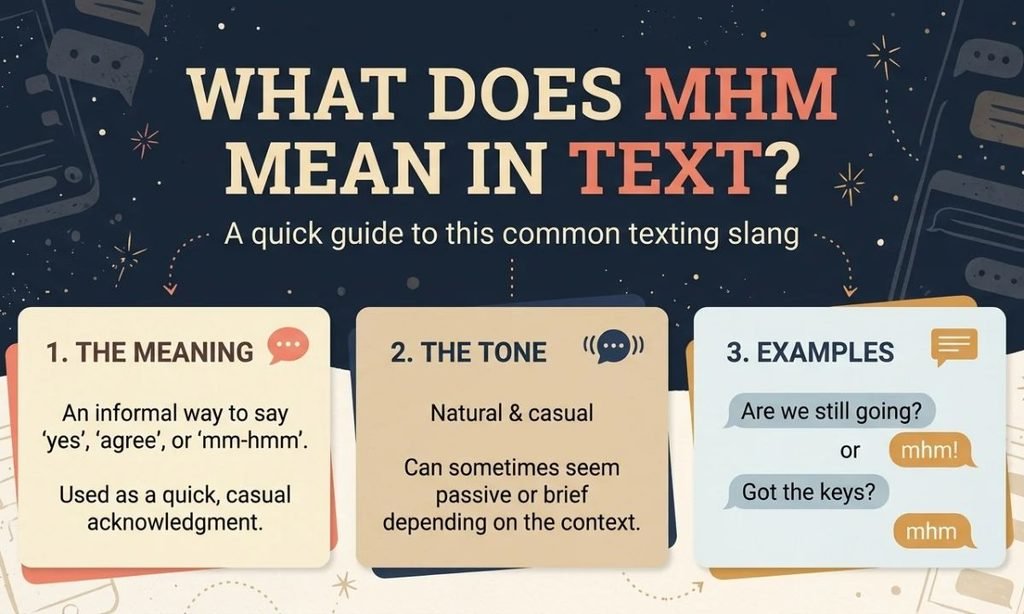
Most of the time, “mhm” means “yes.” It’s the written form of the closed-mouth sound people make when they want a speaker to keep going, a kind of soft nod turned into letters. You’ll also see it spelled “mm-hmm” or “mmhm.”
It can also mean “I hear you,” “okay, got it,” or “keep talking.” Depending on the moment, it can signal casual agreement, attention, hesitation, or mild annoyance.
The word itself carries no fixed feeling. That’s the twist. A warm “mhm,” a bored “mhm,” and a passive-aggressive “mhm” look identical on a screen. To tell them apart, check who sent it, what came right before it, and how that person normally writes.
It helps to think of the word as the speech sound first and a spelling second. A definition takes one line, but the tone takes the whole conversation.
MHM Meaning in Text: Primary, Secondary, and Rare Senses
A one-line answer only gets you so far, so it helps to sort the meanings into three layers. Linguists call a single form with several meanings polysemy. The practical fix is simple: let the surrounding messages pick the meaning for you. Most misreadings happen when someone grabs the wrong layer.
Primary Meaning: Simple Confirmation
The most common meaning is plain confirmation. It’s the informal written form of the sound people make face to face when they agree.
“Are you still coming tonight?”
“Mhm, around 7.”
There’s no mystery here. The person is agreeing and confirming a plan. This should be your first reading unless something points elsewhere, and it’s right far more often than it’s wrong.
Secondary Meanings: “I Hear You” and “Keep Going”
Sometimes “mhm” carries a different message. The sender is acknowledging you without strongly agreeing with the content.
“Work was exhausting today.”
“Mhm, I get that.”
That’s a rough day being acknowledged, not judged. This is what linguists call a backchannel response, a small noise that tells the speaker the listener is still there. A plain “mhm” can do that job without agreeing with anything.
Emoji change the picture fast. “Mhm 😏” is teasing, and the playful tone is obvious. Pragmatic meaning is the meaning that comes from how a word is used, not from how it’s spelled, and emoji are one of the strongest signals of it.
Rare and Misread Meanings
Some people assume MHM is an acronym with a hidden expansion. It isn’t. In ordinary messaging, it’s a sound, and treating it as shorthand for something is the most common misconception about it.
A dry “mhm” can occasionally signal skepticism or impatience.
“You totally believe me, right?”
“Mhm.”
Here the sender is basically saying “sure, I believe you,” with a raised eyebrow. Even so, I wouldn’t jump to anger. The letters tell you very little, so lean on context and punctuation, and stay cautious about conclusions.
How Context Changes What MHM Means
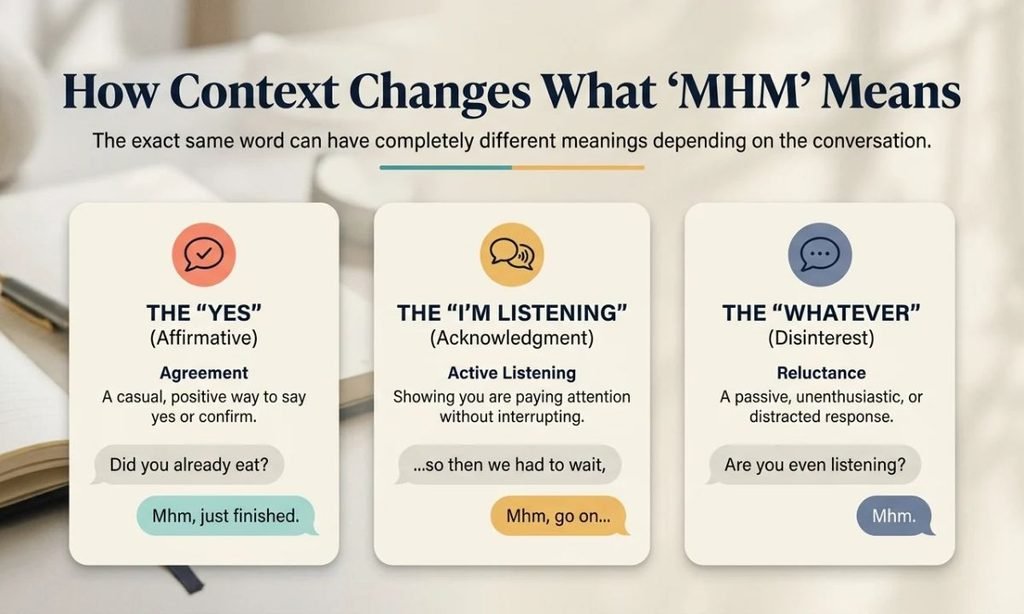
The same word shifts with the setting, the relationship, and the platform. What sounds natural from a friend can sound odd from a manager. Regional habits and the audience also decide how much tone variation feels acceptable.
Texting and Messaging Apps
In SMS, WhatsApp, Messenger, and chats with friends and family, “mhm” is usually relaxed and straightforward.
“Did you already eat?”
“Mhm, just finished.”
It works like a quick nod, a little more casual than a plain “yes.” Capitalization matters a bit, too. “MHM!” looks more excited than “mhm,” though the literal meaning stays the same.
Social Media and Online Communities
On Instagram, “mhm” can appear in DMs or comments as agreement, as in “Mhm, exactly.” On Snapchat, where replies are quick and casual, a standalone “mhm” can simply acknowledge a snap. On TikTok, you’ll see “MHM 👏” under a comment backing someone’s opinion. On Threads, it works as a short reaction to a post or reply.
It also turns up on Reddit, Discord, and in comment sections, where “mhm” is a cheap way to join in without adding much. On these platforms, emoji and punctuation supply the emotion that three letters can’t.
Dating and Relationships
Dating adds emotional weight, because people naturally study short replies from someone they like.
“You miss me?”
“Mhm ❤️”
That reads as affectionate and probably flirtatious. Compare it with this:
“Are we okay?”
“mhm.”
Technically that says yes, but the brevity and the period can feel distant. It doesn’t prove they’re upset. Some people simply text that way, and overanalyzing does more harm than the reply itself. If you’ve seen how they handle short replies before, you can read them far more accurately.
Professional Communication
In formal writing, “mhm” is usually too casual for clients, managers, or new contacts. If your manager asks, “Can you send the final report by noon?” a reply of “mhm” can sound careless. “Yes, I’ll send it by noon” is clearer and leaves no room for doubt.
Between close coworkers in a relaxed team chat, “mhm, that works” is perfectly natural. The call depends on reading the room. Whenever a deadline or responsibility is involved, choose clarity.
Where MHM Comes From
Nobody invented “mhm.” It’s a spelling of a sound, so there’s no first use to point to. Linguists have studied that sound for decades as a backchannel, one of the little signals a listener gives to show they’re following along. “Uh-huh” is its closest cousin. The sound is almost certainly far older than any spelling of it.
The written forms are just attempts to transcribe a hum, which is why you’ll also see “mm-hmm” and “mmhm.” Exactly when those spellings first appeared in print is hard to pin down, and sources disagree. I’d be wary of any site that gives you a confident date.
Regional and Cultural Roots
The “mm-hmm” sound is especially familiar in American English. Many languages have some version of a closed-mouth agreeing noise, though the exact sound and how much agreement it carries differ. Conversational signals vary from language to language and culture to culture, and that’s what cross-cultural pragmatics studies.
Age and Familiarity
Age plays a part, too. Some younger users treat “mhm” as an ordinary casual reply. Someone less familiar with texting slang may wonder whether it’s an abbreviation. That gap in familiarity is a good reason not to judge the word by its spelling alone.
It’s Common Out Loud, Too
The text version is a copy of a very old speaking habit. In real conversations, people use it as a quiet hum of agreement while someone else talks. You’ll hear it in meetings, on phone calls, and across kitchen tables, usually without either person noticing.
Why People Use MHM
Speed and ease are the big reasons. Why type “yes” when it can feel too heavy? “Mhm” takes about a second, and it sounds closer to real speech than a stiff, typed-out answer. It feels natural in a way full sentences often don’t.
It also works as a signal. When someone sends it, they’re saying “I’m listening,” which keeps the conversation moving. The other person can carry on without wondering whether anyone is there.
“You know what I mean?”
“Mhm.”
A small reply like that keeps things flowing. Linguists call this kind of talk phatic communication, meaning words that keep the connection open more than they pass along information. It also builds a bit of familiarity. People reach for “mhm” with those they’re comfortable with, so it does some rapport building almost by accident.
There’s a catch. “Mhm” is passive agreement. You’re responding, but you’re not deeply engaging. That low effort is both its charm and its risk.
How Tone Changes MHM
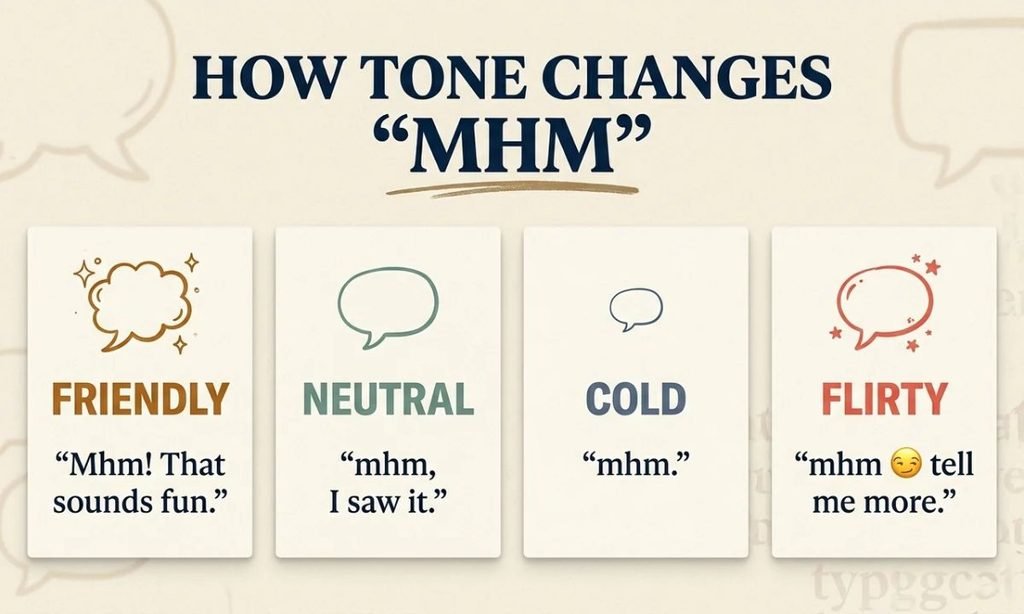
Tone shifts a lot even when the wording doesn’t. Here’s the same word in four moods:
- Friendly: “Mhm! That sounds fun.”
- Neutral: “mhm, I saw it.”
- Cold: “mhm.”
- Flirty: “mhm 😏 tell me more.”
Punctuation does heavy lifting. A period can make a reply look firmer, while an exclamation point adds energy. Trailing dots can make it feel passive or hesitant. Emoji can soften a message or reshape it completely: “Mhm 😊” reads friendly, “Mhm 😐” reads neutral, and “Mhm…” reads slightly passive.
Still, a dry-looking reply doesn’t reliably tell you someone’s mood. Punctuation isn’t a psychological test, and the surrounding context counts for more.
Real-Life Examples of MHM in Text
Here are ten quick examples. In each one the word stays the same, and everything around it changes.
| Message | Reply | What it means |
| “Want pizza tonight?” | “Mhm!” | Yes, and enthusiastic. They like the idea. |
| “You understand what happened?” | “mhm.” | Understood, in a neutral tone. Basic acknowledgment. |
| “You missed me, didn’t you?” | “mhm 😘” | Yes, and flirty. It hints at romantic interest. |
| “I told you this would happen.” | “Mhm…” | Reluctant. They may not want to discuss it further. |
| “Can you pick me up at six?” | “mhm” | The request is accepted, casually. |
| “She was being rude, right?” | “MHM.” | Absolutely yes. Capital letters add emphasis. |
| “I think I need some space.” | “mhm.” | Reserved. The sender may be processing the statement. |
| “This song is incredible.” | “mhm 🔥” | Approving. The emoji strengthens the praise. |
| “You’re not convinced, are you?” | “mhm…” | Hesitant. The ellipsis suggests reservation. |
| “So first we submit the form?” | “Mhm, then wait for approval.” | Correct, and helpful. It confirms the step and keeps going. |
A few more everyday moments show the range:
- A friend texts that a movie was amazing, and you reply “Mhm, I loved it too.” That’s genuine, even strong, agreement, because you added words to it.
- Someone starts a story with “So I went to the store and then…” and you answer “Mhm…” That’s passive listening. It means keep talking.
- A friend describes a three-hour meeting in full detail and you send “Mhm…” That reads as slight disinterest. You’re polite, but not super interested.
- You say, “I think you were wrong there,” and they answer “Mhm.” That could be sarcasm, a hidden attitude, or silent disagreement. Without a face or a voice, you can’t tell, and that’s the trouble with this word.
Where Misunderstandings Happen
Most mix-ups come from a few predictable places. People read too much into a reply during an argument, or too little into a simple yes-or-no answer. Isolated replies, or ones read right after a bad message, are the usual trouble spots. The causes fall into three groups.
Context Confusion
The biggest mistake is treating every “mhm” the same. If a puzzling message sent you searching for the mhm meaning in text, read the previous few messages first. A reply to a yes-or-no question is much easier to interpret than an isolated “mhm” in the middle of an argument. My rule is simple: read first, judge second.
The Generational Gap
Not everyone types conversational sounds the same way. Some people naturally use “mhm,” while others prefer “yes,” “yeah,” or “yep.” That’s mostly stylistic preference. I wouldn’t assume someone is being rude just because their texting style differs from yours. What looks cold to you may be normal to them.
Platform Differences
A TikTok comment is public and reaction-driven. A dating DM is personal. A workplace Slack message has practical consequences. The platform doesn’t redefine “mhm,” but it changes expectations around tone, detail, and formality.
Three Classic Misreadings
- Thinking it always means yes. Sometimes it only means “I heard you,” which is very different from agreement.
- Assuming it’s rude. It’s not automatically rude, and tone matters more than the word. A “mhm” can be perfectly kind in the right chat.
- Overusing it. Too many “mhm” replies in a row can make you seem bored or emotionally distant, even when you’re paying close attention.
Most of these happen when one person is typing in half-attention mode and the other is reading every letter for meaning. I’ve watched whole arguments start that way.
MHM vs Similar Words: How They Differ
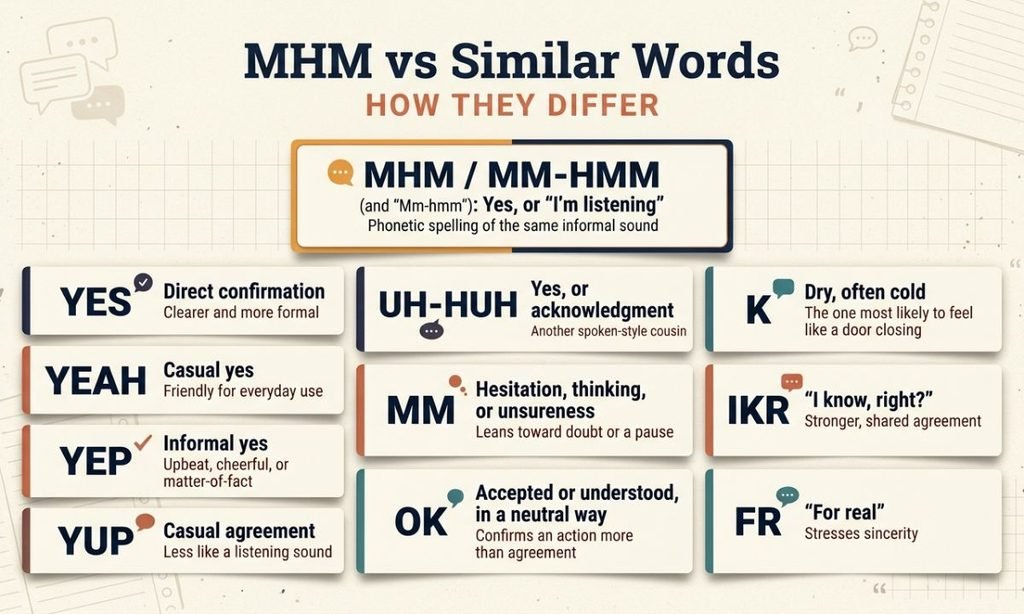
Several short replies overlap with “mhm,” but none is a perfect substitute. They sit at different points on a scale from casual to formal.
| Word | What it does | How it differs from mhm |
| Yes | Direct confirmation | Clearer and more formal |
| Yeah | Casual yes, friendly for everyday use | Slightly more explicit |
| Yep | Informal yes | Upbeat, cheerful, or matter-of-fact |
| Yup | Casual agreement | Less like a listening sound |
| Mm-hmm | Yes, or I’m listening | Phonetic spelling of the same sound |
| Mm | Hesitation, thinking, or unsureness | Leans toward doubt or a pause |
| Uh-huh | Yes, or acknowledgment | Another spoken-style cousin |
| OK | Accepted or understood, in a neutral way | Confirms an action more than agreement |
| K | Dry, often cold | The one most likely to feel like a door closing |
| IKR | “I know, right?” | Stronger, shared agreement |
| FR | “For real” | Stresses sincerity |
“Mhm” sits in a subtle middle spot. It’s softer than “K” and more emotional than “OK,” yet less enthusiastic than “yeah.” “OK” is the closest in function when you’re confirming an action, and “IKR” is stronger when you want to show you feel the same. The takeaway is that “mhm” is built for casual chats and is a poor tool when you need to be exact.
MHM vs Hmm
These two get mixed up often. “Mhm” generally signals agreement or acknowledgment. “Hmm” suggests thinking, curiosity, doubt, or uncertainty. “Mhm, I agree” confirms, while “hmm, I’m not sure” shows consideration.
Is MHM the Same as Yes?
Mostly, yes. It’s just more casual, and it can take on different tones depending on the moment. It isn’t always agreement. Sometimes it’s only attention.
Is it positive or negative? Usually neutral or positive, since it signals agreement or acknowledgment. After an emotional message, though, “mhm.” can read as cold. What came right before decides it.
Can it be flirty? Yes. Between people who are interested in each other, “mhm 😘” is clearly warmer than a bare “mhm.” The relationship between the two people sets the tone.
Is it rude? Not automatically. Some people use it as a normal acknowledgment all the time. It may feel dismissive after a serious topic, when replies are unusually short, or when it breaks from the sender’s usual style. In professional chats, it’s better to skip it and use clear, formal wording so the other person has nothing to decode.
Does gender change it? No. The meaning is the same from a girl or a guy. A romantic reading comes from the relationship, not from who sent it.
How should you reply to one? Follow the conversation. If they’ve answered a simple question, you may not need a follow-up. If their message seems uncertain, continue naturally or ask a clear question.
When Not to Use MHM
Most of the risk comes from a mismatch between the word and the setting. When in doubt, leave it out. A little caution keeps your meaning from being misread.
Professional Risks
Avoid “mhm” when a message needs a precise commitment. “Yes, I approve the final version” leaves less room for doubt than “mhm.” Clear wording matters most in contracts, formal emails, customer complaints, and sensitive instructions. When someone’s responsibility is on the line, ambiguity is costly. In email and work chats, “Yes” or “Understood” is the safer choice, especially if the reader may check back later.
Cultural Risks
If you’re writing to someone who may not recognize American conversational shorthand, choose plain language. “Yes” or “I understand” travels better. Adjusting your tone for your audience shows respect. The goal isn’t to sound trendy. It’s to be understood.
Tone Risks
During disagreements, serious relationship talks, or emotional conversations, “mhm” can seem dismissive even when you don’t mean it that way. A grieving friend or an angry colleague will not read your “mhm” as support. They’ll read it as lazy, or worse. A fuller reply, like “Yes, I understand what you mean,” shows more care and removes the guesswork. It costs you one extra sentence.
When to Use MHM
It works well in a few situations:
- You agree casually, as in “Mhm, that makes sense.”
- You’re following a story and want the person to go on.
- You don’t want to type much and a quick acknowledgment is enough.
If you’re asking yourself whether to use it, think about who’s reading and how much they need from you. If the answer is “a lot,” write a real sentence.
Tips for Using MHM Well
These tips come from watching chats go well and badly.
- Save it for people you know. It fits best with friends, relatives, and partners who know your style.
- Add a few words when your answer must be clear. “Mhm, I agree” or “Mhm, that’s interesting” does far more than a bare “mhm.” Short additions turn a neutral reply into a friendly one.
- Match your punctuation to your mood. “Mhm!” feels livelier than “mhm.”
- Use emoji for warmth or play. They’re optional, but they combine well with it.
- Follow the other person’s level of formality. Mirror their tone.
- Skip it for workplace approvals and deadlines.
- Don’t assume a lowercase reply means someone is angry. Read the context first.
- Ask when the meaning really matters. If the emotional meaning is important, ask for clarification instead of guessing.
Watch the conversation tone before you send it. If the chat is serious, stick to something clearer. The habit that ties all of this together is simple: read the vibe before you hit send, then read it again from the other side.
Reading MHM in Your Own Chats
Next time one lands in your inbox, hear it in your head. “Mhm” is the familiar spoken “mm-hmm,” most often meaning “yes,” “yeah,” “I understand,” or “I’m listening.” It works best in casual conversations with people who know your style.
Don’t overanalyze one short message. Look at the question it answered, the sender’s habits, the punctuation, and the broader conversation. In sensitive discussions, or when a message is ambiguous, ask instead of assigning emotions the person may not feel. For anything where precision matters, use clearer wording.
The key point is that definition and tone are two different things. The definition is simple, and the tone is contextual. A tiny word can carry real emotional weight: it can mean agreement, attention, disinterest, or a subtle attitude, and the reader decides which one landed. So “mhm” usually means yes, and the conversation around it tells you how that yes feels.
FAQs
What does mhm mean in text?
Mhm is the typed version of the sound “mm-hmm.” It usually means “yes,” “okay,” or “I’m listening.” The exact tone depends on the conversation around it.
Is mhm an acronym?
No. Mhm is a spelling of a sound, not shorthand for a phrase. There’s no hidden meaning behind the letters.
Does mhm mean yes?
Most of the time, yes. It can also mean “I hear you” or “keep going” without strong agreement. Check the question it answered to be sure.
Is mhm rude in a text message?
Not automatically. Many people use it as a normal, casual acknowledgment. It can feel dismissive after a serious message or when it breaks from the sender’s usual style.
What does mhm mean from a girl or a guy?
The meaning is the same no matter who sends it. Any flirty or romantic reading comes from the relationship and the emoji, not the sender’s gender.
What does “mhm” mean when someone texts it with a period?
A period can make the reply look firmer or colder, as in “mhm.” It doesn’t prove the person is upset. Some people simply text that way, so compare it with their usual replies.
Can mhm be flirty?
Yes. With an emoji like 😏 or 😘, or between people who are interested in each other, it reads warmer and more playful than a bare “mhm.”
What is the difference between mhm and hmm?
Mhm signals agreement or acknowledgment. Hmm suggests thinking, doubt, or uncertainty. “Mhm, I agree” confirms, while “hmm, I’m not sure” shows hesitation.
Is mhm the same as uh-huh?
They’re close cousins. Both are spoken-style sounds that signal “yes” or “I’m listening.” Mhm is just the more common spelling in texts and DMs.
Is it okay to use mhm at work?
It’s fine between close coworkers in a relaxed chat. For approvals, deadlines, or messages to clients and managers, “Yes” or “Understood” is the safer choice.
Why do people reply with just mhm?
It’s fast, effortless, and sounds like real speech. It also tells the other person you’re still listening, which keeps the conversation moving.
How should I reply when someone texts me mhm?
Follow the conversation. If they answered a simple question, you may not need to reply. If the message feels unclear, ask a direct question instead of guessing their mood.
