
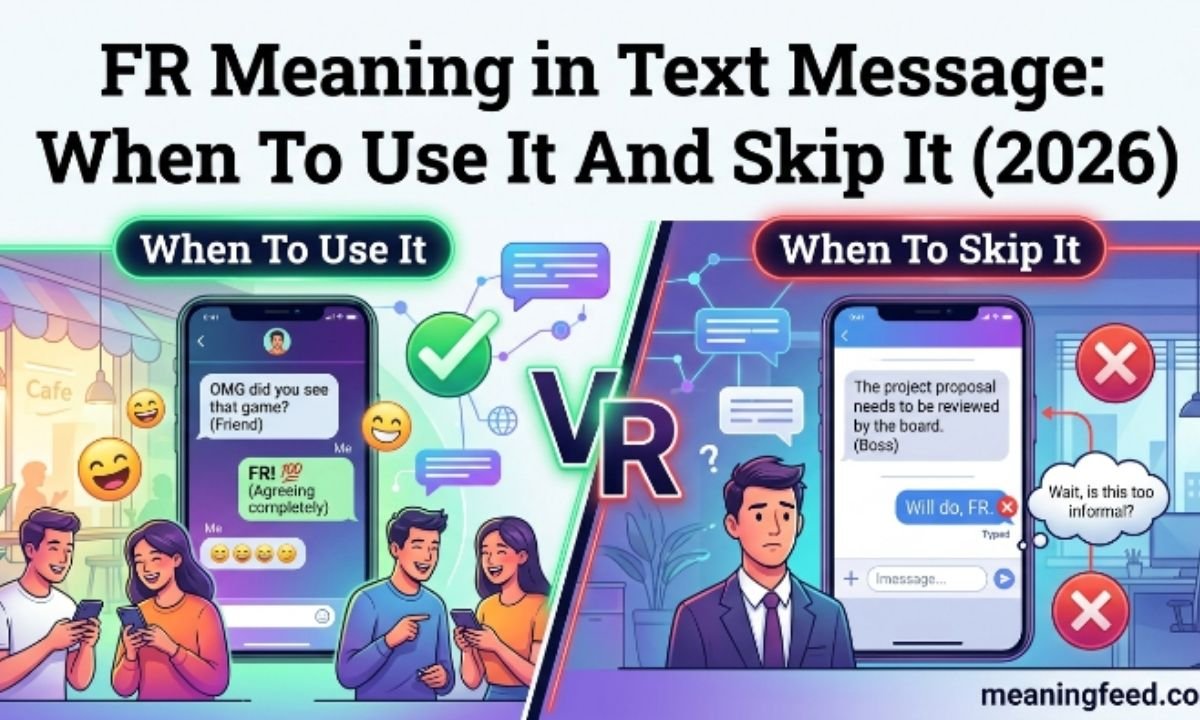

Someone texts you “fr?” and you just… stare at your phone for a second. You’re pretty sure it means “for real,” but then why does it sometimes feel like a question, sometimes a compliment, and sometimes low-key sarcastic? You’re not imagining things. The fr meaning in text message conversations depends almost entirely on context, punctuation, and who’s sending it — and that’s the part most explainers skip right over.
This guide covers what “fr” actually means, why the same two letters can carry completely different tones, and the situations where using it will make you look either fluent in modern texting or painfully out of touch.
What Does FR Meaning In A Text Message?
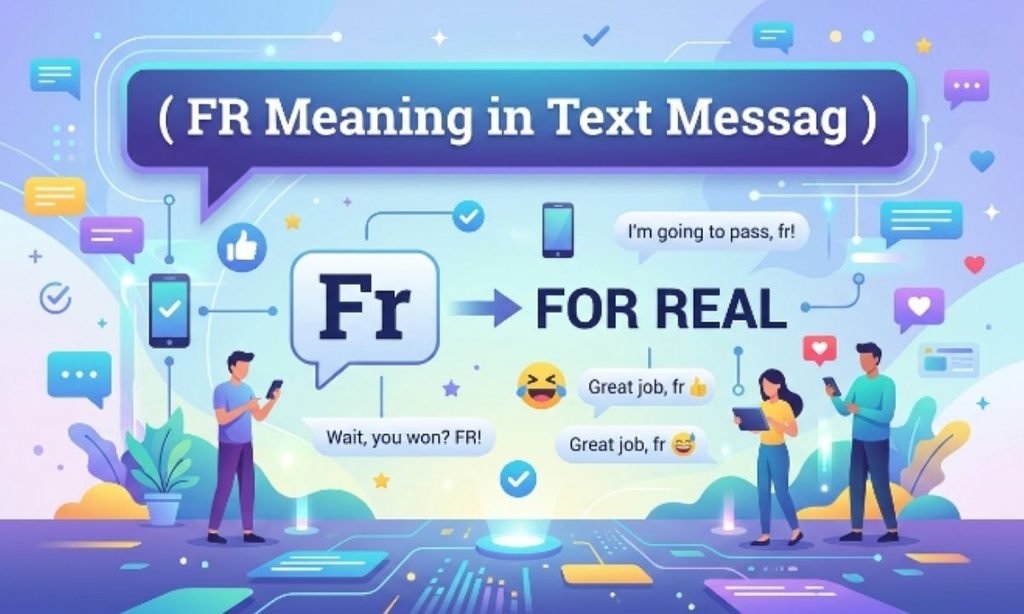
“Fr” stands for “for real.” That’s the short answer.
In practice, it works as a stand-in for phrases like:
- “I’m serious”
- “No joke”
- “Honestly”
- “I agree completely”
It showed up in text lingo the same way “lol” and “omg” did — people got tired of typing full words on tiny keyboards, and the abbreviation stuck. But “fr” didn’t stay a simple shortcut. Over the last few years it evolved into something closer to a tone marker than a literal phrase, which is exactly why the meaning of fr in text messages shifts depending on where it lands in a sentence.
“fr” vs “fr fr”: The Distinction Almost Nobody Explains Properly
Here’s something most articles gloss over in one throwaway sentence, and it deserves way more attention.
Doubling the word isn’t just for emphasis the way “very very” is. It changes the emotional register of the message.
| Version | What It Signals | Typical Use Case |
| fr | Mild confirmation or agreement | Casual chat, low emotional stakes |
| fr? | Genuine surprise, asking for confirmation | Reacting to unexpected news |
| fr fr | Strong emphasis, “I really mean this” | Backing up a bold claim |
| fr fr no cap | Maximum sincerity, “trust me on this” | Convincing someone you’re not exaggerating |
| frfr (no space) | Fast, casual, often typed in the heat of a reaction | Quick replies, less “formal” tone |
If a friend says “that movie was actually good fr fr,” they’re not just agreeing — they’re pre-empting your skepticism. That layered intensity is the part a plain dictionary definition can’t capture, but it’s the part that actually matters if you’re trying to text naturally instead of sounding like you looked the word up five minutes ago.
Where FR Sits Among Other Slang (And Why People Mix Them Up)
“Fr” rarely travels alone. It shows up next to a handful of other confirmation-style slang terms, and mixing them up is a fast way to sound like you’re guessing.
| Term | Meaning | How It Differs From “fr” |
| fr | For real | Confirms sincerity |
| no cap | No lie | Denies exaggeration specifically |
| ong | On God | Adds a stronger, almost oath-like weight |
| deadass | Seriously, literally | More blunt, often used mid-sentence |
| fr fr | Really really | Doubles down on sincerity |
| ngl | Not gonna lie | Admits something honestly, often reluctantly |
A common combo you’ll see is “ong fr no cap” — three sincerity markers stacked together. It sounds excessive out of context, but in a fast-moving group chat, it reads as playful emphasis, not literal repetition.
FR Changes Meaning Based On Tone, Not Just Definition
This is where most explainers stop short. They’ll tell you “fr” means “for real” and call it a day. But the same abbreviation can carry at least three distinct emotional tones, and reading them wrong is how conversations get awkward.
1. Sincere FR
Used to genuinely back up a statement.
“I studied for six hours straight fr”
Here it’s doing exactly what it says — confirming honesty. No hidden layer.
2. Sarcastic FR
Used ironically, often to mock exaggeration or call out an obvious lie.
“Oh yeah, you ‘totally’ finished the project fr”
The tone here flips the meaning almost entirely. Instead of confirming truth, it’s pointing out the opposite. Punctuation and prior context are the only real clues — there’s no separate spelling for sarcastic “fr,” which is exactly why so many people misread it in text form.
3. Shocked/Reactive FR
Used as a standalone reaction to surprising news.
Friend: “I got the job!” You: “FR?!”
Capitalized and paired with a question mark, it becomes disbelief rather than agreement. This version leans almost entirely on punctuation to do the emotional work.
Quick way to tell them apart: if “fr” follows a statement, it’s usually sincere. If it stands alone as a reply with a question mark, it’s asking for confirmation. If it follows something obviously exaggerated or ironic, it’s sarcasm — and the giveaway is usually that the rest of the sentence doesn’t quite add up.
How To Actually Respond When Someone Texts You “fr?”
This is a gap almost every guide leaves out entirely: they explain the term but never tell you what to text back.
| If They Text | What They’re Really Asking | Good Reply Options |
| “fr?” | Confirm what you just said is true | “fr fr,” “yeah I’m serious,” “no lie” |
| “wait fr??” | They’re shocked, want more detail | “yes omg let me explain,” “fr, I couldn’t believe it either” |
| “that’s crazy fr” | Agreement, no reply needed necessarily | “fr fr” or a simple reaction emoji |
| “you good fr?” | Genuine concern, checking in | Give a real answer — this one isn’t just slang, it’s sincerity dressed casually |
That last row matters more than it looks. When someone asks “you good fr?” they’re usually checking in for real, even if the phrasing looks casual. Brushing it off with another slang reply can come across as dismissive when someone was actually trying to have a real moment.
Who’s Actually Texting “FR” — And Where
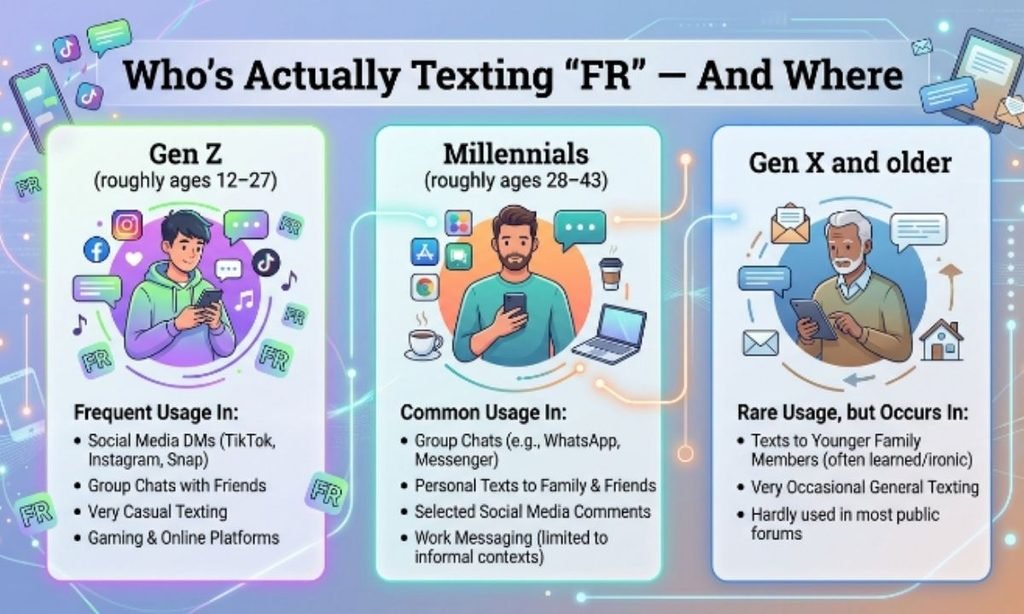
The fr meaning in text messages context also depends heavily on the platform and the age group using it.
- Gen Z (roughly ages 12–27): Uses “fr” constantly, often stacked with other slang like “no cap” or “ong.” Feels completely natural in daily texting.
- Millennials (roughly ages 28–43): Use it more selectively, often single (“fr”) rather than doubled, and usually only in casual friend groups — not with parents or coworkers.
- Gen X and older: Typically only encounter it through kids or younger coworkers, and it often reads as unfamiliar or slightly confusing without context.
Platform matters too. On iMessage and WhatsApp, “fr” tends to appear in full sentences. On Instagram DMs, Snapchat, and TikTok comments, it’s more likely to stand completely alone as a one-word reaction.
The Autocorrect Problem Nobody Talks About
Here’s a genuinely useful detail that’s almost entirely missing from other guides: autocorrect actively fights against “fr.”
- iPhones sometimes capitalize it to “Fr.” as if it’s an abbreviation for a name or title (like “Fr. Michael” for a priest), which can make a casual text look oddly formal.
- Predictive text on some Android keyboards tries to autocomplete “fr” into “for,” which quietly changes your entire sentence if you’re not paying attention.
- Voice-to-text almost never transcribes “fr” correctly — it usually spells out “for” or skips it, so dictated texts using this slang need a manual double-check before sending.
If your texts keep looking oddly formal or getting misread, this is very likely why — not because you typed it wrong.
When You Should NOT Use “FR”
Slang guides love listing when to use a term. Almost none of them tell you when to avoid it, and that’s arguably more useful information.
Skip “fr” in these situations:
- Professional emails or work Slack messages — even casual workplace tone rarely stretches to slang abbreviations like this.
- Texting someone significantly older who won’t recognize it — a grandparent asking “did you eat fr?” won’t land as a joke, it’ll land as confusing.
- Formal apologies or serious conversations — sincerity reads better in full words when the topic is genuinely heavy (a breakup, a health scare, a real apology).
- Customer service or complaint messages — using slang here can make a legitimate complaint seem less credible.
A simple rule that works well: if you wouldn’t say “for real” out loud in that exact conversation, don’t type “fr” either.
Quick Reference Cheat Sheet
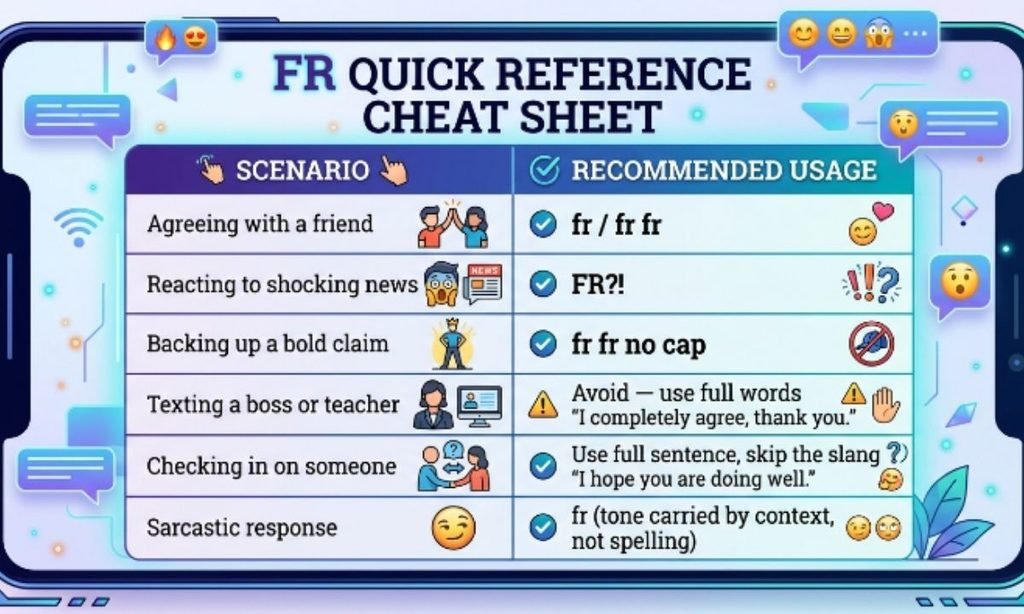
| Scenario | Recommended Usage |
| Agreeing with a friend | fr / fr fr |
| Reacting to shocking news | FR?! |
| Backing up a bold claim | fr fr no cap |
| Texting a boss or teacher | Avoid — use full words |
| Checking in on someone | Use full sentence, skip the slang |
| Sarcastic response | fr (tone carried by context, not spelling) |
Final Thought
The fr meaning in text message conversation isn’t really about memorizing a definition — it’s about reading tone, punctuation, and who’s on the other end of the conversation. Once you notice the difference between a sincere “fr,” a shocked “FR?!,” and a sarcastic one buried in an obviously exaggerated sentence, the whole thing stops feeling confusing and starts feeling like second nature.
Use it where it fits, skip it where it doesn’t, and you’ll never have to guess what someone actually meant by those two little letters again.
FAQs
What does FR mean in a text message?
FR stands for “For Real.” It’s used to confirm that something is true or to emphasize sincerity in a conversation. People often use it to agree strongly with a statement.
What does FR FR mean in texting?
FR FR means “For Real, For Real.” It’s a doubled-up version of FR used to add extra emphasis, showing that someone is being completely serious or genuine about what they just said.
Is FR used in formal or casual conversations?
FR is strictly informal slang and is mainly used in texting, social media, and casual chats. It should be avoided in professional emails, formal writing, or business communication.
Where did the term FR originate?
FR originated from internet slang and gained popularity through social media platforms like Twitter (X), TikTok, and Instagram, before becoming common in everyday texting among younger generations.
Can FR be used in a sentence?
Yes. For example: “That movie was amazing, FR!” or “FR, I can’t believe he said that.” It typically appears at the beginning or end of a sentence for emphasis.
Is FR the same as “no cap”?
Not exactly. While both terms indicate honesty, “no cap” specifically means “no lie,” whereas FR (“for real”) is used to confirm agreement or authenticity in a broader sense.
What is the opposite of FR in texting?
The opposite of FR would be phrases like “cap” or “jk” (just kidding), which indicate that a statement is false, exaggerated, or not meant to be taken seriously.
