

If you searched for NGL meaning in text, you already know it stands for “not gonna lie.” That part took you five seconds to figure out. What’s harder to figure out is why your friend used it in that specific text, at that specific moment, right before saying something you weren’t expecting. That’s the part nobody explains properly.
NGL isn’t a random abbreviation people toss into texts to save three seconds of typing. It’s a tone marker. It tells the reader: “what comes next is more honest than usual, so brace yourself a little.” Once you start noticing that, you’ll read texts differently.
Most articles on this topic stop at “it means not gonna lie” and call it a day. That’s technically correct and practically useless. Knowing the letters doesn’t help you when a friend texts “ngl I’ve been avoiding you” or when someone drops it mid-flirt and you’re not sure if they’re joking or not. The letters are the easy part. Reading the intent behind them is where people actually get stuck.
This guide covers what NGL means, how it’s actually used across different apps and age groups, and — this is the part most articles skip — how to tell the difference between someone using NGL casually and someone using it to soften bad news, flirt, or vent. We’ll also get into when NGL can backfire, because yes, that happens more than people admit, and how it shows up differently depending on who’s typing it.
What Does NGL Meaning in Text?
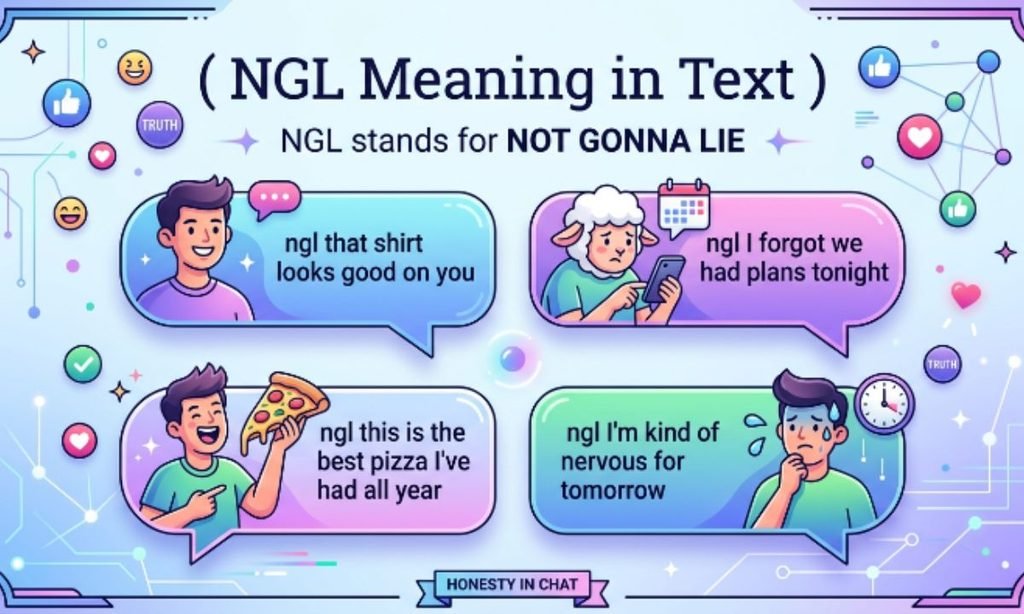
NGL means “not gonna lie.” It’s used right before a statement to flag that the sender is about to say something honest, blunt, or slightly uncomfortable — even if it’s small.
Here’s the thing most guides get wrong: NGL doesn’t always precede negative news. It shows up before compliments, confessions, opinions, and random honest thoughts too.
Examples:
- “ngl that shirt looks good on you”
- “ngl I forgot we had plans tonight”
- “ngl this is the best pizza I’ve had all year”
- “ngl I’m kind of nervous for tomorrow”
Notice something? None of those are harsh. NGL isn’t a warning label for bad news. It’s a warning label for unfiltered thoughts — good, bad, or awkward.
That distinction matters more than it seems. A lot of people assume NGL means “I’m about to say something you won’t like,” and that assumption makes them brace for criticism every time they see it. In reality, NGL shows up just as often before a compliment someone felt shy about giving, or a random true thought that popped into their head. The letters flag honesty, not negativity — and once you separate those two ideas, texts that used to feel loaded start reading a lot more relaxed.
The Real Function of NGL: A Social Buffer, Not Just an Abbreviation
Here’s the content gap nobody covers well: NGL works as a social cushion. It gives the sender permission to say something direct without sounding cold, and it gives the reader a half-second heads-up that honesty is incoming.
Think about the difference between these two texts:
| Without NGL | With NGL |
| “Your haircut looks weird.” | “Ngl your haircut looks weird lol.” |
| “I don’t like that idea.” | “Ngl I don’t really like that idea.” |
| “I’m not coming tonight.” | “Ngl I don’t think I can make it tonight.” |
The message barely changes. The tone changes completely. NGL softens bluntness the same way “honestly” or “to be fair” does in spoken conversation — except it’s faster to type and reads more casual, which matters in text culture where anything too formal feels stiff.
That’s why NGL shows up so often in group chats, DMs, and comment sections. It’s doing emotional labor in three letters.
Linguists have a name for this kind of phrase — a hedge. Hedges soften a statement so it feels less confrontational without actually changing what’s being said. “Sort of,” “I mean,” and “honestly” all do the same job in spoken English. NGL is the texting-native version of a hedge, built for a medium where tone of voice doesn’t exist and every message can be misread as colder than intended. That’s really the whole reason it caught on — not because “not gonna lie” is a phrase worth abbreviating, but because texting desperately needed a built-in tone signal, and NGL filled that gap by accident.
NGL Combinations: What They Signal Together
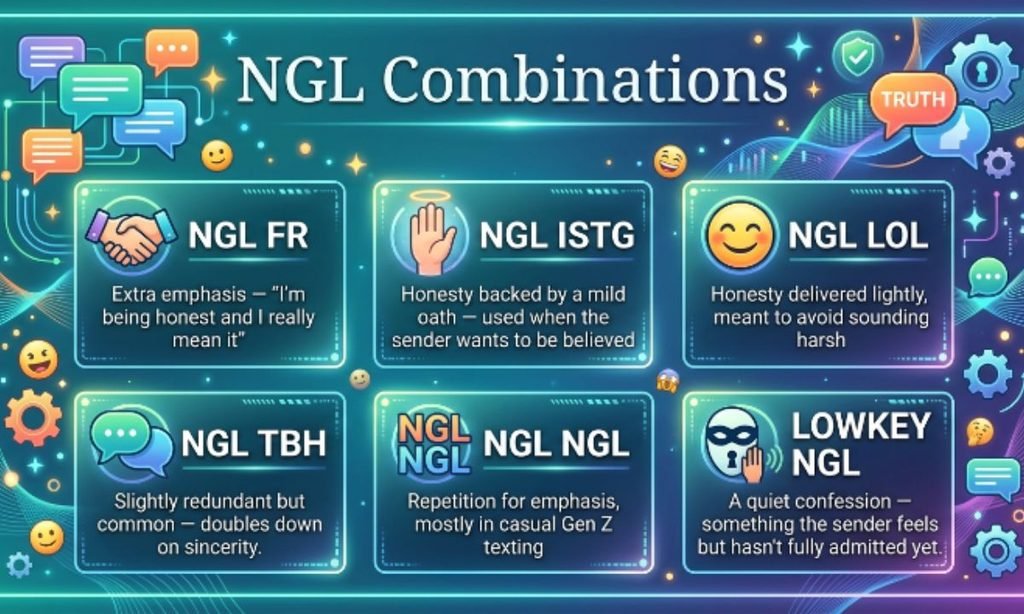
This is where most articles stop short. NGL rarely travels alone anymore. It gets stacked with other slang, and each combination shifts the meaning slightly.
| Combination | What It Signals |
| NGL FR | Extra emphasis — “I’m being honest and I really mean it” |
| NGL ISTG | Honesty backed by a mild oath — used when the sender wants to be believed |
| NGL LOL | Honesty delivered lightly, meant to avoid sounding harsh |
| NGL TBH | Slightly redundant but common — doubles down on sincerity |
| NGL NGL | Repetition for emphasis, mostly in casual Gen Z texting |
| LOWKEY NGL | A quiet confession — something the sender feels but hasn’t fully admitted yet |
If you’re trying to gauge how serious someone is being, the combination matters more than the NGL itself. “Ngl lol” reads casual. “Ngl istg” reads like they actually need you to take it seriously.
There’s also a generational layer here that barely gets mentioned. Younger Gen Z texters tend to stack NGL with intensifiers like “fr fr” or repeat it entirely (“ngl ngl”) almost as a rhythm thing, more style than substance. Older millennials who picked up the term later tend to use it solo, closer to its original “not gonna lie” function, without the extra stacking. If a text feels oddly rhythmic or repetitive with its slang, that’s often a sign of a younger sender leaning into texting as a kind of performance, not just communication.
Does NGL Mean the Same Thing on Every Platform?
Not quite. Context changes the weight of the word.
In Texting (iMessage/SMS)
NGL in a one-on-one text usually signals something personal — an opinion, a small confession, or mild vulnerability. It’s more intimate here than anywhere else.
On Instagram/Snapchat
NGL shows up a lot in captions and comments, often used more casually — closer to “honestly” than “I’m confessing something.” “Ngl this view is unreal” isn’t a confession, it’s just emphasis.
In Group Chats
NGL often introduces a slightly unpopular opinion the sender knows others might not share. “Ngl I think the show got worse after season 2” is a classic group-chat NGL — bracing for disagreement.
In Professional or Semi-Formal Chats (Slack, Work Texts)
This is where NGL gets risky. It reads as very casual, and using it with a boss, client, or professor can land as unprofessional, even if the sentiment behind it is fine. More on this below.
In Dating App Conversations
NGL carries the most emotional weight here of any platform. Because dating conversations already run on a low-key current of nerves and vulnerability, “ngl” tends to precede something the sender has been sitting on for a bit — an attraction they haven’t voiced, a doubt about the match, or a compliment they’re slightly embarrassed to give outright. “Ngl I was nervous to text you first” is a very different sentence than the same words without NGL in front of them. It reads as an admission, not just a statement.
When NGL Can Backfire
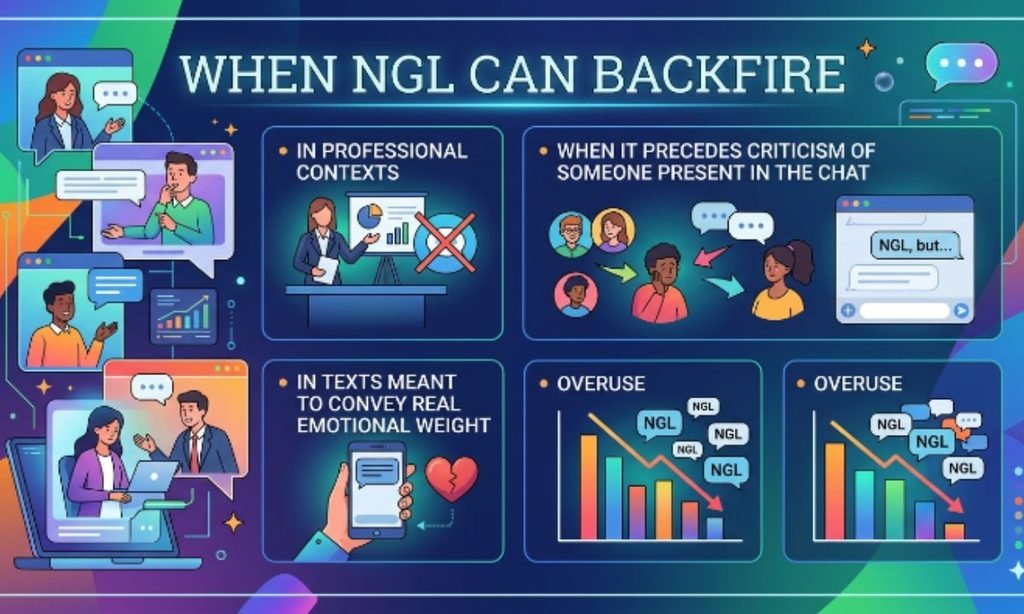
Almost every guide treats NGL as universally safe slang. It isn’t. Here’s where it can go wrong:
- In professional contexts. “Ngl I think the deadline is unrealistic” reads very differently to a manager than “Honestly, I think the deadline is unrealistic.” Same meaning, very different tone perception.
- When it precedes criticism of someone present in the chat. NGL softens tone, but it doesn’t erase the sting of criticism — it just makes it feel more casual, which can come across as dismissive rather than kind.
- In texts meant to convey real emotional weight. If you’re delivering serious news, NGL can accidentally make it sound too casual for the moment. “Ngl my grandpa passed away” reads oddly, because NGL is built for lighter honesty, not grief.
- Overuse. Starting every other text with NGL dilutes it. It stops signaling “pay attention, honesty incoming” and starts just being verbal filler — the same way “literally” lost its literal meaning through overuse.
A Quick Way to Decide If NGL Fits Your Text
Ask yourself these three questions before typing it:
- Is what I’m about to say slightly more direct than my usual tone? (If yes, NGL fits.)
- Am I texting someone I have a casual relationship with? (If no — boss, professor, unfamiliar client — skip it.)
- Is the topic light-to-medium in emotional weight? (If it’s genuinely heavy news, NGL will undercut it.)
If you answered yes, no, and yes, NGL fits naturally. If your answers flip, it’s probably better to just say the honest thing plainly.
One more test that works well: read your text out loud without the NGL, then again with it. If adding NGL makes the sentence feel gentler and more natural, it belongs there. If it makes an already-heavy sentence feel oddly light or flippant, that’s your sign to cut it and just say the thing directly.
NGL vs. Similar Slang: What Sets It Apart
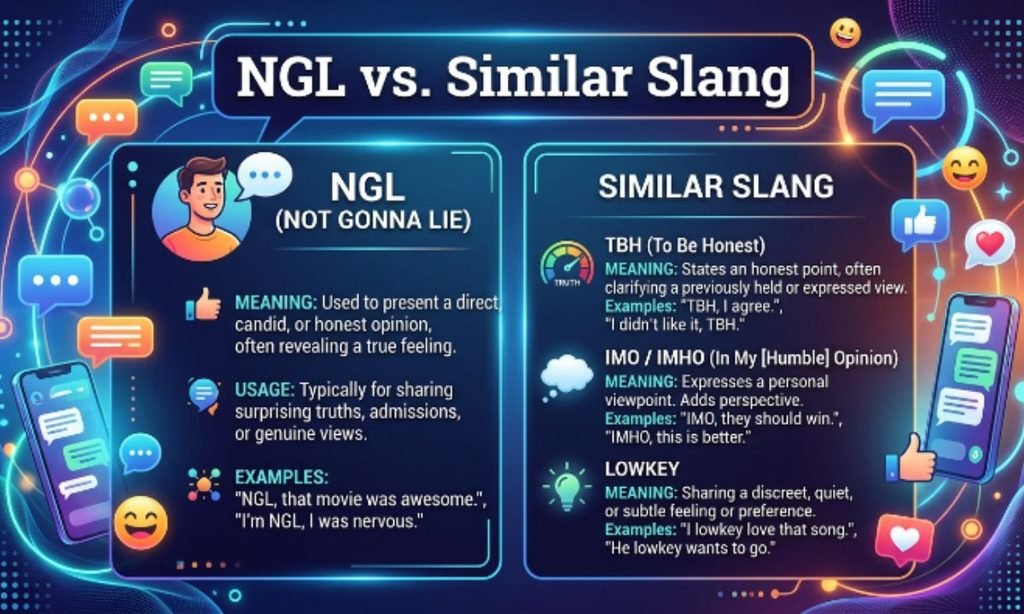
People often mix NGL up with TBH, FR, and JS. They’re related but not identical.
| Term | Meaning | Tone Difference |
| NGL | Not gonna lie | Signals honesty is coming, often slightly vulnerable |
| TBH | To be honest | Similar, but more neutral — less emotional buildup |
| FR | For real | Emphasizes sincerity or agreement, not necessarily confession |
| JS | Just saying | Defensive tone — used to soften an unsolicited opinion |
NGL and TBH are the closest cousins, but NGL tends to carry a touch more emotional honesty, while TBH feels more matter-of-fact. Swap them in a sentence and you’ll feel the difference: “tbh I don’t love this plan” sounds like feedback. “Ngl I don’t love this plan” sounds like a confession the sender wasn’t sure they should share. Same words, different emotional register — and that gap is exactly why NGL survives in texting culture while so many other abbreviations from the same era have quietly disappeared.
Where NGL Came From (Briefly)
NGL has roots in early internet forum and texting slang from the 2000s, gaining real traction through 2010s social media before becoming a fixture of Gen Z texting by the late 2010s and early 2020s. It followed a common pattern: shorthand born from typing speed that evolved into a genuine tone marker once it became widely understood without explanation.
Final Thoughts
NGL is one of those texting terms that seems simple until you actually watch how people use it. It’s not just shorthand — it’s a small piece of emotional stage-direction, telling the reader how to receive what’s coming next.
Next time you see it in a text, don’t just decode the letters. Notice what it’s cushioning, what it’s emphasizing, and whether the person sending it is being playful, honest, or quietly working up to something they’ve been sitting on. That’s the actual meaning behind NGL — not just “not gonna lie,” but “pay a little more attention to this one.”
FAQs
Is NGL always used before bad news?
No. NGL flags honesty, not negativity. It shows up before compliments, confessions, and neutral opinions just as often as before criticism. Context and tone of the sentence around it matter more than the letters themselves.
Is it rude to use NGL with someone I don’t know well?
Not usually, but it depends on the setting. In casual texting or social media comments, NGL reads as friendly and low-stakes. In professional or first-impression conversations, it can come across as overly familiar, so it’s worth reading the room first.
Can NGL be used sarcastically?
Yes. Paired with an obviously exaggerated statement — “ngl you’re the smartest person alive” after someone makes a silly mistake — NGL flips into sarcasm. The honesty framing makes the joke land harder because it mimics sincerity.
What’s the difference between NGL and no cap?
NGL signals that honesty is coming next, often about something slightly personal. “No cap” simply confirms that a statement is true, with less emotional buildup. They can even be combined, as in “ngl no cap that movie was terrible,” stacking sincerity with confirmation.
Does NGL work the same way in written comments as in texts?
Mostly, yes, though comments tend to use NGL more for emphasis than confession. “Ngl this is underrated” on a video comment is closer to genuine enthusiasm than a personal admission, while the same phrase in a private text often carries more weight.
