
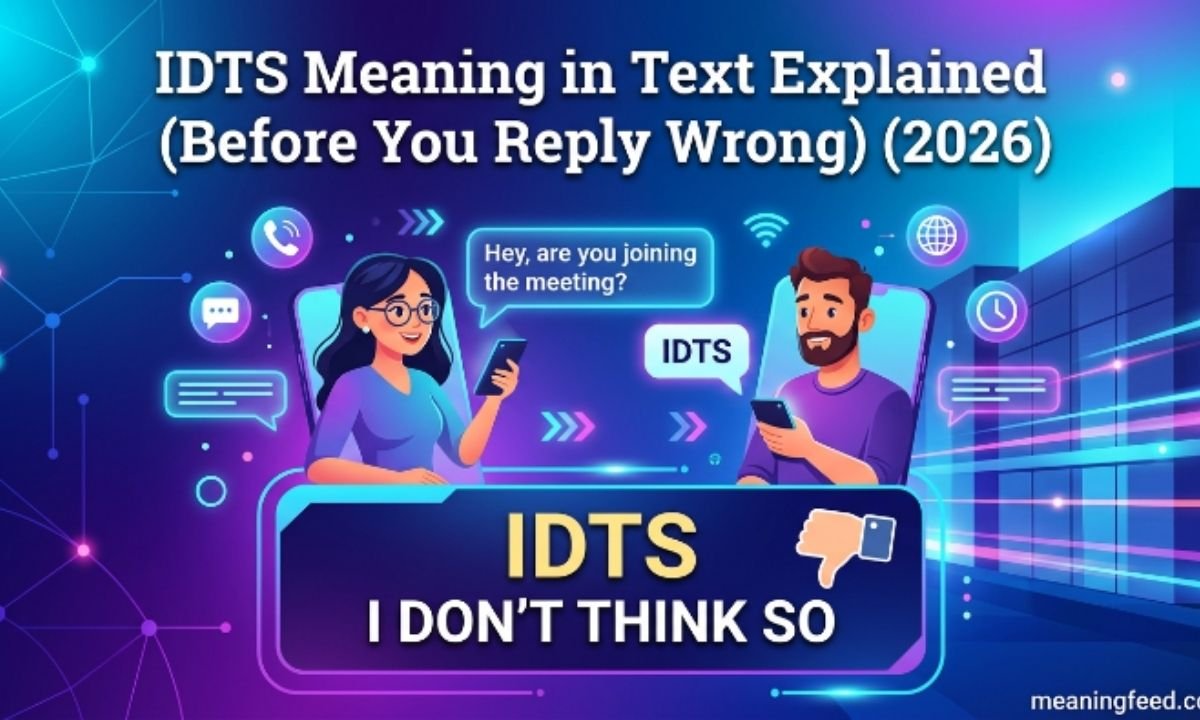

You’re mid-conversation, someone drops “idts” into the chat, and suddenly you’re not sure if they’re annoyed, joking, or just being lazy with their thumbs. That’s the thing about the IDTS meaning in text — it depends almost entirely on the moment it shows up in, and most guides online don’t actually explain that part.
IDTS stands for “I Don’t Think So.” That’s the easy bit. Anyone can Google that in three seconds. What actually trips people up is figuring out how someone means it — because “I don’t think so” can sound like a gentle disagreement, a flat-out rejection, or a sarcastic jab, and the text version strips away every clue you’d normally get from tone of voice.
Learning the IDTS meaning in text is only step one. This guide covers the definition, sure. But it also digs into the part nobody else bothers with: how to read it correctly based on context, how to reply without sounding awkward, and how it’s different from the half-dozen similar abbreviations people mix it up with.
What Does IDTS Mean in Text?
The IDTS meaning in text boils down to “I don’t think so.” It’s used when someone disagrees with a statement, doubts a claim, or wants to shut down an idea without writing out the full sentence.
You’ll see it in group chats, comment sections, Discord servers, and DMs — basically anywhere people are typing fast and don’t feel like spelling everything out.
A few quick examples of how it shows up:
| Message | What They Mean |
| “Is Jake coming tonight?” / “idts” | Probably not, based on what I know |
| “This is the best pizza place in town” / “idts lol” | I disagree, but I’m being casual about it |
| “You really think that’ll work?” / “IDTS.” | Flat disagreement, no room for debate |
Notice how the same three letters carry three completely different weights depending on punctuation, capitalization, and what came before it. That’s the piece most explainers skip — they define the term and move on, like context doesn’t matter. It matters more than the definition itself.
The Real Skill: Reading the Tone Correctly
This is the part that actually helps you in real conversations, not just trivia knowledge.
Texting has no voice inflection, so people lean on small formatting cues to signal tone. Here’s how to decode it based on how it’s written:
Lowercase, no punctuation — “idts”
This is the softest version. It reads casual, almost shrugging. Think of it as the text equivalent of tilting your head and going “eh, I don’t think so.” Usually not confrontational.
All caps — “IDTS”
Caps online generally signal emphasis or heightened emotion. “IDTS” in all caps reads firmer, sometimes frustrated. It’s the difference between disagreeing and disagreeing.
With a trailing “lol” or “lmao” — “idts lol”
Softens the disagreement into something playful. The person is pushing back but doesn’t want it to feel heavy or serious.
Stacked with other abbreviations — “istg idts”
(“I swear to god, I don’t think so.”) This combo usually shows up when someone is genuinely doubtful or mildly exasperated, not just casually disagreeing.
Followed by a period — “IDTS.”
A single period at the end of a short text often reads as blunt or final in youth texting culture, even though it’s grammatically “correct.” “IDTS.” can come across colder than “idts” with nothing after it.
| Format | Typical Tone | Example Use Case |
| idts | Casual, low-stakes | Replying to a random opinion |
| IDTS | Firm, emphasized | Shutting down a bad idea |
| idts lol | Playful, soft | Teasing a friend’s take |
| istg idts | Genuinely doubtful | Reacting to a wild claim |
| IDTS. | Blunt, final | Ending a disagreement |
No competitor explainer breaks this down with this level of nuance, and honestly, it’s the difference between using it well and accidentally sounding harsh when you didn’t mean to.
IDTS vs. Similar Abbreviations: Where People Get Confused
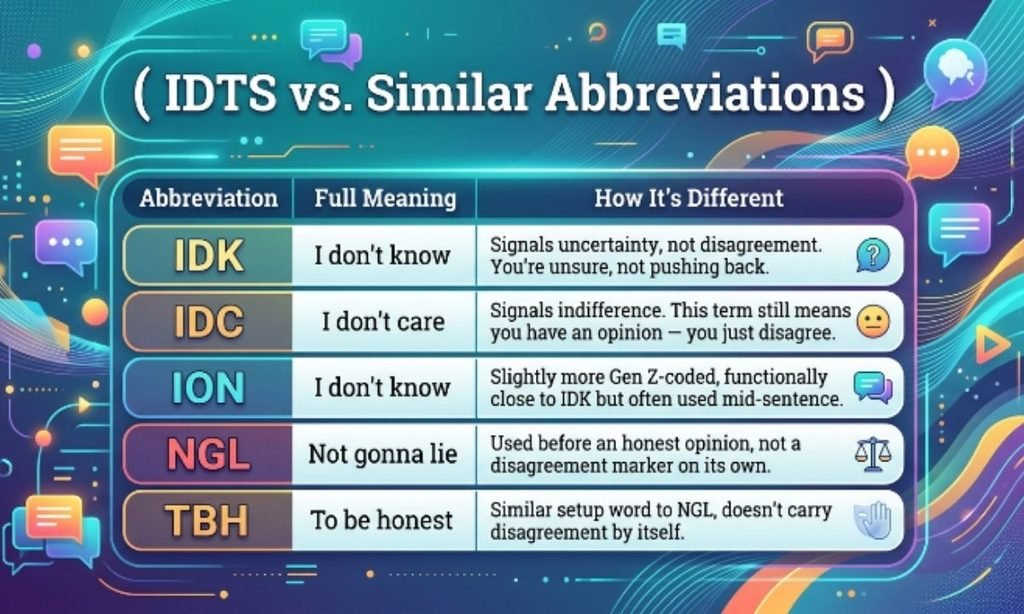
A lot of texting shorthand clusters around the same emotional territory — doubt, disagreement, indifference — and it’s easy to grab the wrong one. Here’s how the IDTS meaning in text stacks up against its closest relatives.
| Abbreviation | Full Meaning | How It’s Different |
| IDK | I don’t know | Signals uncertainty, not disagreement. You’re unsure, not pushing back. |
| IDC | I don’t care | Signals indifference. This term still means you have an opinion — you just disagree. |
| ION | I don’t know | Slightly more Gen Z-coded, functionally close to IDK but often used mid-sentence. |
| NGL | Not gonna lie | Used before an honest opinion, not a disagreement marker on its own. |
| TBH | To be honest | Similar setup word to NGL, doesn’t carry disagreement by itself. |
| IMO / IMHO | In my opinion | States a stance without necessarily rejecting someone else’s. |
The key distinction: this abbreviation always implies you’ve weighed something and landed on “no.” IDK and IDC both imply you haven’t landed anywhere at all. Mixing these up is one of the most common small mistakes in casual texting, especially for people learning internet shorthand as a second language of sorts.
When IDTS Is the Wrong Move (Even If It’s Grammatically Fine)
This is the section nobody writes, and it matters more than another list of examples.
It’s casual by nature. It works fine in:
- Group chats with friends
- Comment threads on social posts
- Discord or gaming chats
- Casual DMs
It tends to land badly in:
- Work Slack or Teams messages — even in casual workplace chat, “idts” can read as dismissive to a manager or client, where “I don’t think that’ll work” or even “I’m not sure about that” lands softer.
- Serious or emotional conversations — if a friend is venting about something real, “idts” can feel curt or careless, even if that’s not the intent.
- First-time conversations with someone new — abbreviations this blunt can read as cold before you’ve established a rapport.
A simple rule of thumb: if you’d hesitate to say “I don’t think so” out loud in that exact moment, don’t type it either. The abbreviation doesn’t soften the message as much as people assume — it just makes it faster to send.
How to Reply to “IDTS” Without Sounding Awkward
Getting one back can feel like a mini rejection, especially in the middle of planning something or debating an opinion. Here’s how to respond depending on the vibe.
If it felt casual:
- “fair enough”
- “okay valid”
- “lol why not”
If you want to push back:
- “wait really? why not”
- “hear me out tho”
If it felt a little blunt and you want to lighten it:
- “damn okay 😭”
- “brutal but okay”
If it’s a genuine disagreement worth resolving:
- “okay what would work better then”
None of this is complicated, but it’s exactly the kind of practical, real-world guidance that turns a dictionary-style definition into something people actually bookmark and use.
Where IDTS Comes From and Why It Stuck Around
It isn’t new slang — this abbreviation has been floating around SMS and early messenger culture since the character-limit days of flip-phone texting, when every saved letter counted. It survived into modern texting apps for the same reason a lot of old-school shorthand did: it’s short, it’s unambiguous once you know it, and it fits the rhythm of fast back-and-forth conversation.
It’s not tied to one platform. You’ll spot it just as often in a text thread as you will under a YouTube comment or inside a group chat about weekend plans. That staying power is part of why the IDTS meaning in text is still searched so often — people run into it constantly, across every corner of digital conversation, and the meaning genuinely isn’t obvious the first time you see it.
Quick Reference: IDTS at a Glance
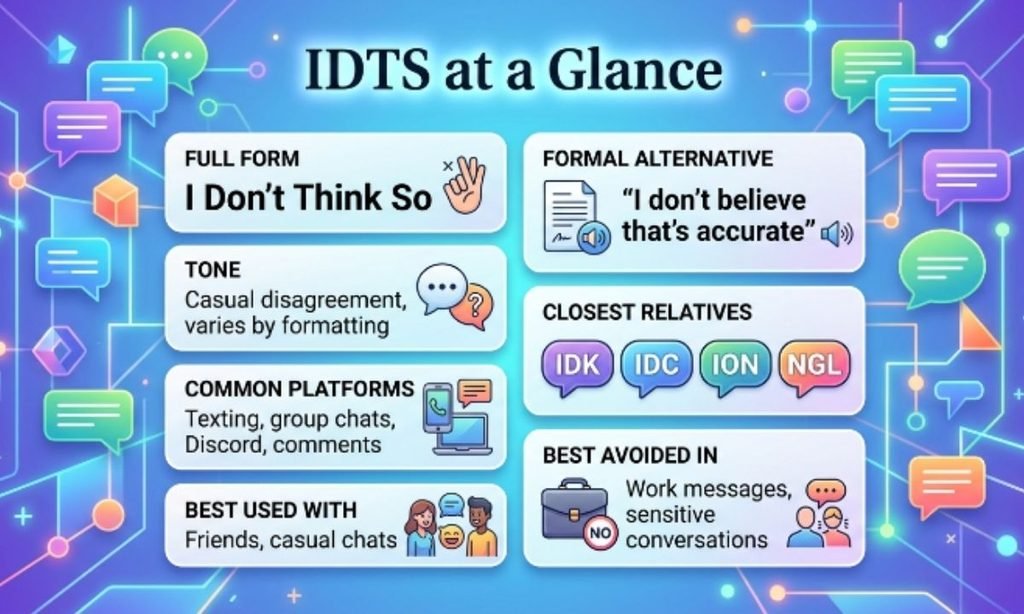
| Detail | Info |
| Full form | I Don’t Think So |
| Tone | Casual disagreement, varies by formatting |
| Common platforms | Texting, group chats, Discord, comments |
| Formal alternative | “I don’t believe that’s accurate” |
| Closest relatives | IDK, IDC, ION, NGL |
| Best used with | Friends, casual chats |
| Best avoided in | Work messages, sensitive conversations |
Final Thoughts
The IDTS meaning in text looks simple on the surface — three letters, one clear definition — but the way people actually use it is a lot more layered than most explainers let on. It’s not just about knowing what it stands for. It’s about reading the punctuation, the caps, the “lol” tacked on the end, and figuring out whether someone’s gently disagreeing or shutting the conversation down.
Once you’ve got that down, it stops being a confusing text you have to decode and starts being just another piece of the way you naturally talk online — quick, casual, and a little more expressive than it first appears.
FAQs
What does IDTS mean in a text message?
The IDTS meaning in text is “I Don’t Think So.” It’s used to express disagreement or doubt about something someone said, usually in a casual or informal way.
Is IDTS rude?
Not inherently. IDTS is neutral on its own, but tone shifts based on formatting — all caps or a period at the end can read as blunter than lowercase with no punctuation.
What’s the difference between IDTS and IDK?
IDK means “I don’t know” and signals uncertainty. IDTS means “I don’t think so” and signals an actual opinion or disagreement, not confusion.
Can I use IDTS in a work chat?
It’s best avoided in professional messaging. Even casual workplace chats generally read better with a full phrase like “I’m not sure that’ll work” instead of an abbreviated disagreement.
What does “istg idts” mean?
It combines “I swear to god” with “I don’t think so,” usually signaling genuine doubt or mild frustration rather than a casual disagreement.
