
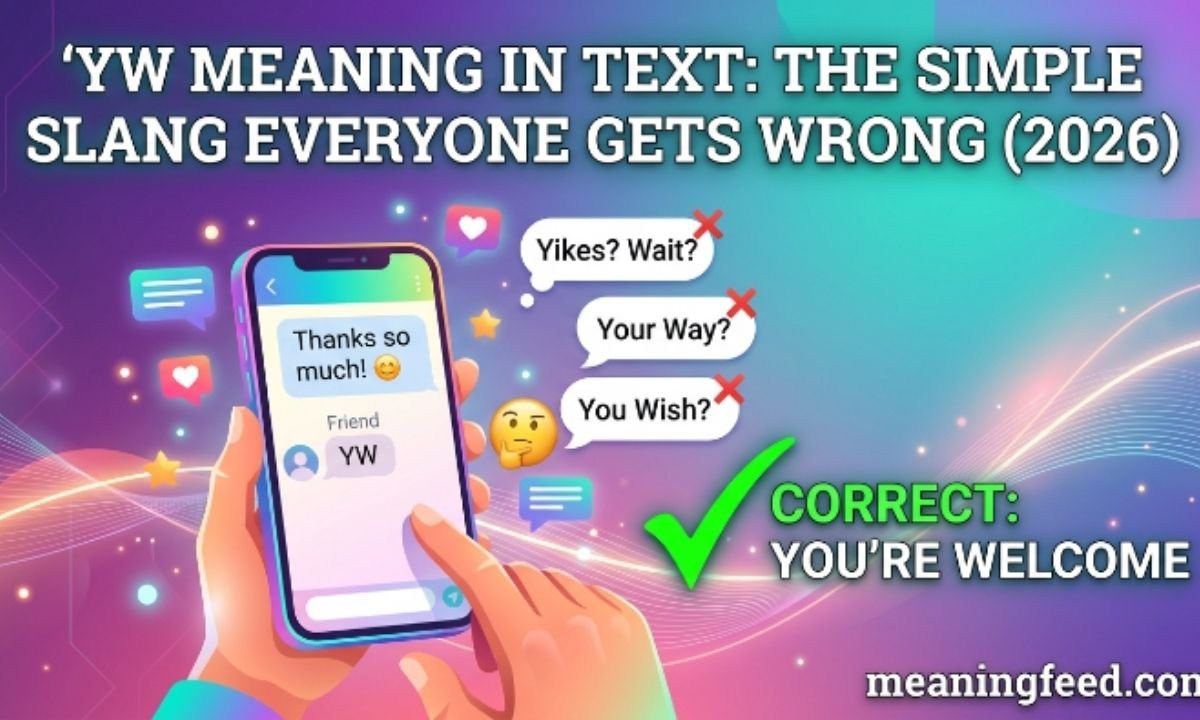

You send someone a favor, they text back “yw,” and that’s supposed to be the end of it. Except sometimes it doesn’t feel like the end of it. Sometimes “yw” lands warm. Other times it lands flat, almost annoyed. Same three letters, completely different vibe — and that gap is exactly what most explainers skip.
So let’s actually answer the YW meaning in text question properly, and then get into the part nobody else bothers to cover: why the same reply can read as sweet in one thread and cold in another.
What Does YW Meaning in Text?
YW stands for “you’re welcome.” It’s the standard reply to “thanks” or “thank you” in texting, DMs, group chats, comments, and pretty much any casual digital conversation.
That’s the surface-level answer, and if you only needed that, you’re covered. But the YW meaning in text isn’t just about the definition — it’s about what the reply is doing socially, and that part is where things get interesting.
If you’ve ever paused before hitting send on “yw,” wondering if it sounds off, you’re not overthinking it. There’s a real reason that happens, and we’ll get to it in a minute.
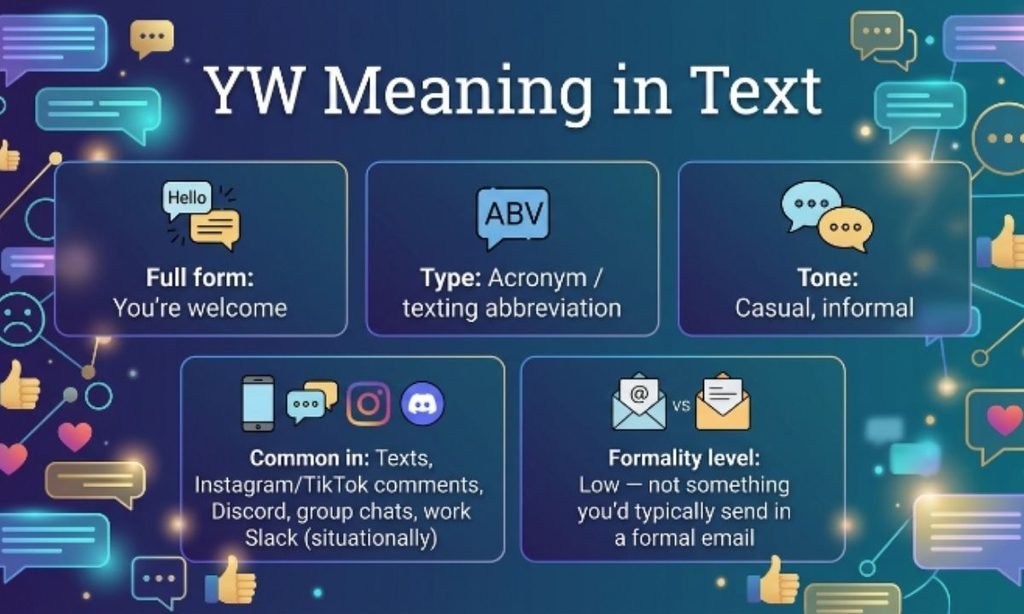
Quick facts before we go deeper:
- Full form: You’re welcome
- Type: Acronym / texting abbreviation
- Tone: Casual, informal
- Common in: Texts, Instagram/TikTok comments, Discord, group chats, work Slack (situationally)
- Formality level: Low — not something you’d typically send in a formal email
Is YW the Same as “You’re Welcome”?
Yes, functionally they’re identical — YW is just the compressed, texting-native version. But they’re not always interchangeable in practice. Typing out “you’re welcome” in full signals a small amount of extra effort, which is why it tends to feel a notch more sincere. YW, on the other hand, signals speed and casualness. Neither is “wrong.” They just carry slightly different social weight, and knowing which one fits the moment is the real skill here.
Where YW Actually Comes From
Most slang breakdowns stop at “it’s short for you’re welcome” and move on. But YW didn’t just appear out of nowhere — it followed the same path as OMG, BRB, and LOL: it’s a product of early SMS character limits and IM culture from the late 90s and early 2000s.
Back when texting cost money per message and screens fit maybe 160 characters, shaving “you’re welcome” down to two letters wasn’t cute — it was practical. AOL Instant Messenger and early flip-phone texting normalized this kind of compression, and YW rode along with it into the smartphone era, where it stuck around purely out of habit even though character limits stopped mattering years ago.
That history matters because it explains something people get wrong: YW isn’t lazy. It’s just old muscle memory from a time when short really did mean faster.
The Part Nobody Explains: Why YW Can Sound Cold
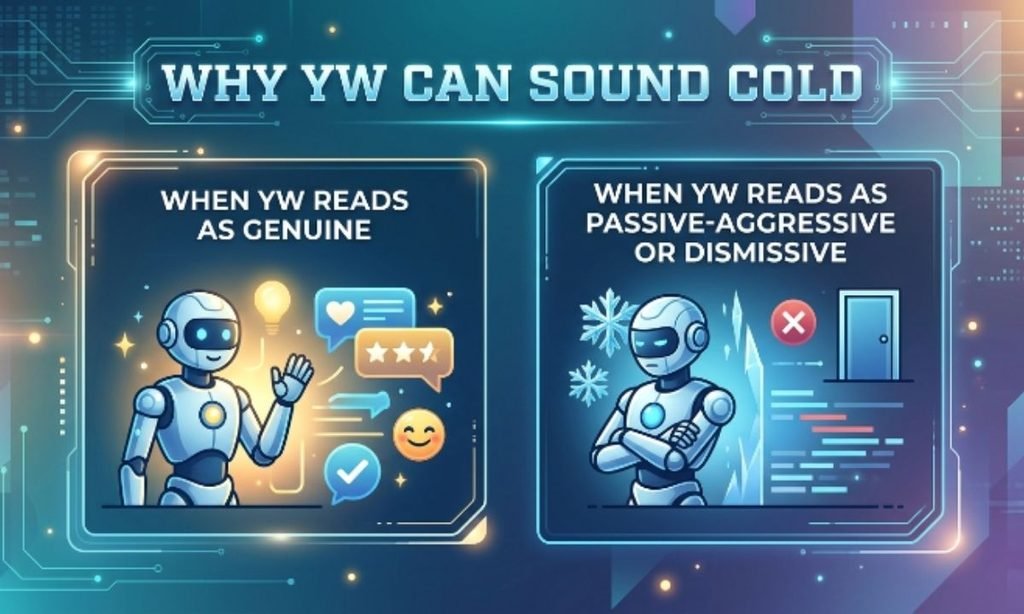
Here’s the actual gap in how this topic usually gets covered. Every article tells you the YW meaning in text is “you’re welcome.” Almost none of them explain why the exact same two letters can feel completely different depending on the conversation.
Text has no tone of voice. No face. No pause. So your brain fills in the blank using context — and “yw” is short enough that it gives your brain almost nothing to work with. That’s the whole problem.
When YW Reads as Genuine
YW tends to feel warm and normal when:
- It follows a low-stakes favor (sending a link, answering a quick question)
- The conversation has a relaxed, back-and-forth rhythm already
- It’s paired with an emoji, a follow-up message, or a longer earlier reply
- You already have a casual, easygoing relationship with the person
In these cases, YW basically reads the way a quick nod would in person. Friendly, unremarkable, done.
When YW Reads as Passive-Aggressive or Dismissive
YW can feel curt or even a little cold when:
- Someone thanked you for something that took real time or effort, and you replied with just two letters
- It’s sent by itself, with no punctuation, right after a longer or emotional “thank you”
- It shows up after a delay — like they thanked you five minutes ago and this is the only reply they get
- The relationship is newer or more formal, where abbreviations can feel underinvested
This is the effort mismatch problem. If someone writes three sentences thanking you for real help, a bare “yw” can read as “I didn’t think this deserved more than two letters.” It’s not usually meant that way. But texting strips out tone, so the mismatch is what people notice.
YW in Different Chat Contexts
The YW meaning in text stays the same everywhere, but how it’s received changes a lot depending on the platform. This is the piece most guides never break down.
| Context | How YW Typically Reads | Better Move If You Want Warmth |
| Close friends, casual texting | Totally normal, no issue | None needed — YW is fine as-is |
| New relationship / early dating | Can feel low-effort or distant | “np, anytime!” or “ofc :)” |
| Work Slack / professional chat | Reads as slightly informal but acceptable in casual teams | “Happy to help” or “Anytime!” |
| Customer service replies | Can feel abrupt or scripted | “You’re so welcome, let us know if you need anything else!” |
| Discord / gaming chats | Completely standard, expected even | None needed |
| Family group chats | Fine, but tone depends on family norms | Add an emoji if the thank-you was heartfelt |
A Quick Decision Framework: Should You Even Reply “YW”?
Most people don’t think about this — they just autopilot “yw” every time someone says thanks. But a two-second gut check saves a lot of unnecessary awkwardness.
Ask yourself these three questions before you send it:
- Did the favor take real effort? If yes, match that effort a little in your reply instead of shrinking it to two letters.
- Is this someone I don’t know well yet? If yes, spell it out — “you’re welcome” reads as more invested than “yw.”
- Did they thank me with more than a couple words? If their message had warmth or detail, mirror that energy back instead of flattening it.
If the answer to all three is “no,” YW is completely fine. If even one is “yes,” it’s worth typing two extra words.
Alternatives to YW (and When Each One Fits Better)
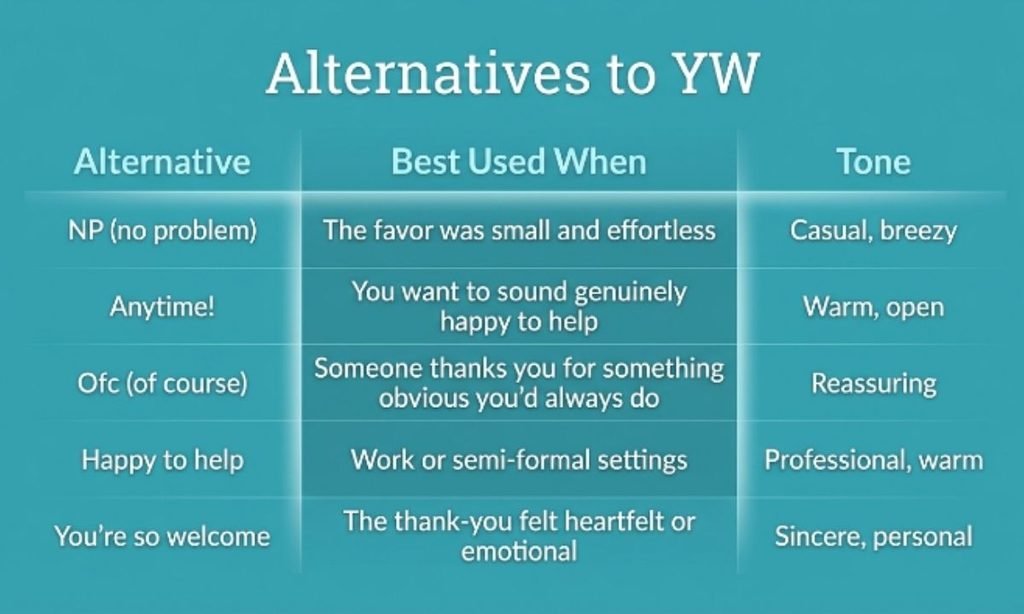
Sometimes YW just isn’t the right amount of effort for the moment. Here’s what to use instead, and why.
| Alternative | Best Used When | Tone |
| NP (no problem) | The favor was small and effortless | Casual, breezy |
| Anytime! | You want to sound genuinely happy to help | Warm, open |
| Ofc (of course) | Someone thanks you for something obvious you’d always do | Reassuring |
| Happy to help | Work or semi-formal settings | Professional, warm |
| You’re so welcome | The thank-you felt heartfelt or emotional | Sincere, personal |
| No worries | Someone apologizes and thanks you at once | Relaxed, easygoing |
How Different Generations Read YW
This is the piece almost every other article completely skips, and it explains a lot of the confusion people run into across mixed-age group chats or workplaces.
- Gen Z generally reads YW as neutral-to-positive. It’s default texting shorthand, not a shortcut that signals low effort.
- Millennials are split. Many use it constantly with friends but avoid it with coworkers or in new relationships, where it can feel underdressed.
- Gen X and Boomers are more likely to read a bare “yw” as slightly abrupt or even mildly rude, especially in family texts, because they’re used to full phrases carrying the weight of politeness.
If you’re texting across generations — a parent, a boss, an older relative — spelling out “you’re welcome” avoids any risk of it landing wrong. It costs you nothing and removes the guesswork entirely.
Common Mistakes People Make With YW
Even once you know the YW meaning in text, it’s easy to use it in ways that undercut what you’re actually trying to say:
- Sending it alone with no punctuation or emoji, which can strip out any warmth even when none was intended
- Using it after apologies, where “yw” can accidentally sound like you’re accepting blame instead of just being gracious
- Replying with a long delay, which makes even a warm “yw” feel like an afterthought
- Defaulting to it in every single context, regardless of who’s on the other end or how big the favor was
None of these are disasters. But small adjustments — an emoji, a slightly longer reply, better timing — go a long way toward making sure your two letters say what you actually mean.
Example Text Conversations
Casual, low-stakes (YW works great):
A: hey thanks for sending that playlist B: yw!! it’s so good right
Effort mismatch (YW falls flat):
A: seriously thank you so much for helping me move all weekend, I don’t know what I would’ve done B: yw (Better: “of course, anytime you need help just ask 🫶”)
Work Slack, casual team:
A: thanks for covering my shift last minute! B: np, happy to help anytime
Final Thoughts
The YW meaning in text will never be complicated — it’s you’re welcome, plain and simple. That part of the YW meaning in text hasn’t changed since the flip-phone days and never will. What actually trips people up is timing, effort, and who’s on the other end of the conversation. Read the room for half a second before you type it, match the energy of the thank-you you just got, and you’ll never have to wonder whether your two letters came across the wrong way.
FAQs
What does YW mean in a text?
YW stands for “you’re welcome.” It’s the standard casual reply to “thanks” or “thank you” in texts, DMs, and chat apps.
Is YW rude to text back?
Not usually. YW only feels rude when it follows a heartfelt or effortful thank-you and is sent alone with no warmth attached. In casual, everyday exchanges, it’s completely normal.
What is the full form of YW in chat?
The full form of YW is “you’re welcome.” It’s simply the shortened, texting-friendly version people use to save time.
Is YW the same as NP?
Not quite. NP means “no problem” and works best for small, effortless favors, while YW is a more direct, general-purpose reply that fits almost any thank-you.
Can I use YW in professional messages?
It depends on the workplace. Casual teams on Slack often accept YW without issue, but in formal emails or with people you don’t know well, “happy to help” reads more professionally.
What does YW mean on Instagram or Snapchat?
It means the same thing everywhere: “you’re welcome.” On social platforms, it’s commonly used to reply to comments or DMs thanking you for a shoutout, tag, or favor.
What should I say instead of YW?
“Anytime,” “of course,” or “happy to help” all work well when you want your reply to feel warmer or more personal than a plain “yw.”
