

You’re texting a new coworker or a friend of a friend, and the reply lands: “Pretty good, wbu?” You stare at it for a second. Nobody warned you that the WBU meaning in text would come up in your everyday messages, yet here it is, and you don’t want to guess wrong.
People search for this term because it shows up everywhere without any explanation. It appears in text messages, Instagram replies, Snapchat chats, and WhatsApp threads. Three lowercase letters with a question mark look like noise until someone spells them out, and a few lookalike abbreviations make the mix-up worse.
This guide covers what WBU stands for, what it asks in a conversation, and how tone changes the way it lands. You’ll also see where it fits, where it doesn’t, and how to answer it without sounding awkward.
Quick Answer: What Does WBU Mean?
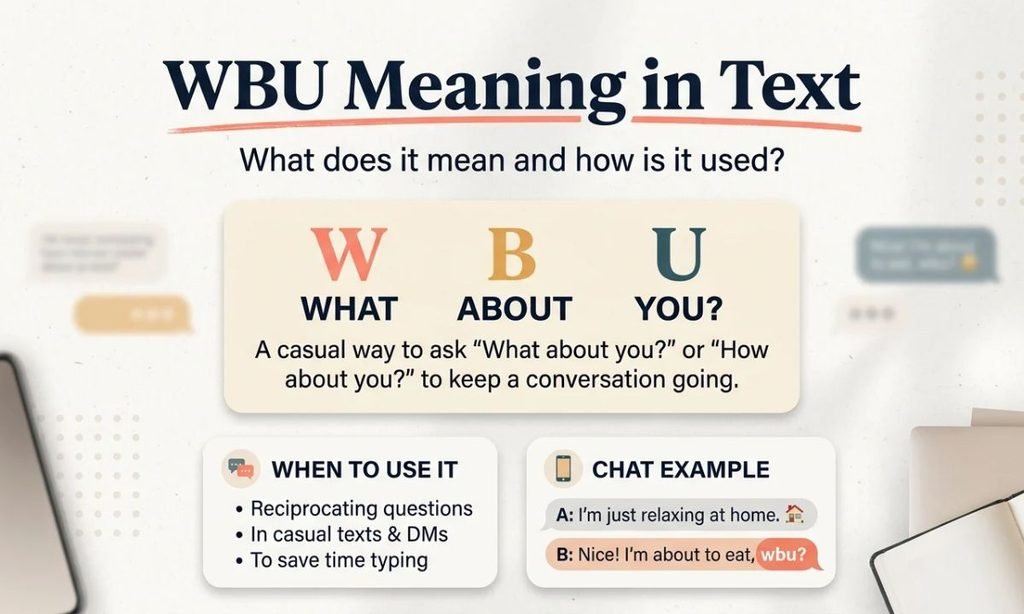
WBU means “what about you?” It’s a texting abbreviation that tosses a question back to the other person right after you’ve answered it yourself. You’ll see it in both capital and lowercase letters, and the meaning is the same either way.
What WBU Stands For
The full form is “what about you.” There’s no hidden second layer and no secret meaning behind it. In chat, WBU is exactly what it looks like.
Here’s a simple example. Someone writes, “I’m from Denver. WBU?” and means, “I’m from Denver. What about you?” They answered a question and turned it around so you can answer it too. A very common version is “I’m good, wbu?”, which reads as “I’m good, what about you?”
Skip the dictionary definition and think of WBU as a handoff. The sender goes first, then invites you to go next with the same question.
Is WBU Slang?
Yes. It’s a casual texting abbreviation, a form of internet slang, and it doesn’t belong in formal writing. You’ll find it far more often in a private message than in a school essay, a business report, or a professional email.
That gap is the difference between formal and informal register. Chats get relaxed language, and formal settings get full sentences. As slang terms go, WBU is mild and extremely common. It isn’t crude or offensive, but it is informal, so it can look out of place in professional or formal situations.
What WBU Does in a Conversation
Linguists would call WBU a discourse marker. It signals that your turn is over and the other person should now speak. I like to think of it as conversational handball: you answer, then bounce the ball back so the other person has to catch it.
This is turn-taking, and it’s all about reciprocity. Text conversations die fast when one person keeps answering without asking anything back. Typing out “What about you?” every single time can feel stiff in a casual chat, so people grab the shortest option. That’s informal register doing its job.
It also saves effort. “I’m watching a movie. WBU?” is quicker to type and lighter to read than the full phrase. The feeling behind the question stays the same. Only the typing effort drops, which is why WBU dominates casual texting and online chat.
WBU as a Conversational Handoff
A handoff is the best way to picture it. One person shares an answer or a bit of their situation, then gives the other person room to speak. If Alex texts, “I’m feeling much better today. WBU?”, Alex wants to know how you feel too.
WBU can stand in for many familiar phrases:
- And you?
- How about you?
- What about you?
- What are your plans?
- What do you think?
The right reading comes from context, and swapping in those phrases is really the whole trick.
What WBU Can Ask
The same three letters stretch to fit whatever question came before them. A few examples:
- “I’m from Chicago. WBU?” asks where you’re from.
- “I’m watching a comedy. WBU?” asks what you’re watching.
- “The new update is better. WBU?” asks for your opinion.
- “I’m nervous about tomorrow. WBU?” asks how you feel about the situation.
The abbreviation never names the question type, so you have to read the whole message. WBU is broader than a lookalike like WYD, which only asks what you’re doing. WBU can ask about your plans, feelings, opinions, location, or experience.
The Emotional Side of WBU
There’s a social meaning under the shorthand. Sending WBU shows interest in the other person and a wish to keep talking. It creates a two-way flow, which matters when you’re building a connection, even over text.
WBU Meaning in Text Across Different Apps
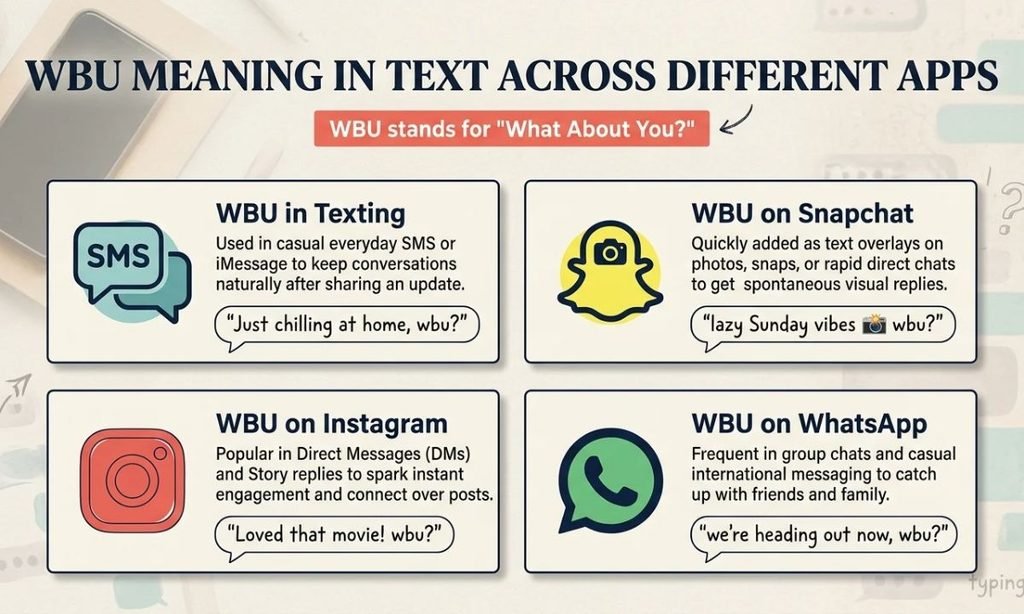
Texting is where you’ll run into WBU most, but each platform adds a slightly different flavor. The meaning never changes. The habits around it do.
WBU in Texting
“Just finished dinner. WBU?” is a typical example. It’s casual and quick, with nothing else hiding behind it. People also use it to give a fast reply without writing a full sentence.
WBU on Snapchat
The casual meaning is identical on Snapchat. In “Heading home rn, WBU?”, rn stands for “right now.” The sender says what they’re up to, then asks about you. Snapchat also has streak culture, where people send quick messages to keep a chat from going cold. A “wbu” is a handy way to do that.
WBU on Instagram
In DMs and comments, it shows up in relaxed conversations. “I love this song. WBU?” asks whether you like the song too. It also works as a loose conversation starter. One answer plus “wbu?” invites a second message, and that’s how a lot of Instagram chats keep going. Some people say they felt a little old after getting “nm wbu” in reply to a story, but it’s just slang, and it looks strange only until you’ve seen it a few times.
WBU on WhatsApp
It feels natural here, especially among friends who already use texting abbreviations. “I’m free after 7. WBU?” asks about your availability. WhatsApp is used by people all over the world, so WBU travels well in group chats with friends from different countries. That’s cross-cultural communication happening by accident.
It also turns up when people reply to statuses. Say someone posts a sunset photo and you answer “nice.” They might come back with “thanks! wbu, what’d you do today?” In group chats it works as a quick check-in, like “I’m down for pizza, wbu?”, which is really asking who else is on board.
Where You’ll Often See It
You’ll spot WBU in text messages, SMS, social media platforms, chat apps like WhatsApp and Messenger, and online gaming chats. It’s common in informal communication and mostly absent from professional email. If you see it in a workplace thread, that’s the exception and not the norm.
How Tone Changes What WBU Means
Three letters can feel very different depending on who sends them and what surrounds them. From a close friend, it’s completely normal. From someone you barely know, it can read as forced politeness, like asking “How are you?” at the grocery store without waiting for the answer.
Is WBU Rude, Offensive, or Neutral?
It’s neutral and usually friendly. The abbreviation itself isn’t offensive. What matters is how much you give alongside it.
- “I’m good, WBU?” reads as warm.
- A bare “WBU” with no context can come across as lazy or uninterested.
WBU asks someone for their opinion, feelings, or response in return, so it works best when you add something of your own. Replying with only “WBU” or overusing it can make a person seem like they aren’t putting anything into the chat. So is WBU rude? Not by itself. A short message can feel cold, but that depends on the whole conversation.
The “Cool, WBU?” Warning Sign
The danger zone is the long, detailed answer followed by “cool wbu.” That tells you the person isn’t really reading and is doing the bare minimum to keep the thread technically alive. It’s autopilot. One reply like that means nothing. If someone never engages with what you say and only sends variations of “wbu,” treat it as a sign of low engagement. They might be busy, distracted, or simply not interested.
A related trap is taking “good, wbu” at face value. It’s a social script, the same way people say “fine” when someone asks how they are, even if they’re only okay or having a bad day. Linguists call this a phatic expression, a politeness formula more than a real status report.
Tone Examples
Tone shifts with context. Here are a few quick samples:
- Friendly: “I’m excited for the weekend, WBU?”
- Casual: “Just chilling, WBU?”
- Argumentative: “I already explained my side, WBU?”
- Work: “I finished my task, WBU?”
- Social: “I’m going out tonight, WBU?”
The abbreviation stays the same in all five. The feeling comes from the words around it. When you spot disengagement, it’s rarely the abbreviation’s fault.
Flirty or Not?
WBU can appear in romantic conversations, but it’s just as normal between friends, classmates, coworkers, and family. An emoji or the surrounding chat sets the mood, not the abbreviation. In a flirty text, “bored, wbu” can be a gentle test of whether you’re free or whether you’ll suggest hanging out.
That meaning sits outside the words, in what linguists call pragmatics. Other slang with a romantic edge can be even trickier to read, so if you’ve ever been confused by one, our guide on hook up meaning in texts explains what it really says.
Realistic Texting Examples
Here’s how WBU plays out in real chats.
Friend 1: “I’m going to the mall after work. WBU?”
Friend 2: “Probably heading home.”
Friend 1: “I’m feeling pretty tired today. WBU?”
Friend 2: “Same. I barely slept.”
Friend 1: “I’m having pizza for dinner. WBU?”
Friend 2: “Making pasta.”
Friend 1: “I’ve been playing this new game all week. WBU?”
Friend 2: “I’ve mostly been watching movies.”
Friend 1: “I think the blue one looks better. WBU?”
Friend 2: “I agree.”
Friend 1: “I’m doing okay after the exam. WBU?”
Friend 2: “Honestly, I’m still stressed.”
Person 1: “I’m free Saturday night 👀 WBU?”
Person 2: “I might be free too.”
That last one isn’t flirty because of WBU. The emoji does the work.
Short one-liners follow the same pattern:
- “just woke up wbu” is a morning check-in.
- “I’m thinking tacos wbu?” is making plans.
- “pretty good wbu” is the standard answer to how are you.
- “nm just scrolling wbu” might be the most honest text anyone sends.
- “stuck in traffic wbu” is venting with a little deflecting.
- “finishing this show wbu” is a nighttime chat opener.
- “I’m so done with today wbu” is bonding over being tired.
Each one has a statement, a bit of intent, and a “wbu” to pass the turn. Most of them sound like someone thinking out loud, and that’s the point.
How to Respond to WBU
Answer the question and keep the conversation going. “I’m good too, just relaxing!” is plenty. Mirror the topic, give something real, and the exchange continues. If the question was about plans, share yours. If it was about feelings, say how you feel, even briefly.
Try not to answer with a single word and nothing else. That’s the same lazy pattern described earlier, and it can make the chat feel one-sided.
WBU vs WYD, HBU, and Similar Slang
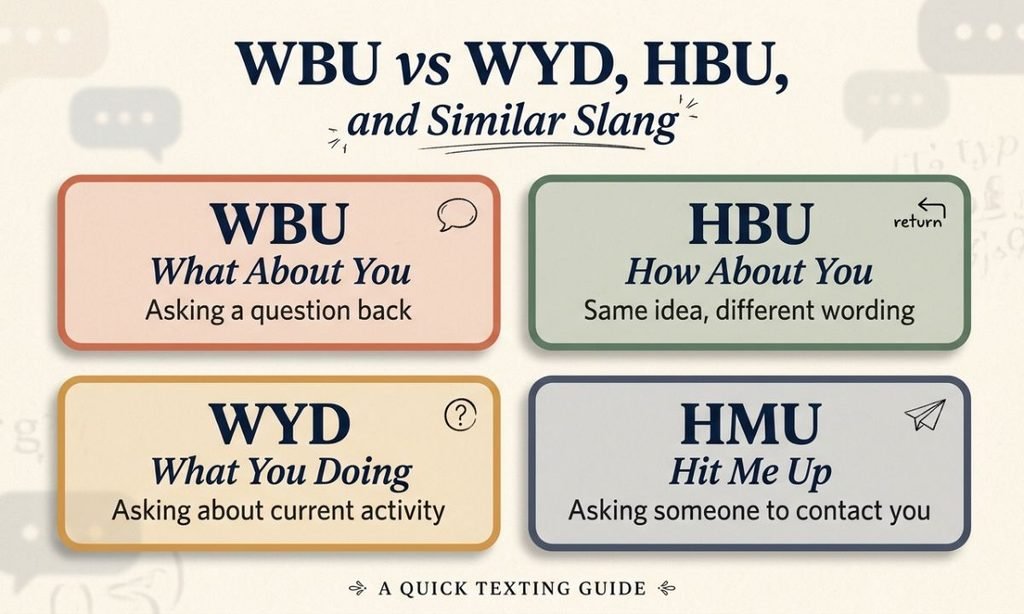
WBU is easy to confuse with its neighbors. WYD asks “what are you doing?” directly. WBU is broader. Here’s a side-by-side look:
| Slang | Full Form | Meaning | Usage Tone |
| WBU | What About You | Asking a question back | Casual |
| HBU | How About You | Same idea, different wording | Friendly |
| WYD | What You Doing | Asking about current activity | Informal |
| HMU | Hit Me Up | Asking someone to contact you | Casual |
Related Variations
A few other forms are worth knowing:
- WBY: A less common cousin of WBU. It means “what bout you,” and the two are basically interchangeable, though WBY sounds slightly more relaxed.
- HBU: “How bout you,” which many younger texters prefer.
- WB: This means “welcome back,” a completely different meaning.
- WYD: Can also be read as “what are you doing.”
One more thing worth knowing is “nm wbu.” It doesn’t mean “never mind, what about you.” It means “nothing much, what about you,” the standard reply when your answer is basically nothing. Another mix-up is WHU, which is usually just a typo. Unless someone is talking about the West Ham United soccer team, it isn’t a real texting term.
Common Misunderstandings About WBU
I’ve heard a few wrong readings over the years, and some mistakes come up again and again.
“It always means the person cares about my answer.” Sometimes it does, and sometimes it’s autopilot with no real interest behind it.
“I have to add it every time.” You don’t. If someone fires three questions at you, tacking “wbu” onto all three gets repetitive and annoying.
“It means What’s Up Bro.” People joke about this, but it isn’t the standard meaning. The sentence structure gives it away. “I’m having coffee. WBU?” clearly asks “what about you.”
“A girl or a guy means something different.” No. WBU means the same thing no matter who sends it, and gender-neutral usage applies. It doesn’t automatically signal flirting, romantic interest, annoyance, or boredom. Some people say women add more emojis, like “wbu? 😊,” while men keep it plainer. That’s a loose texting style pattern and not a rule, and plenty of people break it.
“It’s rude.” A short message can feel cold, but the abbreviation isn’t disrespectful. Politeness comes from everything else in the message, and context decides how it lands.
When to Use WBU and When to Skip It
✅ Use it when chatting with friends and keeping a conversation moving.
❌ Skip it in professional emails, formal conversations, and serious emotional talks, where it can feel too casual.
At Work
Can you use WBU at work? In a very casual team chat, if that’s the style, sure. Even then, “wbu” in Slack can look like you aren’t taking things seriously, especially with your boss. That’s a register mismatch. In formal emails and professional documents, write “What about you?” instead.
Other Places to Avoid It
- When someone shares something serious. If a friend says they’re stressed about family stuff, “that sucks, wbu” is a terrible reply. Sensitive topics need real sentences.
- Dating apps, in your first few messages. It reads as low-effort.
- Public comments and posts. WBU belongs in a one-on-one or small group chat.
- Older relatives. Not everyone is fluent in text slang, so think about who’s reading.
When in doubt, write it out.
Polite Alternatives to WBU
WBU has no true synonyms, but plenty of phrases fill the same slot:
- How about you? Very close and common.
- And you? Short and natural.
- What about yourself? Slightly more polished.
- How are things with you? Warmer.
- What do you think? Good for asking an opinion.
- What are you up to? Good for activity.
- What’ve you been up to? or How’s your day going? Friendlier and more open.
- Your turn! or And you? 👀 Playful, with an emoji.
“I’m doing great, WBU?” can become “I’m doing great, how about you?” For casual texting, “And you?” is the closest match. For something more polite or formal, “What about you?” or “What do you think?” sound better. These work as substitutes in function, though each one shifts the tone a little, and the one you pick signals how much effort you’re putting in.
Most people skip them because WBU is faster, and speed is why it exists. If you ever reached this page by searching “what does wbu stand for,” the answer is the same either way.
Generational and Regional Differences
There’s a generational angle. In my experience, Gen Z and other younger people find WBU a little old-school, even stiff. Teens often lean toward “u?” or “hbu,” which feels more relaxed. To them, WBU can carry millennial texting energy. Slang shifts constantly, and these informal variants will keep multiplying.
On the regional side, WBU is used globally, especially among younger people, social media users, and English-speaking communities. In regions where English isn’t the main language, it’s still widely understood online.
Is WBU Safe for Kids and Social Media?
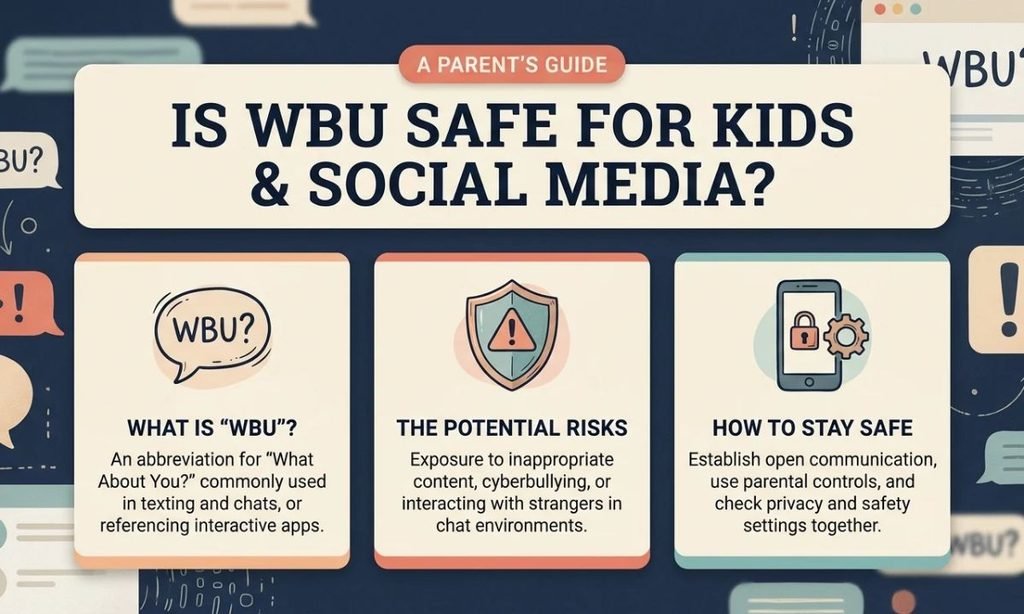
Yes. WBU is harmless and carries no inappropriate meaning. Kids can use it in ordinary conversations about movies, homework, or weekend plans. On social media it’s non-offensive and widely accepted. Just make sure your audience is comfortable with casual language.
The real safety concern lies somewhere else. If someone uses it to ask a young person for private information, such as an exact location, school, or personal photos, the problem is the request and the person asking, not the abbreviation. Sensitive details should stay private with people kids don’t know or trust, and normal online-safety habits still apply.
Where Did WBU Come From?
The exact origin isn’t clearly documented, and I’d be wary of anyone who names a specific person, website, or year. The popular story points to the early texting days, when messages were capped at 160 characters and typing on a flip phone felt like torture, so people trimmed everything. Full keyboards arrived and the habit stuck. That’s the favored explanation, not a proven fact.
What we can say is that WBU belongs to the long habit of shortening common phrases in online chat and messaging. It’s a convenient shorthand for a familiar question.
Why People Use WBU
People use it because it saves time, feels friendly, makes chats interactive, and is widely understood. Speed and a relaxed feel are the benefits, and they’re the reasons it spread. It also helps you avoid sounding like an interviewer who only asks questions or only answers them.
The impact cuts both ways. It makes conversations faster and more relaxed, but it can hurt clarity in formal situations. A very short reply with WBU can feel brief or less expressive than a full phrase, and the tone depends on what surrounds it. You give up some formal grammar and gain conversational flow. Slang suits the settings where it fits.
The Short Version
WBU means “what about you.” It’s neutral and friendly, and HBU is nearly identical. It belongs in casual texting and online chats, and the surrounding context tells you what the sender wants to know. If a message ends in “wbu” and you’re not sure how to read it, check the tone around it and answer with something real.
Texting a friend about weekend plans? Go ahead and use it. Emailing your professor? Skip it. The easiest rule is to match your language to the person on the other end.
FAQs
What does WBU mean in text?
WBU means “what about you?” It’s a texting abbreviation people add after answering a question, so the other person answers the same one. You’ll see it in both capital and lowercase letters.
What does WBU stand for?
WBU stands for “what about you.” There’s no hidden meaning behind it. It’s a shortened form of a common follow-up question used in casual chats.
Is WBU slang?
Yes, it’s a casual texting abbreviation and a mild form of internet slang. It’s common in private messages but doesn’t belong in formal writing like essays or business emails.
Is WBU rude?
No, WBU is neutral and usually friendly. It can feel cold only when it’s used alone with no other context, or when someone sends it over and over without engaging.
How do you respond to WBU?
Answer the question and keep the conversation going. Something like “I’m good too, just relaxing!” works well. Add a detail about your day or plans so the chat doesn’t feel one-sided.
What does “nm wbu” mean?
It means “nothing much, what about you?” People use it as a standard reply when they have nothing special going on. It does not mean “never mind.”
What’s the difference between WBU and WYD?
WYD asks “what are you doing?” and focuses only on your current activity. WBU is broader and can ask about your plans, feelings, opinions, location, or experiences.
Is WBU the same as HBU?
Almost. HBU means “how about you” and WBU means “what about you.” Both ask the same thing, though younger texters often prefer HBU or just “u?” because it feels more relaxed.
Is WBU the same as WBY?
Basically, yes. WBY means “what bout you,” and it’s a less common, slightly more relaxed version of WBU. The two are interchangeable in most chats.
Does WBU mean “what’s up bro”?
No. That reading is mostly a joke. In a message like “I’m having coffee, WBU?”, the structure clearly points to “what about you.”
Is WBU flirty?
Not by itself. WBU shows up between friends, classmates, coworkers, and family just as often as in romantic chats. An emoji or the surrounding conversation sets the tone, not the abbreviation.
Do girls and guys use WBU differently?
The meaning is the same no matter who sends it. Some people say women add more emojis, but that’s only a loose style pattern and not a rule.
Can you use WBU at work?
Only in a very casual team chat where that style is normal. In emails, professional documents, or messages to your boss, write “What about you?” instead.
When should you not use WBU?
Skip it when someone shares something serious, in formal messages, in your first dating app messages, or with relatives who may not know text slang. When in doubt, write the full phrase.
What can I say instead of WBU?
Good alternatives include “how about you?”, “and you?”, “what about yourself?”, and “what are you up to?” For a warmer tone, try “how’s your day going?” or “how are things with you?”
What does it mean when someone only replies “wbu”?
It often signals low engagement. They may be busy, distracted, or not very interested. One short reply is nothing to worry about, but a repeated pattern is worth noticing.
Is WBU safe for kids to use?
Yes, WBU is harmless and has no inappropriate meaning. The real safety concern is anyone using casual chat to ask kids for private details like their location, school, or photos.
Where did WBU come from?
The exact origin isn’t documented. It likely grew out of early texting habits, when people shortened phrases to save time and typing effort, but no specific first use has been confirmed.
Is WBU used on Snapchat, Instagram, and WhatsApp?
Yes, it appears on all three with the same meaning. It’s common in Snapchat streaks, Instagram DMs, and WhatsApp group chats, and it travels well across countries.
Is WBU still popular with Gen Z?
It’s still widely understood, but many Gen Z users find it slightly old-school. Teens often lean toward shorter or looser versions like “hbu” or “u?” instead.
