

You ask a friend if they want to grab dinner, and thirty seconds later your phone buzzes with a single reply: “cba tonight.” Nothing else, no explanation, no emoji. If you’re staring at the screen wondering about the CBA meaning in text, you’re not alone, and no, your friend isn’t mad at you.
People search for this one because it looks like a typo or a random string of letters. It pops up in text messages, TikTok captions, Instagram comments, and gaming chats, usually with no context attached. It also has a second meaning in the business world, which adds a bit of extra confusion.
This guide covers what CBA means, how people use it, where it likely came from, and when it sounds rude. You’ll also see how it differs from similar slang like IDC and TBH, plus a few tips for using it without causing a mix-up.
CBA most commonly stands for “can’t be asked,” and many people also read it as “can’t be bothered.” It is an informal text and social media abbreviation that means you feel too lazy, tired, or unmotivated to do something. The sender is not angry, just low on energy.
What Does CBA Mean?
CBA is an abbreviation for “can’t be asked,” and it signals a lack of motivation. In practice it sits right next to “can’t be bothered,” and the two versions are used interchangeably. Don’t spend time worrying about which one the sender had in mind. When people say it out loud, “can’t be bothered” is the version I hear most. In writing, the abbreviation often reads as “can’t be asked.”
The key idea is that CBA is about effort, not ability. The person could do the thing. They just don’t want to spend the energy on it. Think of it as a way to say no without making a speech. Nobody types “I’m too tired, it’s not worth the effort, and I don’t want to do that right now.” They type CBA and move on.
What comes through is tiredness, a little laziness, maybe some mild frustration. Real anger is rare. The interest is simply gone. In everyday language, CBA works as “I’m too tired” or “I can’t be bothered,” a flat no that doesn’t bother explaining whether the person wants to do it or not.
Here’s a simple example. Someone asks if you want to go shopping, and you reply “CBA today” with a sleepy emoji. You’re not interested, you don’t want to go, and the conversation continues.
CBA Meaning in Texting and Slang
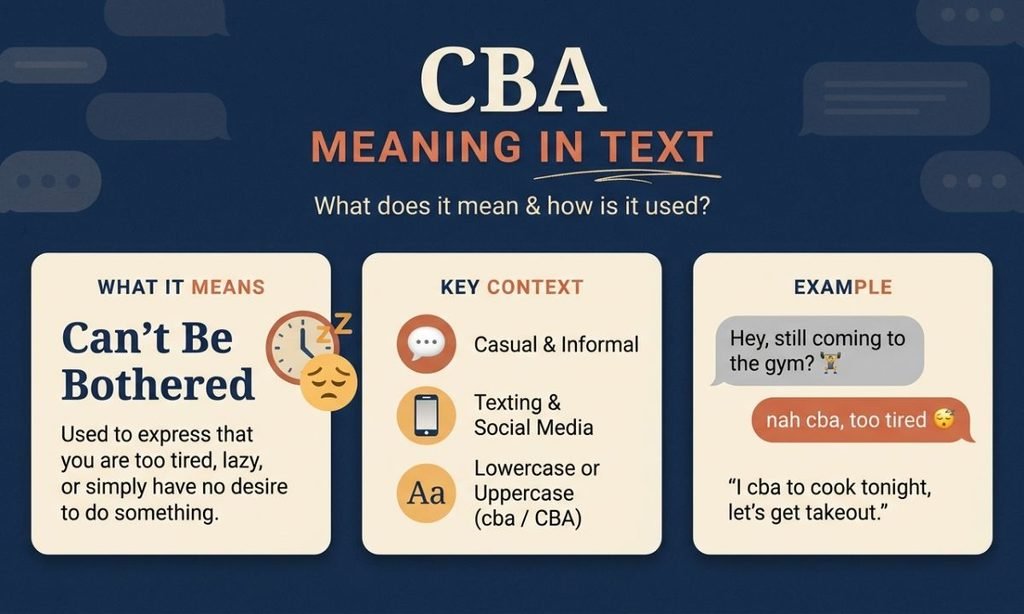
As a slang term, CBA is a short answer for when you don’t want to do something and can’t be bothered to justify it. The short intent behind it is to say no and skip the speech.
On social media it works the same way, only more publicly. Across platforms, the meaning stays identical: low energy, minimal words, and laziness or lack of motivation squeezed into three letters. Whether it’s a private chat or a public post, the CBA meaning in texting carries over without changes.
CBA in a Chat
In a chat, CBA works like a shrug. Someone asks, “Can you join the call?” and you reply “cba right now.” A parent says “clean your room” and the teenager sends “cba.” Both replies are laziness with a short answer attached, and both are typical.
Add “maybe later” and the whole thing softens: “cba, maybe later.” That small tail turns a flat refusal into a postponement. I’ve seen this pairing more often than any other in everyday texting.
Where You’ll See CBA Online
CBA is common and widespread across digital communication. Each space gives it a slightly different flavor, but the meaning holds.
Social Media
On TikTok, Instagram, Facebook, X (formerly Twitter), and Threads, people use CBA in captions, comments, and replies. Mostly it describes a mood. People use it for daily feelings, like complaining about the weather or announcing they’re done replying to someone.
A caption might read “cba going out today.” A comment might say “cba with this weather.” A reply might admit “cba even replying anymore.” Under a messy thread, someone might drop “CBA with all this drama anymore.” These platforms reward quick mood posts, so CBA fits right in. I also see it often in Snapchat chats and TikTok captions.
Text Messages and WhatsApp
In a text or on WhatsApp, CBA usually shows up as a one-line reply in casual chats. Say it’s raining and someone suggests a plan. The answer comes back: “CBA going anywhere.” That’s casual conversation at its most typical.
Gaming Chats and Forums
Gamers use CBA in gaming communities, on Discord, and in game chat. A line like “CBA grinding for another 3 hours” tells teammates you don’t feel like taking part. Fast messages matter in games, and nobody wants to type a paragraph mid-match.
Online forums work the same way, with a bit more backstory. A user might write, “I started the project but honestly CBA finishing it,” which is forum slang for running out of steam. The feeling is the same. Only the amount of explanation changes. Platform changes the volume, not the meaning.
Why Do People Use CBA?
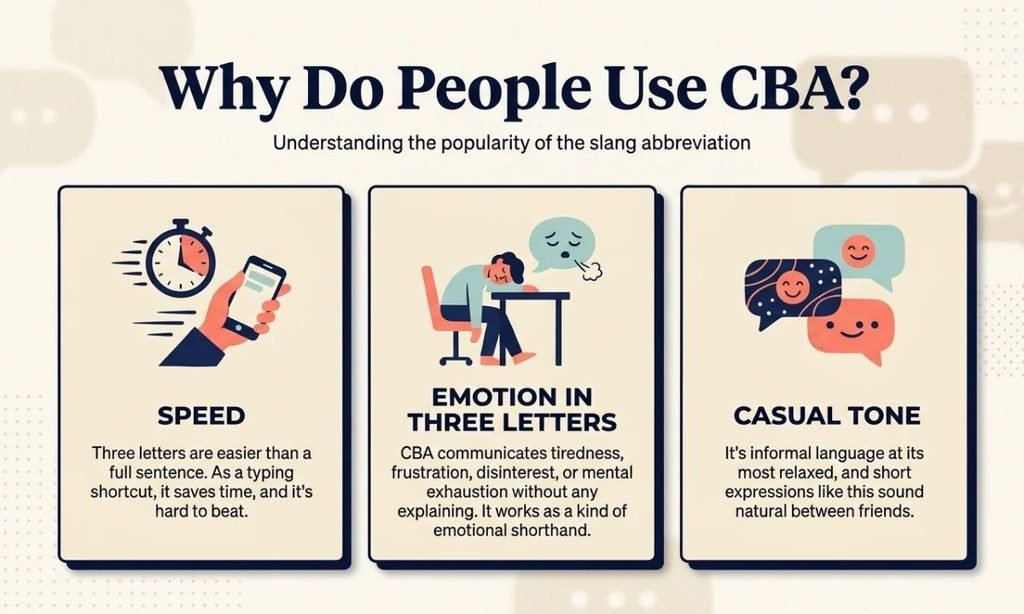
Slang usually catches on because of convenience, internet culture, and tone. CBA has all three.
- Speed. Three letters are easier than a full sentence. As a typing shortcut, it saves time, and it’s hard to beat.
- Emotion in three letters. CBA communicates tiredness, frustration, disinterest, or mental exhaustion without any explaining. It works as a kind of emotional shorthand.
- Casual tone. It’s informal language at its most relaxed, and short expressions like this sound natural between friends.
- Fit with modern communication. LOL, BRB, IMO, and TBH came first, and those texting abbreviations taught people to expect shorter messages. People now write in fragments, and being conversational often beats being complete.
Why CBA Fits Gen Z Communication
In a Gen Z context, CBA is everyday slang that matches how people already write. Short messages, fast replies, and informal English go together, and CBA does all three at once.
It also pairs well with emojis, which add expression on top. A yawning face or a skull emoji after “cba” shows exactly how tired the sender is. That casual online tone helps it fit in group chats and comment sections, which is really the whole point of the term.
CBA isn’t the only slang term that can confuse people in a group chat. If you’re also trying to decode other online expressions, check out our guide on cringe meaning in chat to see how that word is used and when it can sting.
Where Did CBA Come From?
Here’s the honest answer: nobody has pinned down a first use. The history of CBA is mostly informal, so any single origin story should be treated with caution.
British Slang Roots
CBA is usually linked to British English, where “can’t be asked” and “can’t be bothered” are common informal phrases. Abbreviating casual phrases is a long habit in texting, and CBA grew out of that habit. I’d call the British origin a working assumption rather than a documented fact. Other English-speaking regions use it too, and its exact roots remain debated.
How Internet Culture Spread It
Its rise came through internet culture. Texting, forums, and social media carried it well beyond the UK, and over time it became a widely recognized abbreviation across many English-speaking communities. Its spread reflects the broader evolution of internet slang. Is it still popular? Current usage says yes. It continues to appear on every major platform, from TikTok and Instagram to gaming chats and messaging apps.
Real-Life CBA Examples
Examples show how people actually use it. Here are five everyday situations, covering homework, social plans, work, drama, and exercise.
- Homework. A friend asks if you’ve finished. You say, “Nope, CBA tonight.” You don’t have the motivation, and that’s the whole meaning.
- A social event. A friend invites you to a party. You answer, “Sorry, CBA going out.” You decline the invitation, and the “sorry” softens it.
- Work. A coworker asks if you can stay late and help. You say, “Honestly, CBA today.” You’re not interested in staying longer. This only works with a coworker you know very well.
- Online drama. A friend asks about the comments on a post. You say, “Nah, CBA dealing with that.” You’d rather not waste energy on it.
- Exercise. Someone asks about the gym tonight. You write, “CBA. Maybe tomorrow.” You’re unmotivated, though “maybe tomorrow” keeps the plan technically alive.
Everyday Situations
In daily life, people mostly use CBA when responding to plans. Think of homework, chores, or going out: “cba doing homework,” “cba with the chores,” “cba going out.” All of these share one feeling, which is that the effort doesn’t seem worth it.
More Natural Sentence Examples
These sound the way people really write:
- “CBA getting out of bed” is the mood after a rough night.
- “CBA going to the gym” is a classic.
- “CBA dealing with this drama” ends a messy group argument.
- “CBA cooking, let’s order food” is probably the most honest sentence ever typed.
- “CBA with everything today” covers a bad day in general.
- “CBA to study” and “honestly cba replying to messages” need no help interpreting.
One practical note: if you need help with a task and someone answers “cba,” you’ll usually get nothing. Ask again with a reason.
Tone, Emotion, and Intent
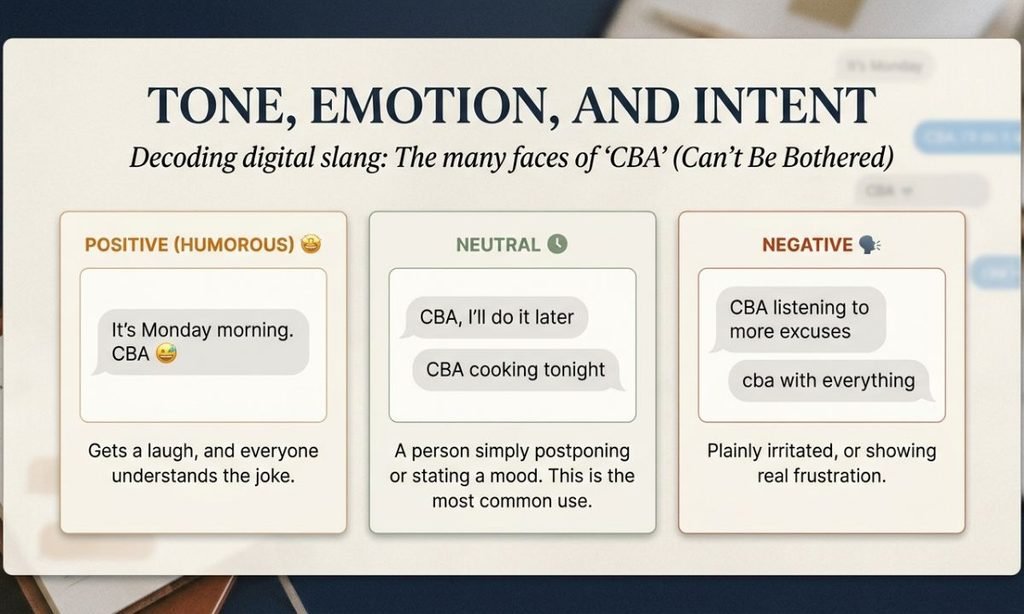
Tone decides how CBA lands. The default tone is flat, so how you feel about a message usually comes from the situation, not the letters. For intent, think “low effort, low drama.”
What Emotion Does CBA Show?
CBA usually reflects laziness, exhaustion, or disinterest. Lack of motivation sits underneath, and feeling worn down often sits under that. It is rarely angry. The emotional tone is tired, not hostile.
Is CBA Positive, Negative, or Neutral?
The answer depends on context, because the sentiment lives in the surrounding words, not the letters. Generally it’s neutral, though it can sound negative depending on tone, and it’s almost never truly positive.
- Positive (humorous): “It’s Monday morning. CBA 😅” gets a laugh, and everyone understands the joke.
- Neutral: “CBA, I’ll do it later” is a person simply postponing. “CBA cooking tonight” is just a statement of mood. This is the most common use.
- Negative: “CBA listening to more excuses” is plainly irritated, and “cba with everything” shows real frustration.
Sarcasm vs. Serious Use
Among friends, CBA is often a joke. People exaggerate their laziness with lines like “cba breathing today.” Other times it signals real disinterest. A joking tone usually comes with emojis or a laugh, while a serious one arrives bare. Sarcastic use is common, but the lack of any softener is the clue that someone means it.
Tone in text is tricky because there are no facial expressions. What’s funny to you may sound rude to someone else, and that gap causes plenty of miscommunication. The missing voice does the damage, so choose your tone with care.
Is CBA Rude?
Not usually. As casual slang, CBA is not offensive, and it’s generally safe in informal chats. It can still sound dismissive when it arrives with no explanation.
When CBA Sounds Rude
If a friend asks “can you help me?” and you send “cba,” that reads as dismissive. In serious or emotional conversations, adding context matters, or a polite alternative works better. Something softer, like “I’m wiped, can we do this tomorrow?” gives a reason and keeps things warm.
In professional and other formal conversations, CBA can suggest you don’t care about the person or the task, even when you do. Among friends, it rarely raises an eyebrow. The term is informal and can be considered crude or unprofessional in workplaces, so keep that in mind.
When to Use CBA (and When to Skip It)
CBA works best in informal situations where nobody’s feelings are at stake. Good places include chats with friends, family, classmates, gaming friends, and social media followers. In those spaces, relaxed phrasing like “CBA cooking tonight” is normal.
Formal Situations
Skip it in job applications, business emails, academic papers, school assignments, professional meetings, and any formal customer communication. It reads as rude and unprofessional there, and it isn’t suitable for professional writing.
Instead of “CBA completing the report,” write something like “I’m currently unable to complete the report today.” It says the same thing politely. If you actually mean the business term, spell out “cost-benefit analysis” or write a normal sentence.
Sensitive Conversations
In conversations about important or emotional topics, CBA can come across as careless. It shows poor sensitivity to tone. I’ve watched a single “cba” turn a supportive chat sour, so avoid it anywhere a careless tone could cause harm.
CBA vs. Similar Slang Terms
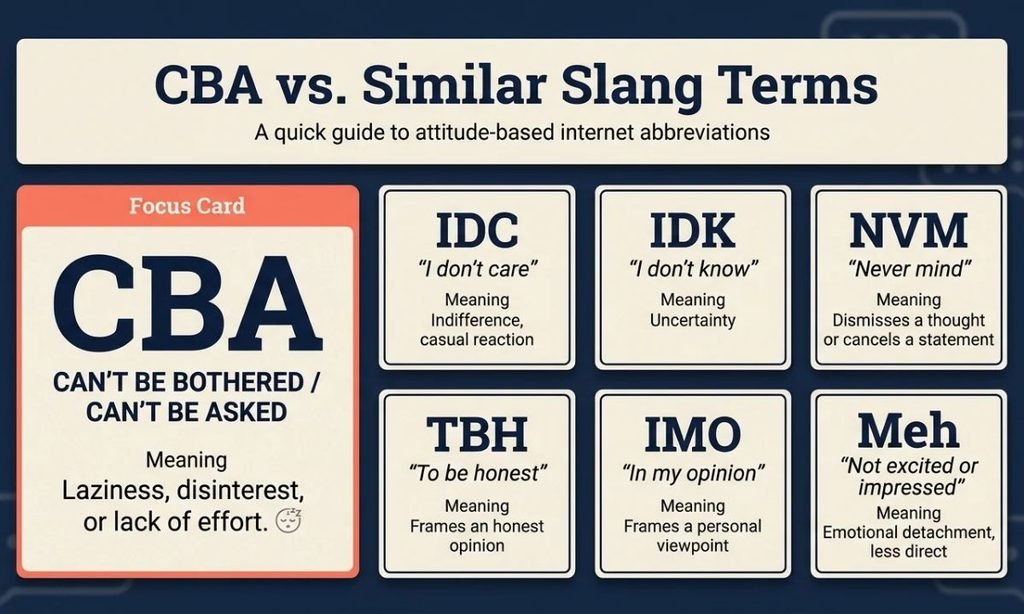
Several slang terms sound close but do different jobs. The ones people confuse most with CBA are IDC, IDK, NVM, and TBH. All of them are common texting shorthand, but each carries its own meaning.
| Term | Meaning | Usage | Key difference |
| CBA | Can’t be bothered / can’t be asked | Laziness, disinterest, lack of effort | Effort |
| IDC | I don’t care | Indifference, a casual reaction | Care |
| IDK | I don’t know | Uncertainty | Knowledge, not effort |
| NVM | Never mind | Dismisses a thought or cancels a statement | Withdraws the topic |
| TBH | To be honest | Frames an honest opinion | Opinion |
| IMO | In my opinion | Frames a personal viewpoint | Opinion |
| Meh | Not excited or impressed | Emotional detachment, less direct | Mood, not a refusal |
| Lazy | Unwilling to work | A direct description | More direct |
| Can’t be bothered | Similar meaning | Same idea in a spoken style | Slightly more formal |
TBH and IMO aren’t really rivals to CBA. They frame an opinion, while CBA frames effort. Meh and “can’t be bothered” are the closest matches.
CBA vs. IDC
This is the pair people mix up most. CBA points to a lack of motivation, while IDC points to a lack of concern. “CBA replying” means replying takes too much effort. “IDC about it” means you don’t care about the topic. One is about energy and the other is about attitude.
CBA vs. IDK and NVM
IDK admits a lack of knowledge, so it has nothing to do with laziness. NVM is about dismissing a thought or a concern, so it withdraws the topic instead of refusing to act. These are different feelings, so use each one for its own job.
Synonyms and Alternatives
If you want a different way to say it, these casual phrases work well: “can’t be bothered,” “not in the mood,” “too lazy,” “not feeling it,” and “too tired.” They’re also handy for audiences who may not know the abbreviation.
Other Meanings of CBA
The slang is the most common meaning, but CBA stands for other things in other settings. Most belong to work and study, and they rarely overlap with the texting one.
Cost-Benefit Analysis
In business, economics, and school, CBA stands for cost-benefit analysis. It’s a method for comparing costs against advantages before making a decision, and it’s often used to judge business projects and public policy. You can read more about cost-benefit analysis on Wikipedia. A team might run one before a project launch to see whether it’s worth the money.
A sentence like “we did a CBA” in a meeting has nothing to do with laziness. Students run into it in academic examples, too. The slang and the business term share an acronym only.
Why Context Matters
The meaning depends completely on where it’s used. A CBA in a group chat almost always refers to the slang, while CBA in a professional setting usually points to analysis or evaluation. A quick look at who’s talking and where tells you which one you’re reading.
Common Misunderstandings About CBA
Some confusion about this slang is predictable. These myths come up again and again.
“It means anger.” Not necessarily. Someone may be annoyed, but CBA usually signals a lack of motivation. The anger myth comes from reading the tone too hard.
“It’s always rude.” Not always. It’s harmless among friends, and context matters more than the letters.
“Everyone knows it.” Older users often don’t understand it. Think about your audience before sending it.
“It’s universal.” It’s more common in some regions than others, and some audiences prefer phrases like “can’t be bothered,” “too tired,” or “not feeling it.” Regional usage varies, which is why alternatives exist.
“It’s the same as the business term.” This is the mix-up between the slang and cost-benefit analysis. Tone causes the other big misreading, since people often take CBA as rude when it’s casual shorthand. That usually happens when someone expected more effort in the reply.
A few quick reference points: the meaning is the same on Snapchat and TikTok, where it works as a laziness marker. Its origin is British slang, though usage is wide. In business, the full form is cost-benefit analysis.
Tips for Using CBA the Right Way
These tips come from how I see it used in practice, and they’ll help you sound natural.
- Keep it casual. It belongs in relaxed conversations only.
- Know your audience. The person you’re messaging may not know it, and plain English costs you nothing.
- Don’t overuse it. Constantly sending CBA makes you sound negative or lazy.
- Add context. Instead of only “CBA,” explain why: “CBA going out because I’m exhausted.” The message lands softer.
Common Ways People Write CBA
There are many ways to use it, and these are the ones I see most:
- The basic form: just “CBA.”
- With an explanation: “CBA doing that today.”
- As a verb in a sentence: “I seriously CBA.”
- In captions: “Sunday mood: CBA moving from bed.”
- With emojis: 😴 or 😂 tells people how to read it.
Final Takeaway on CBA
CBA marks a lack of energy or desire, not hostility. It’s popular internet slang that’s mostly harmless, and it’s about laziness, disinterest, and low motivation, nothing darker. You’ll see it in text messages, social media posts, and gaming chats.
Keep it to casual conversations and informal chats, and avoid it in professional or serious situations. Its popularity comes down to speed: one feeling that would take a whole sentence fits in three letters, which matches a wider shift toward shorter, more everyday conversation.
The next time someone texts you “cba,” read it as “can’t be bothered,” take no offense, and move on. If you’re the one sending it, a short reason or a “maybe later” keeps things friendly.
FAQs
What does CBA mean in text?
CBA means “can’t be asked,” and many people also read it as “can’t be bothered.” It’s a casual way to say you feel too tired, lazy, or unmotivated to do something.
What does CBA stand for in texting?
In texting, CBA stands for “can’t be asked” or “can’t be bothered.” Both versions mean the same thing, so you don’t need to worry about which one the sender meant.
Is CBA the same as “can’t be bothered”?
Yes, in practice they carry the same meaning. “Can’t be bothered” is more common when spoken, while “can’t be asked” is what the abbreviation often reads as in writing.
What does “cba tonight” mean?
It means the sender doesn’t feel like doing something tonight, such as going out or making plans. It’s a low-effort no, not a sign they’re upset with you.
Is CBA rude?
Not usually. Among friends it’s casual and harmless, but it can sound dismissive if you send it with no explanation, especially in serious or emotional chats.
Is CBA an angry or negative term?
Mostly no. CBA usually signals tiredness or low motivation rather than anger. It can sound negative when the tone is frustrated, like “cba with everything.”
Where did CBA slang come from?
CBA is usually linked to British English, where “can’t be bothered” is a common phrase. Nobody has pinned down a first use, so the British origin is a working assumption.
What’s the difference between CBA and IDC?
CBA is about effort, meaning you don’t have the energy to do something. IDC means “I don’t care,” which is about attitude toward the topic itself.
What’s the difference between CBA and IDK or NVM?
IDK means “I don’t know,” so it’s about knowledge, not effort. NVM means “never mind,” and it withdraws a topic instead of refusing to act.
Can I use CBA in a work email or professional message?
No, skip it in work emails, school assignments, and formal messages. It reads as unprofessional, so try something like “I’m unable to complete this today” instead.
What does CBA stand for in business?
In business and economics, CBA stands for cost-benefit analysis. It’s a method for comparing the costs of a decision against its advantages, and it has nothing to do with the slang.
How can I tell if CBA means slang or cost-benefit analysis?
Check the setting. In a group chat or social media post, it’s almost always the slang, while in a meeting, report, or class it usually means cost-benefit analysis.
What can I say instead of CBA?
Good alternatives include “can’t be bothered,” “not in the mood,” “too tired,” and “not feeling it.” These work well when the person you’re messaging may not know the abbreviation.
How do I reply to someone who texts “cba”?
Keep it light and don’t take it personally. If you still need their help, ask again with a reason, or suggest a different time like “no worries, maybe tomorrow?”
Is CBA still popular in 2026?
Yes, it still shows up on TikTok, Instagram, Snapchat, WhatsApp, and in gaming chats. Its speed and casual tone keep it in everyday use.
