

Someone in your group chat drops a screenshot of a painfully try-hard message, and within seconds three people reply with the same word and a skull emoji. If you have ever wondered about the cringe meaning in chat, you have probably been on one side of that exchange already. You either sent the word or got a wince from reading it.
People search for this word because it sounds simple but covers a lot. It can be a joke, a verdict, or a plain insult, depending on who says it and how. You will see it on TikTok, Instagram, X, YouTube comments, gaming lobbies, school hallways, and increasingly at work.
This article explains what the word means, where it came from, and why your body reacts to it. You will also see how it differs from words like awkward and embarrassing, how to use it without sounding rude, and how to handle the feeling when it hits.
Answer Block: In chat, “cringe” is slang for the secondhand embarrassment you feel when someone else’s message, post, or behavior is so awkward that you wince for them. It works as an adjective (“that was so cringe”), a one-word reaction (“cringe”), or a verb (“I cringed at my old posts”).
Cringe Meaning in Chat, Explained in Simple Terms
Think of it as awkward plus embarrassing plus uncomfortable. It is a feeling first and a label second. Your shoulders tighten, you want to look away, and the moment ends only when you scroll past. It can happen in a group chat, and it can just as easily happen at a family dinner.
Almost every time, the word is about someone else. You are watching a person try too hard to impress others, and it does not work. That uncomfortable feeling is the whole point of the word, and it usually comes from another person’s actions, words, or behavior rather than your own.
Here is the part people miss. Cringe describes what a message makes you feel, not a measurable fact about the message. Two people can read the same post, and only one of them winces. Once you separate the feeling from the post, the definition gets much easier to hold onto.
The three ways people use it
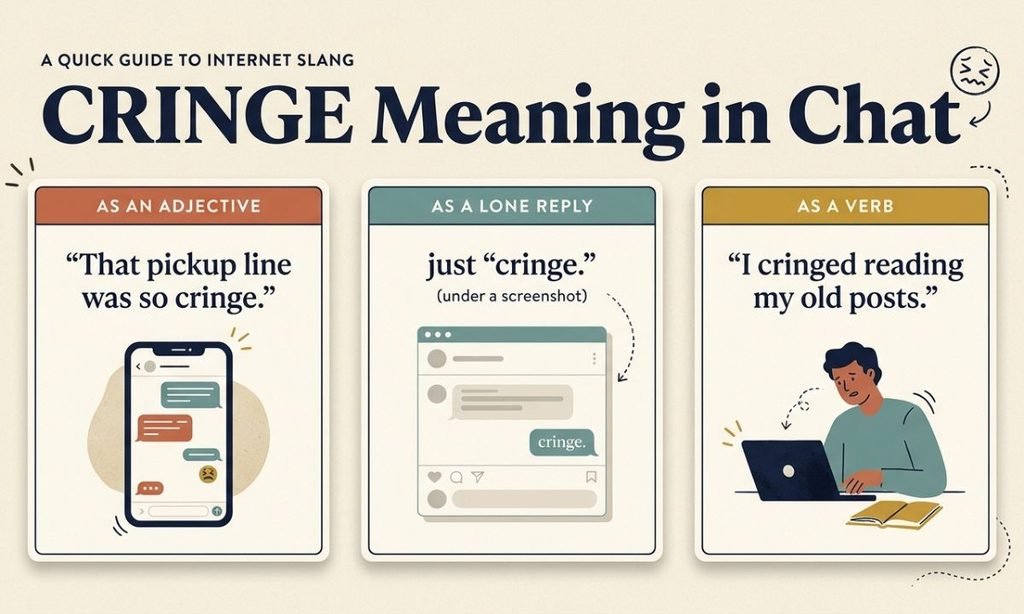
People use the word in three main ways:
- As an adjective: “That pickup line was so cringe.”
- As a lone reply under a screenshot: just “cringe.”
- As a verb: “I cringed reading my old posts.”
In the group chats I’m part of, the lone reply wins by a mile, and it is usually followed by a skull emoji.
What Is Cringe, Really? The Science Behind the Wince
Researchers call it a vicarious emotional reaction. Mayer et al. (2021) describe it as what happens when we witness someone break social norms or damage their social integrity. Escoe et al. (2024) put it plainly: a social blunder or faux pas that puts someone’s social image at risk, and sometimes ours too, even though it is not happening to us directly. That is what we call cringe. It is a vicarious reaction to another person’s stumble, and a close relative of secondhand embarrassment.
The trigger is usually trivial. There are no moral consequences, and the social slip-ups involved are mostly harmless, so sometimes we laugh. What gets us is often someone trying to make a good impression and then messing up in a way that is hard to ignore.
How cringe shows up in your body
This is a surprisingly physical emotion. Cringe can show up as:
- A flush or a hot face
- A bit of sweat or goosebumps
- A scrunched face
- A hand over the mouth
- A muffled shout of “eww”
- A squirm in your seat, or a full recoil
Some people blush. Others just get a gut-wrenching feeling. Your brain knows perfectly well that nothing is happening to you, and your body reacts anyway. Researchers have even measured heart rate, blushing, and skin responses while people watched cringe videos. .
A painfully awkward voice note in a work channel can set it off. So can an embarrassing memory from years ago, and the moment feels just as uncomfortable the second time around.
Where the Word Comes From
The verb is old. It traces back to the Old English cringan, which meant to give way or yield, often in battle. Over the centuries it drifted toward shrinking back or cowering in fear by the 1500s, which is close to the physical flinch we still describe today.
The slang meaning, feeling embarrassed on someone else’s behalf, is far newer. It grew up online. Forums, video-sharing sites, and Reddit-style communities built around awkward clips pushed it into everyday chat, and Reddit’s r/cringe is often named. Cringe comedy on TV gets some of the credit too.
Sources disagree on exactly when and where it first took off, most placing it in the 2000s and 2010s, so be wary of anyone who names a single starting point. From there the word spread. It became an adjective, cringey (also spelled cringy), and then a full internet slang term used daily by people who never visited those forums. I first noticed it jump from online arguments into school hallway talk. Now I hear it at work too, usually as a joke.
Where You’ll See and Hear It
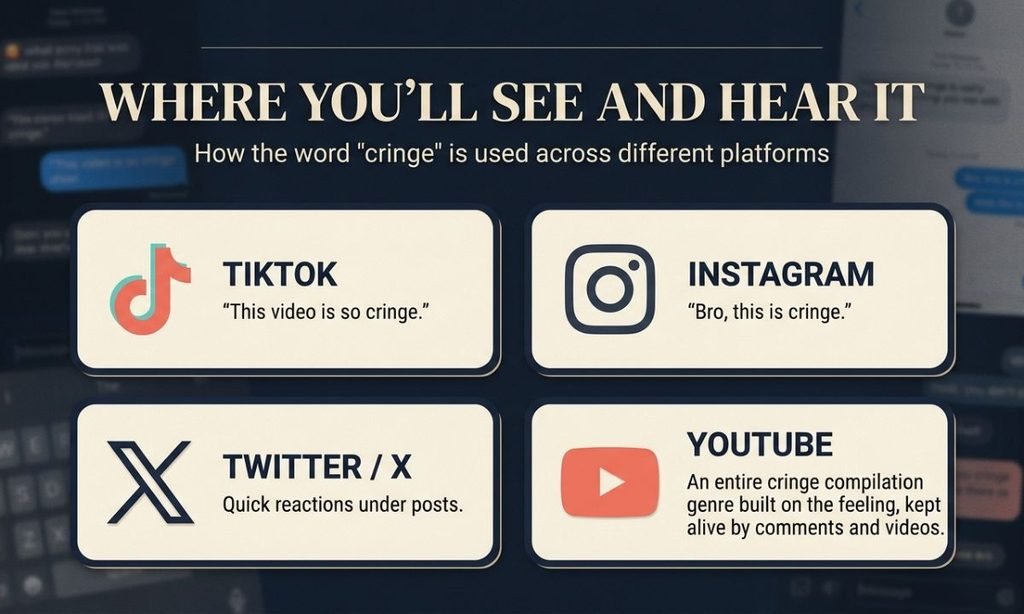
The word is everywhere, especially online:
- TikTok: “This video is so cringe.”
- Instagram: “Bro, this is cringe.”
- Twitter/X: quick reactions under posts.
- YouTube: an entire cringe compilation genre built on the feeling, kept alive by comments and videos across social media platforms.
Offline, it turns up in everyday conversations, school or college gossip, and real-life talk between friends. Group chats and other social media chats are where I run into it most.
In gaming and online communities, it lands when someone acts overly dramatic or throws out forced trash talk. It also lands when awkward moments pile up and turn annoying.
Why People Use the Word
The real reason is not embarrassment alone. People use it because it describes a feeling that would otherwise need a long explanation. Others understand it instantly, so it connects people socially. It also adds humor and expresses judgment, sometimes harshly.
Think of it as a shorter, more expressive version of “wow, that’s awkward” or “yikes.” It is a reaction word, and the embarrassment it carries is borrowed from whoever is on screen.
Real Examples of Cringe in Everyday Life
Here are a few situations you will probably recognize:
- A social media flex. Someone posts a video flexing fake money. People feel embarrassed for them, and the comment section fills with the same reaction.
- A friend trying too hard. A buddy tries to act cool and fails badly, so you say, “Bro, that was cringe.” The moment felt awkward and forced.
- An over-the-top message. A romantic text that is too dramatic or overly emotional gets “that’s kinda cringe.” Here the meaning is that it feels fake.
- A workplace voice note. A painfully awkward voice note in a work channel makes everyone wince in silence.
- Your own past. Facebook memories pop up with posts you would rather forget, and you think, “I was so cringe back then.” You feel embarrassed for your past self.
Cringe vs. Embarrassment: What’s the Difference?
The two are close, but not quite the same. Embarrassment is personal. You mess up socially and others see it. Waving back at someone who was not waving at you is one example. Calling your teacher “mom” is another. It is an instant feeling, and it belongs to you.
Cringe, on the other hand, is secondhand embarrassment. The classic example is a stranger pulling out a wedgie in public, or someone trying too hard to seem cool in front of new people. It is funny and painful at once. The awkwardness makes you squirm and feel uncomfortable just watching.
We can also cringe at ourselves. Remembering something cringey from years ago brings the feeling right back, which says a lot about how we feel about ourselves.
In chat, the test is simple. If you sent it, that is embarrassment. If you only read it, that is cringe.
Cringe vs. Awkward, Cheesy, and Try-Hard
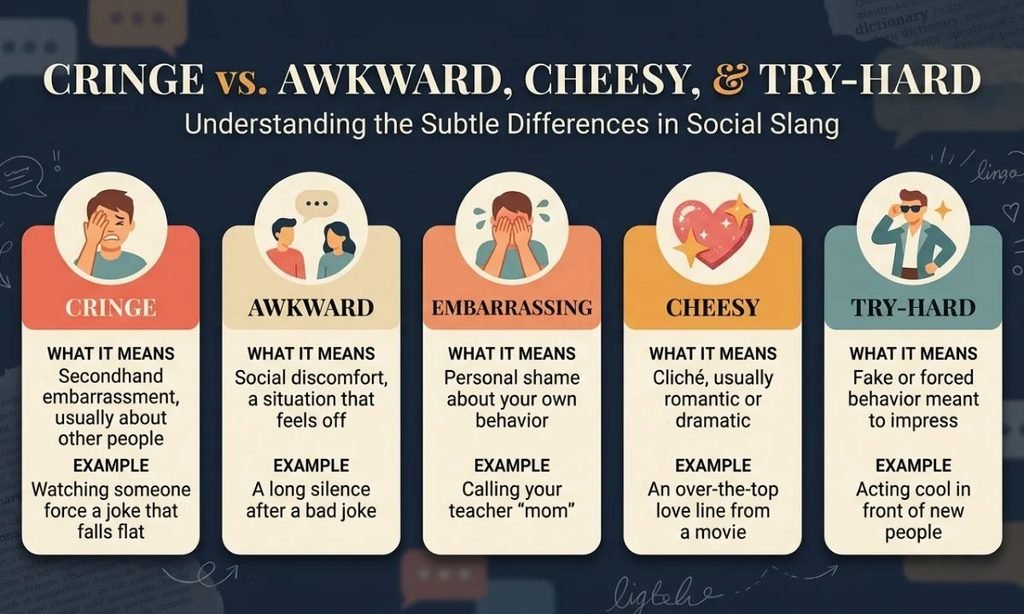
Several words live in the same neighborhood. This table shows how they differ.
| Word | What it means | Typical example |
| Cringe | Secondhand embarrassment, usually about other people | Watching someone force a joke that falls flat |
| Awkward | Social discomfort, a situation that feels off | A long silence after a bad joke |
| Embarrassing | Personal shame about your own behavior | Calling your teacher “mom” |
| Cheesy | Cliché, usually romantic or dramatic | A over-the-top love line from a movie |
| Try-hard | Fake or forced behavior meant to impress | Acting cool in front of new people |
Cringe sits across all of them. The key difference is that it is usually about other people, and watching awkward behavior is the trigger. Fake or forced behavior also overlaps with what people call larping, another slang term for pretending to be something you are not.
Why We Feel Cringe in the First Place
It starts with belonging
Humans are social creatures, inherently so. We share emotions, work out what others are thinking, and learn fast which behavior leads to embarrassment or shame. Belonging is a basic survival instinct, so we avoid anything that makes us look weird or unacceptable.
When someone breaks a social rule, or we suddenly recall an embarrassing moment of our own, the brain treats it like a threat. It is a social threat, but the response is real. We squirm, look away, and get that full-body “eugh” feeling. The brain is trying to protect us from feeling the awkwardness firsthand.
What the brain is doing
The neurological explanation points to two areas. The anterior insula helps process self-conscious emotions like embarrassment, and it is closely connected to the amygdala, the brain’s emotion center. When these connected areas work together, they help explain pain empathy (Paulus et al., 2014). We experience someone else’s pain, or embarrassment, as if it were our own.
Why we share cringe
Cringe has a social power, and surprisingly it is not only uncomfortable. It makes us want to talk about it. Sharing cringeworthy moments gives us a chance to compare ourselves with the person who messed up and, in the process, feel a little more socially competent (Escoe et al., 2024).
That is social comparison at work. “At least I’m not that awkward!” is the thought, and we feel better about ourselves. It is a big reason screenshots travel so fast.
When to Use Cringe and When to Avoid It
Use it when something looks forced or fake, feels uncomfortable, or causes the kind of secondhand embarrassment that makes you think “yikes.” Good usage sounds like:
- “That video was cringe.”
- “That joke was kinda cringe.”
- “I can’t watch this, it’s too cringe.”
Be careful, though. The word can sound rude or judgmental when used harshly. Avoid saying it directly to someone, because that turns it into an insult. Skip it in serious or sensitive situations too, since some people find it offensive.
It is also an informal slang term. In professional settings it can come across as crude or dismissive, so save it for casual chats.
Common Misunderstandings About the Cringe Meaning in Chat
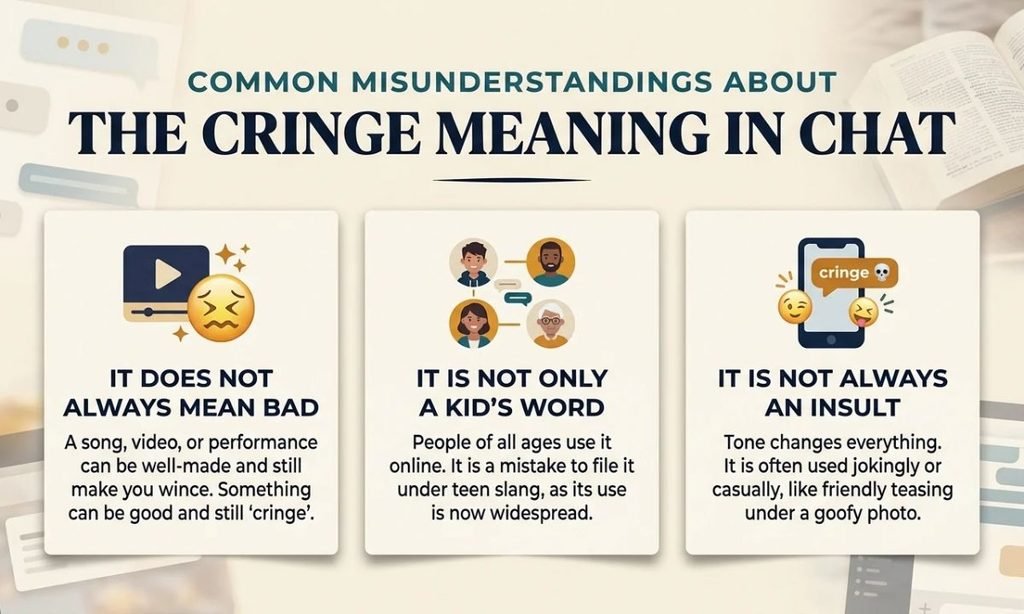
A few mix-ups come up again and again.
Cringe does not always mean bad. Something can be good and still cringe. A song, a video, or a performance can be well made and still make you wince.
It is not only a kid’s word. People of all ages use it online, so it would be a mistake to file it under teen slang.
It is not always an insult. Mostly it leans negative, but tone changes everything. Plenty of people say it jokingly or casually, and a friendly “cringe 💀” under a goofy photo is usually just teasing.
It is not the same as embarrassing yourself. The word is mostly about watching others, though sometimes people aim it at themselves. The adjective cringey carries the same meaning as the noun and simply describes something that causes the feeling.
Pro Tips for Using the Word Naturally
Follow these habits to sound natural:
- Keep it casual. Use it in informal chats, not professional settings.
- Add tone with emojis. A 😬 or 💀 signals that you are joking or wincing, not attacking.
- Don’t overuse it. When everything is cringe, the word loses its punch.
- Know your audience. What is a joke among close friends can land badly with a coworker or an older relative.
- Pick your spelling. “That was cringey” and “cringy” work the same way.
What about formal writing? Leave it out. It belongs in casual conversation and online content, and a work email is never the right place for it.
How to Handle the Cringe Feeling
Cringe is a normal reaction, and it is unavoidable. It is also not the most comfortable feeling, so a few ways to handle it with grace can help.
Pause and breathe
When something catches you off guard, stop for a moment. Let yourself be shocked or embarrassed, breathe, and let the awkward feeling float away.
Shift your focus
Skip the dwelling. Check your phone notifications, chat with a friend about something else, and move your attention elsewhere.
Practice empathy
Put yourself in their shoes. The sender probably feels just as awkward as you do. Cut them some slack, and maybe give them a mental high-five for bravery.
Find the humor
Sometimes the cure is a giggle. Life is too short to stay tense over a wedgie in public or a clumsy message. Most cringeworthy moments are not serious, and many turn into funny stories when you look back. Everyone has had the “wait, did I really just do that?” moment. Keep it kind, though. The goal is to find the humor, not to pile on.
Embrace your inner cringe
Cringe is part of being human. Awkward moments happen to the rest of us, and they will not last forever. The key is to stay kind and not take too seriously what you cannot change. Sometimes those moments even make life more interesting.
Final Thoughts on Cringe Meaning in Chat
Cringe is more than just slang. It captures that awkward, uncomfortable feeling in one short word, and people understand it instantly. It is a shared emotional reaction, which is why it spreads so easily from group chats to comment sections to the lunch table.
Here is the practical takeaway. Use the word lightly, aim it at moments and not at people, and save it for casual settings. And the next time you see a message that makes you wince, remember that the person who hit send is just a human, like you.
FAQs
What does cringe mean in chat?
In chat, cringe means the secondhand embarrassment you feel when someone else’s message, post, or behavior is awkward. It works as an adjective, a one-word reply, or a verb.
What does cringe mean in slang?
As slang, cringe describes something so awkward or forced that you wince on someone else’s behalf. It’s an informal reaction word, often used jokingly.
Is cringe a bad word?
Mostly it leans negative, but tone matters. Between friends it’s usually playful teasing, while aimed directly at someone it can come across as an insult.
What is the difference between cringe and embarrassed?
Embarrassment is personal: you slip up and others see it. Cringe is secondhand: you only watched or read it. If you sent the message, you’re embarrassed. If you just read it, you’re cringing.
What does “cringey” mean?
Cringey is the adjective form and carries the same meaning. It describes anything that causes that awkward, wincing feeling. “Cringy” is a common alternate spelling.
Where does the word cringe come from?
It traces back to the Old English cringan, meaning to give way or yield. By the 1500s it meant shrinking back in fear. The modern slang sense grew up in online communities, with exact origins still debated.
Why do I feel cringe when watching other people?
Researchers describe it as a vicarious emotional reaction to someone’s social blunder. Your brain treats it like a small social threat, so your body reacts even though nothing is happening to you.
Why does cringe make my body react?
Cringe can cause a hot face, goosebumps, a scrunched expression, or a squirm in your seat. Brain areas linked to self-conscious emotions help you feel another person’s embarrassment as if it were your own.
Why do people share cringe content?
Sharing it lets you compare yourself with the person who slipped up and feel a bit more socially at ease. That social comparison is a big reason screenshots spread so quickly.
Can you cringe at yourself?
Yes. Remembering an old post or an awkward moment from years ago can bring the feeling right back. Many people say “I was so cringe back then” about their past selves.
Is cringe only used by kids or teens?
No. People of all ages use it online and offline. It started in internet communities but now shows up in school, social media, group chats, and even workplaces.
Can you say cringe at work?
It’s best to avoid it in professional settings. Cringe is informal slang and can sound crude or dismissive, so save it for casual chats with people who know your tone.
Is it okay to call someone cringe to their face?
Usually not. Saying it directly to a person turns an observation into an insult. It’s kinder to aim the word at a moment, a video, or a joke rather than at a person.
Can something be good and still be cringe?
Yes. A video, song, or performance can be well made and still make you wince. Cringe describes how something makes you feel, not whether it’s good or bad.
What emojis go with cringe?
The most common are 😬 and 💀. They signal that you’re joking or wincing rather than attacking, which helps keep the tone light.
How do I stop feeling cringe?
Pause and breathe, then shift your focus to something else. Putting yourself in the other person’s shoes and finding the humor can also help the feeling pass faster.
