

Someone texts you “the plan is looking kinda ify” and you pause. Is that a typo? A new slang word? Something your cousin made up?
It’s not a typo, and you’re definitely not alone in wondering. “Ify” pops up constantly in texts, group chats, and casual conversation, yet almost nobody explains what it actually means or where it comes from. That’s exactly what we’re fixing here.
By the end of this guide, you’ll know the ify meaning in every context you’re likely to run into it — as everyday slang, as text-speak, and as a suffix that shows up at the end of dozens of common English words. Let’s get into it.
What Does IFY Mean?
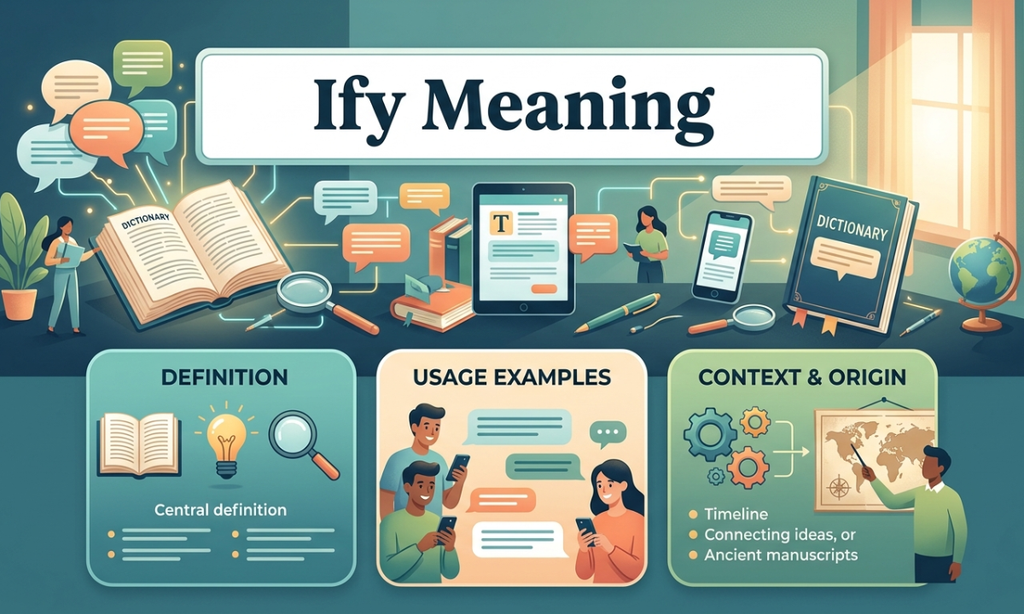
The simplest definition of ify is: uncertain, questionable, or not quite reliable. When something is “ify,” it’s not a clear yes and it’s not a clear no. It’s sitting somewhere in the middle, and that middle ground is usually where a little doubt lives.
So if you’re asking what does ify mean, think of it as a shorthand way of saying “I’m not totally sure about this” or “this could go either way.”
A few quick examples make it click fast:
- “My Wi-Fi connection has been ify all day.” (It keeps cutting out — not reliable.)
- “That restaurant’s reviews are pretty ify.” (Mixed opinions, hard to trust completely.)
- “His alibi sounded ify to the detective.” (Questionable, not fully believable.)
When people ask what is ify, they’re often surprised to learn it’s actually a shortened, informal spelling of “iffy” — a word that’s been in English dictionaries for decades. Over time, especially in texting and casual online writing, people started dropping the extra “f” to save a keystroke. Language does this constantly. Think “thru” instead of “through,” or “tho” instead of “though.”
So if you ever see someone ask what do ify mean, or search for the ify definition online, the honest answer is simple: it’s casual shorthand for “iffy,” meaning doubtful, risky, or not quite dependable.
Where the Word Actually Comes From
“Iffy” itself first showed up in American English in the mid-20th century, built directly from the word “if.” Something described as “iffy” is, quite literally, full of ifs — full of conditions, uncertainties, and maybe-maybes. The playful “-y” ending turned the conjunction “if” into an adjective, the same way “spot” becomes “spotty” or “crank” becomes “cranky.”
The texting version — “ify” — is younger. It rode in on the wave of abbreviated spelling that came with SMS messaging, where every character counted and speed mattered more than proper spelling. Once it caught on, it stuck around, especially with younger texters who use it as a natural part of casual writing.
What Does IFY Mean in Text?
Texting has its own rhythm, and ify meaning text conversations usually center on quick judgment calls. When you see ify text meaning used in a message, it almost always signals hesitation about a plan, a person, a decision, or a situation.
Here’s what makes this word so popular in texting: it does a lot of work in very few letters. Instead of typing out “I’m not entirely sure this is going to work out,” someone just types “this is ify.” Same meaning, way less effort — and texting rewards efficiency.
So what does ify mean in text conversations specifically? Usually one of these things:
- Plans that might fall through — “Saturday’s ify, I might have to work.”
- Trust or reliability concerns — “That seller on the app seems ify.”
- Health or how someone’s feeling — “I’m feeling kinda ify today, might be coming down with something.”
- Quality or condition of something — “The Wi-Fi at this hotel is ify.”
Here’s a quick real-world example thread showing ify meaning in text:
Sam: Are we still on for the hike tomorrow?
Jordan: Weather’s looking ify, might rain.
Sam: Ugh, let’s decide in the morning then.
Notice how much information “ify” packs into one word here. Jordan isn’t saying no, and isn’t saying yes — just flagging real uncertainty in a natural, conversational way.
If you’re interested in understanding other short texting expressions that can be confusing in casual chats, you can also check out our guide to NVM meaning in text.
This is also why ify meaning in chat apps like Snapchat, Discord, and Instagram DMs follows the exact same pattern as texting. The tone is casual, the spelling is relaxed, and “ify” fits right in alongside other shortened chat words like “ngl,” “fr,” and “lowkey.”
Common Texting Phrases Using IFY
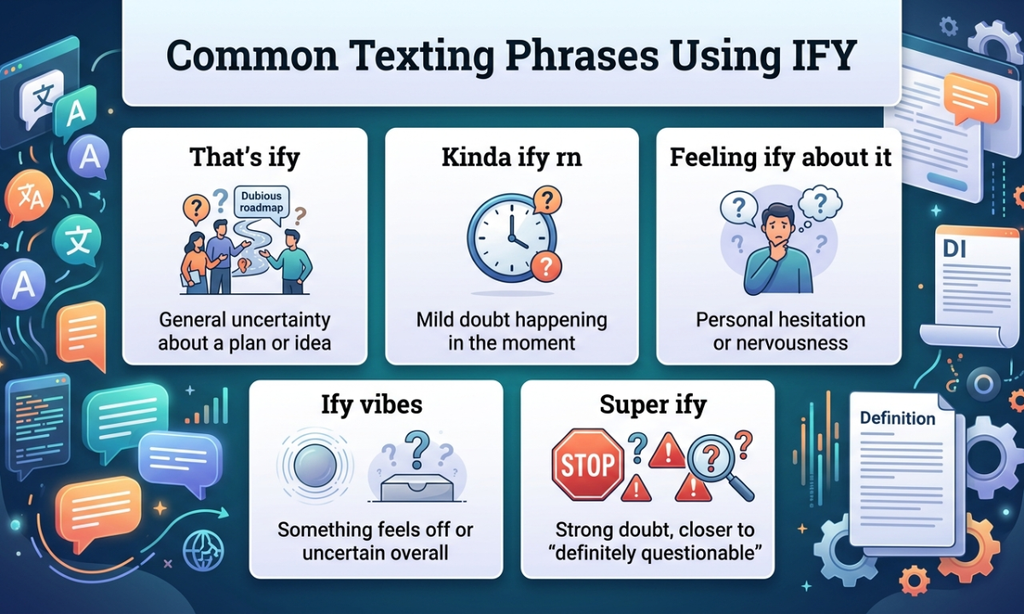
| Phrase | What It Signals |
| “That’s ify” | General uncertainty about a plan or idea |
| “Kinda ify rn” | Mild doubt happening in the moment |
| “Feeling ify about it” | Personal hesitation or nervousness |
| “Ify vibes” | Something feels off or uncertain overall |
| “Super ify” | Strong doubt, closer to “definitely questionable” |
IFY Meaning in Slang
Slang words don’t always match their dictionary cousins perfectly, and that’s true here too. When you’re looking specifically at ify slang meaning, you’ll notice the word carries a slightly more casual, sometimes playful edge than formal “iffy” does.
Ify slang is common among teens and young adults, but it’s really crossed generational lines at this point. Parents use it, coworkers use it in Slack messages, and it shows up in product reviews online. That crossover is part of what makes it worth understanding — it’s not confined to one age group or platform anymore.
So what does ify mean in slang specifically, compared to standard usage? A few nuances:
- It’s often used to soften criticism. Saying “the food was ify” feels gentler than saying “the food was bad.”
- It works as a social cushion. Telling a friend “your plan sounds ify” is less blunt than “I don’t think that’s a good idea.”
- It can describe people, not just situations. “That guy gives ify energy” means someone seems untrustworthy or slightly off, based on a gut feeling rather than hard evidence.
This softening effect is actually a big reason the word has stayed popular. English speakers, especially in casual settings, often prefer words that let them express doubt without sounding harsh or overly critical. “Ify” does exactly that.
IFY vs. Similar Slang Words
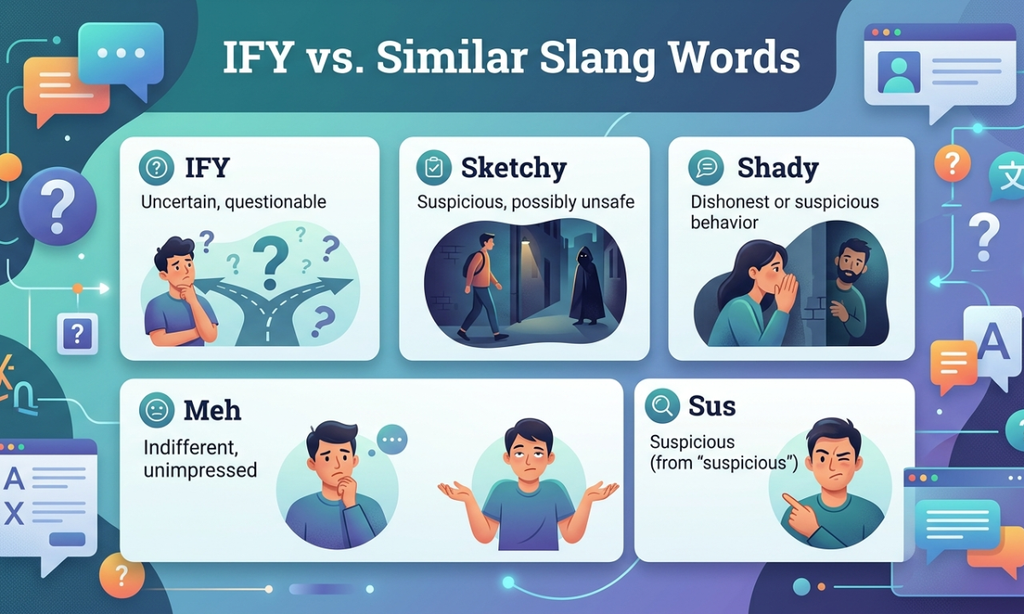
It helps to see how “ify” stacks up against words people often use interchangeably, even though the tone is slightly different for each one.
| Word | Meaning | Tone |
| Ify | Uncertain, questionable | Casual, mild |
| Sketchy | Suspicious, possibly unsafe | Stronger, more wary |
| Shady | Dishonest or suspicious behavior | Negative, distrustful |
| Meh | Indifferent, unimpressed | Neutral, low energy |
| Sus | Suspicious (from “suspicious”) | Playful but pointed |
Notice that “ify” sits on the milder end of this spectrum. It expresses doubt without necessarily accusing anyone of anything. That’s an important distinction — calling a person “sketchy” is a much stronger statement than calling their plan “ify.”
What Does the Suffix -IFY Mean?
Now let’s shift gears completely, because there’s a second, totally unrelated way this letter combination shows up in English: as a suffix.
The ify suffix meaning has nothing to do with uncertainty or slang. This is a formal piece of grammar with roots in Latin, and it’s been part of English for centuries.
The suffix ify definition, in simple terms, is this: adding “-ify” to a noun or adjective turns it into a verb meaning “to make” or “to cause to become.” It’s a way of building action words out of descriptive ones.
So what does the suffix ify mean in practice? Take the adjective “pure.” Add the suffix, and you get “purify” — to make something pure. Take the noun “beauty,” adjust it slightly, and you get “beautify” — to make something beautiful.
This pattern traces back to the Latin suffix “-ficare,” related to the verb “facere,” meaning “to make” or “to do.” Over centuries, as Latin influenced French and then English, that suffix evolved into the “-ify” we use today.
Here’s the meaning of the suffix -ify broken down step by step:
- Start with a root word (usually a noun or adjective).
- Add “-ify” to the end.
- The result is a verb meaning “to cause to become [the root word].”
A simple formula: Root word + ify = to make [root word] happen.
Words That End in -IFY
Once you understand the pattern, you’ll start noticing words ending in ify everywhere — in recipes, science class, business meetings, even song lyrics.
Here’s a table of common ify suffix words, organized by how they’re typically used:
| Word | Root Meaning | Definition |
| Clarify | Clear | To make something clearer or easier to understand |
| Purify | Pure | To remove impurities, make pure |
| Simplify | Simple | To make something easier or less complicated |
| Beautify | Beauty | To make something more attractive |
| Notify | Notice/note | To inform someone of something |
| Classify | Class | To sort into categories |
| Justify | Just | To show or prove something is right or reasonable |
| Identify | Identity | To recognize or establish who/what something is |
| Verify | True (Latin: verus) | To confirm something is accurate |
| Modify | Mode/manner | To change something slightly |
| Amplify | Ample | To make louder or stronger |
| Terrify | Terror | To cause intense fear |
| Satisfy | Enough (Latin: satis) | To fulfill a need or expectation |
| Glorify | Glory | To praise highly or make glorious |
| Solidify | Solid | To make firm or solid |
For a reliable dictionary reference, the definition of iffy confirms that iffy is an informal adjective used for something uncertain or not completely good, honest, or suitable.
That’s just a sample — English has dozens of words with ify attached, and new ones occasionally get coined too. “Gentrify,” “diversify,” and “personify” all follow the exact same building pattern.
Why This Suffix Matters for Everyday English
Understanding words with ify suffix isn’t just trivia. It genuinely helps with reading comprehension, writing clarity, and even vocabulary building for anyone learning English as a second language. Once you recognize the pattern, you can often guess the meaning of an unfamiliar “-ify” word just from its root.
For example, if you already know “solid,” you can reasonably guess that “solidify” means “to make solid” — even the first time you see it. That’s the power of recognizing suffix patterns instead of memorizing every word individually.
Putting It All Together
Here’s the thing that trips people up: “ify” (the slang word) and “-ify” (the suffix) look almost identical but come from completely different places and serve completely different purposes.
- Ify (slang) = a casual, texting-friendly version of “iffy,” meaning uncertain or questionable.
- -ify (suffix) = a grammatical building block, added to root words to create verbs meaning “to make” or “to cause.”
If someone in a group chat says “that idea sounds ify,” they’re using the slang version. If someone says “we need to simplify this process,” they’re using the suffix version, even though neither person is likely thinking about grammar at all.
Context makes the difference obvious almost every time. Slang “ify” stands alone as its own word. The suffix version is always attached to the end of another word, never floating by itself.
Final Thoughts
Language moves fast, especially online, and “ify” is a great example of how a single tiny word cluster can mean completely different things depending on where you encounter it. Whether you saw it in a friend’s text, heard it used as slang, or stumbled across “-ify” while learning new vocabulary, you now have a clear, practical answer.
Next time someone texts you that their plans are “ify,” or you spot a word like “solidify” in a book, you’ll know exactly what’s going on — no second-guessing required.
FAQs
What does ify mean?
Ify is a casual, shortened spelling of “iffy,” meaning uncertain, questionable, or not fully reliable. It’s commonly used in texts and everyday conversation to express mild doubt about a plan, situation, or person.
Is ify a real word?
Ify itself isn’t in the dictionary, but it comes directly from “iffy,” which is a recognized English word. Think of “ify” as the informal, texting-friendly version people use online and in casual chat.
What does ify mean in a text message?
In texting, “ify” usually signals that plans, timing, or reliability are uncertain. For example, “Saturday’s ify” means the person isn’t sure they can commit yet.
What’s the difference between ify and iffy?
They mean the same thing — uncertain or questionable. “Iffy” is the standard spelling, while “ify” is a shortened, informal version common in texts and social media.
What does the suffix -ify mean?
The suffix “-ify” means “to make” or “to cause to become.” It turns root words into verbs, like turning “simple” into “simplify” or “pure” into “purify.”
What are some common words that end in -ify?
Common examples include clarify, simplify, notify, identify, verify, and beautify. Each one adds “-ify” to a root word to create a verb meaning “to make that thing happen.”
Where did the word iffy come from?
“Iffy” originated in mid-20th century American English, built from the word “if.” It describes something full of conditions or uncertainty, much like something being “full of ifs.”
Is ify slang or proper English?
“Ify” is informal slang, mostly used in texting, chat apps, and casual speech. “Iffy,” its formal counterpart, is standard English and appropriate for everyday writing.
