

You’re texting a friend about weekend plans when they suddenly write, “OT, did you see that game?” and you stop for a second. OT meaning in text is usually simple, but those two letters can point in more than one direction. A wrong guess is rarely a disaster, though it can lead to some awkward replies.
People search for this slang term because it shows up everywhere: group chats, comment sections, work chats, and dating conversations. Short abbreviations like this exist because people want faster communication, but a tiny acronym with several possible meanings can cost more confusion than the seconds it saves. What it means often depends on the platform, the workplace, and the person typing it.
This guide gives you the main meaning first, then the second common one, where each came from, and real examples from everyday life and the workplace. You’ll also learn how to spot mix-ups, reply politely, and decide when to skip the abbreviation entirely.
OT most often means “off topic” in texting. Someone types it before a message that has nothing to do with the current conversation, as a quick warning that the subject is about to change. At work, OT usually means overtime: extra hours beyond a regular schedule. The sentence around it tells you which meaning applies.
What Does OT Mean in Text?
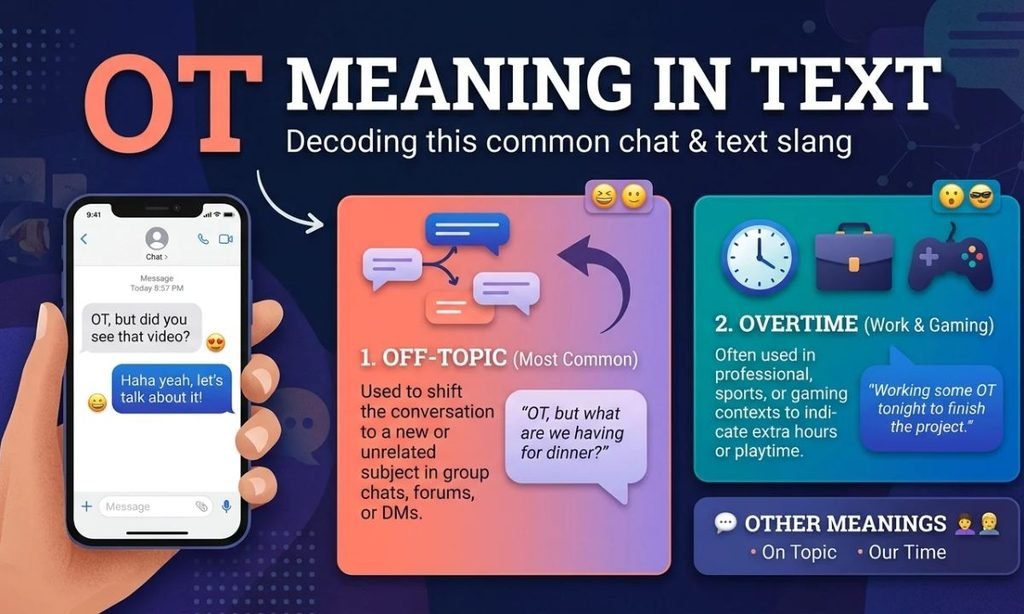
The quick version: OT is shorthand placed in front of a message that doesn’t connect to the current conversation. “OT, have you finished that movie?” simply expands to “Off topic, have you finished that movie?” You’re introducing a subject that isn’t directly related to what everyone was just saying.
The catch is that the same letters can mean something else in other settings. A message about a work schedule and a random tangent can look identical on screen. Treat the letters as a clue, not a final answer, and let the rest of the message settle it.
Primary Meaning: Off Topic
“Off topic” is the most common conversational meaning of OT. You mostly see it in forums, chat groups, and comment sections, anywhere a discussion has a main subject and a stray thought doesn’t fit. The writer admits the detour and still gets to share the thought.
Picture a chat about dinner. Someone asks, “OT, are you traveling this summer?” The vacation question has no link to dinner, and the abbreviation says so. A softer version, “OT for a second…”, tells people a short detour is coming and the original conversation will pick up again afterward.
Here’s a typical exchange:
Person A: I love this new movie! What did you think?
Person B: OT, but did anyone watch the game last night?
Person B changes the subject on purpose and admits it. Without OT, the reply looks like they ignored the movie. With it, the topic shift reads as honest rather than rude.
Linguists call a small label like this a discourse marker. It announces what kind of message is coming without adding any content of its own. That’s the whole job of this acronym, and it’s why “off topic” is the first reading I reach for when the chat is casual.
Secondary Meaning: Over Time (Overtime)
OT also stands for “over time,” which in work, sports, and payroll conversations means overtime. In professional texts it describes extra working hours: time worked beyond a regular work schedule. “I’m working OT tonight” is the workplace version, and “the game went into OT” is the sports version.
Dictionaries agree on this one. Merriam-Webster defines overtime as time worked on top of your normal hours, and also as the pay you get for that extra work
Here’s a short work exchange:
Boss: Can you finish this report today?
Employee: I might need some OT to complete it.
The employee isn’t changing the subject. They’re saying they’ll put in extra hours to get the report done. The same two letters now describe hours worked, not a conversation detour, so casual and professional usage need to be read separately.
You’ll see this meaning constantly in shift swaps, payroll talk, and work-related texts. If hours, pay, or a schedule are anywhere nearby, think overtime. Reading it as “off topic” in that setting would be an odd choice.
Some communities use OT for other phrases, such as “on topic,” but those meanings aren’t universal. Don’t assume one definition fits every group.
Rare and Misinterpreted Meanings
The classic slip is treating every OT as “off topic.” If a coworker says, “I got 4 hours of OT this week,” they’re almost certainly talking about overtime, not steering the chat somewhere new.
The surrounding words are your best clue. “OT, random question” strongly suggests off topic, while hours, pay, shifts, or a game point toward overtime. Linguists call this collocation: the words that travel with an abbreviation tell you which reading fits.
Where OT Came From
Nobody has a clean first-use record for either meaning, so treat any date as rough. The order of events is reasonably clear, though. Over Time is the older one, rooted in workplaces and HR records. Off Topic came later, when online forums and bulletin boards needed a quick way to flag a tangent.
That’s a classic semantic shift. One abbreviation started in a professional setting, then picked up a second meaning once a new platform appeared. The etymology of the letters is plain initials, but the meaning change is the interesting part. Early on, OT was workplace shorthand. Later, helping people manage messy threads became its second career.
| Year | Usage of OT | Context |
| 1980s | Over Time | Workplaces, HR records |
| 1990s | Off Topic | Online forums, bulletin boards |
| 2000s | Widely used | Social media, chat apps |
| 2020s | Common everywhere | Text, Discord, Reddit, Slack |
This timeline shows how usage evolved more than it pins down exact history. Anyone who gives you a precise year for either meaning is guessing. What’s solid is the rise: once chat apps took over, OT became a common sight in digital conversations, in professional and academic settings, and on casual messaging platforms. That history explains why one acronym ended up with two jobs.
How OT Is Used in Different Places

The meaning shifts with the setting. Across texting, social media, dating, work, and different communities, the abbreviation bends toward whatever the people around it expect. Linguists would file this under pragmatics, the study of how context shapes meaning, with a good dose of domain variation and sociolinguistics.
Texting and Messaging
In everyday messages, OT usually introduces a quick side question or an unrelated thought. “OT, did you ever try that new coffee shop?” is a typical case. The sender isn’t abandoning the original discussion. They want to add another thought and then return to it.
Capitalization doesn’t change anything. Texting doesn’t require it, so a lowercase “ot” carries the same meaning. Teenagers mostly use OT for “off topic,” especially in group chats and comment sections, which is where the abbreviation feels most at home.
OT Meaning in Text on Instagram, Snapchat, and TikTok
On Instagram, Snapchat, TikTok, and Threads, OT can show up in comments, captions, stories, and DMs. A TikTok commenter might write, “OT but your nails are amazing,” moving from the video’s subject to a compliment. On Instagram, “OT, where did you get that bag?” or “OT, where’s that jacket from?” works as a side question the same way.
Snapchat is very informal, so a short “ot lol” feels natural there, and capitalization or punctuation can be all over the place. Threads often hosts longer discussions, where OT marks a temporary detour. The platform changes the style more than the meaning. If a Snapchat message mentions work hours or sports, though, another reading may apply.
Dating and Relationships
In romantic conversations, OT can introduce a personal question without making the shift feel abrupt. “OT, are you free Friday night?” is just a change of subject. The letters carry no automatic romantic meaning.
If someone writes, “OT, I miss seeing you,” the feeling comes from the rest of the message, not the abbreviation. A person might use OT before something flirtatious or affectionate, but it only signals the subject change. I’ve watched people read extra meaning into short messages when the real clue was the full sentence, so read the whole line before deciding how personal it is.
Professional Communication
Workplaces draw a sharp line. In a team chat, “OT: Can someone recommend a good lunch spot?” means off topic. “OT approved for Saturday” almost certainly means overtime.
Because workplace abbreviations can touch scheduling and pay, guessing isn’t worth it. If the meaning isn’t obvious, ask. In professional emails, OT is rare, since emails tend to spell things out. In workplace chat tools, it appears often, usually to flag overtime hours. A wrong guess here can cost you a shift.
Cultural and Regional Differences
OT doesn’t mean the same thing to every age group or region. Younger texters may use it casually, while others rarely use it at all. Someone in payroll or healthcare may read it as overtime by habit, while someone in an online discussion reads it as off topic.
The sender’s community can matter as much as the sentence. Workplace culture, community norms, and plain usage variation all shape what people expect to see.
Real Conversation Examples
Real situations teach faster than definitions, so here are some short exchanges, starting with everyday life.
Person A: Did you finish the project?
Person B: OT, the new café opened downtown, have you been?
Person B labels the shift first, so the reader isn’t thrown.
Colleague A: How many hours are you working today?
Colleague B: 9 regular hours plus 2 OT.
Same letters, different usage. Here it’s plain extra hours, and nobody could mistake it for a topic change.
User 1: I love reading mystery novels.
User 2: OT, but has anyone tried fantasy books this month?
This is the textbook online-discussion case. User 2 changes the subject on purpose and doesn’t hijack the thread without saying so.
A tip from watching beginners: the answer is usually in the next few words. A question after OT means a topic change. A number means overtime. Used with confidence, those labels save everyone a clarifying message.
Ten Messages Explained
Each message below comes with its meaning, tone, and likely interpretation.
- “OT, what time does your flight leave?” The sender is changing subjects. Casual tone, a simple unrelated question.
- “OT but I love your new profile pic.” A compliment in a warm tone. Friendly praise, nothing hidden.
- “OT: Did you submit the form?” A work-related question in a direct tone. They want a quick answer.
- “OT, can I ask you something personal?” The sender is preparing you, and the tone is cautious. Expect a personal question.
- “OT, anyone watching the game tonight?” A topic switch toward sports, relaxed. They want conversation.
- “I’m doing OT again tonight.” Here OT means overtime, and the extra working hours explain the frustrated tone.
- “We won in OT!” A sports game decided after regulation time. Excited.
- “OT, where did you buy those boots?” A side question in a friendly tone. They like the boots.
- “OT for a sec, remember that restaurant?” A brief return to another subject, nostalgic, probably tied to a separate memory.
- “OT, sorry, but are you okay?” The sender is checking on your well-being. Caring tone.
OT Examples in 2026 Chats
Newer platforms use OT the same way, and each of these examples shows the abbreviation doing its job.
On a Discord server, one member writes, “I love this game!” and another replies, “OT, but has anyone tried the new VR experience?” The second member acknowledges the shift instead of disturbing the main conversation. That small courtesy keeps everyone else from guessing what they missed.
In a Slack chat, a team lead says, “Please update the spreadsheet.” An employee answers, “I’ll finish it tonight with 1 hour OT.” This is workplace chat, so OT means overtime. The reply sounds professional and gives a clear answer about extra hours without a long explanation.
On TikTok, one commenter says, “This dance is amazing!” and another adds, “OT, check out my latest video challenge.” The second commenter admits they’re off topic and pivots anyway. It reads as self-aware, though some people will still find it pushy. OT usage in 2026 hasn’t changed the meaning, only where it appears.
Why People Use OT
OT is mainly a conversation-management shortcut. It tells the reader, “I’m about to move away from our current subject.” That feels considerate, because instead of asking something unrelated out of nowhere, the sender gives a small warning.
It’s quick, too. In a fast-moving group chat, typing OT beats typing “This is off topic but…” while the thread keeps scrolling. As a discourse marker, a social signal, and a politeness strategy, it packs a lot of manners into two letters. I think that’s why it outlasted other abbreviations.
What OT Says About the Sender
I wouldn’t read too much into personality from two letters, but communication styles do show. Someone who writes OT before changing topics is often organized and socially aware, the kind of person who thinks about conversation flow before dropping something unrelated into it.
In forums and discussion boards, OT helps readers separate side threads from the main one, so people can mark unrelated comments. In work emails or team chat, it can reflect commitment, a quiet way of saying someone is putting in extra effort. On social media, people use it to keep personal thoughts from derailing ongoing discussions.
Whatever label you prefer, pragmatic marker or topic marker, it shows audience awareness. The writer is thinking about the reader, and a courteous sender usually pairs OT with a polite tone.
The Emotional Layer
OT itself is neutral, neither positive nor negative. Tone comes from the words around it. “OT quick question” sounds friendly. “OT!!! You won’t believe this” feels excited. “OT…” can sound hesitant or serious, especially when the next message is personal.
So “OT I love your haircut” reads as positive, while “OT can we talk” could feel serious, even though the abbreviation is identical. Watch the words that follow and the punctuation. Exclamation points and ellipses tell you more about sentiment than the letters ever will.
Common OT Mistakes and Mix-Ups
Most misconceptions come from assuming one meaning fits everywhere. These are the slip-ups I see most, and I’ve made a few myself.
Assuming OT always means overtime is the first, and the reverse is equally wrong. Without context, either reading can cause real confusion, so the fix is to look at the surrounding words instead of the abbreviation alone.
Misplacement is the second. Dropping OT into the middle of a conversation with no context leaves readers wondering what it refers to. It works best at the start of the off-topic message.
Overuse is the third. Labeling every tangent makes the signal meaningless, because the marker only works when it’s rare enough to notice. Ignoring tone is the last. OT should stay polite, especially in professional settings, where a flat “OT, are you upset with me?” can sound abrupt.
Context Confusion
The biggest problem is that OT has more than one meaning. A message about schedules may point to overtime, while a casual topic change points to off topic. Reading it in isolation is where the mix-up starts. If hours or shifts are involved, lean overtime. If it’s a casual tangent, lean off topic.
Generational Gap
Some people recognize common texting abbreviations instantly. Others know OT only from workplace or sports contexts. If someone doesn’t respond naturally to your message, they may simply be unsure what you meant. That familiarity gap is bigger than most people expect.
Platform Differences
A social media comment tolerates casual slang, while a workplace message needs more precision. The same two letters feel perfectly normal in one setting and confusing in another. Slang that lands fine in a comment thread can fall flat in a manager’s inbox, so match the formality of the place.
OT vs. Similar Abbreviations
OT isn’t the only shorthand people use to steer a conversation. Here’s how the usual suspects differ.
| Term | Meaning | How it differs from OT |
| OOT | Out of topic | Less common and more literal |
| BTW | By the way | Adds a side thought without saying it’s off topic |
| FYI | For your information | Shares information instead of changing the subject |
| TBH | To be honest | Signals frankness, not a topic shift |
| IMO | In my opinion | Introduces a personal view |
| IDK | I don’t know | Expresses uncertainty |
| BRB | Be right back | Signals temporary absence |
| OT | Overtime | Extra work hours or sports overtime |
These aren’t true synonyms. Each has its own expansion and meaning, and OT stands out as the one that works as a discourse marker for topic changes. A side thought and a change of subject are different jobs.
Short abbreviations are easy to mix up, so if you’re sorting out another one, our guide on OM meaning in text is a good next read.
When Not to Use OT
Unexplained abbreviations carry risk, so skip them when the stakes are high. Clear language is the safer choice whenever accuracy matters or the audience is unfamiliar. Think of OT as an informal expression that belongs in casual chat more than in formal writing.
Professional Risks
A manager reading OT will reasonably assume overtime, especially in a scheduling conversation. If you’re discussing pay, shifts, deadlines, or contracts, write the full phrase whenever there’s any chance of confusion. A short note beats a payroll error. That kind of workplace mistake is easy to avoid and annoying to fix.
Cultural Risks
Not everyone uses internet shorthand. A client, an older relative, or a new contact may read the abbreviation differently or not at all. With unfamiliar audiences, plain language wins.
Tone Risks
OT can sound abrupt before a sensitive question. Compare “OT, are you upset with me?” with “Can I ask you something a little personal?” The second version feels more considerate and gives more emotional context. Wording choice is the whole difference.
How to Reply When Someone Texts OT
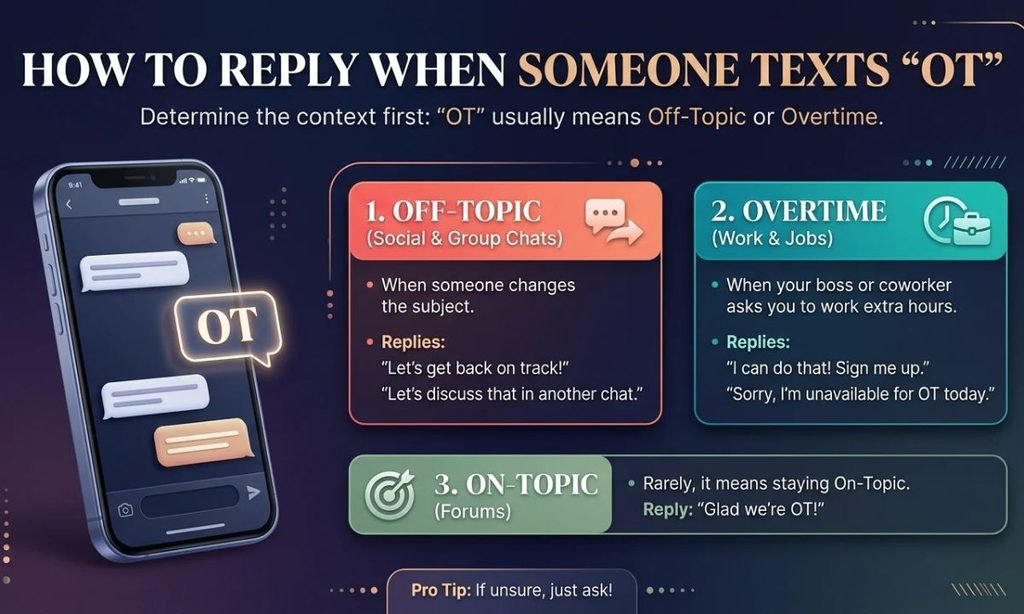
Usually you don’t need a special response. Answer the new question or comment. If the shift confuses you, ask for clarification. When someone writes, “OT, can I ask you something?” a simple “Sure what’s up” works fine.
If you can’t tell which meaning they intend, ask a direct question: “Do you mean off topic or overtime?” It takes five seconds and saves a misunderstanding. I ask whenever I’m not sure, and nobody has ever minded.
Smart Tips for Using OT
Check the context first, and look at the words just before and after OT. In an informal chat, use it for off-topic transitions, and keep “OT quick question” as your go-to casual opener. In a forum, start with OT and follow it with your off-topic message, so readers can skip the tangent if they like.
Don’t assume off topic when the subject is hours, pay, shifts, or sports. With coworkers, write out “overtime” whenever money or scheduling is involved, and in professional settings state clearly how many hours OT means. Use OT sparingly in social settings, because excessive abbreviations are harder to follow and overuse dulls the signal.
Consider your audience, since friends need less explanation than customers or clients. Let the rest of your sentence set the tone. If you’d rather skip the abbreviation, “side note” or “different topic” covers off topic, and “extra hours” or “overtime” covers the work meaning. Those options take longer to type, but they’re harder to misread. And yes, OT is still used in 2026, in both social and professional conversations.
Here’s a quick reference to keep handy:
| Abbreviation | Full form | Context | Example |
| OT | Off Topic | Online chats, forums | OT, did you see the new café? |
| OT | Over Time | Work-related texts | I’ll need 2 hours OT to finish the report. |
The Takeaway on OT Meaning in Text
OT is a compact way to say you’re about to mention something unrelated. You’ll see it in group chats, social media comments, and informal DMs, where it protects the flow of a conversation by marking a quick change instead of making the new subject feel random.
It isn’t limited to one definition, though. In workplace and sports talk, overtime is the other major meaning, and “OT tonight” or “went into OT” have nothing to do with changing topics. Hours, wages, shifts, or a game are your hints.
The smartest move is simple: read the surrounding sentence before you decide. A random side question means off topic. Anything about hours means overtime. Next time OT shows up in your messages, let the context tell you what it means, and you’ll rarely get it wrong.
FAQs
What does OT mean in text?
OT most often means “off topic.” People type it before a message that has nothing to do with the current conversation.
In work chats, it can also mean overtime.
What does OT mean when someone texts it to you?
Most likely they’re about to change the subject, like “OT, did you see the game last night?”
Check the words after it. A question usually means off topic, and a number of hours usually means overtime.
How do I know if OT means off topic or overtime?
Look at the surrounding words. Hours, pay, shifts, or schedules point to overtime. A random question or a new subject points to off topic.
If you still can’t tell, ask: “Do you mean off topic or overtime?”
What does OT mean on Instagram, Snapchat, and TikTok?
On all three, it usually means off topic. People use it in comments and DMs before a side question or compliment, like “OT, where did you get that jacket?”
Snapchat tends to be the most casual, so you may see a lowercase “ot lol.”
Does OT mean overtime in a text message?
Yes, especially in work or sports conversations. “I’m doing OT tonight” means extra working hours, and “we won in OT” means a game went past regulation time.
What does OT mean at work?
In a work chat, it usually means overtime, so “OT approved for Saturday” is about extra hours. In a casual team channel, it can still mean off topic, as in “OT: any lunch spot recommendations?”
When pay or scheduling is involved, spell out “overtime.”
Does OT have a romantic or flirty meaning?
No. The letters only signal a subject change. Any flirty or affectionate feeling comes from the rest of the message, such as “OT, I miss seeing you.”
Is OT rude or negative?
No, it’s a neutral shorthand. Tone depends on what follows, so “OT, I love your haircut” sounds friendly and “OT, can we talk?” may sound serious.
It’s usually meant as a polite heads-up before a subject change.
How should I reply when someone texts OT?
Just answer the new question or comment. A simple “Sure, what’s up?” works fine.
If the message is confusing, ask what they mean before you reply.
What’s the difference between OT and BTW?
BTW means “by the way” and adds a side thought without announcing a topic change. OT says outright that the message is off topic.
They overlap, but OT is the clearer signal of a full change of subject.
Can I use OT in a professional email?
It’s best avoided. OT is rare in formal emails because it can be read two ways, and a manager may assume overtime.
It’s more common in informal workplace chat tools.
What can I say instead of OT?
For off topic, try “side note,” “different topic,” or “random question.” For overtime, write “overtime” or “extra hours.”
These take longer to type but are harder to misread.
Where did OT come from?
Nobody has a clear first-use record for either meaning. Overtime is generally considered the older one, from workplaces and payroll. The off-topic use grew later on online forums and bulletin boards.
Exact dates are debated, so treat any precise year with caution.
Is OT still used in 2026?
Yes. It’s still common in group chats, comment sections, and workplace messaging apps.
Both meanings remain in use, so context is still the key.
