

A text pops up that says IML and nothing else. Is the sender owning up to a fib, or sneaking in a love note? The IML meaning in text depends on who typed it and what came right before it.
People search for this one because the same three letters point in two directions. You’ll run into it on Snapchat, TikTok, Instagram, WhatsApp, and plain SMS, in captions, comments, and bios. Parents also stumble on it while glancing at a teenager’s chat and wonder if they should be worried or touched.
This guide sorts it out. You’ll get both meanings, the origin of each, real conversation examples, reply ideas, grammar notes, and the mistakes that cause awkward moments. By the end, you’ll know exactly what to make of IML when it lands on your screen.
Answer Block: IML in text has two common meanings. In a joking chat it can mean “I’m lying,” a quick way to admit a joke or exaggeration. Typed as ImL in the Arial font, it means “I love you,” a visual pun on the American Sign Language hand sign. The sender and the conversation tell you which.
Two Meanings, One Abbreviation
Most slang has one meaning and a few spelling variants. IML has two live meanings that have nothing to do with each other. One is a confession, the other is a compliment, and mixing them up can be genuinely awkward.
The “I’m lying” version is pure texting shorthand. The “I love you” version is a typographic trick that depends on a specific font. I’ll cover each in full, then show you how to tell them apart in a real thread.
IML Meaning in Text as “I’m Lying”
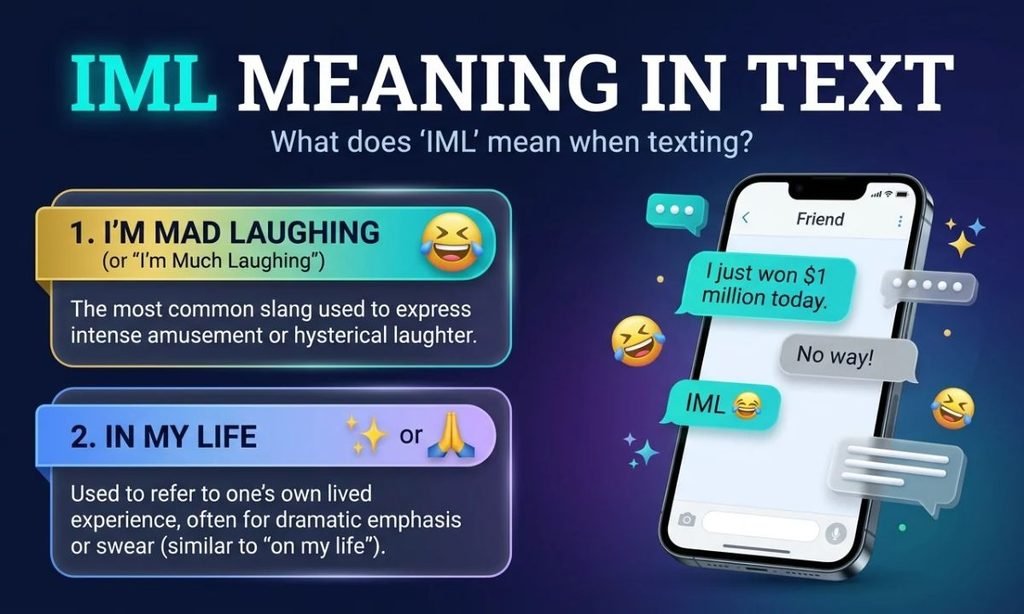
Spell it out and you get a complete thought: I’m lying. IML is a short-form expression that stands in for that sentence. What it really carries is tone and intent. The sender is telling you the previous line was a bit, not a fact.
It’s an internet acronym people type in online conversations to take something back. They were kidding, joking, exaggerating, or simply not telling the truth. You’ll usually spot it right after a claim that sounded too wild to be real.
A quick example shows the rhythm:
A: I just won $1 million today.
B: No way!
A: IML 😂
A makes a claim, B reacts, and the laughing emoji works as a tone marker. IML tells B the message wasn’t serious. That’s three speaker turns: claim, disbelief, retraction. The whole exchange takes about five seconds.
Is It an Acronym, Slang, or a Typing Shortcut?
People argue about the label, and I’d say it’s all three. The letters map to a phrase, so it’s an acronym. It lives in online chats, so it’s internet slang. And it saves you from typing a full sentence, so it’s a typing shortcut too.
What it isn’t is a meme word, and it isn’t phonetic spelling like “gonna.” It belongs to fast texting culture and sits in an informal register. It does one small job and does it well.
How IML Works in a Chat
In a general chat, people use it to reveal they were joking, correct a lie, or admit sarcasm. It often adds playful humor to an exaggeration the other person just called impossible. The pattern is always the same: someone says something big, someone doubts it, and IML clarifies.
A: I ate 20 burgers today.
B: That’s impossible.
A: IML, I only had two.
The claim is 20 burgers, and the fix is “I only had two.” B usually answers with a laugh or an eye-roll. It’s a handy starter example because the correction does the explaining.
IML on Snapchat, TikTok, Instagram, WhatsApp, and SMS
The “I’m lying” meaning stays the same across apps. What shifts is the tone and the spot where it appears. Here’s how each platform handles it.
Snapchat
Snapchat runs on quick back-and-forth, so short acronyms fit right in. IML there leans playful, with quick humor, casual joking, and light teasing. Nobody blinks at it.
A: I just met a celebrity at the mall.
B: Who??
A: IML lol.
The sender made it up. “Who??” is an interjection, “lol” is a laughter marker, and the whole thing ends in a shrug. I’ve seen versions of this exchange more times than I can count, usually about a famous person who was supposedly in a grocery store.
TikTok
On TikTok, IML turns up in comment sections, video captions, and reply threads. People use it for self-aware humor and playful exaggeration, then reveal the claim wasn’t true. It’s social media language at its most compressed, and it often shows up later in a thread, after someone calls out the claim.
Comment: “I can run 50 miles without stopping. IML.”
That’s hyperbole with a tone signal stuck on the end.
Instagram gives it three homes: direct messages, comment replies, and story reactions. DMs are where it’s used most. The tone often tilts toward trolling.
A: I just bought a private island.
B: Seriously??
A: IML 😭
The claim gets a disbelieving reply, and the crying-laughing face seals the joke.
WhatsApp chats feel more personal, so IML usually appears as a quick confession between friends. It works because both people know each other’s sense of humor. The same line sent to a stranger would just be weird.
A: I’m moving to Mars next week.
B: Stop lying.
A: IML 😂
SMS
Regular text messaging works the same way. IML admits a joke, clarifies sarcasm, or corrects an exaggeration. SMS is simply the oldest format for it.
A: I finished the whole pizza myself.
B: Wow!
A: IML. I shared it.
How Tone Changes the “I’m Lying” Meaning

The words stay the same, but the mood around them shifts what the sender intends. Linguists call this pragmatics. In everyday terms, the same three letters can signal a joke, a flirt, or a backtrack depending on the moment.
Funny Tone
A: I just adopted 12 dogs.
B: Seriously?
A: IML 😂
This is the easiest version and probably the most common one you’ll see. It’s a joke reveal with an emoji attached.
Sarcastic Tone
A: Yeah, I totally love waking up at 5 AM.
B: Really?
A: IML.
Used after sarcasm, IML flags the irony. It’s handy when the sarcasm didn’t come through clearly in text, since tone is the first thing to disappear on a screen.
Romantic Tone
A: I don’t miss you at all.
B: Wow rude.
A: IML… I miss you a lot.
Occasionally it shows up while flirting. The retraction carries the affection, and the emotional payoff sits in the second half.
Angry Tone
A: I hate talking to you.
B: Okay then.
A: IML… I was just mad earlier.
This one is rare. The anger comes first, then a backtrack. It works less like a joke and more like a quick apology for a heated moment.
Playful Tone
A: I ate your snacks.
B: What??
A: IML lol.
Friendly teasing among close friends, and very common. The laughter marker makes the tease obvious.
15 Real Text Examples of IML
Here are fifteen everyday exchanges where IML turns up. Each one follows the same arc: a claim, a reaction, and a retraction.
- A: I just bought a Ferrari. B: Stop lying. A: IML.
- A: I failed the test. B: Oh no! A: IML I passed.
- A: I’m quitting my job tomorrow. B: Why? A: IML lol.
- A: I’m moving to Japan. B: Really? A: IML.
- A: I hate pizza. B: Impossible. A: IML 😂
- A: I finished the entire Netflix series today. B: Already? A: IML.
- A: I forgot your birthday. B: Wow… A: IML don’t worry.
- A: I ran 10 miles today. B: That’s impressive. A: IML 😅
- A: I’m famous now. B: Where? A: IML.
- A: I deleted Instagram forever. B: Really?? A: IML lol.
- A: I ate all the cake. B: No way. A: IML.
- A: I met your favorite actor today. B: WHAT?? A: IML 😭
- A: I won the lottery. B: Stop playing. A: IML.
- A: I’m the smartest person alive. B: Sure. A: IML 😂
- A: I’m never texting you again. B: Okay. A: IML.
Look at the patterns across the list. Speaker turns stay short, and the emoji usually decides whether the tone lands warm or awkward.
The Grammar of IML
Knowing how IML behaves in a sentence helps you use it correctly. The syntax is looser than most people expect.
Part of speech: It’s an acronym phrase standing in for a full sentence. It isn’t a noun or a verb on its own, so there’s no tidy label for it. Think of it as a clause squeezed into three letters.
Sentence role: It often replaces lines like “I was lying,” “I’m joking,” or “That was not true.” The speech act is a retraction. It cancels the claim that came before.
Sentence position: It usually lands at the end of a sentence: “I just ran 20 miles… IML.” It can also stand alone as a reply to “Really?” Placement flexes, but the end is the favorite spot.
Formal vs informal: It’s internet-only slang. It stays out of essays, assignments, and professional documents. The formality line here is a hard one.
Tone impact: IML signals humor, playfulness, self-correction, or sarcasm. Without it, people might read your message as serious. That’s the problem the acronym solves.
How to Reply When Someone Texts IML
When someone admits they were joking, match their mood and you’ll sound natural. Your reply depends on what you want to say about the joke.
Funny Replies
Try “You almost had me,” “I believed that for a second,” “Nice try,” or “You’re a professional liar 😂.” Keep it short, because the joke was short.
Serious Replies
“Okay, good to know.” “I figured you were joking.” “That makes more sense.” These acknowledge the retraction without adding spark.
Flirty Replies
“You’re lucky you admitted it.” “I was about to get mad at you.” “Good thing you told the truth.” A little playful reproach goes a long way here.
Neutral Replies
“Lol okay.” “Got it.” “That explains it.” A short reply is usually plenty.
Is IML Rude or a Bad Word?
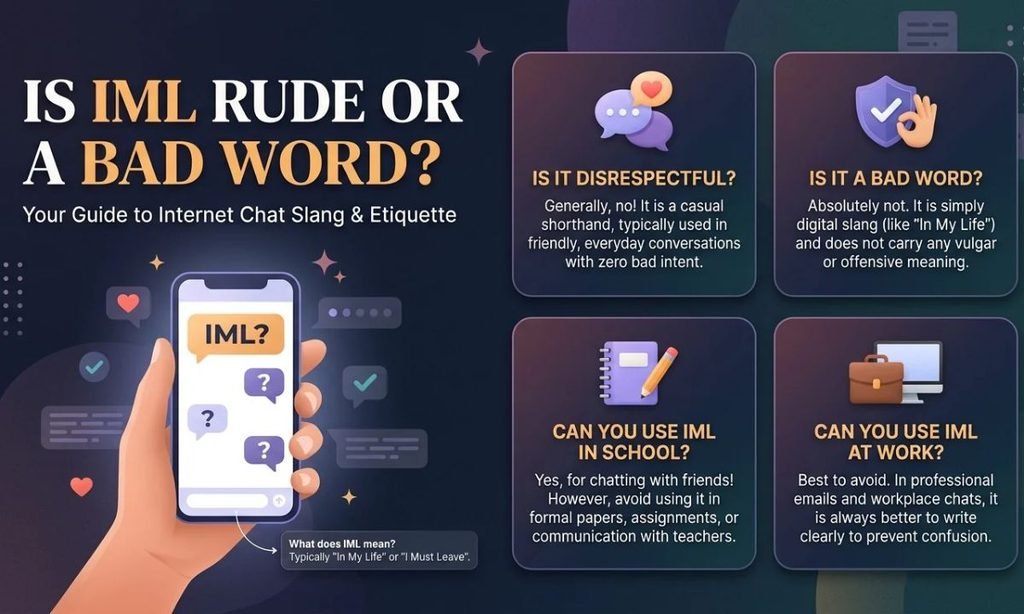
No. IML isn’t considered rude or offensive, and it contains no profanity. Context still matters, though, since how you use it can land badly even when the word is clean.
Is It Disrespectful?
Usually not. It’s a playful admission of joking. Whether it reads as respectful depends on what you lied about.
Is It a Bad Word?
No. It’s safe, harmless slang with nothing offensive in the vocabulary. Still, it’s informal, so it can look out of place in formal or professional settings.
Can You Use IML in School?
Casual chats with friends are fine. Essays, assignments, and formal emails are not. Formal writing needs a different register.
Can You Use IML at Work?
I’d skip it in professional communication. The exception is casual messages with coworkers you already joke around with. Most work channels run on a professional register, and that tips the balance toward plain language.
Who Uses IML, and Where
The “I’m lying” version skews young. It travels with the platforms that spread slang fastest.
Age Groups
It’s most popular with Gen Z, teenagers, and young adults. Millennials sometimes use it, though less often. That split matches how most slang moves from younger groups outward.
Regions
It appears mostly in the United States, the United Kingdom, and Canada, plus global internet communities. Because internet slang spreads fast, it’s recognized worldwide now. Regional usage and dialect still vary.
Most Common Platforms
You’ll see it most on Snapchat, TikTok, Instagram, WhatsApp, and SMS. These apps reward fast, casual texting, and short acronyms thrive there.
Where the “I’m Lying” Meaning Comes From
The origin of this version isn’t clearly documented, and I’d be wary of anyone who gives you a neat story. It most likely grew out of fast typing culture in online messaging. People wanted to save typing time, share humor quickly, and avoid misunderstandings in short messages.
Instead of typing “I’m lying” or “I was joking,” they shortened it. That’s slang formation doing what it always does. No single meme or TikTok trend created it, though social media helped it spread.
IML Meaning in Text as “I Love You”
Now for the other meaning. Here the definition fits in one line: IML stands for “I love you,” and the reason is the font. Type ImL with a capital I, a lowercase m, and a capital L in Arial, one of the most common fonts on phones and computers.
Look closely and the letters echo the hand shape of the American Sign Language sign for “I love you.” That sign blends the letters I, L, and Y. The pinky goes up, the index finger and thumb extend, and the middle and ring fingers fold down.
Squint at ImL and you can see it. The tall I and L frame the rounded m in the middle, like extended fingers around folded ones.
Why the Arial Font Matters
Texting abbreviation guides from the early days carry a small note: in Arial font. The blocky letterforms make the illusion work. In other fonts the letters can look too thin, too curly, or too stylized, and the pun falls apart.
So ImL is a tiny picture of a hand gesture drawn with keyboard characters. It’s part abbreviation, part ASCII-style art, and part love note, all in three keystrokes. I can’t think of another slang term with this kind of font dependency.
Breaking Down Each Letter
The character mapping is the whole trick. The capital I stands for the raised pinky, the “I” in “I love you.” The lowercase m sits in the middle and suggests the folded-down middle and ring fingers. The capital L is the extended index finger and thumb, the “L” of love.
Together in Arial, they become a miniature love note you can only fully appreciate if you know the secret. That hidden quality is the charm. Sending it feels like sharing a code or an inside joke with someone you care about.
Where ImL Came From
Nobody can hand you an exact birth date for ImL. The footprints lead back to the early 2000s, the golden age of instant messaging. On AIM, MSN Messenger, and early SMS texting, every character counted and creativity was currency. One of the best-known early references is Webopedia’s text abbreviations guide
It earned a spot in the abbreviation dictionaries of the era, next to LOL, BRB, and TTYL. One of the best-known early references is Webopedia’s text abbreviations guide. It listed ImL as meaning I love you in Arial font, a way of borrowing American Sign Language for text.
That single entry got copied word for word across hundreds of abbreviation websites, and nearly every list still repeats it. It’s how most of the internet learned the term. It also means the documentation is thin, so treat any tidy origin story with caution.
The ASL link tells you something about the time. By the late 1990s the I-love-you hand sign was a widely recognized cultural symbol, flashed at cameras by celebrities and athletes. Texting culture took that borrowing and translated it into type.
Then devices changed, from flip phones to smartphones to Instagram, Snapchat, and TikTok. ImL survived the move. It never went mainstream like ILY or the heart emoji, but it settled into a lasting niche as the thoughtful, boutique way to say I love you.
How Popular ImL Is Today
It sits in a middle ground. You won’t see it as often as LOL or OMG, but it hasn’t faded either. Search interest, as far as I can tell, shows a steady stream of people looking it up year after year. I don’t have a hard search volume number, but the pattern is easy to read.
I think of it as a cycle of discovery. Someone gets a message, gets curious, looks it up, and starts using it. A few things keep that cycle turning.
It leans romantic and affectionate, which keeps it timeless. Slang tied to a joke or trend dates fast, but new ways to say I love you rarely do. The ASL connection also makes it feel thoughtful rather than lazy, and typing it signals a bit of insider knowledge that appeals to teens and young adults.
On TikTok and Instagram it shows up in captions, comments, and bios, often next to the ASL hand sign emoji. On Snapchat it lives in streaks and late-night chats between close friends and couples. Parents meet it while scrolling their kids’ messages, which is why “what does IML mean” is such a common search among moms and dads.
It’s still far less common than ILY, ILU, or ILYSM. Think of it as the boutique option: distinctive and memorable when it appears.
How People Use ImL in Chats
Knowing the definition is half the battle. The other half is knowing how the message behaves, because context changes how it lands.
As a Standalone Message
The most common use is ImL by itself. It tends to arrive at the end of a conversation, as a goodnight text, or as a midday surprise. The brevity is the point.
As a Sign-Off
Plenty of people use it the way others use “love you” or xoxo. Something like “Good luck on your exam tomorrow, ImL!” works. It softens a message and adds warmth without a full sentence.
In Captions, Comments, and Bios
On Instagram and TikTok it appears in comments on a partner’s post, in photo captions from weddings and anniversaries, and in bios, where space is tight.
Flirty and Playful
Because it’s less direct than typing out “I love you,” ImL can carry a flirty, light tone. That makes it popular in the early stages of dating, when the full phrase might feel too heavy. It’s just as common between friends and family, though, so the tone depends on the relationship.
Between Family
Parents, kids, siblings, and grandparents use it too, usually after someone explains the trick. It has a wholesome secret-code quality that suits family group chats. I’ve watched it spread through a family chat because one person got curious.
One caution applies. It’s almost never used in professional or formal communication. A work email, a message to your boss, or a formal announcement is the wrong place for it.
Real ImL Conversations
Seeing it in action is the quickest way to grasp how it works.
Friendly Examples
Alex: “Made it home safe.”
Jordan: “Good. Get some rest, ImL.”
Goodnight message: “Long day. Heading to bed. ImL, talk tomorrow.”
Mom: “Dinner’s ready, everyone come downstairs!”
Daughter: “Coming! ImL mom.”
Between best friends: “Thanks for letting me vent for an hour. You’re the best. ImL.”
Professional Examples
Here’s the honest truth: there aren’t good professional examples. Texting your manager ImL after a performance review would be confusing at best and inappropriate at worst.
The closest case is a warm note to a longtime colleague who’s also a close friend. Even then, plain language is safer. To show appreciation at work, skip the slang and write, “Thanks so much, I really appreciate you.”
Funny Examples
After sending a meme: “This one’s you. ImL, you absolute gremlin.”
Food-related affection: “Saved you the last slice of pizza. ImL, and don’t forget it.”
Playful exaggeration: “You did the dishes without being asked?? ImL, marry me again.”
Pet messages: “The dog just did the cutest thing. ImL, both of you.”
Notice the mock-serious tone. A grand gesture like “I love you,” even in code, meets something silly like pizza or dish duty. That playful contrast is what makes texting fun.
ImL vs ILY and Other Love Shorthand
ImL isn’t the only way to say I love you in shorthand. Here’s how the close cousins compare.
| Term | Meaning | Tone | Best used |
| IML / ImL | I love you (ASL pun in Arial) | Sweet, clever, playful | A creative, insider-feeling love note |
| ILY | I love you | Warm, standard | Everyday affection with partners, friends, family |
| ILU | I love you | Casual, relaxed | Quick texts when ILY feels formal |
| ILYSM | I love you so much | Intense, heartfelt | Anniversaries, apologies, big moments |
| LY | Love you | Breezy | Sign-offs and rapid-fire chats |
| 143 | I love you (1-4-3 letters) | Retro, nostalgic | Pager-era, old-school vibe |
| XOXO | Hugs and kisses | Affectionate | Sign-offs, cards, friendly warmth |
The real difference is effort and cleverness. ILY is the workhorse everyone understands. ImL is a conversation piece, and decoding it is part of the gift. If ILY is a hug, ImL is a hug with a wink.
Both carry the same basic message, but clarity still matters. If the person might not know the slang, ILY is the safer pick. ImL works best with people who are already in on it.
Other Meanings of IML
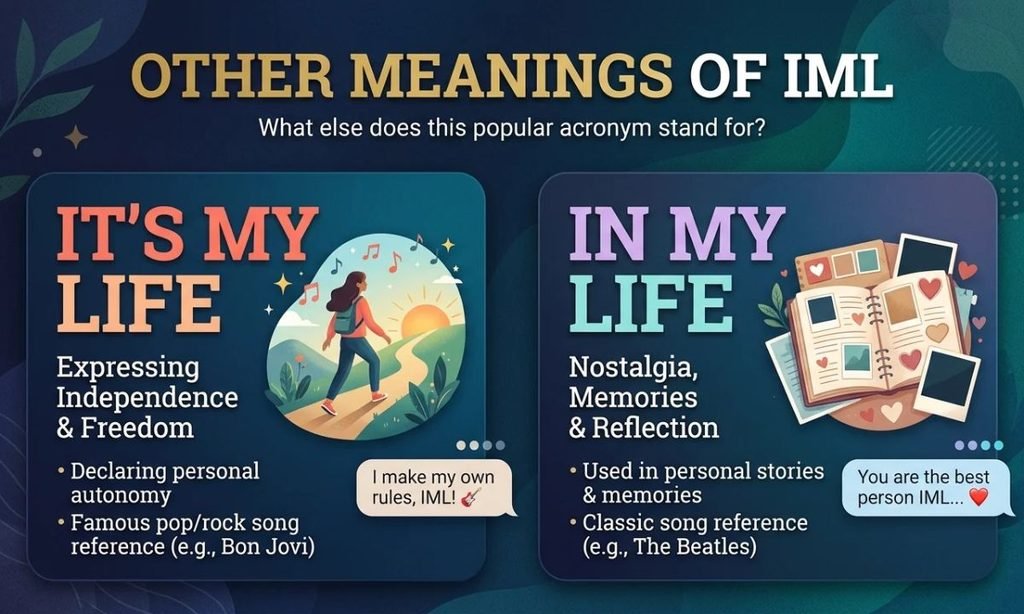
Like many three-letter combos, IML has more than two uses. Context is everything, and the ambiguity is real.
It’s My Life
The most common extra meaning is “It’s My Life.” It reads as a statement of independence, with the attitude of YOLO. Someone might post it beside a bold decision, living life on their own terms.
The Bon Jovi song of the same name strengthened the link and turned the phrase into an anthem of self-determination. On social media, that cultural reference is a useful clue.
In My Life
IML can also stand for “In My Life,” often when someone reflects on experiences or relationships. A caption might read, “The best thing IML right now is my morning coffee ritual.” It’s less common, but it does appear in casual posts.
Technical and Industry Meanings
Outside texting, IML has technical definitions. These include in-mold labeling in packaging manufacturing, interactive machine learning in artificial intelligence, and initial microcode load in computing.
You’ll almost never see these in a text message. They’re still worth knowing so you aren’t thrown when the term shows up in a work document or news article.
How to Tell Which IML You Got
Disambiguation usually takes seconds. Start with the sender and the moment.
A joking thread right after a wild claim points to “I’m lying.” A sweet message from someone close, especially typed ImL, almost certainly means “I love you.” A bold social post about independence likely means “It’s My Life.” A technical document or industry article points to the technical definitions.
On Snapchat and TikTok, the two main meanings both circulate. You’ll see it in comments, captions, streak messages, and bios. Check the post or the thread before you decide, because the surrounding conversation resolves the ambiguity nearly every time.
IML vs IDK and Other Slang
People sometimes mix IML up with other short acronyms. This comparison uses the “I’m lying” meaning.
| Slang | Meaning | Register | Tone | Popularity | Confusion risk |
| IML | I’m lying | Informal | Playful | Medium | Medium |
| IDK | I don’t know | Informal | Neutral | Very high | Low |
| ION | I don’t | Informal | Casual | Medium | Medium |
| Dunno | I don’t know | Informal | Neutral | High | Low |
| IDC | I don’t care | Informal | Dismissive | High | Low |
IDK and IDC are used far more than IML. The meanings are also completely different, so the mix-up usually comes down to similar letters. If you want more short acronyms explained, check our OT meaning in text guide.
In my own chats, people rarely type IML alone unless they’ve exaggerated something first. It most often travels with laughter: “IML 😂,” “IML lol,” or “IML I was joking.” Those markers make the message read as friendly and less confusing. That’s just my observation of real messaging habits, not a formal study.
How to Type ImL Correctly
For the “I love you” meaning, type a capital I, a lowercase m, and a capital L: ImL. That mixed casing in Arial creates the visual resemblance to the ASL sign.
All caps still gets the abbreviation across to people who know it. You just lose the visual pun that makes it special. For the “I’m lying” meaning, casing doesn’t matter much, and most people type it in capitals.
Polite Alternatives to IML
IML can be charming or funny, but it isn’t always the right call. With professional contacts, formal messages, or people who may not know texting slang, plain language wins. The rule of thumb is simple: if there’s any chance the other person won’t understand it, pick clear words. Slang is a spice, not the whole meal.
For Work and Formal Settings
Try “Thank you so much, I really appreciate your help” or “I’m grateful for everything you do.” “It was wonderful working with you” fits too. For sign-offs, “Warm regards” or “Best wishes” is safe.
For Expressing Affection Clearly
“I love you” is simple, direct, and never misunderstood. “Love you lots” is a bit looser. You can also try “Sending you so much love,” “You mean the world to me,” or “Thinking of you and sending love your way.”
For Friendly Warmth Without Romance
Platonic phrases keep things light: “You’re the best!”, “So thankful for you,” “Appreciate you!”, and “Take care!”
When to Use IML and When to Avoid It
Use it when you made a joke, exaggerated something, or want to clarify sarcasm. Use the love version with people who already know the trick, or when you want a playful, affectionate message. These are the situations where it fits naturally, usually with people who already know your sense of humor.
Avoid it in professional emails, school essays, and formal conversations. It’s informal slang, and it looks out of place where a professional register is expected. For anniversaries, apologies, and big emotional moments, spell things out in full words, because full words beat any abbreviation when it counts.
Common IML Mistakes
A few missteps can turn a simple message into an awkward moment. Here’s what I’d watch for.
- Sending it without context. If nobody saw the claim, nobody knows what you’re retracting.
- Assuming everyone understands it. Plenty of people don’t, and that’s where mix-ups start.
- Choosing the wrong audience. Your boss, a new acquaintance, or a formal contact will likely be confused. This is the workplace mistake I see most.
- Typing it in all caps when you want the love pun. The lowercase m turns into an uppercase M, and the illusion weakens.
- Trusting the font. Some messaging apps use custom fonts, and the visual trick vanishes. The meaning usually survives, but the cleverness may not.
- Overusing it. Sprinkled into every message, it loses its punch, like any term of affection.
- Misreading the context. If someone posts IML after quitting their job to travel the world, replying “aww love you too” misses the mark. They meant “It’s My Life.”
- Using the love version too early in dating. Because it secretly means I love you, dropping it in week one can send a stronger signal than you intended.
- Explaining the joke every time. A paragraph about the Arial trick kills the charm. Let curious people ask.
- Using it in formal settings. That’s a register error, and a little audience awareness prevents most of the miscommunication.
Tips for Using ImL Naturally
Match the casing: a capital I, a lowercase m, and a capital L keep the classic Arial pun intact. Keep it personal, since it works best one-on-one or in group chats with close friends and family rather than with strangers.
Timing helps. A goodnight text, good news, or a random Tuesday message lands well, because unexpected affection hits hardest.
Don’t force it. If “I love you” or ILY feels more natural, use those. It should feel playful, not performative. In serious conversations, plain words like “I love you, I’m here for you” carry more weight than clever slang.
If someone asks what it means, explain the trick once with some enthusiasm, then use it freely with them.
The Short Version Before You Hit Send
The IML meaning in text comes down to context. In a joking exchange, it’s a quick confession: I’m lying. In a warm message typed ImL, it’s a hidden hand sign that says I love you.
Check who sent it, read the thread, and notice the casing. Keep it out of work emails and school writing, and pick plain words when the moment matters. If you’re still decoding a group chat, our guides to whf meaning in text and csl meaning in text are good next stops.
FAQs
What does IML mean in text?
IML has two common meanings in texting. It can mean “I’m lying,” used to admit a joke or exaggeration. Typed as ImL in Arial, it means “I love you.”
How do I know which IML someone means?
Check the conversation first. After a wild claim, it usually means “I’m lying.” In a sweet message from someone close, especially typed ImL, it usually means “I love you.”
Why does IML have to be in Arial font to mean “I love you”?
In Arial, the tall I and L frame the rounded m, matching the American Sign Language “I love you” hand sign. Other fonts change the letter shapes, so the resemblance disappears.
What does IML mean on Snapchat and TikTok?
On both apps, it can mean “I’m lying” in a joking thread or “I love you” in a sweet message. You’ll see it in comments, captions, chats, and bios. Read the surrounding conversation to be sure.
Is IML the same as ILY?
They can carry the same message when IML means “I love you,” but they feel different. ILY is the standard version everyone knows. ImL is the clever, insider version with a hidden visual trick.
How do you type IML correctly?
For the “I love you” meaning, type a capital I, a lowercase m, and a capital L: ImL. All caps still works for people who know it, but it loses the visual pun. For “I’m lying,” casing doesn’t matter.
How do you reply when someone texts IML?
Match their mood. For the joke meaning, try “You almost had me” or “Nice try.” For the love meaning, a simple “ILY too” or “Love you too” works.
Is IML rude or a bad word?
No. IML is harmless slang with no profanity in it. It’s informal, so it looks out of place in formal or professional settings.
Can you use IML at work or in school?
Skip it in work emails, essays, and formal messages. Casual chats with friends or close coworkers are fine. Use plain language everywhere else.
Is sending ImL flirty?
It can be. It’s less direct than writing “I love you,” so people often use it in a light, flirty way, especially early in dating. It’s just as common between friends and family.
Does IML have other meanings besides “I’m lying” and “I love you”?
Yes. It can also mean “It’s My Life” or “In My Life” on social media. In technical fields, it can stand for in-mold labeling, interactive machine learning, or initial microcode load.
Who uses IML the most?
It’s most popular with Gen Z, teenagers, and young adults. Millennials sometimes use it too, but less often. It shows up most in the United States, the United Kingdom, and Canada.
Where did the IML slang come from?
The “I love you” version dates back to the early 2000s era of instant messaging and appeared in texting abbreviation lists such as Webopedia’s. The “I’m lying” version has no clearly documented origin.
