

You open a group chat and there it is: a lone “OM” with nothing else. The OM meaning in text is usually “Oh My,” a quick reaction to something surprising, funny, or shocking. If it came with an exclamation mark, that’s almost certainly what your friend meant.
Two letters shouldn’t cause this much confusion, but they do. People see OM in text messages, Snapchat stories, TikTok comments, and gaming chats, and wonder whether it’s excitement, shock, a typo, or an unfinished message. I’ve watched people stare at a bare OM in a group chat, and the tone around it usually settles the question.
This guide covers what OM stands for, where the habit came from, and how people actually use it. You’ll also get real chat examples, a comparison with OMG, SMH, and LOL, and the mix-ups worth avoiding.
OM in text is short for “Oh My,” an informal slang reaction to something surprising, funny, or exciting. It works like a milder OMG. Less often, OM can mean Old Man, On My, Oh Man, or Oh My God, so the surrounding conversation, tone, and platform decide the right meaning.
What Does OM Mean in Text Messages?

Start here: OM = Oh My. It’s text slang, a short form people use to show surprise, shock, or excitement without typing a full sentence. “OM, that was amazing!” is the classic case. The sender is impressed and typing fast.
The meaning shifts with context, though. Here are the main ones you’ll run into:
- Oh My: the everyday reaction, and by far the most common.
- Old Man: informal talk about a father or husband.
- On My: the start of a phrase like “OM way,” usually meaning “on my way.”
- Oh My God: a shortened version some people prefer over OMG.
- Oh Man: a close variant for mild frustration or surprise.
- Order of Merit: a rare, formal use. It’s a British honour and has nothing to do with chatting.
With this many options, the situation, tone, and conversation style matter more than the letters. A quick check works well: ask yourself what just happened. If something amazing or odd just landed, it’s Oh My.
The OM Meaning in Text Explained in Simple Words
In very simple words, OM is short text slang that shows strong feelings. It lets you type faster and react right away. That’s the whole definition.
The words themselves were never the hard part. Reading the tone and the emotion behind them is the real work.
Origin and History of OM in Text
Nobody can point to the first person who typed OM, so the origin is debated. What follows is the likeliest story, not a documented fact.
The history of OM probably runs alongside OMG. In early SMS culture, around the early 2000s, messages had tight character limits. People got used to shortening words and dropping letters. Oh My God became OMG, and Oh My became OM. It’s the same shortening pattern, just with less drama.
Internet chat rooms, forums, and MSN Messenger carried the habit forward, which is why early internet slang is full of clipped phrases. Mobile texting kept it going. From 2010 to 2026, WhatsApp, Instagram, Snapchat, and TikTok pushed online talk toward fast replies, quick reactions, and short comments. OM never grew as big as OMG, and it reads as a bit less formal than writing out “Oh My.”
If you want the origin in one line, it’s a text abbreviation that grew out of thumbs trying to keep up with feelings.
Common Meanings of OM in Text

Here’s how I’d sketch the meanings in a table, each with a full form, a usage type, and an example.
| Meaning | Full form | Usage type | Example |
| Oh My | Oh My | Emotional reaction | “OM, this is crazy!” |
| Old Man | Old Man | Family slang | “My OM is calling me.” |
| On My | On My | Phrase start | “OM way home” |
| Oh My God | Oh My God | Strong reaction | “OM, I can’t believe it!” |
| Order of Merit | Order of Merit | Formal honour | Never used in chat |
OM as Oh My
This is the emotional reaction, a short response to news or a funny moment. “OM, this is crazy!” is typical.
OM as Old Man
This is family slang. Someone writes “My OM is calling me,” and they mean their father. It’s a personal use, and you’ll mostly see it between people who already know each other. In gaming and Discord chats, it sometimes shows up as a joking “Old Man,” and in some gaming or military-style chats it can be mistaken for the other meanings.
OM as On My
This one is a slang phrase start, and it’s the one I see least. “OM way home” is the standard example. To be honest, I’ve mostly seen it as a typo or a rushed thumb, so don’t count on it.
OM as Oh My God
Some people use OM as a short reaction in place of OMG. “OM, I can’t believe it!” works either way, and the conversation tells you which one is meant.
OM as Oh Man
This close variant covers mild frustration or surprise. When someone writes “OM” after bad news, I read it as Oh Man. After good news, it’s Oh My.
OM as Order of Merit
This is purely formal. It refers to the Order of Merit, a British honour. You’ll meet it in an academic or awards setting, never in a chat.
How OM Is Used in Real-Life Chats
OM fits best when someone is reacting. Think of seeing shocking news, watching a surprising video, or getting an unexpected message. It also suits funny or emotional content, where a full sentence would feel like too much effort. The pattern is always the same: something happens, and the reaction comes first.
Real-Life Examples With Simple Explanations
An example chat is easier to read when someone spells out what’s going on. In these, A and B are two people texting.
Example 1: a surprise reaction. A: “I won the competition!” B: “OM, that’s amazing!” B is surprised and happy.
Example 2: a funny situation. A: “I just slipped but didn’t fall.” B: “OM, that was close!” B is reacting to a risky moment that ended well.
Example 3: a family context. A: “My OM is coming home today.” B: “Nice, you must be happy!” Here OM means Old Man, so A is talking about their father.
Example 4: casual slang. A: “I’m on my way.” B: “OM way too, see you.” It’s shorthand for “On My.” It reads like a typo to me, but it’s common enough in some chats.
Example 5: a shock reaction. A: “The price of phone dropped by half!” B: “OM, seriously?” B is stunned by the price drop.
More Text Message Examples
These show the range of moments where OM fits. Notice how each one opens the message and the rest of the sentence explains the surprise.
- “OM, did you actually win the giveaway?”
- “OM, I can’t believe she said that.”
- “OM, this weather came out of nowhere.”
- “OM, that ending completely caught me off guard.”
- “OM, you got the job, that’s amazing.”
- “OM, I totally forgot about the meeting today.”
- “OM, that trailer looks incredible.”
- “OM, she really said that in front of everyone?”
- “OM, I just found twenty dollars in my old jacket.”
- “OM, the traffic today was absolutely unreal.”
They cover a win, a shock, a forgotten meeting, a small lucky find, and a rant about traffic. In every case, a full sentence would slow the reaction down.
The Emotional Meaning Behind OM
Typing OM instead of a full sentence usually signals genuine surprise. It’s instinctive and spontaneous, and it mirrors how people react out loud: quick, short, and in the moment. Nobody speaks a carefully composed paragraph when something catches them off guard.
That’s why OM feels honest. It doesn’t look overly thought out, so the reaction stays fresh. When people write something polished, the in-the-moment surprise goes missing.
Who Uses OM
Let me be clear that these are my own observations, not research. The people who use OM tend to share a few traits. They’re fast communicators, they show feelings quickly, and they like a casual tone. A digital native will drop OM in without a second thought.
| Trait | What it means |
| Fast communicator | Uses short words and quick replies |
| Emotion expresser | Shows feelings right away |
| Informal speaker | Prefers a casual tone |
They enjoy fast typing and relaxed conversations, they’re active on social media, and they use modern internet slang without thinking about it. These traits show up in plenty of online slang, not just OM.
When and Where OM Is Used
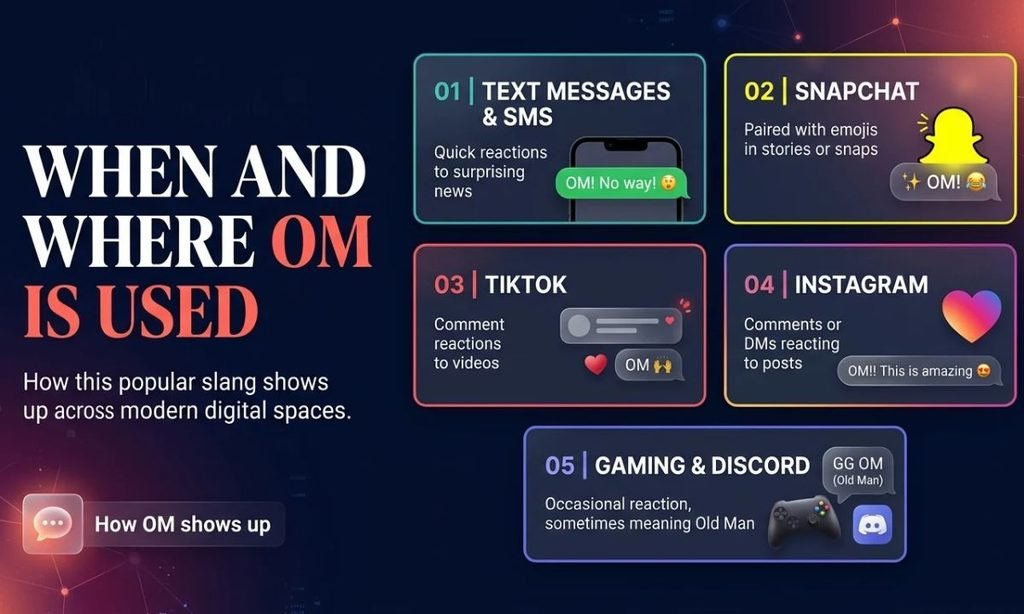
OM lives mostly in informal chats with friends and family. That means WhatsApp, Messenger, and Snapchat. In comment sections it appears as reactions and replies. The tone can shift a little from place to place, but the core meaning stays steady.
| Platform | How OM shows up |
| Text messages and SMS | Quick reactions to surprising news |
| Snapchat | Paired with emojis in stories or snaps |
| TikTok | Comment reactions to videos |
| Comments or DMs reacting to posts | |
| Gaming and Discord | Occasional reaction, sometimes meaning Old Man |
Gamers use it to react fast during play, whether that’s surprise at an event or a bit of frustration. Tone shifts can happen between platforms, so read the room.
Regional and Cultural Usage
OM appears across English-speaking regions, especially among teens and young adults in the United States and the United Kingdom. It’s most common in fast group chats and comment sections. Slower, more formal writing rarely uses it. The quicker the format, the more likely OM shows up.
When Not to Use OM
OM doesn’t belong in emails, office reports, or academic writing. It’s casual internet slang, and those settings expect something more serious. Skip it in professional emails and workplace messages too.
I’ve seen it slip into a workplace chat once, and the pause that followed said it all. I’d also avoid it with anyone who isn’t familiar with slang. If a conversation is serious and the tone needs to stay clear and direct, plain words win. When you’re unsure of your audience, leave it out.
OM in 2026
Texting culture keeps getting faster, and shorter slang keeps replacing longer phrases. OM is still used in quick-typing situations, especially by Gen Z and other younger users. Gen Z slang moves fast, though.
Here’s a 2026-style chat. A: “New AI robot can cook food now.” B: “OM, that’s next level.” B is surprised by a technology advancement.
Is OM Still Popular Today?
Yes, but not as popular as it once was. OM is used less than OMG. Younger users still type it, and you’ll still see it in quick replies.
Emojis are more common now, and voice messages cut down on slang. The emoji question comes down to speed: a reaction emoji is faster than any word. In many chats, emojis replace slang entirely. OM is a small corner of that larger shift.
Common Mistakes and Misconceptions
Misreading OM happens in a few predictable ways, and the confusion often comes down to who is talking and where.
- Thinking OM always means Oh My God. It doesn’t. The meaning depends on context.
- Confusing OM with OMG. OMG is the longer, stronger one. OM is shorter and can carry other meanings.
- Using OM in formal writing. OM is only for informal chats.
- Misreading “OM way.” It can look like a typo. When it’s intentional, it means “on my way.”
- Mistaking it for Old Man. This happens most in gaming or military-style chats.
- Confusing it with the spiritual chant. The chant “Om” is used in meditation and yoga and has nothing to do with texting slang. The gap between OM and Om is mostly capitalization and setting.
- Reading it as a typo for OMG. It’s a separate, deliberate shorthand.
- Assuming it always signals excitement. Tone can lean toward shock or concern instead.
I once saw an “OM” reaction to bad news get read as excitement, which made for an awkward few minutes. These slips are small, but they cause real awkwardness.
OM vs OMG and Other Slang Terms

A quick comparison helps here.
| Term | Full form | Typical tone | Intensity |
| OM | Oh My | Surprised, excited, casual | Medium |
| OMG | Oh My God | Dramatic, strong | High |
| SMH | Shaking my head | Disappointed, unimpressed | n/a |
| LOL | Laugh out loud | Amused, lighthearted | n/a |
OM is informal slang, while OMG is a very common reaction. The difference is mostly intensity. If you want a bigger reaction, reach for OMG. Both are informal. Against SMH and LOL, the difference is emotion, not just length. Those two aren’t surprise reactions in the same way, so each plays its own role, and OM sits at the milder end. If another short abbreviation has you stuck, our guide on IWK meaning in text is a good next read.
Short Dialogues for Better Understanding
A few short dialogues make this clearer.
Dialogue 1. A: “I passed the test!” B: “OM, well done!” B shows happiness and surprise.
Dialogue 2. A: “The movie ending was crazy.” B: “OM, I need to watch it!” B is excited and wants to see it too. The crazy ending sold it.
Dialogue 3. A: “I’m OM way to school.” B: “Okay, see you.” Here OM way means “on my way.” Again, I’d call it half slang, half typo.
OM works best when it opens a reply and the real message follows.
How to Respond to OM
Match their energy with a similarly short, casual reply. If the context feels unclear, ask a quick follow-up question. That’s the safest move when a message leaves you guessing.
If the news is genuinely surprising, answer with your own reaction word. If the tone feels playful, add a laughing emoji. A shocked emoji works for bad news. I usually send a short casual reply first and sort out the details afterward.
Why People Prefer Using OM in Texting
It’s short and fast. It saves time, and it expresses emotion with minimal effort. It’s easy to understand in context, and it fits a modern chat style that values speed.
People who like OM aren’t being lazy. They’re reacting in the moment, the same way they would out loud.
Is OM Safe for Kids?
Generally, yes. As shorthand for “Oh My,” it carries no offensive or inappropriate meaning. It’s harmless, kid-friendly slang that fits casual conversation between friends and family. Parents can relax about this one, though it’s still informal and best kept out of schoolwork or formal writing.
Reading OM Correctly
The OM meaning in text is simple at its core: short, flexible slang that mostly means “Oh My.” It can also stand for Old Man, On My, Oh Man, and once in a while the Order of Merit. Outside texting, the same letters can point to the spiritual chant “Om.”
Context is what keeps the confusion away. Watch the tone, the people, and the platform, and the right meaning usually jumps out. Next time a slang term stumps you, look it up before you reply. A few seconds of checking beats an awkward pause in the group chat.
FAQs
What does OM mean in text?
OM usually stands for “Oh My.” People send it as a quick reaction to something surprising, funny, or exciting. It works like a shorter, milder version of OMG.
Is OM the same as OMG?
Not quite. OMG means “Oh My God” and carries a stronger, more dramatic reaction. OM is shorter, a bit softer, and can sometimes mean other things depending on the chat.
What does OM mean from a girl or a guy in a text?
It means the same thing no matter who sends it. Most of the time it’s a surprised or excited “Oh My.” Check the tone and the topic of the conversation to be sure.
Can OM mean Old Man?
Yes. In family chats or gaming and Discord conversations, OM can stand for “Old Man,” often meaning a father or husband. The context usually makes it clear.
What does OM way mean in a text message?
“OM way” is shorthand for “On My Way.” It’s often a rushed typo, so it isn’t as common as the “Oh My” meaning, but some people use it on purpose.
What does OM mean on Snapchat, TikTok, and Instagram?
On these apps, OM is a quick reaction to a snap, video, or post. You’ll often see it paired with an emoji in comments, replies, or DMs.
Is OM formal or informal?
OM is strictly informal slang. Avoid it in work emails, reports, and school writing, where plain words sound clearer and more professional.
Is OM the same as the spiritual chant “Om”?
No. The chant “Om” belongs to meditation and yoga and has nothing to do with texting slang. The difference usually comes down to capitalization and setting.
How do I reply when someone texts me OM?
Match their energy with a short, casual reply, like your own reaction word or an emoji. If the meaning feels unclear, a quick follow-up question clears it up fast.
Is OM still used in 2026?
Yes, mostly by Gen Z and younger users in quick replies. It’s used less than OMG, and emojis and voice notes now replace it in many chats.
Is OM safe for kids to use?
Yes. As shorthand for “Oh My,” it has no offensive or inappropriate meaning. It’s harmless slang, though it’s best kept out of schoolwork and formal writing.
