

You send a quick “I’m doing great, how are you?” and the reply lands: “Good, hbu?” Three letters, no punctuation fuss, and suddenly you’re the one with a question to answer. If you’ve ever paused over the HBU meaning in text, you’re in good company, because this tiny acronym shows up in almost every casual chat.
People search for it because it looks like a code even though it’s an everyday phrase. It appears at the end of messages, often in lowercase, and the question it asks changes depending on what came before it. You’ll spot it in text messages, Snapchat streaks, TikTok comments, Instagram DMs, Discord servers, and dating apps.
This guide covers what HBU stands for, the different feelings it can carry, and where it came from. You’ll also see how it behaves on each app, how it compares to look-alikes such as WBU and HRU, and what to send back when someone uses it on you.
HBU stands for “how about you?” (sometimes written “how ’bout you?”). It’s an informal texting abbreviation people use to hand a question back to the other person after answering it themselves. For example, “I’m doing great today, HBU?” means “I’m doing great today, how about you?”
What Does HBU Mean in Text?
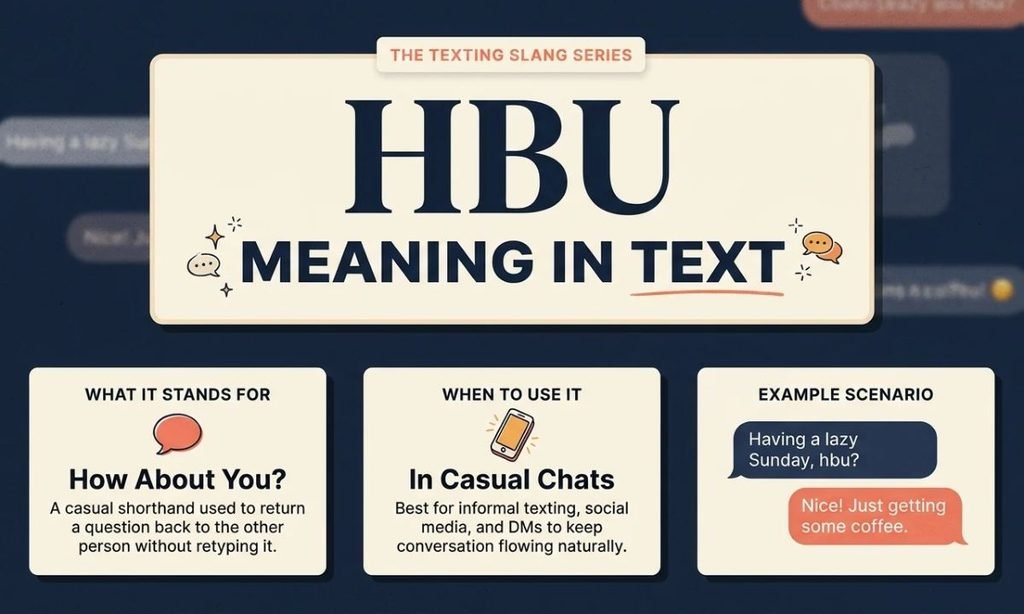
HBU is a texting abbreviation for “how about you” or “how ’bout you.” People shorten the phrase to save time and to return a question without typing out a full sentence. The sender shares something about themselves, then tosses the turn back to you.
Think of it as a conversational handoff. A friend asks, “How are you?” and you reply, “I’m fine, HBU?” You’ve given your answer and asked for theirs in one short message.
The question it returns can be about almost anything: a mood, weekend plans, a preference, a feeling, or what someone is up to. After “I’m staying home tonight, HBU?” it asks about plans. After “I prefer coffee, HBU?” it asks about taste. “My day was busy, HBU?” asks about their day, and “I love watching movies, HBU?” asks whether they do too.
Because it points back at whatever came first, the meaning depends on context. The expansion never changes, but the question it carries does. Here’s the check I use: swap in “how about you” and read the sentence again. If it still makes sense, you’ve decoded it correctly.
The Simple Meaning Behind HBU
When someone writes “hbu,” they usually mean one of a few things: “what about you?”, “and you?”, “how do you feel?”, or “what’s your answer?” All of those are the same question in different clothes. HBU simply asks the same thing back, and it works as a polite request for your answer.
One Example in the Wild
Here’s a quick exchange:
- A: i love this song 😍
- B: same lol hbu?
B is asking the same question back. Specifically, B wants to know if the other person likes the song too. B said “same” and handed the turn over, and the emoji does some of the emotional work.
The Four Meanings Behind HBU
The same three letters do a few different jobs. The tone around them tells you which one you’re looking at.
Literal Meaning
This is the default in almost every texting app. Someone answers a question and immediately asks it back: “I’m free after 7. HBU?”
The emotional intent is polite reciprocity. The sender doesn’t want a one-sided chat, so they keep things even.
Conversation Bridge
Sometimes the message isn’t about information at all. HBU works as a quick bridge that keeps momentum going and quietly says “your turn.” Think of “I’ve been busy all week, hbu?”
The intent here is to keep the chat alive without writing a full sentence.
Flirtatious Meaning
This one is the hardest to spot. When a crush texts HBU after sharing something personal, the subtext can shift toward “I want to know more about you.” Example: “I love late-night drives. HBU?”
The intent is invitation and curiosity. They’re testing compatibility, not just collecting facts.
Low-Effort Meaning
In fast-moving chats, HBU is plain shorthand. Picture “Pretty good hbu” with no punctuation, typed while someone’s thumbs are busy. The intent is efficiency, not distance.
Don’t assume coldness from brevity alone. People who reply quickly usually aren’t pulling away. This version is mostly about speed.
Is HBU Flirty, Rude, or Just Casual?
The tone of HBU is friendly and informal. It isn’t rude, and it carries no hidden or romantic meaning by itself. What shifts the feel is the conversation around it.
A warm message with a few extra details reads as interested. A short reply that ends in a bare “HBU” can feel like a polite formality. Compare “Pretty good, HBU?” (relaxed and low-pressure) with “Pretty good, and honestly I’ve been thinking about this weekend, HBU?” (clearly reaching for more).
Can HBU Be Flirty?
Sometimes, but not by default. HBU can sound playful depending on the situation. Take this one: “i had fun talking to you tonight 😊 hbu?” Here the person is encouraging more conversation and showing interest.
Still, the abbreviation itself isn’t automatically flirty. In flirty texts, the words around it do the flirting. Another example of that playful tone: “you looked amazing today 👀 hbu had fun?”
Is HBU Rude Because It’s Short?
Usually not. “Good, HBU?” is a normal reply between friends. The only catch is that repeated one-word answers can feel less engaging if the other person is hoping for a deeper conversation.
Where HBU Fits on the Formality Scale
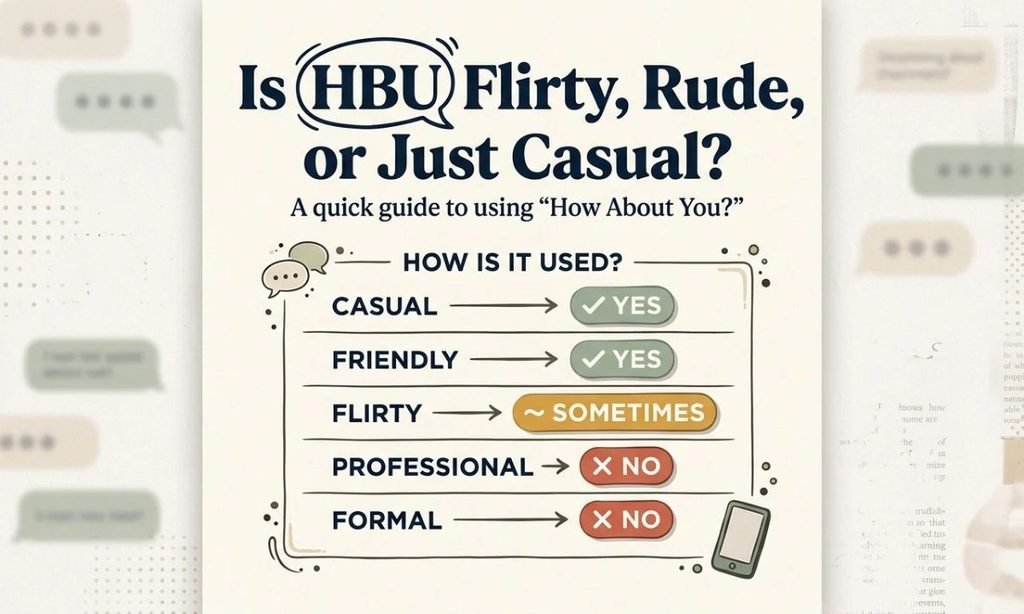
| Style | Is HBU used? |
| Casual | Yes |
| Friendly | Yes |
| Flirty | Sometimes |
| Professional | No |
| Formal | No |
HBU lives mostly in friendly, casual settings, so it suits friends, classmates, online buddies, and people you’re casually talking to. It’s slightly playful at most, and it’s informal slang, so it may come across as too casual in professional or formal writing.
Where Did HBU Come From?
Nobody can point to the person who invented HBU. There’s no reliable record of a first use, no precise date, and no company or individual credited with coining it. I’d be wary of any site that hands you a confident year, because no widely established record backs it up. The safest description is a natural shortening of an everyday phrase.
The background is easier to trace than the exact origin. Internet culture grew up around chat rooms and instant messaging, where typing fast mattered. Short forms like LOL, BRB, and IDK caught on for exactly that reason. Early mobile phones raised the effort even higher, since one letter could take several key presses. HBU slotted in beside those abbreviations as handy mobile messaging shorthand for text messages. .
Modern smartphones fixed the typing problem, but the habit stayed. It gives digital conversations a quick rhythm, and people who prefer brief messages still reach for it. It also keeps a chat from feeling like a questionnaire, since you answer and ask in a single breath.
HBU is closely related to WBU, short for “what about you,” and the two serve a similar purpose. They’re interchangeable in most chats. You’ll run into both across age groups, platforms, and online communities. Expressions like this don’t belong to one crowd. They spread because they’re useful.
HBU Meaning in Chat on WhatsApp, Instagram, Snapchat, TikTok, and More
The basic HBU meaning in text stays the same across messaging platforms. Only the pace and style shift a little. In a regular private chat, it usually follows a short answer, like “Just finished dinner, HBU?”, which asks about your current activity or whether you’ve eaten.
Where People Commonly Use It
Friends use it in text messages and everyday conversations. It’s very common in streaks and casual snaps on Snapchat. You’ll see it in TikTok comments and Instagram DMs, where replies stay short.
Gamers drop it into gaming chats and team conversations. Discord and other online communities run on short slang like this, which keeps chats fast and easy. Most of it is just people chatting casually.
WhatsApp is where I see it most among friends, family, and classmates. “I’m at home, HBU?” usually asks about the other person’s location or activity, depending on the earlier question. Plenty of casual conversations there run on exactly this pattern.
On Instagram, HBU turns up in DMs, story replies, and comments. A reply to a travel story, “That place looks amazing! I love traveling, HBU?”, helps continue a conversation about shared interests.
Snapchat
On Snapchat, HBU is extremely common because users prefer quick, short messages. Examples include “cute snap hbu?”, “streaks hbu?”, and “at school rn hbu?” Snapchat slang is casual, fun, and fast-paced, and the meaning matches what you’d see anywhere else.
TikTok
TikTok users drop HBU into comments and DMs when swapping opinions about trends or personal experiences. “This song is fireeee hbu?” is a typical one. It creates quick interactions in comment sections, and the song gives people something to react to.
Gaming Chats and Discord
In gaming chat, something like “we won that round hbu?” keeps communication quick between rounds. The abbreviation isn’t tied to any one app. Context does the work, and its ordinary texting definition stays consistent everywhere, so don’t believe rumors that it has a secret platform-specific meaning.
Examples of HBU in Conversation
Realistic examples teach more than rules do, so here are seven that people use all the time. The emoji are optional.
Example 1
- A: i’m so tired today 😩
- B: same honestly hbu?
Example 2
- A: what are you doing rn?
- B: just watching netflix hbu?
Example 3
- A: i had pizza for dinner 🍕
- B: niceee hbu tomorrow?
Example 4
- A: school was boring today
- B: lol fr hbu?
Example 5
- A: i’m going to the mall later
- B: sounds fun 😄 hbu after that?
Example 6
- A: i love this new game
- B: same bro hbu on level 10 yet?
Example 7
- A: good morning ☀️
- B: morninggg hbu?
Notice that HBU isn’t locked to the present. It stretches to tomorrow, after that, or later tonight. It also travels easily from Netflix to a dull school day to a new game.
A friendlier workplace-adjacent example: a typical weekend chat might go “What are you doing this weekend?” “Probably going hiking, HBU?” “I might visit my cousins.”
When to Use HBU and When to Skip It
Like most internet slang, HBU works well in some situations and poorly in others. It mostly comes down to who’s reading.
When to Use HBU
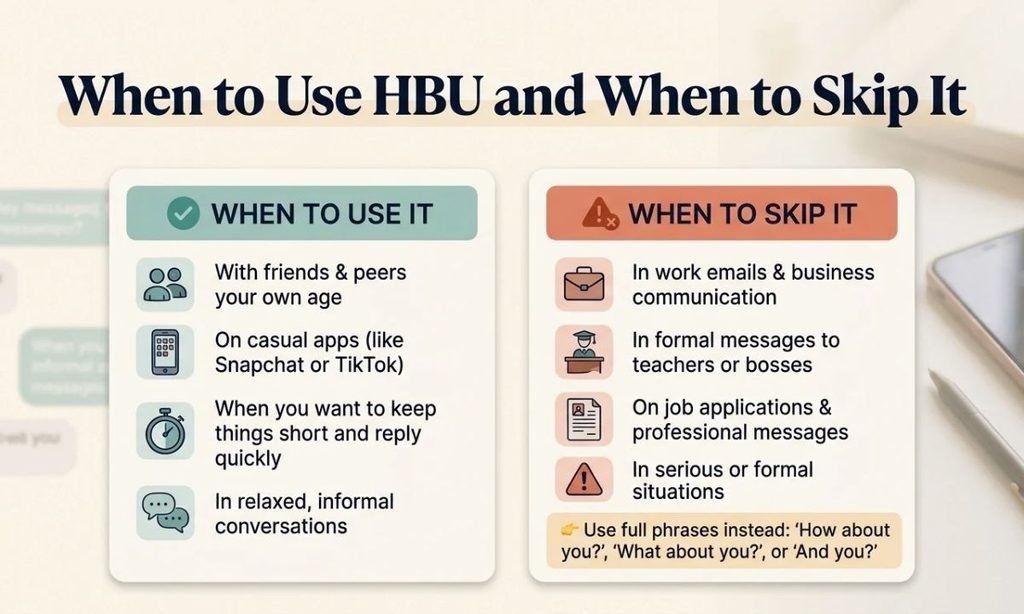
Use it with friends, in casual texts, on Snapchat or TikTok, when you want to keep things short, when you’re replying quickly, or in relaxed conversations. It’s also fine with someone your own age, where it feels relaxed rather than stiff.
When Not to Use HBU
Skip it in work emails, formal messages to teachers, serious situations, professional messages, job applications, and business communication. Use full phrases like “How about you?”, “What about you?”, or “And you?” instead.
HBU in Professional Settings
This is where I slow down. In a team chat between coworkers who already joke around, “I’m available after lunch, HBU?” is fine. I’ve seen it used that way, and nobody blinked. A friend from work would probably do the same.
Formal emails, job applications, client messages, and official reports are different. Not everyone recognizes texting abbreviations, and a confused reader costs more than three extra words. Write the full phrase when the message matters, and keep informal language for casual chats. Careful use is acceptable. Careless use is where mix-ups start.
Usage by Context
| Context | Example phrase | Why it works |
| Friend chat | “i’m bored lol hbu 😭” | Casual and natural |
| Snapchat | “nice snap hbu?” | Fast and social |
| Gaming chat | “we won that round hbu?” | Quick communication |
| Work chat | “How about you?” | More professional |
| “What are your thoughts?” | Formal and clear |
HBU in Physics, Medical, and Aircraft Terminology
As texting slang, HBU is simple. In technical fields it isn’t. Specialized fields reuse letter combinations constantly, and some are used only inside one organization. HBU shouldn’t automatically carry its texting meaning there.
Physics. HBU isn’t a standard symbol with one established meaning. If you find it in a paper, diagram, or technical note, it may be a locally defined label, an equipment code, or something the author introduced. The surrounding explanation or the document’s glossary should say which.
Medical terminology. I wouldn’t assume “how about you” here either. It might be an internal abbreviation, a department label, or a local code at one institution. No single general medical definition can be safely applied to every occurrence, so confirm the full term from the clinical document itself.
Aircraft and aviation. HBU isn’t a general aviation abbreviation with one meaning across manuals. In a maintenance document, flight record, or technical system, it could depend on the manufacturer, the equipment, or the specific context.
The rule is never to guess from the letters alone. Check the official glossary, or ask a professional. Ambiguity in scientific writing causes real problems, so whatever the term turns out to be, the definition has to come from that document, not from texting habits.
Common Misconceptions About HBU
“HBU means how are you.” The two are related, but the actual expansion is “how about you.” HBU often asks how someone is doing, yet it can return many other questions, so treating it as a fixed greeting is a mistake.
“It’s flirtatious.” It can show up in romantic conversations, but the abbreviation itself is neutral. People use it to be polite or to keep a chat going, so don’t assume anything from three letters.
“It’s rude because it’s short.” Usually it’s just casual. The only real risk is a string of one-word replies that leaves the other person wanting more.
“It has a special meaning on certain apps.” It doesn’t. The same texting definition holds on WhatsApp, Instagram, TikTok, and everywhere else.
“I can work out technical meanings from the letters.” Don’t invent them. In scientific or professional documents, read the context and look for an authoritative definition.
Similar Terms and Alternatives to HBU
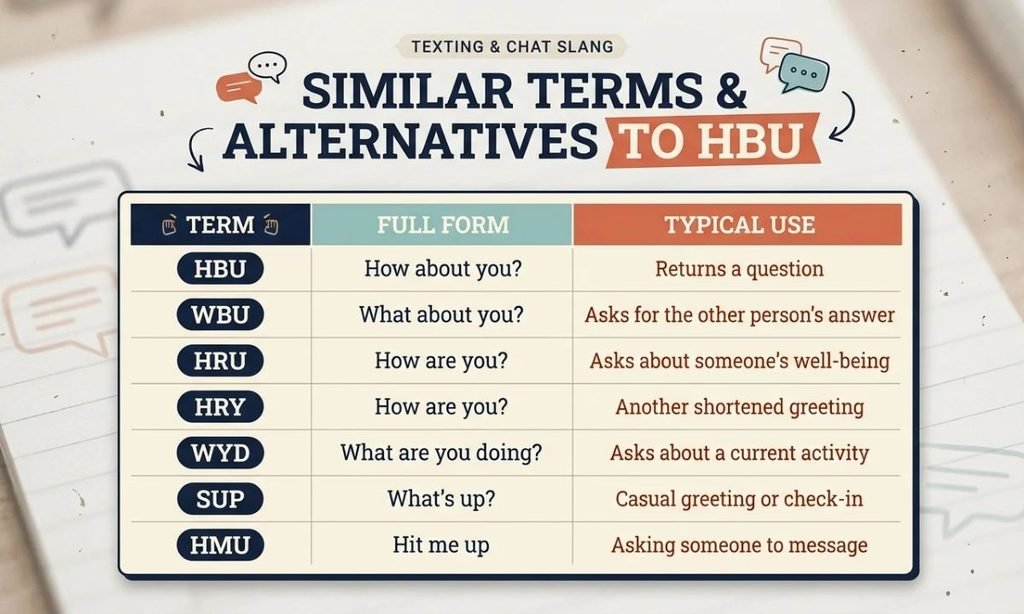
Several abbreviations sit close to HBU, and knowing them makes quick chats easier to follow. Each does a slightly different job.
| Term | Full form | Typical use |
| HBU | How about you? | Returns a question |
| WBU | What about you? | Asks for the other person’s answer |
| HRU | How are you? | Asks about someone’s well-being |
| HRY | How are you? | Another shortened greeting |
| WYD | What are you doing? | Asks about a current activity |
| SUP | What’s up? | Casual greeting or check-in |
| HMU | Hit me up | Asking someone to message |
| IDK | I don’t know | Casual replies |
| TBH | To be honest | Sharing opinions |
| NGL | Not gonna lie | Honest reactions |
Shortened phrases aren’t limited to chat slang, either. If you’ve ever wondered about the ETC meaning in text, that one is a classic abbreviation you’ll also see in everyday messages.
Plain-English Alternatives
If you’d rather skip abbreviations, “and you,” “how about yourself,” and “what do you think” communicate almost the same idea. They’re clearer in formal or unfamiliar settings. “And you” is short and natural, and “what do you think” works better when you’re asking for an opinion. Choosing well depends on the question: “I like pizza, HBU?” and “I like pizza, WBU?” land about the same, though only the second sidesteps echoing the first.
HBU vs WBU, HRU, WYD, and SUP
These look alike, but they don’t do the same job.
HBU vs WBU. Both return a question, and people use them interchangeably. The full forms differ by one word: how versus what. “i’m hungry hbu?” and “i’m hungry wbu?” both sound natural. My own hunch is that HBU sits slightly better after feelings and WBU after choices, but that’s habit, not a rule.
HBU vs HRU. HRU directly asks “how are you.” HBU is more flexible because it refers back to the previous question. After “I’m 25, HBU?” you’re being asked your age, not your mood.
HBU vs WYD. WYD asks what someone is doing. HBU can mean the same only when earlier context makes it clear.
HBU vs SUP. SUP is a greeting that can start a conversation, whereas HBU rarely opens one.
The takeaway is simple: pay attention to the reference, not just the letters.
How to Respond to HBU
Look at the message before it, work out what the person is asking, and answer that. Once you’ve identified the question, the reply gets easy.
If someone writes “I’m doing well, HBU?” you can say “I’m good too, thanks!” If it’s “I’m watching a movie, HBU?” try “just relaxing at home.” A few more natural replies:
- “I’m great, thanks for asking!”
- “Not bad! Just finishing some work.”
- “I’m planning to visit my family this weekend.”
- “I love that song too. What’s your favorite part?”
- “I’m a little tired today, but otherwise good.”
Casual texters might also go with “i’m good too 😊”, “just relaxing rn”, “not much honestly”, “pretty busy today”, or “doing great!” An emoji is a nice touch.
Add a question of your own to keep the chat going, so a short reply doesn’t end it. If the context is unclear, ask what the person means: “Do you mean what I’m doing today?” That’s a quick way to clarify before you answer. The best response isn’t the longest. A friendly, relevant answer that matches the conversation does the job.
Regional, Cultural, and Generational Differences
I can’t point to hard numbers on regional use, but I can describe how it tends to show up. In Western countries, HBU is widely understood among younger internet users and frequent texters. Many English-speaking internet users in Asia recognize it, especially on social media and gaming platforms. In Middle Eastern countries, it appears often among bilingual users who mix English abbreviations with local languages. Overall, it’s recognizable across countries, cultures, and age groups, and its simplicity helps.
Typing habits vary by generation:
- Gen Z prefers lowercase texting, where a bare “hbu” feels fast, effortless, and casual.
- Millennials commonly pair HBU with other classic texting abbreviations, often capitalized: “Doing great. HBU?”
- Older generations tend to favor complete phrases like “How about you?” and may be less familiar with abbreviation-heavy chat.
Why HBU Is So Popular (and Who Uses It)
Online conversations move fast, and people like shorter words and quick replies. HBU saves typing time, feels casual, keeps chats flowing, and is easy to understand. It works on every social app, and it’s especially common among teens and young adults. Slang like this also makes an exchange feel relaxed and personal.
Is HBU Only Used by Teens?
No. Teens use it the most, but plenty of adults use HBU in casual chats too. Anyone who texts often or spends time on social media might. Younger users simply lean on texting slang more, so it isn’t only for teens, just used by them more often.
HBU on Dating Apps and in Online Conversations
On dating apps, HBU is useful because it encourages a two-way exchange. The sender invites the other person to share something, which keeps the chat balanced and less like an interview. It’s a polite habit, and sometimes pure curiosity.
People use it around interests, work, weekend plans, or preferences. “I’m into hiking and live music, HBU?” gives someone an easy opening to talk about themselves. That invitation is what turns an exchange into a real conversation.
HBU alone isn’t proof of romantic interest. The broader conversation matters, and one abbreviation proves nothing. To strengthen your replies, answer the question and add a detail the other person can respond to. Instead of “Good, HBU?” try “I’m good! I just got back from a great coffee shop. HBU?” Leaning on it as a stand-in for real answers doesn’t work well anywhere.
Common Mistakes to Avoid With HBU
Most mistakes come down to mismatch.
Using it in professional emails. “I completed the report hbu?” sounds far too casual for work.
Overusing slang. Too many abbreviations confuse readers: “wyd rn hbu idk lol.” With WYD, RN, IDK, and LOL stacked together, some readers won’t understand any of it.
Using it in serious conversations. If someone is upset or you’re discussing something emotional, HBU can sound too casual. In those moments, write it out.
Final Takeaway
HBU simply means “how about you?”, a friendly way to return a question and keep a conversation quick and natural. It isn’t automatically romantic, it isn’t rude, and it isn’t limited to one platform. In professional settings, write the full phrase, and if you meet HBU in a technical document, check that document’s glossary instead of guessing.
The message before it tells you exactly how to answer. Next time someone texts “hbu?” you’ll know what to send back, emoji included if it fits 😄.
If you enjoy learning internet slang, you may also like the WYD meaning, TBH meaning, NGL meaning, WBU meaning, HMU meaning, and IDK meaning. They all belong to the same family of related slang terms commonly used in online chats and social media conversations.
FAQs
What does HBU mean in text?
HBU stands for “how about you?” People use it to answer a question and hand the same one back to the other person. For example, “I’m good, HBU?” means “I’m good, how about you?”
What does HBU stand for on Snapchat, TikTok, and Instagram?
It means the same thing on every app: “how about you?” Only the pace and style change, with shorter, lowercase replies on Snapchat and in TikTok comments. No platform gives it a secret or special meaning.
Is HBU the same as “how are you”?
No. “How are you” is HRU, while HBU means “how about you.” HBU refers back to whatever was asked before, so it could be about your mood, your plans, your age, or your taste.
Is HBU rude or disrespectful?
No, it’s a casual and friendly abbreviation. It only feels flat if every reply is a bare “good, hbu” with nothing else. Adding a detail makes the chat feel warmer.
Can HBU be flirty?
Sometimes, but not on its own. The words and emoji around it set the tone, such as “I had fun talking tonight 😊 hbu?” A plain “HBU” after a routine answer is just polite.
What is the difference between HBU and WBU?
HBU means “how about you” and WBU means “what about you.” People use them interchangeably in most chats. Some feel HBU fits feelings and WBU fits choices, but that’s a habit, not a rule.
How do I reply when someone texts me HBU?
Check the message before it, work out what they asked, and answer that. If they said “I’m watching a movie, HBU?” you could reply “just relaxing at home.” Adding a question back keeps the conversation going.
Is it okay to use HBU in work emails or professional messages?
It’s best to avoid it in emails, job applications, and client messages. Write “How about you?” or “And you?” instead. In a casual team chat with close coworkers, it’s usually fine.
Where did the term HBU come from?
No one knows who first used it, and there’s no reliable record of a date. It most likely grew out of early chat rooms, instant messaging, and phone texting, where short forms saved typing. Be wary of sites that claim an exact year.
Do older people use HBU too?
Yes, but less often. Teens and young adults use it the most, and many adults use it in casual chats. Older generations tend to write out “How about you?”
Does HBU mean something different in physics, medical, or aviation documents?
It can. In those fields HBU isn’t a standard abbreviation, so it may be a local code or label. Check the document’s glossary or ask a professional instead of assuming the texting meaning.
What are some other texting abbreviations like HBU?
Close ones include WBU (what about you), HRU (how are you), WYD (what are you doing), and SUP (what’s up). HMU, IDK, TBH, and NGL are also common in casual chats. Each does a slightly different job, so match the abbreviation to the question.
