

A friend texts you, “Bring snacks, drinks, cups, etc.” You read it twice and wonder what the “etc.” is hiding. Here is the quick answer on the ETC meaning in text: it tells you the list goes on, and you are trusted to guess the rest.
People search for this one because it sits right next to LOL, BRB and IMO, so it looks like new texting slang. It also shows up in group chats, emails, captions and school notes, often with different capitalization and punctuation. That mix of styles leaves some readers unsure whether it is casual, formal, or even rude.
This guide explains what the abbreviation means, where it comes from, and how to use it without tripping up. You will also see real examples, the mistakes people make most, and the moments when it is smarter to skip it.
Answer Block: ETC stands for et cetera, a Latin phrase meaning “and so on” or “and other similar things.” In a text, it tells the reader that a list continues beyond the items typed. It is a standard English abbreviation, not internet slang, and it is also the most common meaning everywhere else.
What Does ETC Mean in Text?
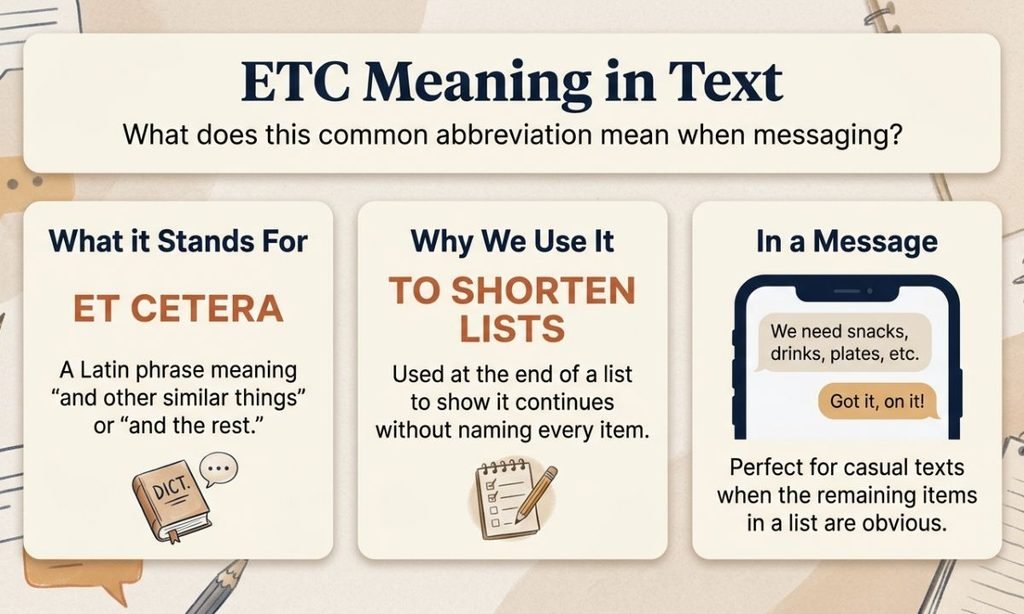
When someone types ETC at the end of a list, they are saying, “I named a few, you can picture the rest.” It works as a shortcut for “and more,” “and other things,” or “you get the idea.”
Take a grocery message like “milk, eggs, bread, snacks, drinks, chips, etc.” Only some items are named. The abbreviation covers whatever else was on the sender’s mental list.
Here is another one: “I’m into movies, music, games, etc.” The sender assumes you already know the kind of topics involved, so naming every hobby would only slow things down. The list stops, but the idea keeps going. You might add podcasts or sports in your head.
That is the whole trick. The sender counts on shared understanding, and the reader fills the gap. It saves time on both ends.
Plenty of people call it a texting abbreviation, and that is understandable, since a phone screen suits it so well. But the phrase has been around for centuries. I have watched people puzzle over it in group chats as if it were brand-new slang. It isn’t.
Full Form of ETC
The full form of ETC is et cetera. You will sometimes see it written as a formula: ETC = Et Cetera.
Split it in two and the meaning is clear. “Et” means “and.” “Cetera” means “the remaining things.” Put together, you get “and the rest,” “and so on,” and “and other similar things.”
Translations from Latin are rarely this tidy. The meaning of et cetera has barely moved over the years, and the Merriam-Webster dictionary entry still lists it as a Latin phrase for “and so forth.” English speakers say it daily, in writing and in conversation, usually without a thought for where it came from. It kept its Latin spelling, too. .
Is ETC Texting Slang?
No. People ask because ETC appears beside LOL, BRB and IMO, but compare ETC with LOL and the age gap is huge. Those abbreviations are recent. ETC is a standard English abbreviation, understood almost everywhere.
That makes it the safest of the bunch. You can use it in text messages, emails, social media captions, business writing, notes and shopping lists. Slang shifts with every generation and ages fast, while ETC has stayed put.
Some folks do call it internet slang because it is so common online. That is a fair reaction, but it is not accurate. Phones made the term more visible. They did not invent it. If you want to see what real texting slang looks like, take a look at our guide on BBW meaning in text.
Where Is ETC Used?
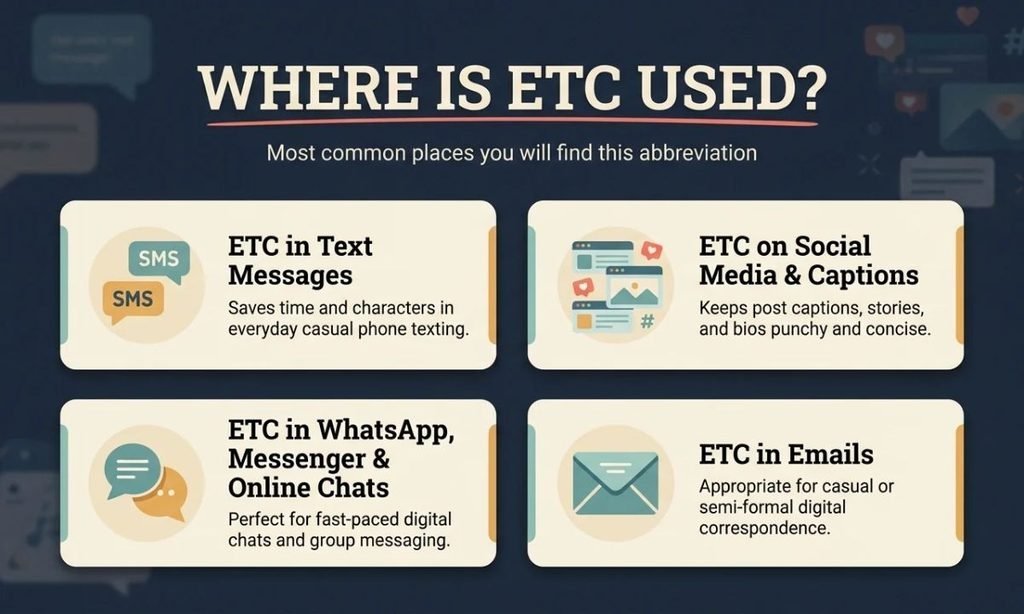
Almost anywhere a person names several items. It works the same way for a teenager in a group chat and a manager writing a status update. Here is how it shifts from place to place.
ETC in Text Messages
This is where I see it most. Friends use it when plans get messy: “Bring plates, cups, napkins, etc.” covers a whole picnic. Thumbs are lazy, and people love a shortcut.
ETC on Social Media and in Captions
Captions, comments and posts lean on it for the same reason. “Sunsets, street food, bad haircuts, etc.” works fine as a caption. A morning routine post might read: coffee, reading, journaling, etc. It is a creator habit on Instagram and Facebook.
A book lover might write, “I love reading fantasy, mystery, romance, etc. Need recommendations!” Someone sharing a desk setup might post, “Upgrading laptops, monitors, keyboards, etc.” Posts stay short, and the point still lands.
ETC in WhatsApp, Messenger and Online Chats
Friends in WhatsApp and Messenger threads use it when talking about plans: “We still need plates, napkins, cups, chips, soda, cookies, etc.” In forums and messaging apps, where discussions move fast, you will see “traveling, photography, hiking, etc.” in nearly every thread about interests. Nobody blinks.
ETC in Emails
Professionals use it when listing what they offer: pricing, delivery, support, etc. That reads fine. A line like “please attach receipts, invoices, contracts, etc.” is also common. Formal records such as invoices and contracts are a different story, and I explain why later.
ETC in School Assignments and Notes
Students and teachers use it in notes and drafts. A teacher might say the test covers math, science, history, etc. But when you write your own answer, name exactly what the question asks for. A grader cannot give credit for something the abbreviation only implies. You will also see it in academic writing, though writers there tend to use it with care.
Why Do People Use ETC?
Every reason traces back to efficient communication.
- It saves time. Typing a long list on a phone is slow. “Pens, pencils, markers, etc.” beats listing every highlighter and stapler.
- It keeps messages short. Brevity matters in texting, and a short message is easier to scan.
- It avoids repetition. A list of near-identical items adds words without adding meaning.
- It assumes shared understanding. Mention school supplies or office supplies and the reader already knows the category. Among texting abbreviations, it is one of the few older than the phone.
The result is a cleaner, quicker message.
Real Conversation Examples of ETC Meaning in Text
Theory is fine, but chats show it better. Here is how it plays out in everyday question-and-answer exchanges.
- Emma asks, “What should I pack?” Liam replies, “Clothes, shoes, toiletries, etc.”
- Alex asks, “What do you watch?” Noah says, “Mostly football, basketball, tennis, etc.”
- Sara wonders, “What do we need for the party?” Mia answers, “Balloons, snacks, drinks, decorations, etc.”
- Jake asks, “What’s on your shopping list?” Chris says, “Bread, milk, eggs, fruit, etc.”
- Olivia asks, “What did you learn today?” Ben says, “Fractions, decimals, percentages, etc.”
Notice that nobody asks what the “etc.” covers. Both people already share the category, and that is real-life usage in a nutshell.
Here is what the same pattern means in a few more situations:
| Situation | Text | What it really says |
| Planning a party | “Don’t forget balloons, decorations, snacks, etc.” | Expect the usual party supplies, like cups or candles |
| Shopping | “Need vegetables, fruit, bread, etc.” | Use your judgment on other groceries |
| Travel | “Pack clothes, chargers, toiletries, etc.” | Bring other trip essentials, maybe a jacket or power bank |
| School | “Bring notebooks, folders, binders, etc.” | Other school supplies count too |
| Office | “We need to review budgets, deadlines, staffing, etc.” | Several business topics from the same meeting |
The shopping one carries a small risk. What you buy might not match what the sender pictured. That is the price of the shortcut.
Other Meanings of ETC
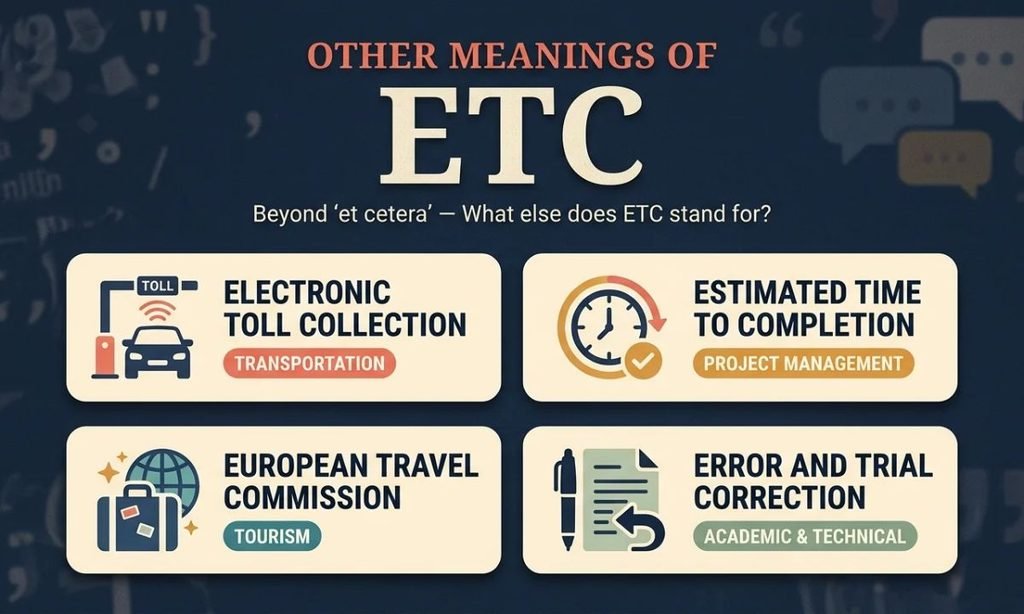
Outside everyday writing, ETC can carry specialized meanings. Look up its full forms and you will find several, depending on the field.
| Meaning | Field | Example or note |
| Electronic Toll Collection | Transportation | Drivers pay highway tolls automatically |
| Estimated Time to Completion | Project management and software | “The ETC for this task is two hours” |
| European Travel Commission | Tourism | Promotes travel across Europe |
| Error and Trial Correction | Academic and technical | Appears in limited discussions |
Where you see it tells you which meaning you have. In a casual text, it means et cetera. The other senses belong to specific fields and rarely overlap with what a friend sends you.
How to Use ETC Correctly
The rules are simple.
Put it after a list of similar items. Use it after examples that belong to the same general category. “Apples, oranges, bananas, etc.” works, because the reader can guess the rest is fruit. “Apples, my teacher, yesterday, etc.” does not, because nothing connects those items.
Never write “and etc.” The word already contains “and,” so you would be saying it twice. It is grammatically wrong, and it is the slip I flag most when I proofread other people’s emails.
Mind the punctuation. The standard form is lowercase with a period: etc. Uppercase ETC is common in texts, captions and for emphasis, and people sometimes treat it like any other acronym. Capital letters are not required in normal writing, so in standard writing I would stick with lowercase. In the middle of a sentence, a comma often follows. At the end, the period does double duty.
Common ETC Mistakes
Most errors fall into a handful of patterns.
Treating It as Texting Slang
“ETC is texting slang” is something I hear a lot. It is wrong. The Latin roots are plain, with “et” meaning “and” and “cetera” meaning “the rest.” It has been in English for hundreds of years, which makes it the opposite of a modern internet abbreviation.
Writing “and etc.”
“Pens, pencils, and etc.” should be “Pens, pencils, etc.” Using it after “and” gives you a doubled “and.”
Using It After a Complete List
“Monday, Tuesday, Wednesday, Thursday, Friday, Saturday, Sunday, etc.” makes no sense. You already named everything, so there is nothing left to imply. Finish the list and stop.
Using It Without Examples
“I need to buy etc.” leaves the reader with nothing to work with. There is no category to extend. Give a few examples first, like “chairs, tables, decorations, etc.” Even a short list like “pens, pencils, etc.” can work when the category is obvious, but never assume the reader can guess a category you never mentioned.
Using It Over and Over
“Snacks, drinks, etc., decorations, etc., chairs, etc.” reads like a stutter. Dropping it repeatedly into one sentence creates redundancy, and readers lose track of what you mean. Use it once, at the end of the list it belongs to. Sometimes it is better to finish the list. These mistakes cost you clarity more than they cost you correctness.
ETC vs Similar Terms
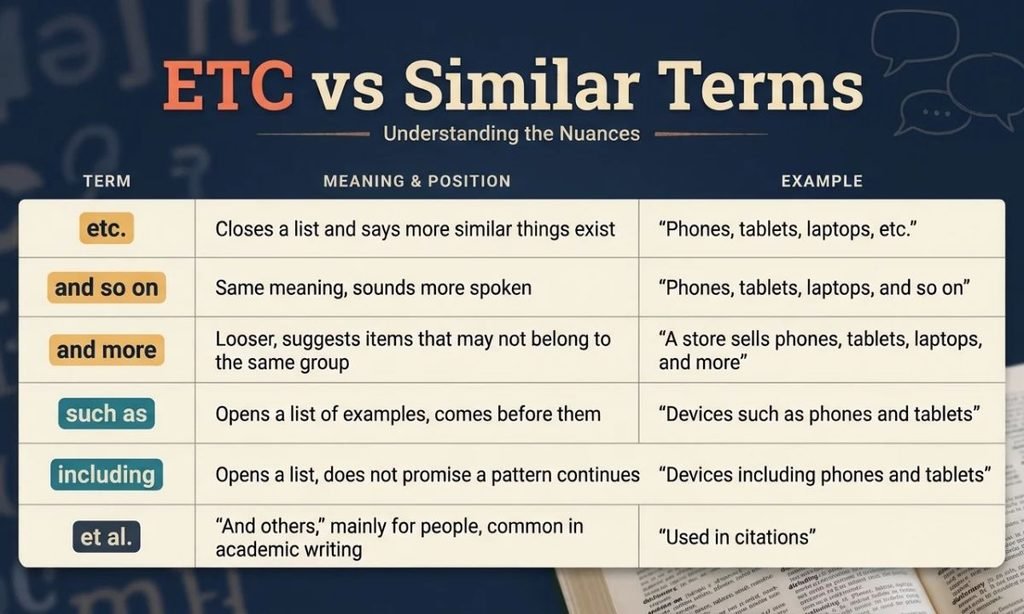
Several expressions point toward “more,” and people mix them up. The difference mostly comes down to position and signal.
| Term | Meaning and position | Example |
| etc. | Closes a list and says more similar things exist | “Phones, tablets, laptops, etc.” |
| and so on | Same meaning, sounds more spoken | “Phones, tablets, laptops, and so on” |
| and more | Looser, suggests items that may not belong to the same group | “A store sells phones, tablets, laptops, and more” |
| such as | Opens a list of examples, comes before them | “Devices such as phones and tablets” |
| including | Opens a list, does not promise a pattern continues | “Devices including phones and tablets” |
| et al. | “And others,” mainly for people, common in academic writing | Used in citations |
A few notes on these:
- ETC vs and so on: Both carry “and other similar things.” “And so on” feels more spoken, and ETC feels more written. You can swap them in most cases.
- ETC vs and more: Retailers like “and more” because it is open ended. ETC is tighter, since it says the rest are the same kind of thing.
- ETC vs such as: “Such as” introduces examples. ETC ends them. Using both in one sentence repeats the same job.
- ETC vs including: “Including” works in both formal and informal writing. When I am unsure, it is the safer pick for lists in anything official.
- ETC vs et al.: Some traditional guides say etc. belongs with things, not people, and that “and others” fits better when you name people. Modern writers bend that rule, but the logic holds.
Is ETC Formal or Informal?
Both, with a catch. How it lands depends on where you use it.
Informal use is easy. A text like “chips, soda, cookies, etc.” never raises an eyebrow.
Formal use is fine in moderation. A business email might say, “Our team handles onboarding, scheduling, reporting, etc.” That reads as normal professional writing. If you attach a price list or spec, the abbreviation in the email body is even better, since the details live in the attachment.
Invoices, receipts and contracts call for the opposite approach. In highly formal documents, list the important items in full. The abbreviation looks vague there, and vague is risky. It is also worth knowing that some readers consider it a bit casual or lazy in very formal writing, so a full list is the cautious choice.
When Should You Use ETC?
Use it when the list is obvious. If I text “bring forks, spoons, knives, etc.,” nobody wonders whether I mean a wrench. They know I am talking about utensils.
The remaining items should be similar enough that people can fill them in without guessing. A clear category does most of the work. “Cats, dogs, rabbits, etc.” is clearly animals. “Hiring, training, payroll, etc.” tells anyone who has worked in an office what is being discussed.
If you want to save words and the reader will not miss anything, go ahead.
When to Avoid It
Skip it when precision matters. Ask yourself whether the reader needs the exact items you are leaving out. If yes, name them.
- Legal documents and contracts. Exact wording can change what a contract covers.
- Safety instructions and technical manuals. Gaps cause errors.
- Forms and requirements. Write “bring identification, proof of address, etc.” and someone will show up with the wrong paperwork, unsure what to submit. List every required document instead.
- Unclear categories. If someone says they bought “books, batteries, etc.,” you cannot guess the rest. With no relationship between the items, the abbreviation has nothing to stand on.
- Lists of people. Use “and others” instead.
It is a trade between precision and brevity. When a mistake would cost money, time or legal trouble, choose precision. In highly formal documents, I would write out the full list.
Origin of ETC
Et cetera was borrowed from Latin into English. Hundreds of years of use have left its purpose unchanged: it helps writers avoid repeating long lists while making clear that similar items are included. Sources differ on exactly when it entered English, so I will not pin a year on it.
It is a clean case of Latin borrowing, and it shows how a handy phrase can outlast fashions. Today it works in everyday conversation, academic writing, business communication and digital messaging. The story is the same now as it was then.
Pro Tips for Using ETC Correctly
These tips come from a lot of writing and editing, and from seeing what goes wrong.
- Use it after examples. “Apples, oranges, bananas, etc.” gives enough information to see the group is fruit.
- Keep the items similar. If they belong to the same group, the reader can extend the category easily. If they do not, skip it.
- Be clear. If the reader might need specifics, give the details instead of hiding them behind the abbreviation.
- Think about your audience. Professional readers often prefer full lists, while friends will understand the shortcut instantly.
- Do not overdo it. Too much of it becomes lazy writing. Often the better move is to cut the list short rather than trail it off.
Key Takeaways
ETC usually stands for et cetera, and it means “and so on” or “and other similar things.” It is a standard English abbreviation, not internet slang. Use it after a list of similar items, never write “and etc.,” and skip it when the reader needs exact details. Other fields give it different meanings, such as Electronic Toll Collection, but in texting it almost always means one thing.
My rule is simple: use it when the category is clear, and spell things out when the details matter. Follow that and it will read as natural in a group chat, a work email or a caption. It is the easiest way to say there is more without typing it all.
FAQs
What does ETC mean in text?
ETC stands for et cetera, a Latin phrase meaning “and so on” or “and other similar things.” In a text, it shows that the list continues beyond the items typed. The reader is expected to fill in the rest.
What is the full form of ETC?
The full form of ETC is et cetera. “Et” means “and” and “cetera” means “the rest.” Together they mean “and the rest.”
Is ETC considered slang?
No, ETC is a standard English abbreviation, not internet slang. It has been used for hundreds of years and predates texting by a long way. Phones simply made it more visible.
Is it etc or ETC?
In standard writing, lowercase “etc.” with a period is the traditional form. Uppercase ETC is common in texts and captions, often out of habit or for emphasis. Both are readable, but lowercase is the safer choice in formal writing.
Is it wrong to say “and etc.”?
Yes, “and etc.” is incorrect. The “et” in et cetera already means “and,” so you would be saying it twice. Write “pens, pencils, etc.” instead.
Can I use ETC in a professional email?
Yes, as long as the list is obvious and the missing items are easy to guess. Avoid it when the reader needs exact details, like required documents, prices, or contract terms. In those cases, list everything.
Is ETC formal or informal?
It works in both. It fits easily in a casual text and in most business emails. Highly formal documents, such as legal papers, are better with a complete list.
What is the difference between etc. and et al.?
Etc. is used for things, while et al. means “and others” and is mainly used for people, especially in academic citations. If you are listing names, “and others” or et al. is the better fit.
What is the difference between ETC and “and so on”?
They mean the same thing and can usually be swapped. “And so on” sounds more spoken, while ETC feels more written. Both signal that similar items continue the list.
Should I use ETC with “such as” or “including”?
No, pairing them repeats the same job. “Such as” and “including” open a list of examples, while etc. closes one. Pick one approach per sentence.
Does ETC have other meanings besides et cetera?
Yes, depending on the field. ETC can mean Electronic Toll Collection, Estimated Time to Completion, or European Travel Commission. In a casual text message, it almost always means et cetera.
When should I avoid using ETC?
Avoid it when precision matters, such as in contracts, safety instructions, forms, and technical manuals. Also skip it when the category is unclear or when you are naming people. If the reader could be confused about what is missing, write out the full list.
