

You just sent a text you were kind of proud of. Maybe it was funny. Maybe it took you ten minutes to word correctly. And the reply you got back was one syllable: “hm.”
Now you’re staring at your phone wondering if you did something wrong.
That single reaction — reading way too much into two letters — is exactly why so many people search for HM meaning in text. It’s not that the word is complicated. It’s that it changes shape depending on who sent it, what came before it, and how it’s punctuated. Most articles on this topic will tell you “hm means thinking or hesitation” and stop there. That’s true, but it’s also incomplete, and it’s the reason you’re still confused after reading three other explanations.
This article goes further. We’ll break down what HM actually signals in different relationships, why punctuation around it matters more than the word itself, and what to do when you get one and don’t know how to respond.
What Does HM Meaning in a Text, Really?
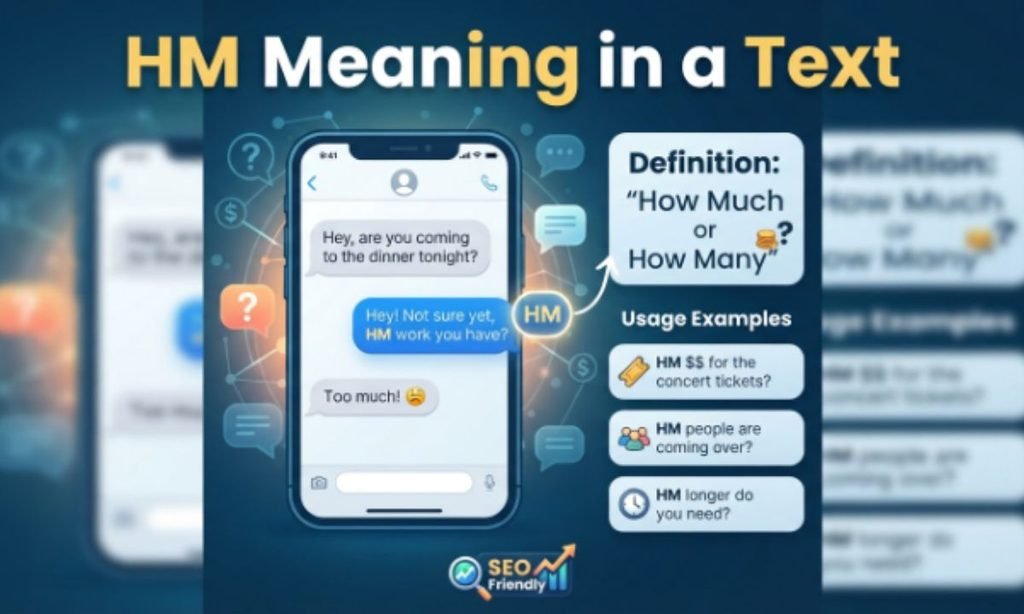
At its core, “hm” is a verbal filler turned into a text reaction. In speech, people say “hmm” while they’re processing something — buying time before they respond. In texting, that same sound got typed out and became shorthand for a pause in thought.
So the baseline meaning is:
- Mild consideration
- A small hesitation before agreeing or disagreeing
- An acknowledgment that doesn’t commit to an opinion yet
That’s the dictionary-level answer. But here’s what most guides skip entirely: HM rarely exists on its own in a real conversation. It’s almost always a reaction to something specific — a plan, a question, an opinion, or a piece of news. And the meaning of “hm” bends completely around that trigger.
The Part Nobody Explains: Context Changes Everything
This is the real gap in most explanations of HM meaning in text. They treat “hm” like a fixed-definition word, similar to looking up a term in a glossary. But texting isn’t a dictionary. It’s a conversation with tone missing, and “hm” is one of the words most affected by that missing tone.
Here’s a more useful way to think about it — as a reaction filtered through context, not a standalone word.
| Situation | Likely Meaning of “hm” |
| Reply to a suggestion or plan | Weighing it, not fully convinced yet |
| Reply to news or gossip | Processing, possibly surprised |
| Reply to a compliment | Mild skepticism or playful disbelief |
| Reply to an apology | Not fully accepting it, still thinking |
| Reply to a question with no follow-up | Distracted or unsure how to answer |
| Reply during a flirty conversation | Teasing, coy, deliberately vague |
| Reply after a disagreement | Passive frustration, unspoken irritation |
Notice how none of these are “bad” or “good” by default. That’s the piece that trips people up. They see one word and assume the worst-case emotional reading, when half the time it’s just someone typing while distracted.
Why Punctuation Changes the Whole Message
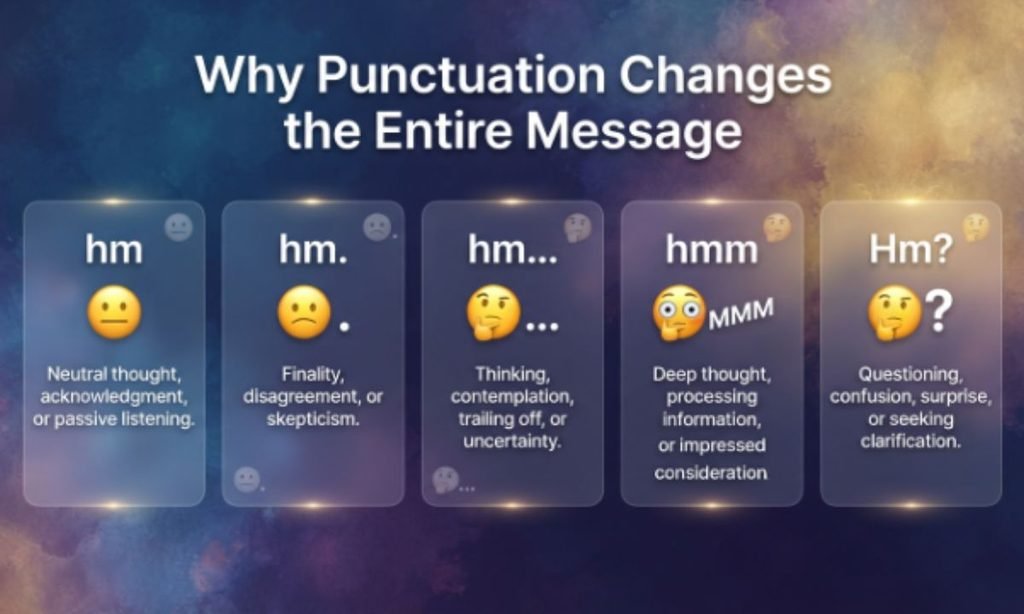
If there’s one thing that separates a casual explanation from a genuinely useful one, it’s this: the punctuation attached to “hm” carries more emotional weight than the word itself. Almost no other article breaks this down clearly, and it’s arguably the most practical part of understanding HM meaning in text.
“hm” (no punctuation)
Neutral to slightly flat. Reads as quick and low-effort, but not necessarily negative. Often just a placeholder reply from someone who’s busy or multitasking.
“hm.”
The period does a lot of damage here. Adding a full stop after a short word usually signals finality, mild annoyance, or a closed-off tone. In casual texting culture, periods at the end of short replies often read as more serious or clipped than intended by older generations — but among younger texters, it frequently reads as passive-aggressive or cold.
“hm..” or “hm…”
Trailing dots suggest the person is still processing, unsure, or holding something back. This version leans toward genuine hesitation or subtle discomfort — like they want to say more but aren’t ready to.
“hmm” or “hmmm” (extra M’s)
Stretching the word out softens it. This usually reads as playful curiosity, gentle teasing, or exaggerated thinking — almost performative. It’s far less likely to carry negative weight than a short, punctuated “hm.”
“Hm?” or “hmm?”
Adding a question mark almost always signals genuine confusion or a request for clarification. This is one of the more literal uses — the person actually wants you to explain further.
| Version | Typical Tone |
| hm | Neutral, quick, possibly distracted |
| hm. | Clipped, mildly annoyed, or final |
| hm… | Hesitant, thoughtful, holding back |
| hmm | Playful, curious, softer |
| hmm? / hm? | Genuine confusion, wants clarification |
| HM (all caps) | Emphasis, often sarcastic or dramatic |
Does HM Mean Something Different Depending on Who Sends It?
Yes — and this is another angle competitors barely touch. The same three letters land completely differently depending on the relationship.
From a friend: Usually low-stakes. Friends use “hm” as a casual filler far more often than as an emotional signal. If it’s out of character for them to go quiet after, that’s a stronger signal than the word itself.
From a romantic interest or partner: This is where people overanalyze the most. A “hm” mid-flirtation can be playful teasing. A “hm” after a serious question can mean they’re genuinely unsure how to respond, or they’re stalling because the honest answer feels uncomfortable to type out.
From a boss or coworker: In professional texting or Slack-style messages, “hm” almost always means genuine consideration — they’re thinking through what you said, not judging you. Workplace texting culture tends to strip out the emotional undertones that show up in personal conversations.
From a parent or older relative: Older generations sometimes use “hm” more literally, closer to its spoken meaning — actual thinking or mild disapproval — without the layered, coded meanings younger texters attach to it.
How to Respond to a “Hm” Text Without Overthinking It
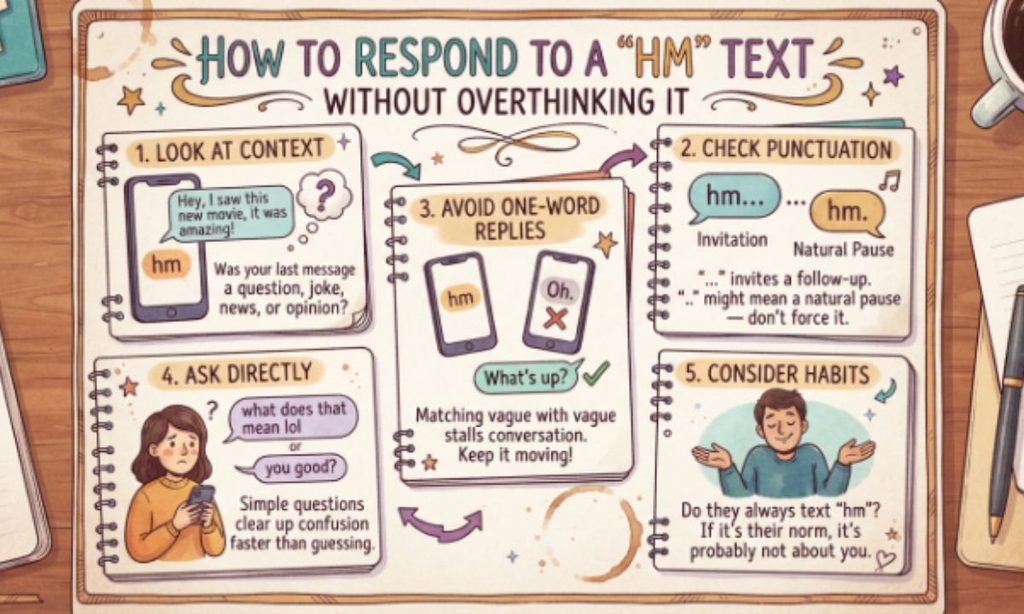
This is the part most people actually came here for, and it’s usually missing or reduced to one vague line in other articles. Here’s a practical way to handle it.
- Look at what you sent right before it. Was it a question, a joke, a piece of news, or an opinion? That context tells you more than the word does.
- Check the punctuation. A trailing “hm…” invites a follow-up. A flat “hm.” might mean the conversation naturally paused — don’t force it.
- Don’t reply with another one-word message. Matching a vague reply with another vague reply usually stalls the conversation instead of clarifying it.
- Ask directly if it matters to you. Something simple like “what does that mean lol” or “you good?” clears up more confusion in five seconds than ten minutes of guessing ever will.
- Consider their texting habits overall. Some people just type “hm” constantly, regardless of mood. If it’s their normal pattern, it’s probably not about you at all.
Quick Reference: HM vs Similar Text Reactions
Because “hm” often gets lumped in with other minimal text replies, here’s how it actually compares:
| Reply | Core Signal |
| hm | Processing, mild reaction, ambiguous |
| ok | Acknowledgment, sometimes flat or final |
| k | Often read as dismissive or annoyed |
| lol | Deflecting, softening, or genuinely amused |
| oh | Reaction to new information, surprise |
| idk | Uncertainty, sometimes avoidance |
Seeing them side by side makes it clearer that “hm” sits in its own category — it’s the only one on this list that’s specifically tied to active thinking rather than a finished reaction.
The Bigger Pattern Behind One-Word Replies
Here’s the honest takeaway that rarely gets said out loud: short replies like “hm” usually say more about bandwidth than emotion. People type “hm” when they’re half-focused on something else, when they don’t have a fully formed thought yet, or when typing a real response feels like more effort than the moment calls for.
It’s easy to build an entire narrative around two letters, especially in a text thread you care about. But most of the time, “hm” is just a placeholder — a small verbal shrug typed out while someone’s brain catches up with the conversation.
If a pattern keeps repeating — short, flat, unclear replies over and over — that’s worth paying attention to. But one “hm” in isolation almost never deserves the spiral it usually causes. Read the punctuation, read the relationship, and when in doubt, just ask. It’s faster than guessing, and it saves you from writing a paragraph in your head that the other person never intended.
FAQs
What does HM mean in a text?
HM is a short text reaction that usually signals thinking, mild hesitation, or a pause before responding. It works like a typed version of the sound people make out loud when they’re processing something. Its exact meaning shifts depending on what was said right before it.
What does it mean when a girl texts “hm”?
It typically means she’s considering what you said rather than reacting negatively. Tone depends heavily on punctuation — “hm…” often shows genuine thought, while “hm.” can feel more clipped or final. Context from the rest of the conversation matters more than the word itself.
What does it mean when a guy texts “hm”?
Most of the time, it’s low-effort acknowledgment rather than a hidden signal. Guys often use “hm” as a quick placeholder reply when they’re busy, distracted, or unsure how to respond right away. It rarely carries as much emotional weight as it’s assumed to.
Is “hm” a rude or dismissive reply?
Not inherently — it depends on punctuation and context. A flat “hm.” with no follow-up can come across as dismissive, especially in a serious conversation. But “hmm” or “hm?” usually reads as curious or thoughtful rather than rude.
What’s the difference between “hm” and “hmm”?
“Hm” tends to read as quicker and more neutral, almost like a fast acknowledgment. “Hmm,” with the extra letters, usually softens the tone and signals more active thinking or playful curiosity. The stretched-out spelling generally feels less serious than the short version.
Why do people reply with just “hm” instead of a full sentence?
It’s usually about effort and timing, not the message itself. People send “hm” when they’re half-focused, still forming an opinion, or don’t have a complete thought ready to type out. It’s a placeholder more often than a deliberate emotional cue.
Does “hm” mean someone is upset or annoyed?
It can, but only when paired with certain cues — like a period, a sudden drop-off in replies, or a shift from longer texts to one-word answers. On its own, a single “hm” is more often neutral than a sign of frustration.
