


Your friend texts at lunchtime asking if you want to join a late-night gaming session. You’re beat and plan to be asleep by ten, so you send back “nty” and return to your sandwich. If you’ve ever received that reply and wondered what does nty mean in text, the answer is simpler than those three letters suggest.
People search for this because NTY has no vowels, so it can look like a typo, a username, or a stock ticker. It shows up in DMs, group chats, comment sections, and in-game chat, usually with no explanation attached. If you don’t spend time in those spaces, nothing tells you what it means.
This guide covers the meaning, the likely origin, how to say it out loud, and the tone it carries. You’ll also get real chat examples, a comparison with other ways to say no, and the mistakes that trip people up.
NTY stands for “No Thank You.” It’s an informal texting abbreviation people use to politely decline an offer, invitation, or suggestion. The “thank you” built into it softens the refusal, so it reads as friendly rather than blunt. You’ll mostly see it in texts, DMs, group chats, and gaming chats.
What Does NTY Mean in Text Messages?
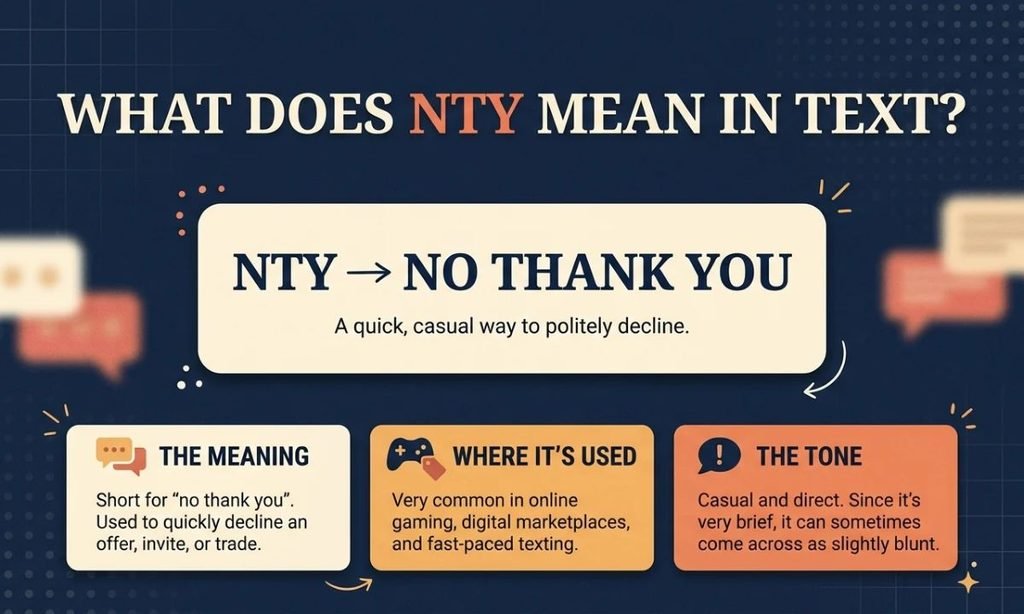
NTY is a texting abbreviation for turning something down without sounding harsh. Think of it as a polite wave-off, the digital version of shaking your head with a small smile. It works for an offer, an invitation, or a suggestion.
I see it land mid-conversation all the time. Someone offers something, a quick “nty” comes back, and the exchange moves on with no awkward pause. The meaning rarely changes, whichever app you see it in.
The Full Form
NTY equals No Thank You. It’s an initialism, built from the first letter of each word, and there’s nothing more exotic hiding behind it.
A Plain-English Explanation
NTY politely says no while still showing appreciation. The “thank you” does the heavy lifting, because it tells the other person you noticed their offer even though you’re passing on it.
People type it when someone offers help they don’t need, or when a friend invites them somewhere they can’t go. They also use it when they want to decline politely and keep the conversation short. I’ve sent it myself when a reply needed to feel warm but not wordy.
A Quick Example
Picture this. Someone asks, “do you want another slice of pizza?” and the other person answers, “nty i’m full.” The offer is on the table, the person politely refuses, and nobody has to explain anything.
Where Does NTY Come From?
Nobody can point to the exact spot where NTY was born. It follows the same pattern as older chat shorthand like “ty” for thank you, which is part of a much wider tradition of internet slang. It likely spread through chats and gaming rooms by simple imitation.
That’s about as far as the evidence goes. Anyone claiming a precise first use or a specific inventor is guessing, so treat those claims with caution.
Why Do People Use NTY Instead of Writing “No Thank You”?
Speed is the obvious reason. Nobody wants to type a full sentence to turn down a second slice of pizza, and typing it out costs time and energy. NTY saves both.
The better reason is that it lets you soften the no. A flat “No” can come across as blunt or even cold. The full “No Thank You” can sound formal, sometimes sarcastic, depending on who’s reading.
NTY sits in the middle ground. It’s casual enough to be friendly and polite enough to avoid unnecessary drama.
It also mirrors how people speak. Face to face, you’d say “nah, thanks” and move on. NTY gives you that same energy in text form, and the conversation keeps moving forward instead of stalling on an explanation.
Why NTY Matters in Modern Communication
Digital communication strips out tone of voice, so small words carry a lot of weight. A message that’s overly formal can read as cold, and one that’s too short can read as rude. NTY works because it sounds like speech while keeping the courtesy of a thank-you.
In my experience, context decides everything. The same three letters feel warm between friends and abrupt between strangers. Declining is a small social act, and in modern communication this abbreviation has become one of the easier ways to do it gracefully.
The Psychology Behind Abbreviated Politeness
There’s a bit of psychology in how we say no online. In face-to-face communication, a refusal comes with a smile, a shrug, or a gentler tone of voice. Text has none of those social cues, so people built shortcuts that carry politeness inside them.
The “thank you” in NTY does real emotional work. It signals that you appreciate the offer even though you’re passing. That small phrase can decide whether a conversation ends warmly or leaves a bit of awkwardness behind, and it protects relationships in a quiet way.
I don’t buy the idea that this is lazy shorthand. These abbreviations have evolved into socially intelligent communication tools. The same goes for other terms people search for, like PFP meaning in text or PYO. They’re compact phrases that grew out of how people actually chat.
How Do You Pronounce NTY?
You almost never hear it spoken. It’s a written-only abbreviation that lives in chats, DMs, and comment sections. If you had to say it out loud, you’d spell it out, N-T-Y, with each letter individually.
Some people in gaming communities blur it into a fast, word-like sound, roughly “en-tee-why.” That’s niche, though. In everyday conversation, nobody pronounces it at all.
Is NTY Formal or Informal?
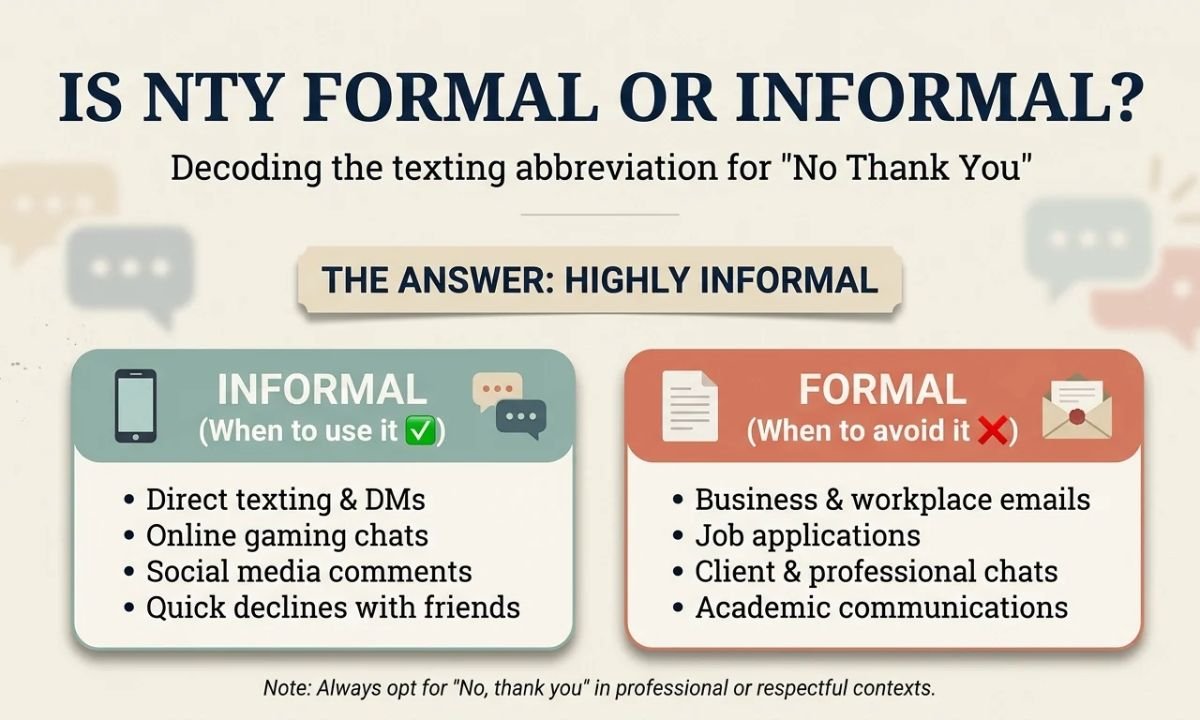
Informal, without question. It belongs in text messages with friends, gaming chats, social media comments, DMs, and casual group chats. That’s the kind of digital conversation it grew up in.
It doesn’t belong in a professional email, a cover letter, or a message to your boss. A few ultra-casual workplace cultures might tolerate it, but tread carefully even there. In any professional setting, a polite response written out in full, like “No, thank you,” is the safer choice.
People who look up this term often end up checking similar slang too, such as YH meaning in text or TF meaning in text. They follow the same logic, since chat shorthand is informal by default.
Does NTY Sound Rude?
Usually not. The tone depends on what surrounds it, and since “thank you” is built into the abbreviation, it reads as a friendly, low-key decline by default.
I’ve noticed the “rude” worry is the one that nags most people. A bare “no” can land hard on a screen, and NTY gives you a small cushion.
How Punctuation Changes the Tone
Punctuation is where it can turn. A lone “NTY.” with a period can feel cold or dismissive. Compare that with “NTY 😊” or “NTY, I’m good though!” and the vibe changes completely, because both feel warm.
The abbreviation itself isn’t rude. The framing carries the tone.
NTY With Emojis
Emojis work like a tone of voice for your text. They take NTY from ambiguous to crystal clear, and different combinations land differently:
| Combination | How it reads |
| NTY 😊 | Warm and friendly |
| NTY 😅 | Slightly apologetic, as if you feel bad declining |
| NTY 🙏 | Grateful but firm, a respectful decline |
| NTY 😂 | Joking around, very casual |
| NTY 😬 | An awkward decline, often played for humor |
Pick the emoji to control the tone of the whole message.
Where Is NTY Commonly Used?
NTY lives in casual online conversations. It’s informal digital communication through and through, and if you spend any time in chats, you’ll see people use it without a second thought. Here are the main places it turns up.
Text Messages
Between friends, it’s mostly about declining an invitation. Someone asks, “want to go out tonight?” and gets “nty i’m staying home.” Short, clear, no hard feelings.
Social Media Messages
On social platforms, people reply with NTY in direct messages, comments, and replies, and you’ll spot it on Instagram, Snapchat, TikTok, and X (Twitter). Someone asks, “want to join the live stream?” and the answer is “nty maybe later.” That “maybe later” is a nice touch when you want to leave the door open.
It works well here because it’s concise, and brevity gets rewarded online. NTY also invites no argument. You aren’t explaining yourself or writing an essay, just saying no politely and moving on.
It also shows up when a brand is promoting a product, or when a friend tags you in a challenge you’re not feeling. Either one can get an NTY back.
Be mindful of who else can see it, though. NTY on a public post reads differently than the same reply in a private message, because others may not have the context behind it.
Group Chats
Group chats are full of suggestions and invitations, so NTY shows up frequently there. If someone asks, “anyone joining the game tonight?” a quick “nty i’m busy” does the job. Nobody needs a paragraph about why you’re busy.
Gaming Chats
Gamers decline offers with NTY all the time. Asked “want to join our squad?” a player in the middle of a session might answer “nty i’m finishing another match.” It’s fast, and it fits the pace of play.
Why NTY Thrives in Online Gaming

Online gaming is where NTY really thrives. Whether it’s Roblox, Minecraft, Fortnite, or any MMO, play is fast-paced, and players need to communicate quickly without losing focus.
Someone wants to trade items? NTY. A clan invite you don’t want? NTY. A stranger offering in-game currency for something you’d rather keep? Same answer.
It’s efficient and universally understood, and it keeps things respectful. Younger players lean on it because platforms have normalized it as civil communication. Across most gaming spaces, you’ll see it any time someone is offering something that isn’t wanted.
What Does NTY Mean in Roblox?
Roblox is a gaming platform with a lot of younger audiences, and its in-game chat runs on abbreviated slang. So what does nty mean in text on Roblox? The same thing as everywhere else: No Thank You.
Players use it to turn down a trade, skip an invitation to join a team, or pass on a game mode they don’t like. With kids and teens making up so much of the audience, the polite wording helps, and it leaves no hard feelings. It also spares everyone long back-and-forth replies, so gameplay keeps going. Offer declined, everyone understands immediately.
Who Uses NTY, and Is It Common Slang?
Yes, it’s common slang, especially in casual conversations. It appears in texting, group chats, and social media messages. Teenagers, online communities, and frequent texters tend to use it the most.
It’s mostly familiar inside digital-native circles, though. Age groups and communities differ, and plenty of older relatives have never seen it. If you text a parent or grandparent, don’t assume they’ll know what you mean.
Real Chat Examples Using NTY
Seeing NTY in action helps more than any definition. Here are exchanges I’d expect to see on any given day:
- “want some coffee?” / “nty i just had one”
- “do you want to join the call?” / “nty i’m busy right now”
- “extra tickets available if you want” / “nty but thanks”
- “want help with the project?” / “nty i got it”
- “another round of the game?” / “nty i’m logging off”
- “should we order pizza?” / “nty i already ate”
- “want to watch a movie tonight?” / “nty maybe tomorrow”
- “need a ride home?” / “nty i’ll take the bus”
- “do you want to join our group?” / “nty i’m good”
A few more, with a little more context in each reply:
- “Want to join our group project?” / “NTY, I already have a team!”
- “I’m selling my old headphones, interested?” / “NTY, I just bought new ones.”
- “Wanna hop on a call tonight?” / “NTY tonight, I’m exhausted. Tomorrow?”
- “Trade you my sword for your shield?” / “NTY, I need this for the next level.”
- “Want some of my fries?” / “NTY, I’m full, but thank you!”
In every case, someone politely refuses something, and the other person gets the message at once. NTY declines without shutting the conversation down.
NTY vs Other Ways to Say No
There’s a whole spectrum of ways to refuse something in a text, and each expression carries its own tone. Here’s how I’d line them up:
| Expression | Tone | Best used when |
| NTY | Polite, casual | Friendly chats, gaming, DMs |
| Nah | Casual, slightly blunt | Close friends |
| No thanks | Neutral, slightly formal | Mixed audiences |
| I’m good | Relaxed, non-confrontational | Casual offers |
| Hard pass | Humorous, emphatic | Joking around with friends |
| Not interested | Direct, firm | When you mean business |
NTY sits comfortably in the middle. It’s less stiff than “No thanks” and less sharp than “Not interested.”
Is NTY the Same as Saying No?
Not exactly. NTY adds politeness by including “thank you,” which a plain no doesn’t. The refusal is the same, but the feel is different.
Similar Slang Words and Alternatives
Texting culture is packed with abbreviations, and several overlap with NTY in feel, even if they aren’t true replacements.
| Slang | Meaning | When to use |
| NVM | Never Mind | Cancel a suggestion |
| IDC | I Don’t Care | Show indifference |
| Nah | Informal “No” | Casual conversations |
| Nope | Friendly refusal | Everyday chats |
| Maybe Later | Polite delay | Decline temporarily |
Nah is a casual, friendly way to say no. Nope is another relaxed refusal, the kind you toss into a conversation without thinking. Maybe Later is what people reach for when they don’t want to say no completely.
All of these help people respond quickly, though NTY carries the most built-in courtesy.
Does NTY Have Other Meanings?
Almost every time, NTY is No Thank You. In some niche circles, mostly older forum threads and a few online communities, it has also meant “Not To You,” a way of directing a statement away from a specific person.
That use is uncommon. Internet abbreviations do shift meaning depending on where you meet them, but this one stays consistent. If someone sends you NTY while politely declining something, you’ve found the safe interpretation. A mix-up is possible, but it’s rare enough that I’ve never needed to second-guess it.
When to Use NTY and When to Skip It
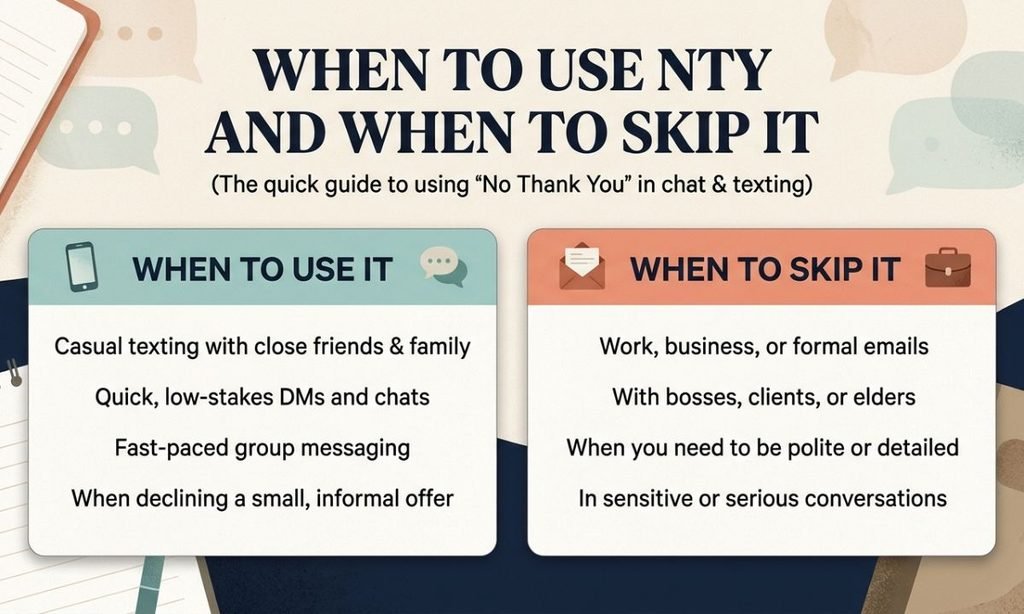
Context matters, even though the meaning is simple. The same three letters can be perfect in one chat and wrong in the next.
When You Should Use NTY
Use it when you’re declining invitations, refusing offers politely, texting friends casually, chatting in group messages, or replying quickly online. If a friend asks, “want to grab lunch?” then “nty i already ate” is exactly right.
When You Should Not Use NTY
Avoid it in professional communication. That means work emails, business messages, academic writing, formal invitations, and official communication. Something clearer works better there, like “No, thank you for the offer.”
Skip it in serious conversations too. If someone is vulnerable or asking for genuine help, a quick NTY feels tone-deaf. Write out something real.
First impressions are another spot to be careful. Using abbreviations too early with someone new can look like you’re not taking the exchange seriously.
Some situations need more explanation. If a friend invites you to their birthday and you can’t make it, they deserve a proper reply, not three letters. Professional environments are the last hard line, so keep NTY out of your work inbox. It falls short when more is needed.
I’ve seen people slip and send slang to a client or a teacher. It’s rarely a disaster, but it does make the message look rushed.
Quick Comparison by Context
| Context | Example phrase | Why it works or doesn’t |
| Casual chat | “want coffee? nty” | Works perfectly |
| Social media | “join the stream? nty” | Natural response |
| Work email | “nty for the meeting” | Too informal |
| Formal invitation | “nty for attending” | Not appropriate |
The takeaway: match the slang to the situation and the tone.
Common Mistakes When Using NTY
The biggest workplace mistake is using it in formal contexts. If a manager emails asking you to join a meeting and you answer with NTY, expect raised eyebrows. Keep it casual.
Another is the bare NTY with no context. If someone puts real thought into an invitation, a lone NTY can feel dismissive even if you meant nothing by it. Add a few words, like “NTY but thanks for thinking of me!”
The third is assuming everyone knows it. When in doubt, write it out, and don’t treat it as something everyone gets. I’ve watched it get misused and misread more than once.
Final Thoughts: Why NTY Keeps Spreading
NTY is easy to overlook, but it’s efficient, socially aware, and surprisingly warm for three letters. Digital communication keeps evolving, and people keep inventing abbreviations to communicate faster. This one is among the simplest examples of a small way to decline that still sounds respectful.
So if you were still wondering what does nty mean in text, here’s the short version. Use it with friends, in gaming, and on social media, and add an emoji when you want more warmth. Save formal wording for serious conversations and work. If you’re unsure someone will get it, write it out. “No thank you” never goes out of style.
The next time someone sends “nty,” you’ll know they’re politely saying no to your offer, invitation, or suggestion.
FAQs
What does NTY mean in text?
NTY stands for “No Thank You.” People use it to politely decline an offer, invitation, or suggestion in texts, DMs, and group chats.
Is NTY rude to send?
Usually not. The “thank you” built into it softens the refusal. A lone “NTY.” with a period can feel cold, so add an emoji or a few friendly words.
What does NTY mean in Roblox?
It means the same thing: No Thank You. Players use it to turn down trades, team invites, or game modes without slowing down gameplay.
How do you pronounce NTY?
You spell it out letter by letter: “N-T-Y.” It’s mostly a written abbreviation, so people rarely say it out loud.
Is NTY formal or informal?
It’s informal slang. Keep it for friends, gaming chats, and social media, and write “No, thank you” in full for work or school messages.
Can I use NTY in a work email or professional message?
It’s best to avoid it. A written-out reply like “No, thank you for the offer” looks more professional and avoids any mix-up.
Does NTY have any other meanings?
Rarely. In a few older forums and niche communities, it has meant “Not To You.” In nearly every modern chat, it means No Thank You.
What is the difference between NTY and “nah”?
“Nah” is a casual, slightly blunt no. NTY adds politeness because it includes “thank you,” so it feels warmer.
Who uses NTY the most?
Teenagers, gamers, online communities, and frequent texters use it most. Some older people may not recognize it, so spell it out when unsure.
What is a polite way to reply with NTY?
Add a short follow-up or emoji, like “NTY, but thanks for thinking of me!” or “NTY 😊.” This keeps the tone friendly and avoids sounding dismissive.
