

Flip over a bottle of vitamins, a bag of coffee, or a tube of sunscreen, and you’ll usually spot a small stamp that reads “MFG” followed by a date. Most people glance at it, shrug, and move on. But if you’ve ever searched for the MFG Date Full Form — or wondered how it’s different from the “EXP” date sitting right next to it — you’re about to get the full picture.
What Does MFG Stand For?
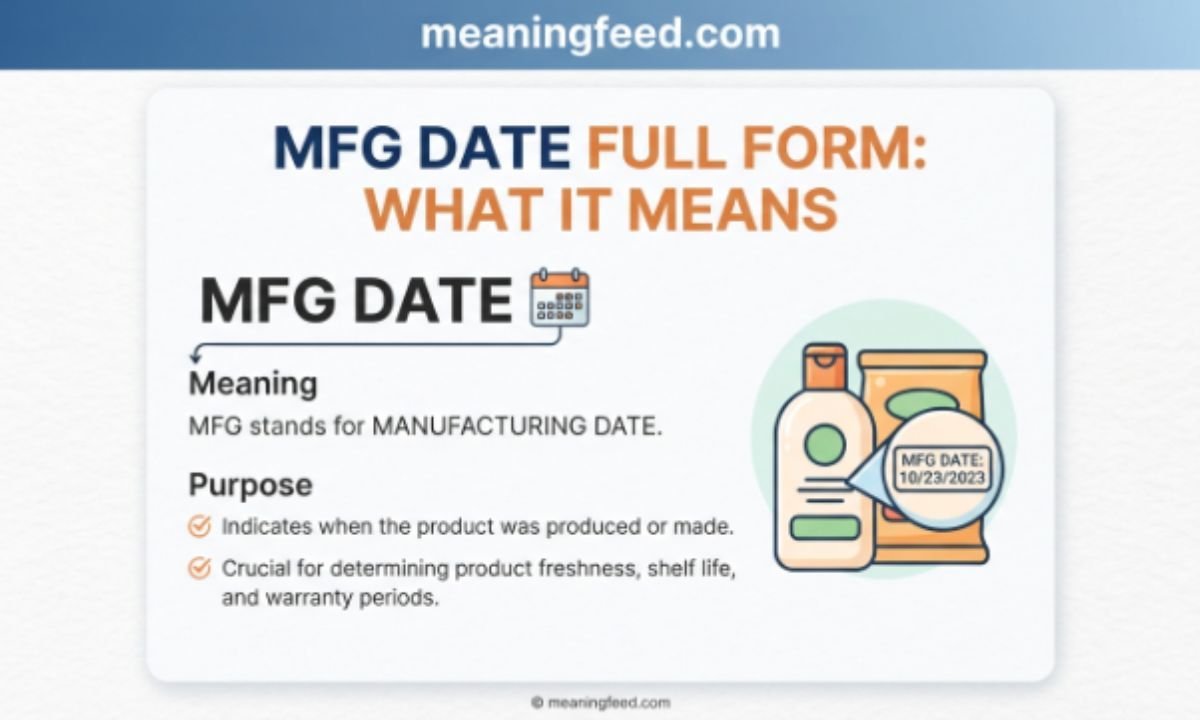
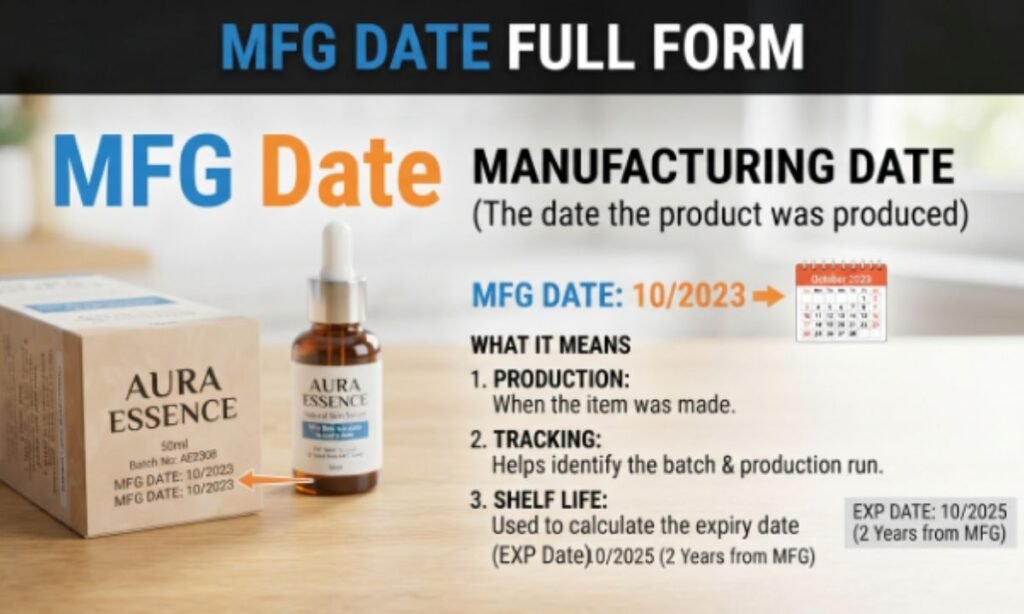
The MFG Date Full Form is “Manufacturing Date” (sometimes written as “Manufacture Date” or “MFD”). It’s the exact date a product rolled off the production line, was mixed, packaged, or otherwise completed and ready to enter the supply chain.
That’s it. No hidden meaning, no complicated formula. If a label says “MFG: 03/15/2026,” the product was made on March 15, 2026.
The confusion usually starts when people assume the MFG date tells them whether a product is safe to use. It doesn’t – at least not directly. It’s a starting point, not a deadline.
Why Manufacturers Print the MFG Date Full Form at All
Companies aren’t required to slap an MFG date on every single product in the U.S., but most do it anyway, and for good reason:
- Traceability — If a batch of food or supplements turns out to be contaminated, the MFG date lets a company pinpoint exactly which production run is affected and pull it fast.
- Inventory rotation — Retailers use it to practice “first in, first out” stocking, so older stock sells before newer stock.
- Quality control — Internal teams track how ingredients perform over time by comparing complaints or test results back to the original production date.
- Consumer confidence — A visible date signals the product wasn’t sitting in a warehouse for years before it reached the shelf.
None of that has much to do with legal expiration. It’s really about accountability across the supply chain – from the factory floor to your kitchen counter.
MFG Date Full Form vs. Other Date Codes on U.S. Labels
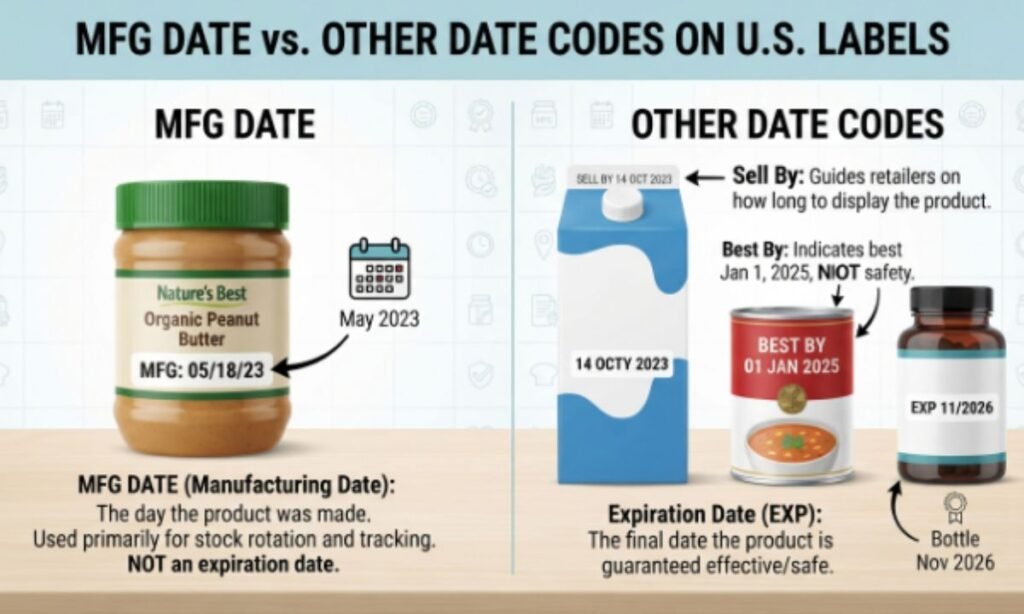
This is where most of the confusion happens. American packaging often carries more than one date, and each one answers a different question.
| Date Code | Full Meaning | What It Actually Tells You | Common On |
| MFG | Manufacturing Date | When the product was made or packaged | Supplements, cosmetics, food, electronics |
| EXP | Expiration Date | The last date a product is guaranteed safe/effective | Medicine, infant formula, some food |
| BB / BBD | Best Before Date | When quality (taste, texture) may start declining, not a safety cutoff | Packaged food, snacks |
| PKG | Packaging Date | When the item was sealed into its final packaging | Meat, bulk goods, wholesale items |
| LOT / Batch Code | Production Batch Identifier | Ties a product to a specific production run for recalls | Nearly everything |
A quick way to remember it: MFG tells you where the clock started. EXP or BB tells you when it’s supposed to stop.
Is MFG the Same as an Expiration Date?
No. This trips up a lot of shoppers, especially with supplements and skincare. <cite index=”8-1″>The manufacturing date is stamped when the product is made, and it’s not the same as the expiration date, which the FDA-guided or manufacturer-set date after which a product is expected to lose quality or safety.</cite> You typically have to do a bit of math yourself – check the shelf life listed elsewhere on the packaging, then count forward from the MFG date.
How to Read an MFG Date (Common Formats)
Here’s the part where things get messy, because there’s no single national standard forcing every company to format dates the same way. In the United States, you’ll usually run into one of these:
- MM/DD/YYYY — the most common American format. “MFG 09/21/2025” means September 21, 2025.
- DD/MM/YYYY — occasionally used, especially on imported goods, and easy to mix up with the format above.
- Julian date code — a 4- or 5-digit number representing the day of the year. “026” means the 26th day of the year, which is January 26.
- Month/Year only — common on long-shelf-life goods like mattresses, furniture, and construction materials, where the exact day barely matters.
- Lot codes embedded in a longer string — where the manufacturing date is buried inside a batch number, often the first four to six digits.
If a date looks off or doesn’t make sense, don’t guess. Most brands list a customer service number or website specifically for decoding batch and date information.
Where You’ll Typically Find an MFG Date
| Product Category | Typical Location | Format You’ll Likely See |
| Dietary supplements | Bottom of bottle or box flap | MM/DD/YYYY |
| Skincare & cosmetics | Crimped edge of tube, bottom of jar | Batch code with embedded date |
| Packaged food | Side or bottom of package | MM/DD/YYYY or Julian code |
| Electronics | Barcode label on the back or underside | YYYY-MM or serial-embedded date |
| Tires | Sidewall (DOT code) | Week/Year, e.g., “2325” = 23rd week of 2025 |
| Furniture & mattresses | Sewn-in tag or stamped frame | Month/Year |
Why Knowing the MFG Date Full Form Actually Matters to You
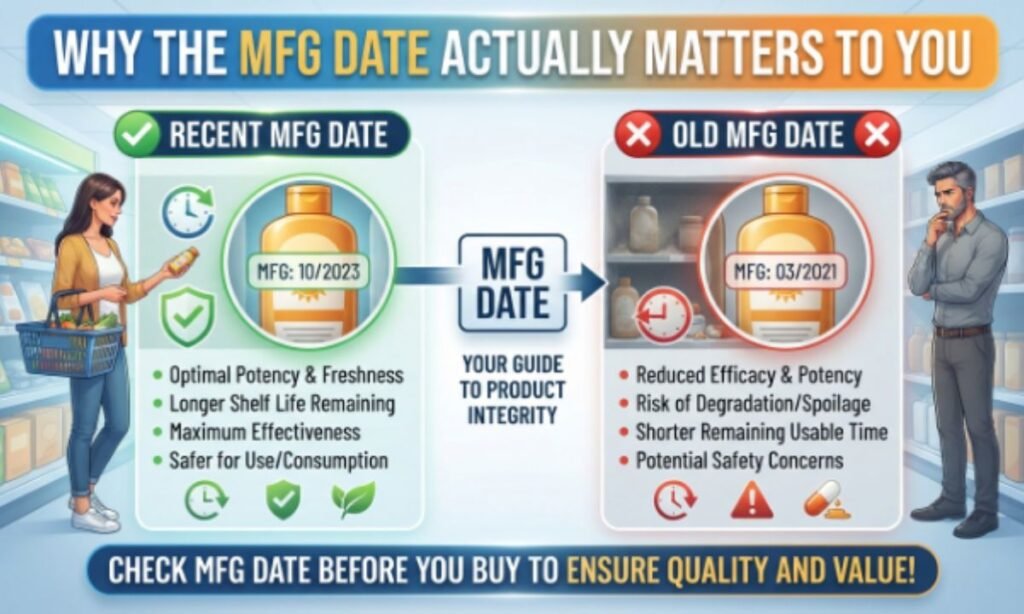
It’s easy to dismiss this as manufacturer paperwork, but there are real, practical reasons to check it before you buy:
- Freshness matters more than you’d think. Vitamins, probiotics, and skincare actives degrade over time, even before an official expiration date hits.
- It helps you compare stock at different stores. Two bottles of the same supplement, from two different retailers, can have MFG dates months apart.
- It protects you during recalls. If a company issues a recall tied to a specific production window, your MFG date is how you check whether your product is affected.
- It’s useful for warranty claims. On electronics and appliances, some warranties are calculated from the manufacturing date, not the purchase date, so it’s worth keeping that info handy.
A Quick Reality Check on U.S. Regulations
Unlike some countries, the U.S. doesn’t have one blanket law requiring an MFG date on every consumer product. <cite index=”1-1″>Labeling requirements vary depending on the product category, and the United States primarily mandates expiration dates for items like infant formula</cite> rather than requiring manufacturing dates across the board. Most of the MFG-date labeling you see on supplements, cosmetics, and packaged goods is a voluntary industry practice tied to good manufacturing practice standards, not a strict federal mandate for every product type.
That’s exactly why formats aren’t standardized – brands are largely deciding for themselves how (and whether) to display this information.
Conclusion
Now that you know the MFG Date Full Form, it’s clear this isn’t complicated once you know what you’re looking at — it’s simply the birthday of the product in your hands. What matters is what you do with that information: pair it with the shelf-life details on the label, compare it against fresher stock when you can, and don’t confuse it with an expiration date that isn’t actually printed there. A few extra seconds checking the fine print can save you from buying something that’s already past its prime, even if the label never technically says “expired.”
Frequently asked Questions
What is the MFG Date Full Form?
It stands for “Manufacturing Date” — the exact day a product was produced, mixed, or packaged before entering the supply chain.
Is it the same as the expiry date?
No. It only tells you when the product was made, while the expiry (EXP) date tells you the last day the manufacturer guarantees it’s safe or effective to use.
Can I use a product after this date?
Yes. By itself, it isn’t a safety cutoff — it’s simply a reference point. You need to check the shelf life or expiry date printed separately to know how long the product remains usable.
How do I calculate the expiry date from it?
Check the shelf-life duration mentioned on the packaging (for example, “Best used within 24 months of manufacture”), then count that duration forward to estimate the expiry date.
Is it mandatory for U.S. companies to print it?
No, not across the board. Most U.S. labeling laws focus on expiration dates for specific categories like infant formula, while this kind of labeling is largely a voluntary industry practice.
What if a product doesn’t show this date at all?
Check for a lot or batch code instead — many brands embed the production date within that code and can decode it for you through customer service.
What’s the difference between this and a packaging date?
One marks when the product itself was made, while the packaging (PKG) date marks when it was sealed into its final packaging — these can sometimes be a few days or weeks apart.
