

Your phone buzzes, and a friend has answered your question with two letters: “DK.” If you’ve ever stared at that reply wondering what you missed, you’re not alone. The DK meaning in text is simpler than it looks, but only if you know which DK you’re dealing with.
People search this abbreviation because it shows up everywhere. It appears in group chats, game lobbies, comment sections, Discord servers and dating apps, and it doesn’t always mean the same thing. One missing letter or a different platform can change the whole message.
This guide covers the main meaning, where it came from and how people use it on different apps. It also shows how to answer it, how it differs from IDK, and when to leave it out of a message.
What Does DK Mean in Text?
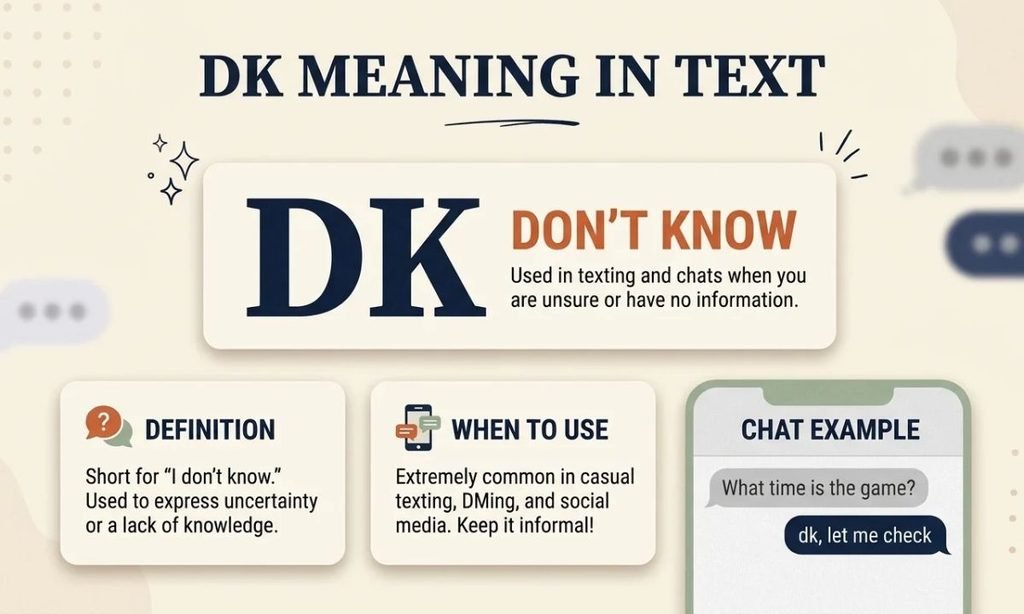
Answer Block: DK most commonly means “Don’t Know” in text messages and online chats. It’s a quick, casual reply for when you can’t answer a question or lack the information. Depending on context, it can also stand for Donkey Kong, Death Knight, Dragon Knight or Dark, so the setting tells you which one fits.
The DK meaning in text is Don’t Know, and it wins by a wide margin. Someone asks you something, you’re unsure, and you type DK. Two letters do the work of a full sentence, and nobody has to wonder what you meant.
It’s popular because it asks nothing of the reader. Nobody expects you to explain further. The other person understands, the chat keeps moving, and you save time when you’re busy.
DK Full Form
The DK full form is Don’t Know. It covers anyone who is unsure or has no information to give. Here’s the quick reference:
| Abbreviation | Full Form | Meaning |
| DK | Don’t Know | Unsure or no information |
DK Meaning Examples You’ll See Often
Here are a few everyday ways people use it:
- Someone asks, “What time is Sarah coming?” The reply is “DK.”
- Someone asks, “Do you know the homework?” The reply is “DK yet.”
- Someone asks, “Why was he upset?” The reply is “I DK.”
None of these replies needs more explanation, which is the whole point of the slang term.
Where Does DK Come From?
Nobody has a birth certificate for DK, so the exact origin is fuzzy. The most likely story starts in the early days of SMS and online chatrooms. People typed on tiny keypads, every character took effort, and short forms were a natural fix.
Shorthand like BRB, LOL and IDK came first. DK looks like the next step: the same phrase with the “I” dropped. Whether people cut it on purpose or just typed fast and let it stick isn’t documented, as far as I know. I’d call the chatroom theory probable, not proven, and nobody can point to the very first DK.
Smartphones then carried it onto WhatsApp, Snapchat, Instagram and other social platforms. Over time it settled into everyday communication across age groups. Today it’s part of texting culture, kept alive by people who want to communicate quickly.
How Do People Use DK in Text Messages?
Usage shifts a little with the situation, so here’s how it plays out in practice.
Casual and Formal Settings
In general conversation, DK is a way to reply when you don’t have enough information. It keeps things moving without extra detail. With friends it’s perfectly acceptable, and it suits fast chats where short replies are normal. When I’m texting casually, I send it all the time and nobody blinks.
Formal communication is another story. In a professional email or a work message, I’d write “I’m not sure” or “I don’t have that information.” Complete sentences protect your professionalism, and a bare DK in a work thread tends to read as careless.
Why Tone Matters
Tone matters more than the two letters themselves. DK can sound neutral, but it can also come across as uninterested or even dismissive. Adding a few words fixes that. “DK, let me look into it” works better than a lone DK when the other person is waiting on you.
DK Meaning on Social Media Platforms
On social media, the DK meaning in text stays the same: Don’t Know. Here’s how it shows up on each app:
- WhatsApp: Quick replies when someone doesn’t know the answer.
- Snapchat: Fast chats full of short, low-detail replies.
- TikTok: Comments or replies when someone is unsure about a video or a discussion.
- Instagram DMs: Casual answers to questions, or a way of expressing uncertainty.
It also turns up in captions and comments, with examples like “DK what to post today” under a post, or “IDK but DK works too.” Across all of these, it appears in short, casual exchanges and keeps conversations brief.
DK on Dating Apps and in Online Chats
On messaging platforms and dating apps, fast replies are the norm, and DK fits because it’s short and easy to type. It saves you from overthinking an answer you can’t give anyway.
On a dating app, though, a lone DK can feel dry or even uninterested. Extra words keep the conversation alive. Instead of just DK, try “DK yet, but I’d love to hear your ideas.” In general chats, DK keeps things fast and simple, which is why it stays popular in digital communication.
What Are the Other Meanings of DK?
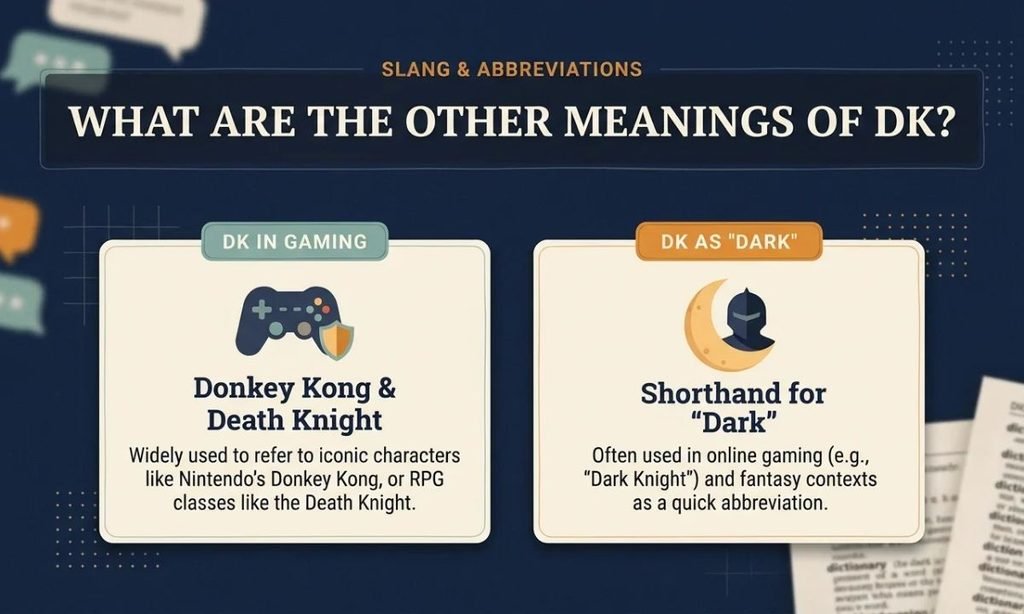
DK has more than one meaning, and I learned that the practical way. When a user asked me whether DK ever means anything besides Don’t Know, the honest answer was yes. Most of the other meanings rarely matter in a regular text thread, but they matter a lot in specific communities.
DK Meaning in Gaming
In gaming, DK splits off completely. Gaming communities read it as a character or a class, and the gaming meaning has no link to knowledge at all.
Donkey Kong. DK often means Donkey Kong, the famous Nintendo character. You might hear “I main DK in Smash,” “DK is one of the strongest characters,” or “Played classic DK today.” A “main” is simply the character you pick most often. Here, DK has nothing to do with Don’t Know.
Related gaming meanings. DK can also mean Death Knight in World of Warcraft, or Dragon Knight in some RPG games. These sometimes overlap, even inside one server’s chat. Phrases like “DK is overpowered” or “Need a Death Knight build” make it clear nobody is admitting ignorance. The abbreviation shifts from game to game, and context tells you which one applies.
DK Meaning as “Dark”
This is the one I run into least. In social media aesthetic communities, DK may stand for Dark. You’ll see lines like “This edit is DK themed” or “I like DK aesthetics.” The word describes a mood, and it’s far less common than Don’t Know.
If DK means Dark, related slang can include emo, gothic, moody, edgy and shadow aesthetic. A sentence like “This profile has a DK vibe” is a typical example.
Technical and Medical Meanings
Outside texting, DK can take on technical meanings. In medicine it’s tied to diabetic ketoacidosis, usually written DKA, and DK alone is less commonly used for it. In technology, DK may refer to a development kit, as in SDK, a Software Development Kit used in programming and software development.
In physics, DK has no widely recognized standard meaning, so don’t waste time hunting there. If you see it in a chat with friends, it’s almost certainly Don’t Know.
DK Meaning Slang: All Popular Meanings Compared
Here are the major meanings side by side, ranked by how often you’ll run into them.
| DK Meaning | Context | Usage Frequency |
| Don’t Know | Texting/chat | Very common |
| Donkey Kong | Gaming | Common |
| Death Knight | MMORPG gaming | Common |
| Dark | Aesthetic slang | Less common |
| Dragon Knight | RPG games | Niche |
What Does DK Stand For?
People often search the same three phrases: “what does DK stand for,” “DK full form” and “DK meaning slang.” The short answer is that DK can stand for Don’t Know, Donkey Kong, Death Knight, Dark or Dragon Knight. Pick the one that matches the chat you’re in.
Example Sentences for Each DK Meaning
Seeing the same two letters in different settings makes the split clear.
| Meaning | Example Sentences |
| Don’t Know | “DK where he went.” “I DK the answer.” “DK if I can come.” |
| Donkey Kong | “DK is my favorite Nintendo character.” “Picked DK in Mario Kart.” |
| Death Knight | “My DK build is strong.” “Leveling a DK in WoW.” |
| Dark | “That artwork has a DK mood.” |
Where Is DK Commonly Used?
I run into DK in four main places, and each one has its own flavor.
- Text messaging: The most common spot, across SMS, WhatsApp, Snapchat and Instagram DMs.
- Social media: Captions, comments and replies.
- Gaming: Very common in gaming communities, though usually as a character or class.
- Forums and Discord: Fast conversations where abbreviations are the default.
Why Do People Use DK?
The reasons are simple. People use slang like DK because it’s faster, easier, relaxed and friendly, and it fits fast-paced chat without effort.
- Faster: Typing DK is easier than typing “I don’t know.”
- Casual: It feels relaxed and friendly, which suits a casual chat.
- Common internet language: People use abbreviations naturally online, so DK blends in.
- Fits fast-paced chat: It works for texting and gaming alike.
Real-Life Examples of DK in Everyday Chats
Tone can change what two letters say, so here are examples across different moods and platforms.
Four Sentences I’d Actually Send
- “What time is the meeting?” / “DK, I’ll check and let you know.” This shows uncertainty while keeping the conversation open.
- “Where are they going tonight?” / “DK, they didn’t tell me.” It’s a casual reply when information is missing.
- “Do you know the answer to this question?” / “DK honestly 😅” The emoji adds a light tone.
- “What should we do this weekend?” / “DK yet, let’s decide later.” This fits when plans aren’t set and nobody is in a rush.
How Tone Changes the Message
- Friendly: A friend asks, “Want pizza tonight?” You send, “DK yet, maybe.” You’ve left the door open.
- Casual: “I DK what movie to watch.” Pure casual tone, no pressure.
- Argumentative: “You always act like I should DK everything.” In an argument, the abbreviation turns sharp, so this is where I’d be most careful.
- Gaming: “DK is my favorite Smash character.” Same two letters, completely different character.
- Social media: “DK why this meme is so funny.” It’s a joke, and it works because the poster really can’t explain it.
Is DK Rude, Offensive or Neutral?
DK is generally neutral. It’s plain slang, and it isn’t offensive. It’s fine with friends, common in texting and accepted on social media.
It can feel rude in some moments, though. Say a friend writes, “Can you help me?” and you answer with a lone DK. That may feel cold, even blunt. Better to write “I don’t know, sorry” or “Not sure yet.”
Keep in mind that DK is an informal expression. It works in relaxed chats, but in formal or professional settings it can look careless.
Common Misconceptions About DK
A few wrong ideas about DK keep circulating:
- “DK always means something technical.” In texting, it usually means Don’t Know. The technical meanings belong to other fields.
- “DK is rude.” Whether it is depends on tone and context. It can be neutral or casual.
- “DK is outdated.” It’s still widely used in modern chats.
DK vs IDK and Other Texting Abbreviations
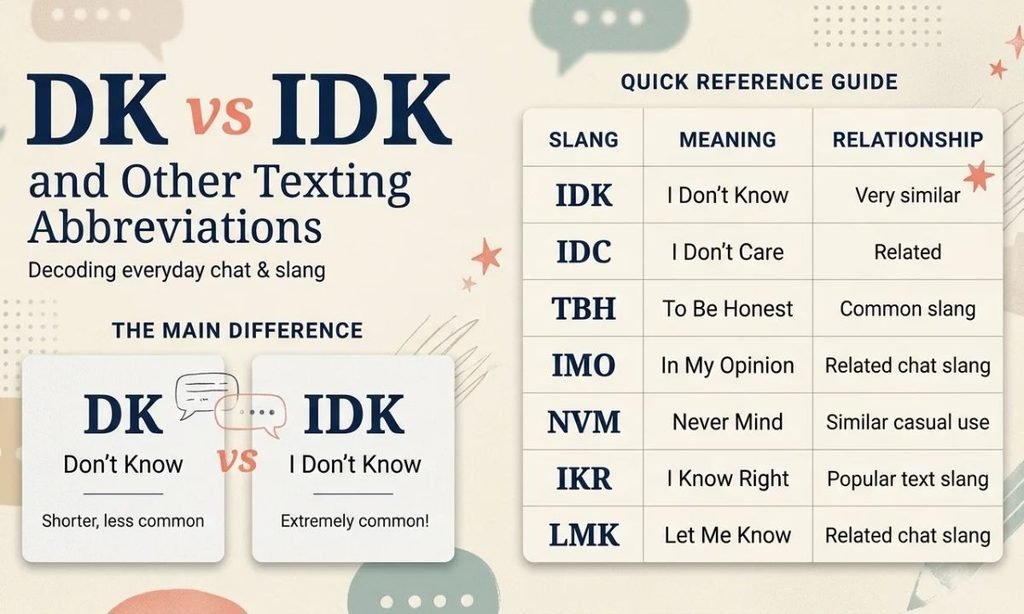
Texting abbreviations are easy to mix up, so here’s a quick map.
The Difference Between DK and IDK
DK is the shorter version of IDK because it drops the subject “I.” The two are closely related. IDK clearly means “I Don’t Know,” while DK leaves the speaker implied, as in “IDK what happened” versus a plain “DK.” IDK is the more common and clearer of the two.
DK is also more neutral than most of its relatives. IDC sounds dismissive because it says you don’t care. TBH signals honesty. DK simply shows uncertainty and a lack of knowledge, nothing more.
Similar Slang Terms Related to DK
DK rarely travels alone. These abbreviations show up in the same chats, and they all belong to the same family of slang and short forms.
| Slang | Meaning | Similar to DK? |
| IDK | I Don’t Know | Very similar |
| IDC | I Don’t Care | Related |
| TBH | To Be Honest | Common slang |
| IMO | In My Opinion | Related chat slang |
| NVM | Never Mind | Similar casual use |
| IKR | I Know Right | Popular text slang |
| LMK | Let Me Know | Related chat slang |
Each one does a different job: sharing an opinion, admitting something honestly, showing how much you care, or telling someone what you know. If you keep running into other two-letter replies like this, our guide on IK meaning in text is a good next read. Knowing the differences helps you choose the right abbreviation for the tone and the conversation.
More Terms People Confuse With DK
Sometimes people search DK but mean something else. Common mix-ups include DKM (Don’t Kill Me or Don’t Kid Me), DYK (Did You Know), IDK (I Don’t Know) and DKW (Don’t Know Why). A single missing letter is enough to confuse a reader, so check the letters before you reply.
How to Respond to DK
When someone sends DK, they mean one thing: they don’t have the answer. Your reply should help the conversation move forward instead of stopping it. These are the three I usually pick:
- “No worries, let’s figure it out together.”
- “Okay, let me check and get back to you.”
- “Alright, we can decide later then.”
When Should You Avoid Using DK?
Even common slang has limits. A few places are worth steering clear of.
- Professional emails: “DK about the report” is wrong for work. Better: “I’m not sure about the report.”
- Formal writing: Skip slang in essays, job applications and academic papers. Formal writing needs full phrasing.
- Serious or emotional conversations: DK can seem careless when someone is upset or the topic matters. Use full words instead.
Polite Alternatives to DK
Instead of DK, you can say “I’m not sure,” “I don’t know,” “Let me check,” “I’m unsure right now” or “I’ll find out.” These sound more polite, and I reach for them whenever the other person is waiting on me.
What Slang Like DK Does to Communication
Slang changes how messages land. It can make them more casual, more efficient and more relatable.
- More casual: It creates relaxed conversation.
- More efficient: Shorter messages get read and answered faster.
- More relatable: Among younger users especially, a bit of slang sounds natural.
Too much slang, though, brings confusion. Balance matters.
Is DK Safe for Social Media?
Generally, yes. It’s non-offensive, common slang that’s platform-friendly and easy to understand. Just use context so people don’t mix up Don’t Know with the gaming meanings.
Using DK Correctly
The DK meaning in text is Don’t Know, but the same two letters can also point to Donkey Kong, Death Knight, Dragon Knight or Dark. That’s why people keep asking what DK stands for. Look at the platform and the people in the chat, and the right meaning usually becomes obvious.
Used well, DK is harmless, useful, everyday text slang. Check your tone, your audience and the context before you hit send, and add a few friendly words when someone is counting on you for an answer. Next time you see DK, you’ll know exactly what it means.
FAQs
What does DK mean in text?
DK most commonly means “Don’t Know.” People send it as a quick reply when they can’t answer a question or don’t have the information.
What is the full form of DK in texting?
The full form of DK in texting is “Don’t Know.” It’s a shortened version of “I don’t know” used in casual chats and messaging apps.
Is DK the same as IDK?
They’re very close, but not identical. IDK spells out “I Don’t Know,” while DK drops the “I” and leaves the speaker implied. IDK is the more common and clearer of the two.
Can DK mean Donkey Kong?
Yes, especially in gaming. Players often use DK for the Nintendo character Donkey Kong, as in “I main DK in Smash.”
What does DK mean in gaming?
In gaming, DK can mean Donkey Kong, Death Knight (World of Warcraft) or Dragon Knight (some RPGs). The game or server you’re in tells you which one applies.
Does DK ever mean “Dark”?
Sometimes. In social media aesthetic communities, DK can stand for Dark, as in “DK themed edit.” It’s much less common than Don’t Know.
Is DK rude or offensive?
No, DK is generally neutral slang. A lone DK can feel cold or dismissive, though, so add a few words like “DK, let me check” when someone is waiting on you.
Can I use DK in a work email or formal message?
It’s best to avoid it. In professional or formal writing, use “I’m not sure” or “I don’t have that information” instead.
How do I reply when someone texts me DK?
Keep the conversation moving with something like “No worries, let’s figure it out together” or “Okay, let me check and get back to you.”
Where is DK most commonly used?
DK appears most in text messages, WhatsApp, Snapchat and Instagram DMs. You’ll also see it in social media comments, gaming chats, forums and Discord servers.
What are some polite alternatives to DK?
Try “I’m not sure,” “I don’t know,” “Let me check” or “I’ll find out.” These sound friendlier when the other person needs a real answer.
Is DK still used today?
Yes, DK is still widely used in modern chats. It stays popular because it’s fast, casual and easy to type.
