

You’re scrolling through a group chat, a dating profile, or a comment thread, and there it is: four capital letters with no explanation. If you landed here searching for BDSM meaning in text, you’re not alone, and you’re not behind on slang. Plenty of people hit this exact moment and wonder whether they missed something.
Part of the confusion is that the term looks like a texting shortcut but doesn’t behave like one. It turns up on TikTok, Reddit, dating apps, in private messages, and in articles about relationships or books and movies. It has no obvious “lol” or “brb” feel, and that mismatch is why people stop and look it up.
This article gives you the plain answer first, then covers where the term came from, how people use it in different places, and how to reply without making things awkward. You’ll also see where it’s out of place, such as at work or school.
BDSM stands for Bondage and Discipline, Dominance and Submission, and Sadism and Masochism. In a text, it refers to a broad range of consensual adult practices and relationship dynamics. It is an acronym, not casual slang, and it rarely stands in for anything else. The surrounding conversation tells you why someone used it.
What Does BDSM Mean in Text Messages?
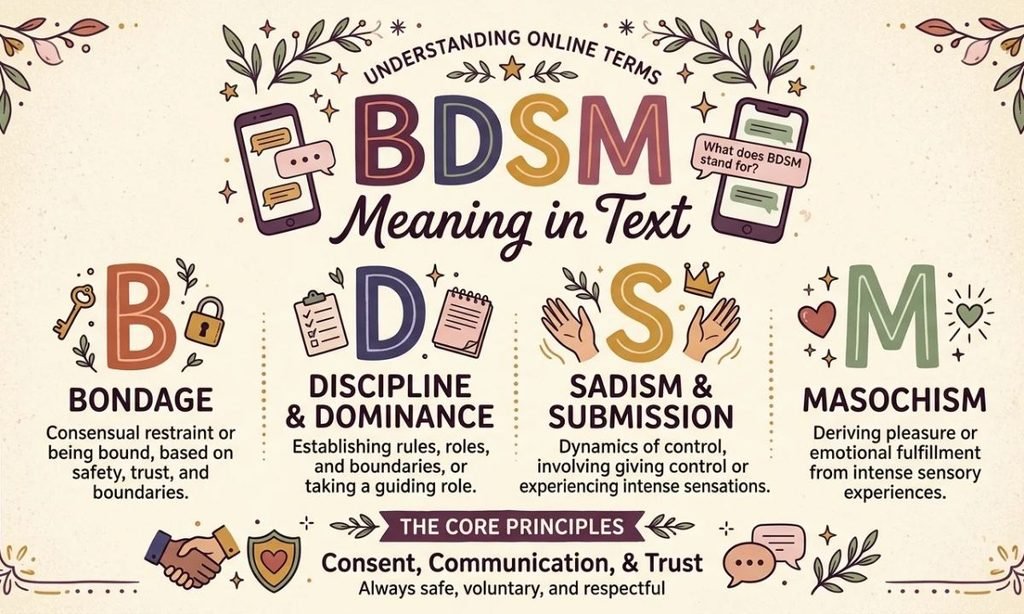
The meaning breaks down into three pairs. B and D stand for Bondage and Discipline. D and S stand for Dominance and Submission. S and M stand for Sadism and Masochism. Four letters carry six ideas, and people often group them into those three pairs.
You don’t have to memorize every component to follow a chat. Knowing it’s an adult subject gives you the basic meaning. Think of it as adult terminology covering a broad category of consensual interests and practices, not one single act.
The themes people associate with it include restraint, power exchange, and the giving and receiving of physical sensation. It’s a wide spectrum of preferences and relationship dynamics. Not everyone who uses the word is interested in every part of it. One person may care only about role-based dynamics, another treats it as a personal interest they’ll happily discuss, and a third wants little to do with most of it.
Is BDSM Always Sexual?
No. It often turns up in a sexual or romantic context, but some couples apply power exchange to their relationship without any sexual activity at all. A pair might agree on consensual roles that are about structure and trust, not sex.
This is one reason context matters more here than with almost any other acronym. The same four letters can come up in a flirty chat, a vocabulary question, or a conversation about relationship roles.
Consent Is the Key Distinction
If people miss one thing, it’s consent. The word describes consensual participation between adults, with agreed roles, control handed over by choice, and boundaries both sides respect. Abuse is the opposite, not a synonym. The word should never be treated as another word for abuse or non-consensual behavior.
Someone who is dominant or controlling in everyday life isn’t what the term describes either. Being bossy at work or in a friendship has nothing to do with it.
Healthy discussions of BDSM usually involve these things:
- Clear agreement between the adults involved
- Open talk about boundaries and limits
- Respect for those limits
- The ability to stop an activity at any time
- Attention to comfort and safety
- Mutual understanding of what has been agreed upon
Seeing the word in a text also isn’t proof that someone wants a particular activity. Read it as a subject, not an offer.
Is BDSM Slang or an Acronym?
Not exactly slang. People often file it under online slang or internet slang, but that’s not quite right. BDSM is an acronym, a shortened form of a longer name. It isn’t a coded phrase or a secret abbreviation for something else.
Say a friend texts, “Do you know much about BDSM?” They’re almost certainly asking about the subject itself. I’ve watched people spend ten minutes hunting for a hidden code that wasn’t there. People may use the word casually in messages, but the term itself describes a specific area of adult relationships and sexuality.
There’s no widely recognized everyday texting meaning that competes with the real one. Context can still affect how someone uses the word, but nobody has a second, separate meaning tucked behind the letters. Read the surrounding conversation, and the meaning in text usually becomes clear.
BDSM vs. Other Common Texting Abbreviations
Put the term next to LOL, IDK, IMO, FYI, and BRB, and the difference jumps out. Those are informal expressions built for speed. Each one shortens a common phrase. BDSM doesn’t shorten a casual phrase. It names a specific subject. If another abbreviation has you stuck, our guide to DK meaning in text covers a more everyday one.
| Term | Meaning | Main use |
| BDSM | Bondage and Discipline, Dominance and Submission, Sadism and Masochism | Refers to a specific subject |
| LOL | Laughing out loud | Shows amusement |
| IDK | I don’t know | Signals uncertainty |
| IMO | In my opinion | Introduces a personal view |
| FYI | For your information | Shares useful information |
| BRB | Be right back | Says someone will return shortly |
The everyday shortcuts carry quick responses like amusement, uncertainty, opinions, and useful information. BDSM serves a different purpose and isn’t interchangeable with any of them. It’s a narrow term with a specific meaning, and it never works as casual filler.
How BDSM Is Used in Different Online Contexts

Where you see the word shapes how you read it, so it helps to go place by place.
In Text Messages
If someone mentions it during a private conversation, a dating discussion, or a relationship chat, they’re usually referring to the practices or to a personal interest in them. Picture Alex asking Sam what kind of relationships they’re looking for. Sam says they’re open-minded and have explored BDSM-related relationships. Here, the word simply describes a personal interest.
On Dating Apps
On a dating app, the term can appear in a profile when someone wants to signal that they’re interested in, experienced with, or open to partners with similar interests. The exact meaning depends on the profile and on how the conversation goes.
Don’t assume a person who lists it wants every practice under the umbrella. In my experience, that assumption causes more awkward first messages than anything else.
On TikTok, Reddit, and Social Media
On TikTok, Reddit, and other platforms, the word shows up in talk about sexuality, books, movies, and personal experiences. Sometimes it’s an invitation or a personal disclosure. Often it’s just an educational discussion where someone is explaining a term, not offering anything.
In Online Communities
Online communities use it as a general term too. Groups built around consensual practices share education and resources, and the word appears constantly because it’s their shared vocabulary.
Does the Platform Change the Meaning?
No. Platforms differ, but the acronym means the same thing on a public feed and in a DM. What changes is the situation. The term might appear in a wider conversation that leaves someone comfortable or uncomfortable, and the sender’s intention matters more than the letters themselves.
If you can’t tell what someone means, ask the sender. People also ask plain vocabulary questions now and then, and that’s fine. Unfamiliar terms need explaining, and online conversations about terminology rarely hide a second meaning.
Who Uses the Term BDSM?
It isn’t one neat group. You’ll find it in educational content, articles, and online conversations, on any social media platform, and across every age group. It appears in adult relationship discussions, in posts and messages, and in general talk about terminology.
When you run into it, interpret the message by what it says instead of guessing. Knowing what the term means tells you nothing about a person’s preferences, so avoid building assumptions. Go by what the person actually says, ask about the acronym if it’s unclear, and let them explain their intentions.
Is BDSM a Gen Z Expression?
No. It isn’t exclusive to any generation. The term existed before modern social media, so it isn’t ordinary youth slang. Younger internet users run into it in broader discussions, and so does everyone else.
Recognizing a term doesn’t reveal someone’s interests or intentions. Read the message, not the age of the person typing it.
Where Did the Term BDSM Come From?
The origin of the acronym is a bit fuzzy, and I’d rather say so than fake certainty. The usual story traces it to online communities in the early 1990s, where B&D, D&S, and S&M were merged into one combined label. Exactly who first typed it is debated. For a broader reference, the Wikipedia article on BDSM lays out the history and terminology in more detail.
The older pieces have clearer roots. “Sadism” draws on the Marquis de Sade, and “masochism” on the writer Leopold von Sacher-Masoch. The psychiatrist Richard von Krafft-Ebing helped popularize both words in the late 1800s.
So BDSM originated as a way to group related terms formed from older labels for adult interests and practices. It’s not a newly invented texting abbreviation, and it didn’t start on a social media app. Digital communication just raised its visibility. Everyday browsing now puts unfamiliar terms in front of people who would never have met them, and many wonder how the concepts connect and which reading applies to the chat in front of them.
Does BDSM Have a Clear Texting Origin?
No. There’s no clear texting origin, and no reason to assume it began as an internet texting code. It’s an established acronym that people now meet in messages, online posts, educational material, and chat.
Its appearance in a conversation doesn’t automatically give it a different meaning. It usually refers to the same general subject, and the surrounding conversation explains why the sender mentioned it.
BDSM vs. Similar Terms: Kink, Vanilla, and More
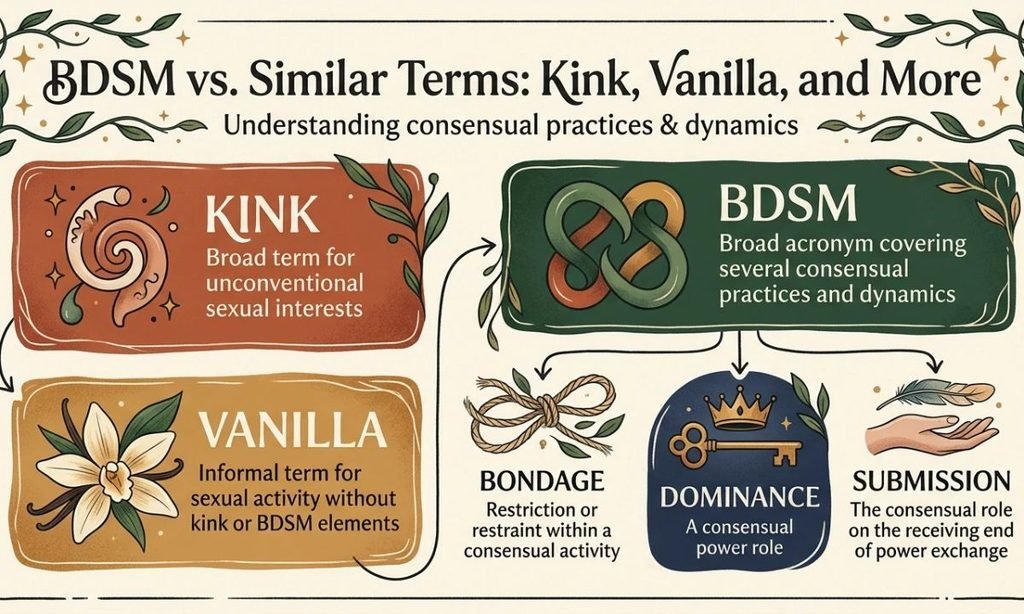
A few neighboring words get mixed up with BDSM. This table sorts out the differences.
| Term | Meaning | Main difference |
| BDSM | Broad acronym covering several consensual practices and dynamics | Umbrella term |
| Bondage | Restriction or restraint within a consensual activity | One part of BDSM |
| Dominance | A consensual power role | One part of BDSM |
| Submission | The consensual role on the receiving end of power exchange | One part of BDSM |
| Kink | Broad term for unconventional sexual interests | Wider term that can include BDSM |
| Vanilla | Informal term for sexual activity without kink or BDSM elements | Often used as a contrast to kink |
These terms overlap, but they aren’t interchangeable. Bondage, dominance, and submission are each one part of BDSM, while kink is the wider term. Kink covers sexual interests outside conventional sexual practices, and BDSM is one major category within the broader world of kink. The main difference is scope.
Common Misunderstandings About BDSM
A few mix-ups come up again and again.
“BDSM means one specific activity.” Not necessarily. It’s an umbrella term covering several different interests and dynamics, so it never points to a single act.
“Everyone interested in BDSM likes the same things.” No. People have different preferences, boundaries, and levels of interest.
“BDSM always means a sexual conversation.” Not always. It frequently appears in sexual or dating contexts, but it also shows up in educational, cultural, relationship, and community discussions.
“If someone says BDSM, they’re inviting me to discuss sex.” Not necessarily. They may be answering a question, describing a preference, or looking at the topic academically, the way any subject gets studied.
Real Chat Examples of BDSM in Text
I’ve watched people panic over this word in group chats when one calm question would have solved it. These examples are non-explicit on purpose. They focus on understanding the word, not on graphic details or specific practices.
Asking About an Unfamiliar Term
Alex: “What does BDSM mean?”
Jordan: “It’s an acronym for an adult subject with specific practices and relationship dynamics.”
Mia: “I came across BDSM in an online article.”
Olivia: “It’s an adult term. The context should explain why the article brings it up.”
Clarifying a Conversation
Noah: “Someone used BDSM in a message and I didn’t get it.”
Liam: “It’s an acronym related to consensual adult practices.”
Emma: “Is BDSM an abbreviation like BRB?”
Sophie: “It’s an acronym, but it’s not an everyday texting shortcut.”
Examples From Dating and Education
A: “I saw BDSM on your profile. What does that mean for you?”
B: “I’m interested in consensual power dynamics. Happy to explain.”
A: “You mentioned BDSM earlier. Is that something you practice?”
B: “Yes, but only with clear boundaries and good communication.”
A: “I keep seeing BDSM online. What does it actually stand for?”
B: “It’s an acronym for several kinds of consensual adult practices and relationship dynamics.”
Setting a Conversation Boundary
Ryan: “Do you know what BDSM means?”
Leo: “I know it’s an adult term, but I’d rather not discuss it.”
A: “Are you comfortable talking about BDSM?”
B: “Sure, but I’d rather keep it educational.”
Every exchange stays polite. You can give a definition in general language and still decline to join a longer chat. Understanding the word doesn’t oblige you to take part, and these examples show why context and consent matter when interpreting the term.
A Real-World Example
Here’s one more. A college student is reading about internet terminology and, for the first time, finds an acronym she doesn’t know.
Alex: “I found an acronym online that I didn’t understand.”
Jordan: “Which one?”
Alex: “BDSM. Do you know what it means?”
Jordan: “It’s an adult subject. You can look up a neutral definition if you need one.”
Alex: “Okay that makes sense.”
The main lesson is that mentioning the term doesn’t automatically mean a personal request. Understanding comes before assuming. If a private chat like this made either of them uncomfortable, they could simply change the topic. Intention shows in what people say next, not in the acronym.
How to Reply When Someone Uses BDSM
Your reply depends on why the person brought it up. They might be curious about a post, passing along something they read, or sharing something personal. Reply naturally and go with your real comfort level.
If you’re curious, ask what they mean, or ask what the abbreviation means. If you want a general explanation or clarification, say so. If you’d like to step back, “I’d rather not discuss that topic” is a complete response, and you owe nobody personal reasons. When a conversation drifts somewhere you didn’t sign up for, setting a boundary is respectful, and you can change the topic.
You can also acknowledge the term, skip assumptions about intentions, and move on. A short response beats a lecture. If someone gives you a definition you didn’t ask for, a plain “thanks, got it” does the job.
When you truly can’t tell what someone means, a simple clarification works best: “What do you mean by BDSM?” That one question prevents most mix-ups and keeps the conversation respectful.
Is BDSM Rude or Offensive in Text?
Not automatically. It isn’t an insult or a swear word. It’s a commonly used term for consensual adult practices and relationship dynamics. It is, however, a sensitive subject, and the setting counts.
What makes things inappropriate is how someone brings it up. A neutral discussion, like a vocabulary question or an educational topic, is fine. Raising a personal subject repeatedly after someone has asked you to stop is not. Respectful communication means honoring comfort levels and steering clear of unwanted personal conversation.
Pressure is the real problem, not the word. Asking what an unfamiliar term means is a different act entirely from pushing someone into a chat they didn’t want. Avoid assuming that someone wants to talk about their private interests simply because they used the term.
Is BDSM Appropriate at Work or School?
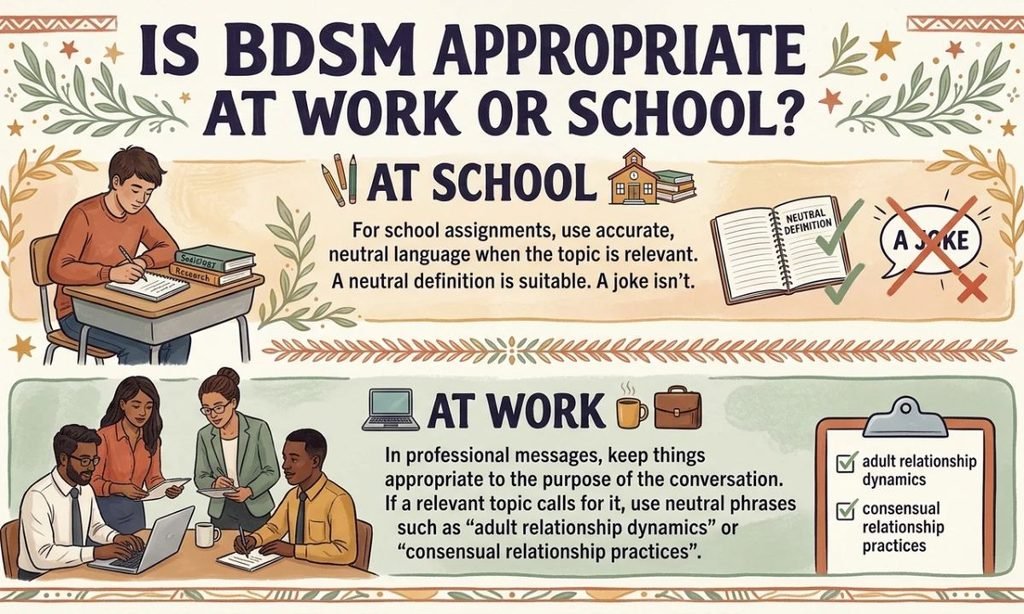
It depends on the subject, the situation, and the audience. Bringing it up in a workplace conversation, in a classroom discussion with no relevant context, or in an unexpected family group chat would usually be inappropriate. It’s the wrong setting, and people end up uncomfortable. In formal or professional settings, the term can also come across as crude or out of place.
At School
For school assignments, use accurate, neutral language when the topic is relevant. A neutral definition is suitable. A joke isn’t.
At Work
In professional messages, keep things appropriate to the purpose of the conversation. If a relevant topic calls for it, use neutral phrases such as “adult relationship dynamics,” “consensual relationship practices,” or “BDSM-related topics.” If the subject isn’t relevant, it’s usually better not to introduce it at all. Nobody needs to know a colleague’s personal interests to get a project done.
In my experience, the people who get into trouble at work aren’t the ones who use the word. They’re the ones who use it with the wrong audience, and that kind of workplace mistake is easy to avoid.
When You Should Avoid It Altogether
Skip it when the subject is unrelated, or when you don’t know whether the other person is comfortable discussing it. It’s especially wise to avoid unsolicited sexual conversations with strangers or in professional settings. Private chats are looser, but comfort level still rules, and nobody should feel pressure.
Where You’re Most Likely to See BDSM
You may run into it in text messages, dating apps, Reddit discussions, TikTok and other social media posts, online relationship communities, and adult educational content. Books and movies that deal with sexuality bring it up too.
Outside those places, it’s much less likely to function as everyday texting slang or ordinary workplace talk. Relationship communities and posts about adult topics use it freely, while an office chat thread almost never will. Where you are changes how likely you are to meet the word.
What to Remember Before You Reply
BDSM is an acronym, not ordinary texting slang. It commonly means Bondage and Discipline, Dominance and Submission, Sadism and Masochism, and it usually appears in adult dating, relationship, and online community discussions. It covers many different interests, so it doesn’t describe one specific activity.
Consent, communication, and personal boundaries sit at the center of the concept. When you see BDSM meaning in text, the safest reading is that the person is referring to those consensual adult practices or relationship dynamics. It can show up in dating profiles, private messages, social media posts, and educational conversations, and it’s normally exactly what it looks like.
Look at the surrounding context before assuming anything about someone’s preferences. Read the whole message, respect your own boundaries, and if you’d rather not talk about it, a polite request to change the subject is plenty.
FAQs
What does BDSM mean in text?
BDSM stands for Bondage and Discipline, Dominance and Submission, and Sadism and Masochism. In a text, it refers to consensual adult practices and relationship dynamics. It is an acronym, not a casual texting shortcut.
Is BDSM slang or an acronym?
BDSM is an acronym. People may use it casually online, but it is not typical slang like LOL or BRB. It names a specific subject rather than shortening a common phrase.
What does BDSM mean on a dating app?
On a dating app, it usually signals that someone is interested in, experienced with, or open to BDSM-related relationship dynamics. The exact meaning depends on their profile and conversation. Don’t assume they want every practice under the umbrella.
What does BDSM mean on TikTok or Reddit?
It carries the same meaning there. Posts and comments may discuss relationships, books, movies, or personal experiences. Sometimes it’s an educational explanation rather than an invitation.
Does BDSM always mean sex?
No. BDSM often appears in sexual or romantic contexts, but some people discuss or practice power exchange without any sexual activity. Context tells you which one applies.
Is BDSM the same as kink?
Not exactly. Kink is a broader term for sexual interests outside conventional practices. BDSM is one major category within the wider world of kink.
Is BDSM the same as abuse?
No. BDSM involves consent, agreed boundaries, and the ability to stop at any time. Abuse lacks consent, so the two are opposites, not synonyms.
Is it rude or offensive to say BDSM in a text?
The word itself isn’t rude or offensive. It becomes inappropriate when someone brings it up without context or ignores another person’s comfort level. It’s a sensitive subject, so the setting matters.
Is it okay to use BDSM in work or school messages?
Only when the topic is relevant, and then with neutral language. In professional or classroom settings, the term can come across as crude or out of place. If it isn’t relevant, it’s better to leave it out.
How do I reply when someone texts me BDSM?
Ask what they mean, acknowledge the term, or say you’d rather talk about something else. “I’d rather not discuss that topic” is a complete answer. You don’t owe anyone a reason.
Does BDSM have a hidden or different meaning in texting?
No. There’s no widely recognized everyday texting meaning that competes with its established adult-relationship meaning. The surrounding conversation explains why the sender used it.
Where did the term BDSM come from?
The usual account traces it to online communities in the early 1990s, where B&D, D&S, and S&M were combined into one label. Exactly who first used it is debated. The older words “sadism” and “masochism” go back to the 1800s.
Is BDSM a Gen Z term?
No. It existed long before modern social media and isn’t exclusive to any age group. Younger users see it online, but so does everyone else.
Does seeing BDSM in a message mean the person wants something from me?
Not necessarily. They may be asking a question, describing a preference, or discussing the topic academically. Ask for clarification instead of assuming.
