

A friend texts you, “LWK excited for the weekend,” and you pause. What does LWK mean in text, and did they hit the wrong keys? Plenty of people ask the same thing, usually a few seconds after the message lands.
The confusion makes sense. Three letters with no vowels don’t look like a word, and they sit next to other short forms like TBH and IDK. You’ll spot LWK in group chats, TikTok comments, Snapchat stories, Instagram captions, and sometimes in a work message where it catches people off guard.
This guide covers the plain meaning, the likely origin, how to place it in a sentence, and the slip-ups that cause mix-ups with coworkers and friends. You’ll also see how it compares with similar slang, so you can pick the right word every time.
LWK means “lowkey” in text. People type it to say something quietly, mildly, or without making a big deal of it. “LWK tired today” means “I’m kind of tired.” It’s an informal abbreviation used in texts, chats, and social media, and it fits casual conversation better than professional writing.
What Does LWK Mean in Text? The Full Meaning
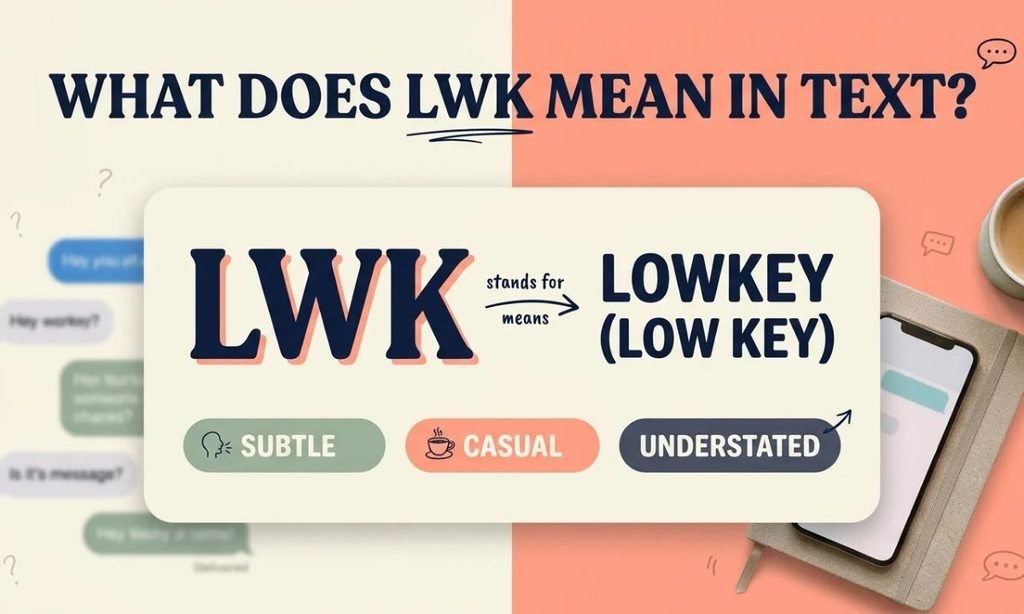
LWK stands for “lowkey,” sometimes written as “Low Key.” It’s a slang term built from the consonants of the word, the same trick that turns “please” into “pls.” Plenty of people call it an acronym. Strictly speaking it’s an abbreviation, because the letters come from one word instead of the first letters of several.
You’ll see it typed as LWK, lwk, “lowkey,” or “low key” in two words. The spelling shifts and the meaning stays put. It’s an informal expression that thrives in texting slang and internet slang, and people fire it off in messaging apps and online conversations without thinking twice.
| Abbreviation | Stands for | Tone |
| LWK | Lowkey (Low Key) | Subtle, casual, understated |
So when someone asks what does LWK mean in text, the full meaning fits in one breath: a feeling or opinion with the volume turned down. Take “LWK tired today.” The sender is saying, “I’m kind of tired, no big deal.”
LWK Meaning in Simple Words
Strip away the slang and you get three ideas: slightly, secretly, quietly. The feeling is real, just not loud. LWK also carries the sense of “not strongly” and “without making it obvious.”
If someone says “I LWK like this song,” they like it, but not in a strong or obvious way. That keeps things light, which is handy in casual conversations where nobody wants to sound intense.
How Lowkey Softens a Sentence
Compare “I lowkey want to go out” with “I want to go out.” The first one doesn’t push anyone. “She lowkey likes him” sounds like gentle gossip instead of a headline.
People use it to avoid sounding too direct or too emotional. Chats feel smoother, and sharing a thought feels less like a confession. You get honesty without a big statement. “That movie was LWK boring” gives your opinion with less bite than a flat “that movie was boring.” Say it in everyday conversations and nobody expects a speech.
A Simple Explanation for Beginners
If you’re new to this, think of LWK as “a little bit” or “quietly.” “I LWK like it.” “That was LWK fun.” Both are easy to understand and easy to use.
LWK also softens the tone more than TBH does. That’s why many people reach for it when they want to express feelings in a soft, simple way.
Where Did LWK Come From? The Origin Explained
Start with everyday English. The adjective “low-key” has long meant calm, simple, and not too intense. It’s often linked to photography and lighting, where a low-key image is dark and subdued instead of bright and dramatic. That link is a likely source, not a proven one.
The slangy adverb “lowkey” is more recent. Merriam-Webster’s entry for low-key lists the informal adverb use as doing something in a moderate or limited way. Many writers trace its spread to Black American English and hip-hop before social media carried it everywhere, though the exact timeline is debated. Online and music culture helped it travel.
Texting culture then did what it always does and shortened it. LWK saved time and kept faster conversations moving.
How LWK Works in a Sentence
Where to Put LWK
LWK works as a modifier. It slides in to soften the meaning and change the tone of the statement, like a dimmer switch for your feelings. Place it before a verb or an adjective. “I LWK enjoyed the party” puts it before a verb. “That was LWK stressful” puts it before an adjective. Both sound casual, friendly, and natural.
| Sentence | What it means |
| I LWK like this song | I slightly like this song |
| I’m LWK hungry | I’m a little hungry |
| That’s LWK funny | That’s somewhat funny |
| I LWK agree with you | I slightly agree |
| I LWK want that phone | I kind of want that phone |
Notice the pattern. LWK in a sentence nearly always sits right before a verb or adjective such as “hungry,” “funny,” “agree,” or “like.”
What Does LWK Mean in Text Messages? Examples
In text messages, LWK works like a volume knob that turns a statement down. People reach for it when they feel mild liking or mild interest. They also use it for a hidden opinion they’d rather not announce, for softening strong emotions, and for agreeing casually without writing a paragraph. It reduces intensity, and that’s the whole job.
- “I LWK like that movie.”
- “I’m LWK tired today.”
- “That idea is LWK good.”
- “I LWK want to go there.”
Nobody gushes and nobody complains. The feeling comes through in a subtle way, and the relaxed conversation keeps moving.
The typical moments are a mild opinion, a hidden feeling, a soft reaction, or any spot where you don’t want to sound too serious. “I LWK want to leave early” is a classic. So is “That was LWK annoying.”
Real-Life Conversation Examples
Say a friend asks, “Did you like the movie?” and you answer, “I LWK liked it.” That’s honest, not too direct, and it helps you avoid a strong reaction. If someone makes a point and you reply, “I LWK agree with you,” the casual tone stays intact.
It works for third parties too. “He LWK likes it” tells you about someone else’s feelings without making a claim about them. “LWK excited for the weekend” means kind of excited, or quietly looking forward to it. “LWK obsessed with this show” suggests the person really likes the show but says so casually.
LWK Meaning in Social Media
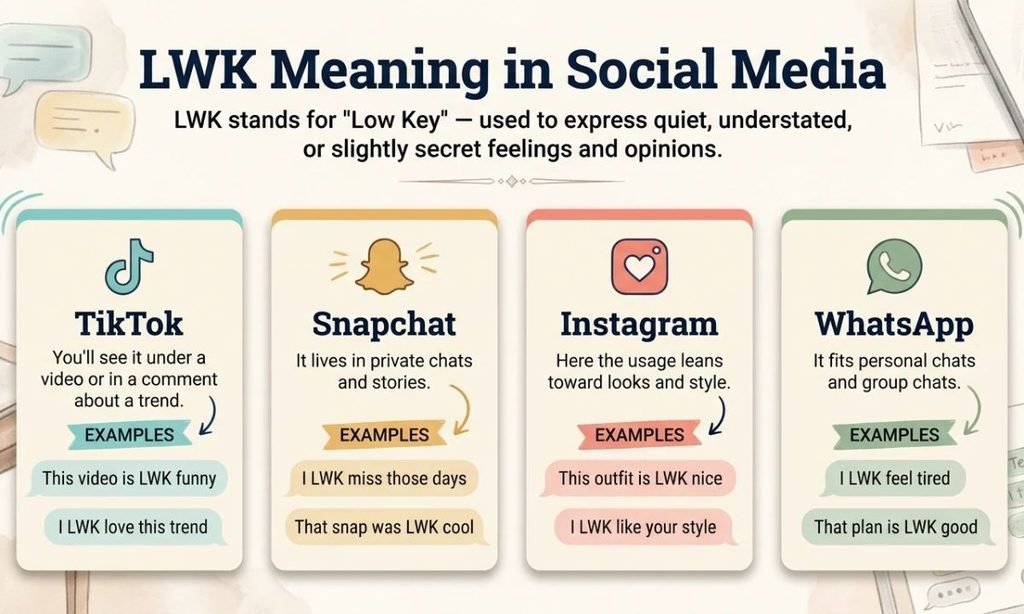
The meaning holds on social media, but the places it shows up differ. Short, simple communication wins there, so users lean on LWK for subtle opinions and quick reactions in captions, comments, posts, and private chats.
“That outfit is LWK nice” reads like a compliment with a shrug. “I LWK agree with this post” lets you share thoughts without starting a debate. It’s especially common among younger users, mostly on TikTok and Instagram. Plenty of people who search what does LWK mean in text first met it in a comment section.
TikTok
You’ll see it under a video or in a comment about a trend. “This video is LWK funny” and “I LWK love this trend” are typical.
Snapchat
It lives in private chats and stories. “I LWK miss those days” and “That snap was LWK cool” are the usual shapes.
Here the usage leans toward looks. “This outfit is LWK nice” and “I LWK like your style” show up in comments and messages.
It fits personal chats and group chats. “I LWK feel tired” and “That plan is LWK good” are the sort of lines that pop up when friends are making plans.
Why Do People Use LWK in Texting?
Speed and Simplicity
The reasons are practical first. LWK is short and easy to type, so messages go out faster. It replaces “lowkey,” saves time, and fits the way modern texting works.
It also keeps the tone casual and handles subtle emotions you don’t want to spell out. “I LWK miss those days” says a lot with very little. “That was LWK funny” does too.
The Psychology Behind It
There’s a psychological side as well. Part of the answer to what does LWK mean in text is tone, not just vocabulary. Most people feel things in a mild way, because not all emotions are strong, and a casual tone feels more comfortable than a dramatic one.
Saying “I LWK miss it” lets someone express an emotion without pressure. Subtle communication feels natural, which helps explain why its popularity keeps growing. Spend a week reading group chats and you’ll see it everywhere. Hit send, and the feeling lands without making a scene.
Is LWK Formal or Informal?
LWK is an informal abbreviation. Its informal usage covers text messages, social media, group chats, and online conversations. It isn’t suitable for formal use, and in business emails or other professional communication it can look unclear or unprofessional.
Compare the two registers. Informal: “I LWK like it.” Formal: “I somewhat like it.” The gap is obvious once you see them side by side.
Here’s a quick test. Picture saying the sentence out loud to your boss. If it sounds odd, don’t type LWK. I’ve watched a half-joking “LWK” land in a work thread. It wasn’t a disaster, but a few people had to guess, and the reaction was more confusion than judgment.
LWK in Different Contexts
Context decides how much weight LWK carries.
| Setting | What LWK does | Verdict |
| Texting | Low Key = slightly or casually | Fits well |
| Social media | Softens opinions | Fits well |
| Conversations with friends | Adds a relaxed tone | Fits well |
| Professional context | Reads as unclear slang | Not recommended |
Understanding context also helps you read other people’s messages. The same three letters can sound sweet from a friend and out of place in a report. Knowing the answer to “what does LWK mean in text” also means knowing where it fits.
When to Use LWK and When to Skip It
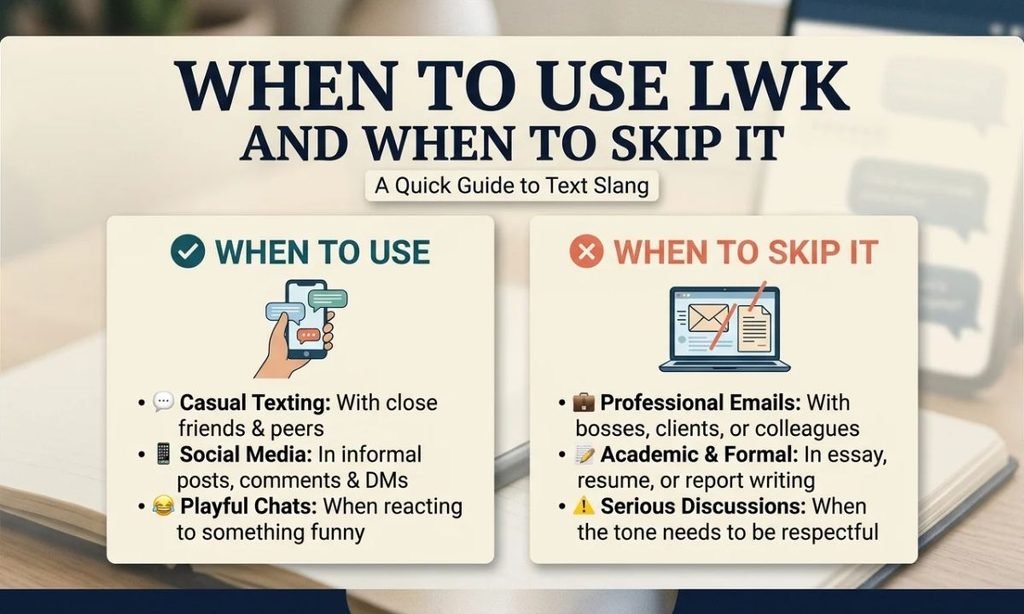
Good Moments for LWK
Use LWK when you want to sound casual and relaxed. It’s best for chatting casually with friends. It also helps when you want to soften a statement or share a mild opinion without sounding too serious. If the moment is low-pressure, go ahead. Think of it as a tool for informal communication only.
Moments to Skip It
Leave it out of formal emails, anything going to clients, professional content, academic writing, and reports. Readers who haven’t seen it before can get confused, and it reads as slang. Do not use LWK in business emails.
The same goes for any serious situation. If the stakes are high, use clear and proper language. “I slightly agree” does the job in a report. Always consider your audience, and if you’re not sure they’ll get it, write the clearer sentence.
Here’s a workplace example. Picture a coworker replying to a manager’s deadline with “LWK think we should push it.” The manager can’t tell whether that’s a mild suggestion or a polite warning. Plain words fix it: “I think we should push the deadline.” That small mix-up is a classic workplace mistake.
Common Mistakes People Make with LWK
Even people who know the answer to “what does LWK mean in text” trip over a few things.
- Using it in formal contexts. Emails to clients, reports, and academic work all call for plain language.
- Placing it badly. Shoving LWK at the start with no comma and no pause creates awkward placement, and confusion follows. Wrong: “LWK I agree.” Correct: “I LWK agree.”
- Assuming everyone understands. Not every reader knows the abbreviation. Learn proper usage and your sentences gain clarity, which helps you avoid confusion.
- Overusing it. Too many “lowkey” lines make every feeling seem hedged, and the message can sound unclear.
Can LWK Mean Something Else?
Yes, in theory. Abbreviations can mean different things in different communities. In casual texting, though, LWK is almost always a shortened form of lowkey, so the answer to “Is LWK the same as lowkey?” is yes.
The sense depends on the sentence, so check the rest of the sentence before reading too much into it.
LWK vs Lowkey vs TBH
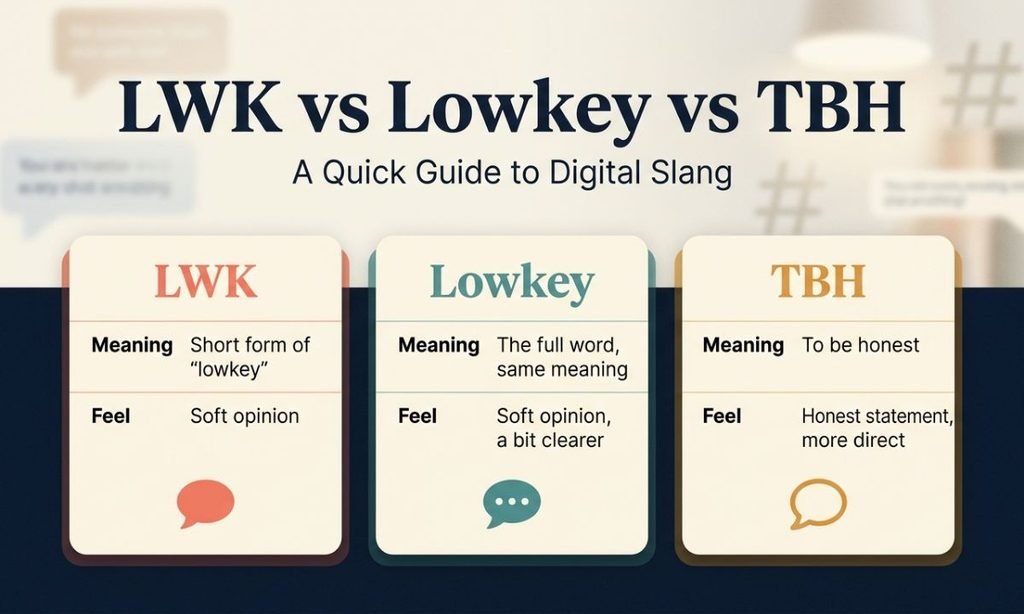
Key Differences
LWK is the short form of lowkey. They share the same meaning, so the choice comes down to space and style. TBH means “to be honest,” and it works as an honest statement. LWK is a soft opinion.
| Term | Meaning | Feel |
| LWK | Short form of lowkey | Soft opinion |
| Lowkey | The full word, same meaning | Soft opinion, a bit clearer |
| TBH | To be honest | Honest statement, more direct |
“I LWK liked it” is mild. “TBH I liked it” is a straight confession. TBH announces honesty, while LWK quietly softens.
Other Slang Like LWK
LWK has plenty of company among texting abbreviations.
| Slang | Meaning |
| TBH | To be honest |
| IMO | In my opinion |
| IDK | I don’t know |
| IDC | I don’t care |
| SMH | Shaking my head |
| NVM | Never mind |
Several of these carry a stronger tone than LWK. IMO frames a view as yours alone, and TBH is more direct. LWK sits at the gentle end of the shelf. That difference is worth knowing before you copy related slang into your own messages.
If you keep running into abbreviations you don’t recognize, our guide on BDSM meaning in text covers another one people often look up.
Pros and Cons of Using LWK
Advantages
- Easy to use and quick to type
- Speeds up quick communication
- Keeps a natural tone
- Expresses subtle emotions
- Widely understood, especially among younger users
Disadvantages
- Not formal
- Can confuse some people
- Overuse may sound unclear
- Not suitable for professional use
How to Use LWK Correctly: Practical Tips
- Keep it to casual chats.
- Place it before the main verb or adjective. Correct placement matters.
- Make sure your audience understands slang before you use it.
- If you’re unsure, write the full word “lowkey.” “I LWK enjoyed it” works with friends. “I lowkey agree” is a safer middle ground with mixed readers.
- When you receive it, read the rest of the sentence to catch the tone.
- Stay updated, because slang changes fast.
Why Understanding LWK Helps You Communicate
Once you understand the abbreviation, you can communicate naturally. You pick up the relaxed, subtle tone of modern texting and express opinions the same way.
You also read other people’s tone better. “Now I understand what LWK means” is a small realization with a real payoff. “He LWK likes it” no longer sounds vague. The benefit runs both ways, for the sender and for the person reading.
So, What Does LWK Mean in Text? The Takeaway
So, what does LWK mean in text? The most common meaning is lowkey, a way to share a feeling, opinion, or thought in a subtle, understated way. You’ll mainly see it in informal messages, social media posts, and online conversations, and it shows up in digital communication every day.
“LWK obsessed with this show” is a good model. The person really likes the show and says so without a speech. Check the rest of the sentence to catch the intended tone. In most casual conversations, it points to something expressed without much emphasis.
If you’re unsure whether your reader will get it, write the full word “lowkey” instead. LWK doesn’t fit well in formal writing, but for friends and feeds it’s a handy way to say a little without saying too much.
FAQs
What does LWK mean in text?
LWK means “lowkey.” People use it to say something quietly or mildly, without making a big deal of it. “LWK tired” means “I’m kind of tired.”
What does LWK stand for?
LWK is short for “lowkey,” sometimes written as “low key.” It’s an abbreviation built from the word’s consonants. It’s informal texting slang.
Is LWK the same as lowkey?
Yes. LWK is just a shorter way to type lowkey, and the meaning is the same. Use the full word if you want to be clearer.
How do you use LWK in a sentence?
Put it before a verb or adjective to soften the feeling. For example, “I LWK like this song” or “That was LWK stressful.” Both sound casual and natural.
Where does LWK go in a sentence?
It usually sits right before the word it softens, like “I LWK agree.” Putting it at the start with no comma, like “LWK I agree,” can read awkwardly. A comma helps if you open with it.
What does “I LWK like you” mean?
It means the person likes you, but they’re saying it in a quiet, low-pressure way. The feeling may be real, just not loudly stated. Tone and context matter, so read the rest of the conversation.
Is LWK formal or informal?
LWK is informal. It fits texts, group chats, and social media comments. Skip it in work emails, reports, and academic writing.
Can I use LWK at work?
It’s best to avoid it in professional messages. Coworkers may not know it, and a vague note can cause confusion. Plain wording like “I think we should push the deadline” is safer.
What is the difference between LWK and TBH?
LWK softens a feeling, while TBH (“to be honest”) announces an honest opinion. “I LWK liked it” sounds mild. “TBH I liked it” sounds more direct.
What does LWK mean on TikTok, Instagram, and Snapchat?
It means the same thing everywhere: lowkey. On these apps you’ll see it in comments, captions, and chats, like “This outfit is LWK nice.” Younger users tend to use it most.
Where did the word lowkey come from?
“Low-key” has long meant calm and understated in everyday English, and some link it to low-key lighting in photography. The slang use spread through online and music culture. The exact origin is debated.
Can LWK mean something else?
In casual texting, LWK almost always means lowkey. Abbreviations can mean different things in different communities, so check the rest of the sentence if something seems off.
Why do people use LWK instead of typing lowkey?
It’s faster to type and fits the relaxed tone of texting. It also lets people share a mild opinion or feeling without sounding too serious.
