

Your group chat suddenly lights up. Someone types, “Okay, I have chisme.” Within seconds, everyone is typing “dime, dime, dime!”
If you’ve ever wondered what that word means, you’re not alone. Chisme meaning is simple at its core: it’s the Spanish word for gossip. But the way people use it in the US, in texts, on social media, and in everyday conversation, adds a lot of flavor that a dictionary won’t give you.
This guide covers what chisme means, how to pronounce it, where it comes from, how people text with it, and how to use it without sounding awkward.
What Is the Chisme Meaning?
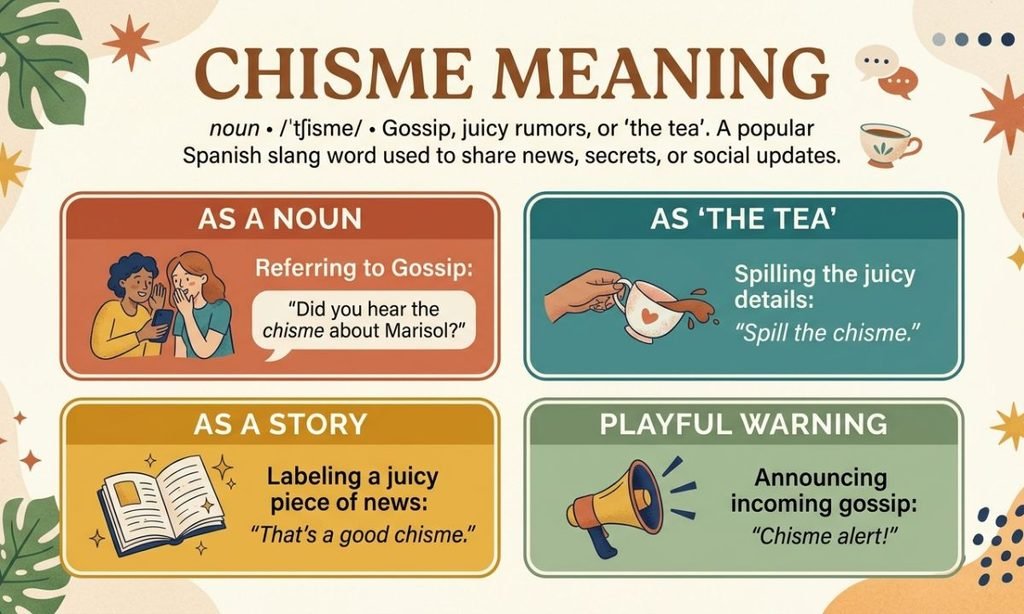
Chisme (pronounced CHEES-meh) is a Spanish word that means gossip, rumor, or juicy news about other people.
It can describe the gossip itself (“That’s just chisme”) or the act of sharing it (“We were swapping chisme all afternoon”). It’s neutral by default. The tone depends on how it’s said. A friendly “tengo chisme” can be playful, while “that’s all chisme” can mean “don’t believe it.”
Here are the main ways the word shows up:
- As a noun: “Did you hear the chisme about Marisol?”
- As a stand-in for “the tea”: “Spill the chisme.”
- As a label for a story: “That’s a good chisme.”
- As a playful warning: “Chisme alert!”
In American English, many bilingual speakers drop “chisme” into English sentences without a second thought. It has become part of everyday Spanglish.
How to Pronounce Chisme
The word is easier than it looks. Say it like CHEES-meh.
- The “ch” sounds like the “ch” in cheese.
- The “i” sounds like a long “ee.”
- The final “e” sounds like “eh,” not a silent “e” as in English.
A common mistake is saying “chizz-mee” or “chiz-m.” Keep the ending short and open, and you’ll sound natural.
Chisme in Spanish: Origin and Related Words
Chisme comes from Spanish and is understood across the Spanish-speaking world, including Mexico, Central America, the Caribbean, South America, and Spain. Its exact historical roots are debated by language experts, so it’s safer to focus on how it’s used today than on a single origin story. For the official Spanish definitions, you can check the Real Academia Española dictionary entry for chisme.
The word also has family members. Once you know them, you can follow almost any gossip conversation in Spanish.
| Word | What It Means | Example |
| Chisme | Gossip, rumor | “Ese chisme es falso.” (That gossip is false.) |
| Chismoso / Chismosa | A person who gossips (male / female) | “Mi tía es muy chismosa.” |
| Chismear | To gossip (the verb) | “Siempre están chismeando.” |
| Chismecito | A little piece of gossip (affectionate) | “Tengo un chismecito para ti.” |
| Chismorreo | Gossiping, chatter | “Hubo mucho chismorreo en la oficina.” |
Notice how many forms come from one word. That’s a clue to how central gossip is in everyday conversation in many Spanish-speaking communities. It’s less a taboo and more a social habit, and often a way of staying connected.
Chisme Meaning in Text and Social Media
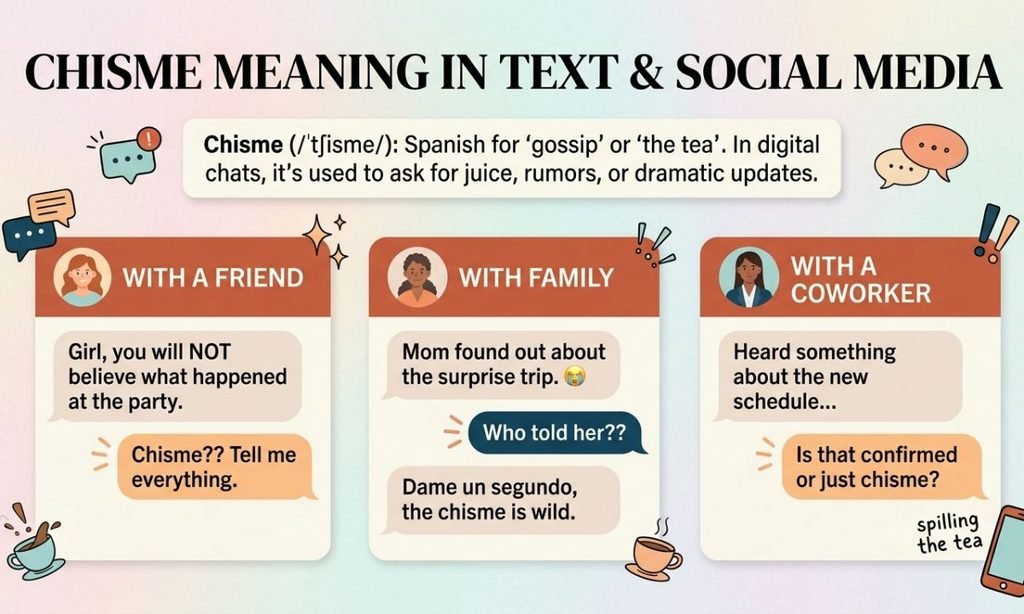
In texts and on social platforms, chisme usually carries a light, entertaining tone. It’s the Spanish-language cousin of “tea” in English slang. If you’re curious about other short, emotional reactions people send in chats, our guide on aww meaning in text explains how one small word can sound sweet, sad, or sarcastic.
If someone says they have chisme, they’re offering you a story. If you ask for chisme, you’re asking to be filled in. It’s playful and social, and it usually signals close friendship.
Realistic Text Examples
Friend: Girl, you will NOT believe what happened at the party.
You: Chisme?? Tell me everything.
Cousin: Mom found out about the surprise trip. 😭
You: Who told her??
Cousin: Dame un segundo, the chisme is wild.
Coworker: Heard something about the new schedule…
You: Is that confirmed or just chisme?
Each message shows a different shade. The first is excited, the second is dramatic, and the third is more cautious, using “chisme” to mean unverified talk.
Chisme vs. Tea vs. Gossip
People often ask whether chisme and “tea” are the same thing. They overlap heavily, but the feel is slightly different.
| Term | Language/Culture | Typical Tone | Best Used When |
| Chisme | Spanish, widely used in Latino communities | Warm, playful, sometimes dramatic | Chatting with friends or family |
| Tea | English slang | Trendy, casual, internet-friendly | Social media, group chats |
| Gossip | Standard English | Neutral to slightly negative | Any setting |
| Rumor | Standard English | Serious, unverified | News or workplace talk |
“Spill the tea” and “dame el chisme” both mean “tell me the juicy story.” The difference is mostly cultural flavor. Chisme often carries a family or community feeling that “tea” lacks.
Is Chisme a Bad Word?
No. Chisme isn’t a swear word or an insult on its own. It’s just a word for gossip, and gossip itself can be harmless, nosy, or even harmful, depending on the story.
That said, calling someone a chismoso or chismosa can sound critical. It’s a bit like calling someone a “gossip” in English. Between friends, it’s often a joke. In a tense situation, it can land as an accusation.
Here’s a simple way to think about the tone:
| Phrase | Usually Means | Tone |
| “Tengo chisme” | I have something juicy to share | Fun, excited |
| “Es puro chisme” | It’s all gossip, not facts | Dismissive |
| “No seas chismoso” | Don’t be a gossip | Scolding or joking |
| “Qué rico chisme” | What delicious gossip | Playful, enjoying it |
Chisme in Everyday Latino Culture
In many families, chisme is part of how people stay in touch. Think of aunts catching up over coffee, cousins texting about someone’s engagement, or neighbors trading news on the porch.
Pop culture has helped too. Telenovelas are built on dramatic gossip, secret romances, and big reveals. Many podcasts, social media pages, and YouTube channels use “chisme” in their names because it instantly signals fun, casual storytelling.
In the US, it also works as a bridge between languages. Plenty of English speakers pick up the word from friends, coworkers, or shows, and use it because it simply sounds more expressive than “gossip.”
A Second Meaning: Chisme as “Thingamajig”
Here’s a detail most guides skip. In some Spanish-speaking regions, especially Spain, chisme can also mean a small object, gadget, or “thingamajig.”
You might hear:
“Pásame ese chisme.” (Pass me that thing.)
In this case, the speaker doesn’t remember the name of the object, or doesn’t need to say it. The context makes it clear. If someone is pointing at a tool or gadget, they’re not asking for gossip.
This is a good example of why chisme meaning depends on the situation. If the conversation is about people, it’s gossip. If it’s about objects, it’s probably “that thing.”
Chisme Meaning in Other Spanish Words for Gossip
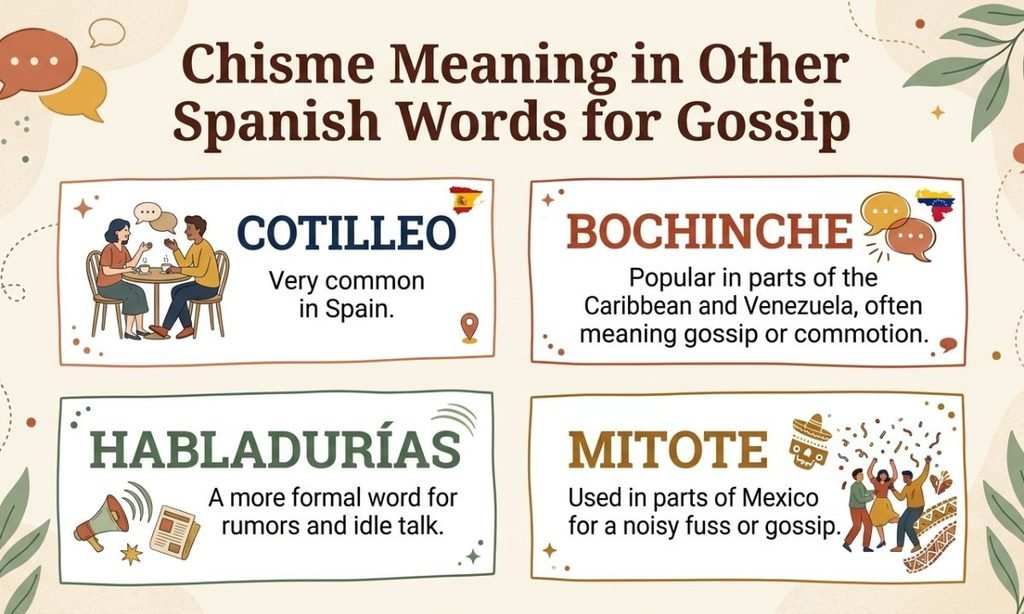
Spanish speakers use many regional words for gossip, and they’re worth knowing if you talk with people from different countries.
- Cotilleo: Very common in Spain.
- Bochinche: Popular in parts of the Caribbean and Venezuela, often meaning gossip or commotion.
- Habladurías: A more formal word for rumors and idle talk.
- Mitote: Used in parts of Mexico for a noisy fuss or gossip.
You don’t need to memorize them all. Just know that chisme is the one most widely understood across regions, which makes it a safe choice if you’re not sure which to use.
How to Use Chisme Naturally
You don’t have to be fluent to use chisme well. A few simple habits will make you sound natural.
- Keep it casual. It fits best with friends, family, and group chats.
- Pair it with English or Spanish. “I have chisme” or “tengo chisme” both work.
- Match the energy. Say it with excitement when sharing something fun.
- Respect the audience. In professional settings, “I heard a rumor” is safer.
- Use the right form. Use “chismoso” for a man and “chismosa” for a woman.
Common Phrases You Can Use
| Phrase | Meaning |
| “Dame el chisme.” | Give me the gossip. |
| “Tengo chisme.” | I have gossip. |
| “¿Cuál es el chisme?” | What’s the gossip? |
| “Ese chisme está bueno.” | That gossip is good. |
| “No me cuentes chismes.” | Don’t tell me gossip. |
| “Chisme caliente.” | Hot gossip. |
How to Reply When Someone Says “I Have Chisme”
Your reply tells the other person how much you want in on the story. A few easy options:
If you’re curious:
- “Okay, spill it!”
- “Dime, dime.”
- “Don’t leave me hanging.”
If you want details first:
- “Is it good chisme or just boring?”
- “Who’s it about?”
If you’d rather stay out of it:
- “I’d rather not get into it, but thanks for thinking of me.”
- “Let’s not talk about people who aren’t here.”
You’re allowed to say no. Not everyone enjoys gossip, and a polite boundary is always fine.
Mistakes to Avoid With Chisme
A few small slips can make the word feel off.
- Mixing it up with “chisme” as an insult. Calling a stranger a chismoso can come across as rude.
- Mispronouncing it. Remember: CHEES-meh.
- Using it in formal settings. In a business email, “rumor” or “unconfirmed information” works better.
- Spreading false chisme. Gossip can hurt real people. If you can’t confirm it, it’s best not to pass it on.
- Assuming it’s always negative. Between friends, it’s often lighthearted.
Is Gossip Always Bad? A Quick, Honest Look
Researchers who study social behavior often point out that gossip can serve a purpose. It helps people bond, share information, and learn what a group considers acceptable. That’s why chisme feels so natural in tight-knit families and friend groups.
The line is thin, though. Sharing happy news or harmless stories is one thing. Spreading private or untrue claims about someone is another. A good rule many people follow: if you wouldn’t say it with that person in the room, think twice.
Quick Reference: Chisme Meaning at a Glance
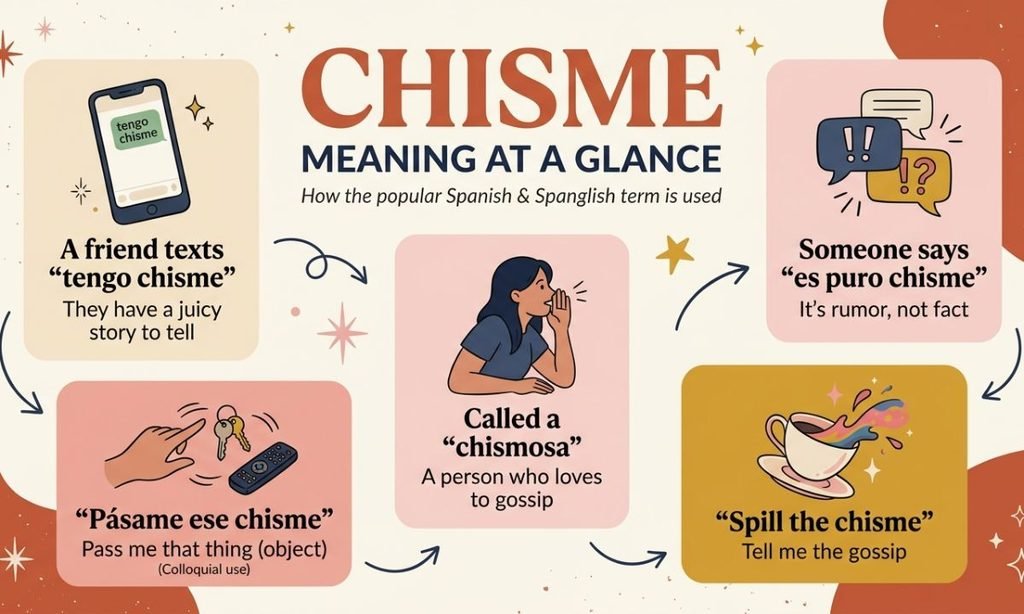
| Situation | Likely Meaning |
| A friend texts “tengo chisme” | They have a juicy story to tell |
| Someone says “es puro chisme” | It’s rumor, not fact |
| Called a “chismosa” | A person who loves to gossip |
| “Pásame ese chisme” | Pass me that thing (object) |
| “Spill the chisme” | Tell me the gossip |
Final Thoughts on Chisme Meaning
Chisme is a small word with a big personality. At its heart, it means gossip, but depending on who says it and where, it can be playful, dramatic, dismissive, or even just a placeholder for “that thing over there.”
If you remember three things, make them these: say it like CHEES-meh, keep it casual, and read the context before you react. Do that, and you’ll understand it in almost any chat, from a family group text to a podcast title.
So the next time someone says “I have chisme,” you’ll know exactly what to say: “Okay, tell me everything.”
FAQs
What does chisme mean?
Chisme is a Spanish word that means gossip, rumor, or juicy news about other people. It’s pronounced CHEES-meh. In casual chats, it’s similar to saying “the tea.”
How do you pronounce chisme?
Say it like CHEES-meh. The “ch” sounds like “cheese,” and the final “e” sounds like “eh,” not a silent letter. Avoid “chizz-mee,” which is a common mistake.
What does chisme mean in text?
In texts, it usually means someone has a juicy story to share or wants to hear one. “Tengo chisme” means “I have gossip.” It’s playful and mostly used between friends and family.
What does “tengo chisme” mean?
It means “I have gossip” in Spanish. People use it to hint that they have something interesting to share. The usual reply is “dime” (tell me) or “spill it.”
Is chisme a bad word?
No, chisme isn’t a swear word or an insult. It’s just a word for gossip, and the tone depends on how it’s used. Between friends it’s often fun, but it can sound critical in a tense situation.
What does chismoso or chismosa mean?
Chismoso (male) and chismosa (female) describe a person who loves to gossip. It’s similar to calling someone “a gossip” in English. Among friends it can be a joke, but in an argument it may sound like an accusation.
What is the difference between chisme and tea?
Both mean juicy gossip, but “tea” is English internet slang while chisme is Spanish. Chisme often feels more family-oriented and community-based. In most chats, you can use them interchangeably.
Does chisme always mean gossip?
Not always. In some regions, especially Spain, “chisme” can also mean a small object or “thingamajig,” as in “pásame ese chisme.” Context tells you whether it’s about people or things.
What does “es puro chisme” mean?
It means “it’s just gossip,” suggesting the story isn’t true or reliable. People use it to dismiss a rumor. It has a skeptical, slightly dismissive tone.
What is chisme in Spanish culture?
In many Spanish-speaking families and communities, chisme is a normal part of staying connected. Think of relatives catching up or telenovelas full of dramatic secrets. It’s often more social than negative.
Can I use chisme if I don’t speak Spanish?
Yes, many English speakers in the US use it casually, especially among bilingual friends and coworkers. Keep it light, pronounce it correctly, and match the setting. In formal situations, “rumor” is safer.
How do you reply when someone says they have chisme?
If you’re curious, say “Okay, spill it!” or “Dime, dime.” If you’d rather skip it, try “I’d rather not get into it, but thanks for thinking of me.” Both replies are polite and natural.
What are other Spanish words for gossip?
Common ones include cotilleo (Spain), bochinche (Caribbean and Venezuela), and habladurías (a more formal word). Chisme is the most widely understood across regions. It’s the safest choice if you’re unsure.
