

A friend texts the group chat that she just missed her flight by five minutes. Someone fires back a single word: “SOL.” No emoji, no explanation, and suddenly you’re wondering about the Sol meaning in text and whether everyone else got a memo you didn’t.
You’re far from alone. Three-letter abbreviations are easy to misread, and this one looks like a typo, a name, or a stock ticker depending on where you spot it. People run into it in text messages, TikTok comments, Reddit threads, Discord servers, gaming chats, and sometimes in finance or legal conversations where it means something else entirely.
This guide gives you the plain answer first, then the origin, the tone, real examples, the lookalike terms, and the other meanings. By the end, you’ll know how to read SOL correctly and when to keep it out of your own messages.
Quick answer: SOL most commonly stands for “Sh*t Out of Luck,” an informal expression meaning someone is stuck in a bad situation with few or no options left. Depending on context, it can also mean “Sooner or Later,” Standard of Living, Statute of Limitations, or Solana’s crypto token.
What Does SOL Stand For in Texting?
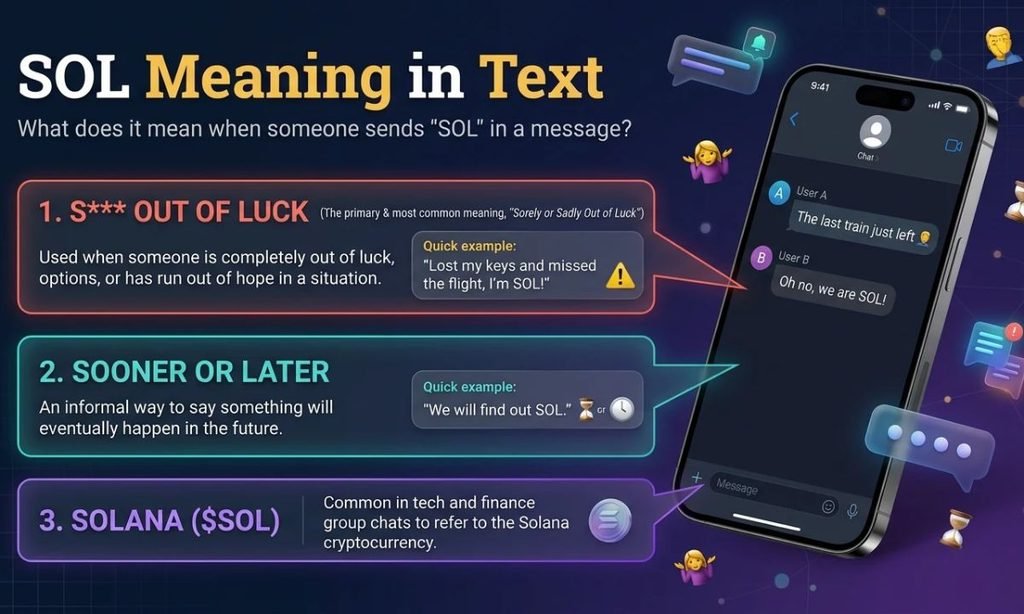
In texting, SOL is the short form of “Sh*t Out of Luck.” The phrase describes a person who has run into a problem and has no good fix. Think unlucky, stuck, and out of options, all packed into three letters.
The simplest picture is a friend who forgot their ID at the door of a venue. “You might be SOL” says everything that needs saying. Another common one: a friend forgets a password and can’t recover it, and the reply is “Wow, you’re SOL.” The situation is unfortunate, and no solution is in sight.
I first saw how flexible the term is when a friend missed a flight. She showed up five minutes after the gate shut, and a flight closes its doors on time no matter how nicely you ask. She couldn’t board the plane, and her backup option had vanished too. Somebody in our group chat typed “you’re SOL” before anyone could offer a kinder reaction.
That’s the pattern. SOL doesn’t always signal a crisis. It works for minor inconveniences just as well. I’ve typed “left my charger at home, I’m SOL for the rest of the day” without feeling a bit of real distress. There’s usually a humorous edge to it, like a small shrug built into three letters.
It covers everything from a ruined project to a dead phone. Say someone writes, “I forgot to save my project and my computer crashed.” The answer comes back: “You’re SOL.” Translation: you are out of luck. Or your phone battery dies in the middle of a long trip, and a friend says, “Looks like you’re SOL.” Both work, and people use the phrase for small problems as much as big ones.
Because the full form contains profanity, plenty of people soften it. “Sorry, out of luck” carries the same idea with no offensive language and no raised eyebrows. If you can’t predict how your audience will react, that cleaner version is a safe swap.
Why People Write SOL Instead of the Full Phrase
Mostly speed. Three letters beat the entire expression, and anyone who has typed on a phone while walking down a sidewalk knows that matters.
There’s a second reason. Writing SOL feels more indirect than spelling out the profanity, and readers who know the abbreviation understand it anyway. It works as a verbal shortcut. You don’t unpack every word, you just recognize it.
Internet slang spreads this way. Online communities adopt short forms because they let people communicate the general idea fast, and the abbreviation survives because nobody needs the full phrase to understand the message. Depending on who’s typing, it can sound humorous, sarcastic, or flat-out blunt.
Where SOL Came From
The expression grew out of informal American English. The full phrase came first, in speech, and the abbreviation followed as people shortened it for writing. Over time it picked up steam on online forums, in gaming communities, and in text messages.
Who said it first, and when, is hard to pin down. I’d be skeptical of anyone who gives you a precise date or a named inventor, because the sources I trust don’t support one. The origin is a bit fuzzy, and that’s honest.
What is clear is that SOL existed in other contexts before online slang took off. Different industries adopted the same three letters for their own purposes, which is exactly why the abbreviation has multiple meanings today. Internet culture then helped the slang version travel, since people wanted faster ways to communicate.
Sol Meaning in Text Across Different Platforms
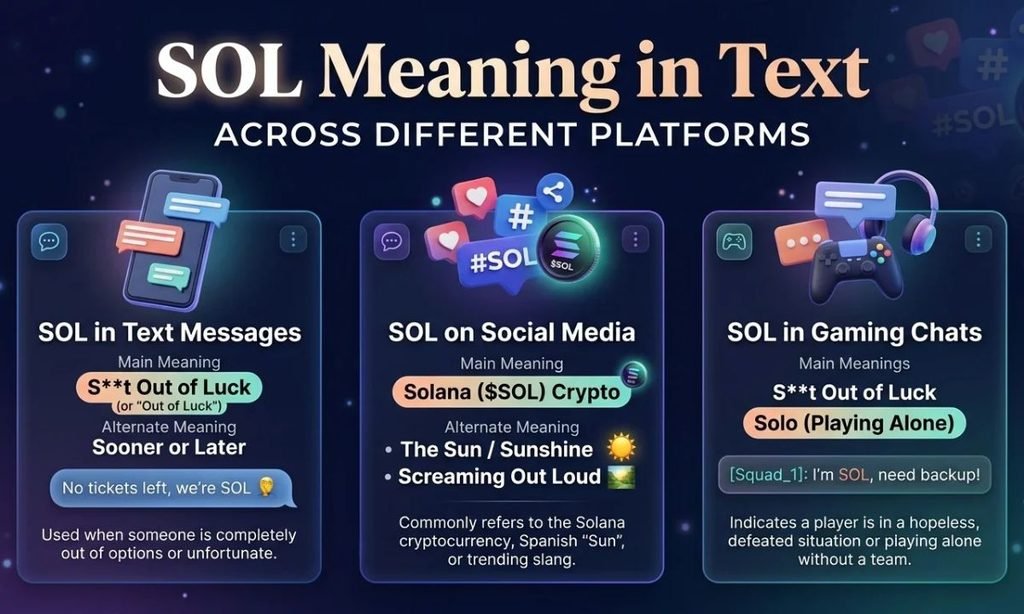
The meaning and tone of SOL shift a little depending on where you encounter it. The interpretation is rarely a mystery, but the setting changes how blunt it sounds. This is the part of the Sol meaning in text that dictionaries tend to skip.
SOL in Text Messages
In private messages, SOL usually describes an inconvenient situation. Say the store closes at six and it’s already 6:15. Someone texts “we’re SOL,” meaning the group missed its chance. Or you forgot to save a file and your laptop died, so you write “I’m so SOL,” which carries both frustration and bad luck.
Here’s another typical exchange. One friend asks, “Did you forget your password again?” The reply: “Yeah, and I can’t recover it.” Then: “Wow, you’re SOL.” The person is stuck, and everyone in the chat knows it without a long explanation.
That’s the appeal. SOL is commonly found wherever people want to describe a problem with no easy solution in about two seconds. Texting is informal, so the abbreviation fits well among friends who are comfortable with slang. I wouldn’t send it to someone I’d just met.
SOL on Social Media
On Reddit, X, TikTok, Instagram, Facebook, Discord, and gaming forums, SOL pops up in comments, replies, memes, and casual posts. Often it’s a reaction to an unfortunate situation. Someone posts that their flight was cancelled and no other flights are available today, and the top comment is a single word: “SOL.”
A line like “when you realize the deadline was yesterday… SOL” adds humor to a frustrating moment. I scroll past this kind of thing daily. It reads as a joke more often than a diagnosis, and the commenter usually isn’t trying to help. They’re just reacting.
Platforms move fast, so users lean on short expressions to keep up. Still, don’t assume the slang meaning automatically. On a cryptocurrency post, SOL can refer to something completely different, which I’ll cover below.
SOL in Gaming Chats
Gaming communities love short slang terms because situations change within seconds. A player runs out of ammunition while surrounded by enemies, and a teammate types “no ammo left? You’re SOL.”
The meaning is straightforward: you’re in a bad position with few options. Gamers also use it when someone loses progress, misses an opportunity, or faces a disadvantage. Picture a boss fight that resets and wipes the team’s progress. “Now we’re SOL.” It describes a difficult situation without slowing the conversation, which is what you want mid-match.
SOL in Group Chats
Group chats are probably where I see it most. One person says the restaurant is fully booked tonight, and someone answers “guess we’re SOL.” Nobody is angry. They’re just saying the group is out of luck and out of options.
Tone matters here. Among close friends it sounds playful. Between people who don’t know each other well, it can feel too blunt, because the profanity behind the abbreviation hasn’t gone anywhere.
SOL and Gen Z Internet Language
Younger internet users lean on short forms to communicate faster. Think IDK for “I don’t know,” TBH for “to be honest,” LOL for “laugh out loud,” and OMG for “oh my God.” Gaming shorthand like AFK Meaning and meme-born words like glizzy Meaning live in the same slang world. SOL fits into the same abbreviation culture, though it’s less common than those.
That’s worth remembering if you’re guessing who will understand it. Frequently, people won’t, especially outside your usual circle.
How to Use SOL in a Sentence
SOL usually shows up in casual sentences that describe someone’s situation. It has three common forms, and each has a slightly different feel.
First-person usage describes your own problem: “I forgot my keys, so I’m SOL.” It tends to sound self-deprecating or humorous.
Second-person usage points at someone else: “You didn’t reserve a table? You’re SOL.” Among friends that sounds playful. Said directly to someone who’s already stressed, it can come across as unsympathetic, depending on the situation.
Group usage covers shared problems: “The tickets sold out, so we’re SOL.” It suggests everyone involved lost the opportunity or faces the same problem.
The common sentence patterns all follow the same pronoun forms:
- I’m SOL: I’m out of luck.
- You’re SOL: You’re out of luck.
- We’re SOL: We’re all out of luck.
- They’re SOL: They’re in a difficult situation.
- Looks like we’re SOL: The softer version, where it appears no good option remains.
SOL Examples by Situation
Context sharpens the meaning, so here are realistic sentences. Notice that SOL usually points at a lack of options, not at bad luck alone.
| Situation | Example | What SOL means |
| Transportation | “Missed the last train? You’re SOL.” | You’re out of luck. |
| Money | “I forgot my wallet, so I’m SOL.” | I have no good option. |
| Work | “If we miss this deadline, we’re SOL.” | We’ll be in a difficult position. |
| Gaming | “No healing items left, I’m SOL.” | I’m in trouble. |
| Shopping | “They sold the last one, we’re SOL.” | We missed our chance. |
| Travel | “The hotel is booked everywhere, we’re SOL.” | We have no easy alternative. |
| School | “I didn’t study for the test, I’m SOL.” | I’m in a bad position. |
| Technology | “My backup drive failed too, I’m SOL.” | There’s no easy recovery option. |
The same three letters appear every time. What changes is what’s missing: a seat, a charge, a plan B.
A few more sentences, because examples teach faster than rules:
- “I forgot my wallet at home, so I’m SOL until I get back.”
- “The server crashed before I saved my work. I’m completely SOL.”
- “You didn’t bring a charger? You’re SOL.”
- “SOL, I guess I’ll have to find another solution.”
- “I believe you’ll understand it SOL.”
- “The price of SOL increased this week.”
- “Without a backup plan, they were basically SOL.”
- “Missed the last train? Looks like you’re SOL.”
Look at the fifth and sixth lines again. The fifth means “sooner or later,” and the sixth is about a cryptocurrency. Same abbreviation, completely different meanings. Understanding context is the whole game.
Tone and Emotion Behind SOL
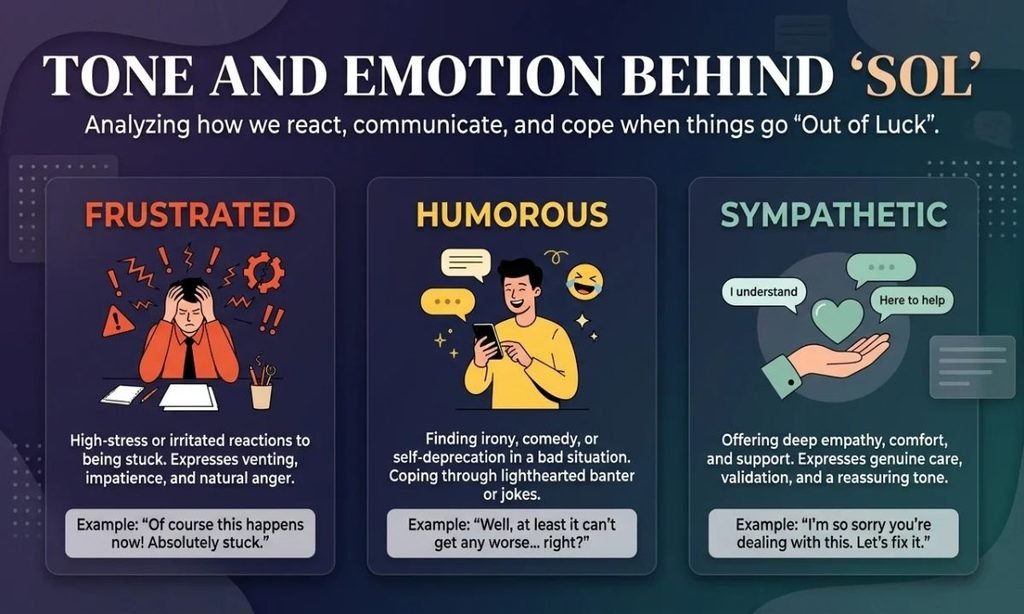
Knowing the definition isn’t enough. Tone decides how SOL feels to the reader, and I’ve watched the same words land very differently. The intent can swing from teasing to cold, and the delivery makes all the difference.
Frustrated
After something goes wrong, SOL can carry real helplessness. “The payment failed again, I’m SOL” stresses the frustration more than the facts.
Humorous
SOL can also turn an annoying moment into a joke. “I brought everything except the tent, guess I’m SOL.” The problem is inconvenient, but the speaker isn’t deeply upset. The same goes for a dropped ice cream: “You dropped your ice cream before eating it? SOL!” Small problem, big laugh.
Sympathetic
Friends sometimes use it while acknowledging someone’s bad luck. “You waited two hours and they canceled the event? Man, you’re SOL.” The speaker recognizes that it’s unfair and unfortunate.
Harsh or Blunt
The same phrase can sound dismissive. “You lost the receipt? You’re SOL.” If the person is already stressed, that lands as insensitive and a bit unfriendly. Slang isn’t automatically warm just because it’s common. I learned that the hard way after saying something similar to a coworker who didn’t laugh.
Negative, Neutral, and Casual Readings
When SOL means “out of luck,” it usually describes a problem or disadvantage. “You forgot the deadline? You’re SOL.” Depending on the situation, that can sound serious or teasing.
When it means “sooner or later,” the tone is neutral, since it only describes timing. “Everything becomes clear SOL” is calm and a little poetic.
Overall, the slang version is mostly informal. It works well in casual conversations and may be out of place in professional settings, which is where we’re headed next.
Is SOL a Bad Word?
The abbreviation is only three letters, but its most common expansion includes profanity. That makes the slang meaning mildly vulgar. Some people consider it inappropriate because it includes a swear word, while others barely notice. Whether someone finds it offensive depends on the setting and the people involved.
Among friends, it’s generally fine. In a classroom, workplace email, customer complaint, or formal document, it looks careless. To be fair, SOL itself isn’t always rude. The offense, when there is any, comes from the phrase behind it.
My rule is simple. If you wouldn’t comfortably write the full phrase in that situation, don’t use SOL there. People who know internet slang won’t be fooled by the abbreviation, so it hides the meaning less well than you’d hope.
If you want a safer option, try “out of luck,” “unfortunate situation,” or “bad timing.” These express the same idea without offensive language.
SOL at Work and Better Professional Alternatives
Is SOL appropriate for work? Usually not. Even in a relaxed office culture, it creates unnecessary ambiguity, and professional communication works better with direct language. A workplace mistake like this is easy to make, because slang slips out when you’re typing fast.
Skip the slang in workplace messages. Instead of “We are SOL because the system failed,” write “We are facing a problem because the system failed.” Same point, and no awkward pause in the meeting.
Here’s another swap. Instead of “If we miss the deadline, we’re SOL,” try “If we miss the deadline, we’ll have limited options” or “We may not be able to complete the project.” Both carry the same worry without the slang.
Other alternatives depend on what you actually mean:
- We’re out of options.
- We’re in a difficult position.
- We may be stuck.
- We’ve missed the opportunity.
- We’re facing a serious problem.
- There’s not much we can do now.
“Out of luck” suits casual speech, while “limited options” fits professional writing better.
When to Use SOL and When to Avoid It
Reach for SOL when the conversation is clearly casual and everyone involved understands slang. That covers texts with friends, group chats, gaming conversations, social media comments, memes, jokes, and minor problems.
Choose neutral wording for job applications, academic assignments, formal emails, business reports, customer service messages, professional presentations, official documents, and sensitive conversations. A cleaner phrase communicates the idea just as well.
Formal Writing
Academic and professional writing should avoid unclear abbreviations. Papers, business reports, resumes, and official emails don’t need this kind of slang. Readers may not know which meaning of SOL you intend, and you shouldn’t make them guess.
When Your Audience May Misunderstand
Because SOL has many meanings, clarity matters. Before you hit send, think about who will read your message. A teenager, a lawyer, and a crypto trader could each read the same three letters differently.
SOL vs. Similar Slang Terms
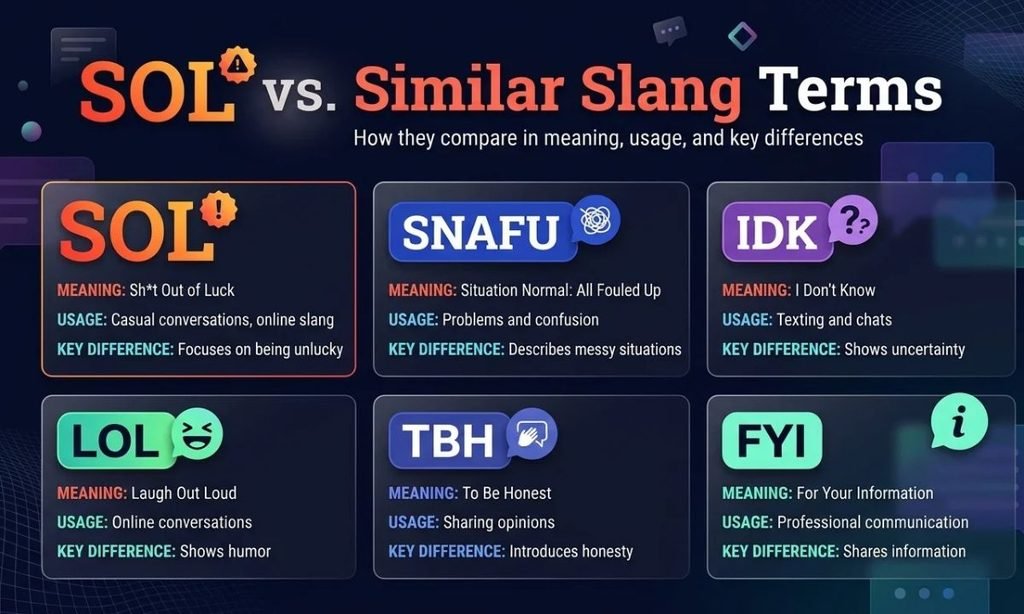
Several expressions describe a difficult situation, but they aren’t perfect substitutes. Here’s how the neighbors compare.
SOL vs. Out of Luck
The two are close in meaning. “Out of luck” is cleaner and acceptable almost everywhere. “We’re out of luck, the tickets are sold out” and “we’re SOL, the tickets are sold out” say the same thing, but the second feels blunter. SOL is shorter and more slang-like, so either one works depending on the room.
SOL vs. Screwed
“Screwed” suggests serious trouble and sounds stronger and more emotional. SOL focuses on having no good options, while “we’re screwed” stresses that the situation itself looks very bad.
SOL vs. Doomed
“Doomed” implies a certain, severe, negative outcome and is far more dramatic. “We’re SOL if the store closes” describes a problem. “We’re doomed” sounds like a movie line.
SOL vs. Stronger Profanity
Harsher vulgar expressions can signal more intense danger or failure, and they’re often aggressive or insulting. SOL is milder because it describes being out of luck rather than attacking anyone. The full phrase still contains profanity, so context stays important.
SOL vs. We’re in Trouble
This is the safest everyday comparison. “We’re in trouble” is neutral, clear, and appropriate in most settings. “We’re SOL” is shorter, slangier, and blunter.
SOL vs. SNAFU
Both describe problems, but the focus differs. SOL means someone has no luck or no options. SNAFU, which stands for “Situation Normal: All Fouled Up,” describes a confusing or messy situation. One is about a person’s position, the other about the state of things.
Tough Luck, IDK, TBH, LOL, and FYI
“Tough luck” is used when someone experiences bad fortune, and it carries a slightly unsympathetic edge. IDK means “I don’t know” and signals uncertainty. TBH means “to be honest” and usually introduces an opinion. LOL, short for “laugh out loud,” expresses humor. SOL and LOL look alike but have nothing in common. SOL describes a difficult situation, and LOL expresses laughter. Mix them up and you’ll send some very strange texts.
| Term | Meaning | Usage | Key difference |
| SOL | Sh*t Out of Luck | Casual conversations, online slang | Focuses on being unlucky |
| SNAFU | Situation Normal: All Fouled Up | Problems and confusion | Describes messy situations |
| IDK | I Don’t Know | Texting and chats | Shows uncertainty |
| LOL | Laugh Out Loud | Online conversations | Shows humor |
| TBH | To Be Honest | Sharing opinions | Introduces honesty |
| FYI | For Your Information | Professional communication | Shares information |
Other Meanings of SOL
Not every SOL online means “Sh*t Out of Luck.” While the slang version is popular, the abbreviation has several other meanings, and some have nothing to do with luck at all. Tech terms cause the same kind of confusion. If you’ve ever wondered what APKPure is, you’ve felt this mix-up before. Context can change the interpretation completely.
SOL Meaning as “Sooner or Later”
In some conversations, SOL can mean “Sooner or Later.” Someone might write, “You will understand the lesson SOL.” It’s less common, and I mostly see it in written communication rather than casual texting.
When SOL means “sooner or later,” it refers to something that will happen eventually, and nothing bad is implied. “You’ll learn how important practice is SOL” is just about future events and timing. If the sentence seems to point toward “eventually,” it probably does.
SOL in Cryptocurrency
In the cryptocurrency world, SOL is the symbol for Solana, a popular blockchain platform. More precisely, it’s the ticker for Solana’s native token. “I bought some SOL today” means exactly what it says. “SOL dropped today” on a crypto-focused page isn’t someone complaining about luck, and “I bought more SOL” has a very different meaning from “I missed the deadline, I’m SOL.” In this setting it has nothing to do with slang or being unlucky.
SOL as Standard of Living
Economics and social discussions use SOL for Standard of Living. “The country’s SOL has improved over the past decade” is a typical sentence. You’d see it in economic discussions rather than a group chat.
SOL as Statute of Limitations
In legal contexts, SOL can refer to the Statute of Limitations, which describes the time limit for taking legal action. Cornell Law School’s Legal Information Institute has a clear explanation if you want the legal detail.
SOL as an Abbreviation in Other Fields
SOL also works as an acronym or initialism for various terms in other organizations and fields, and the meaning depends on the subject being discussed. When you run into it, look past the three letters and read the sentence around it.
How to Tell Which SOL Someone Means
When the meaning isn’t obvious, a few clues usually settle it.
Look at the surrounding words. Deadline, missed, stuck, chance, problem, luck, tickets, and trouble point toward the slang. Crypto, token, blockchain, price, wallet, and market point toward Solana.
Check the conversation topic. A gaming conversation leans slang, while a cryptocurrency discussion leans token.
Consider capitalization. It’s a clue, but not a reliable rule. People often type slang abbreviations in uppercase because that’s how they recognize them.
Consider the speaker. A close friend might use it casually. A financial analyst talking about a crypto portfolio probably means Solana.
Ask. If the context stays unclear, a quick “Do you mean out of luck?” beats confidently misunderstanding the message.
Common Mistakes With SOL
A handful of mix-ups come up again and again.
The biggest is assuming SOL always means “Sh*t Out of Luck.” It has multiple meanings, especially online. It can refer to cryptocurrency, legal terms, or other phrases, and it never has just one job.
Another is forgetting the profane origin. Some people see only three letters and miss what they represent. If you’re writing for a broad audience, choose a cleaner phrase.
A third is using it in formal writing, where it doesn’t belong.
A fourth is ignoring tone. Telling someone “you’re SOL” after a genuine loss sounds cold, even though the same words can be funny in another conversation.
The last is confusing it with Solana, or the reverse. A person discussing investments may mean the token, not internet slang, so if the chat is about portfolios, read it that way. On a crypto forum, SOL probably refers to the currency. In a casual group chat, it probably means out of luck. Context is the deciding factor, and before using any abbreviation, think about your audience and the situation.
How to Respond When Someone Says “You’re SOL”
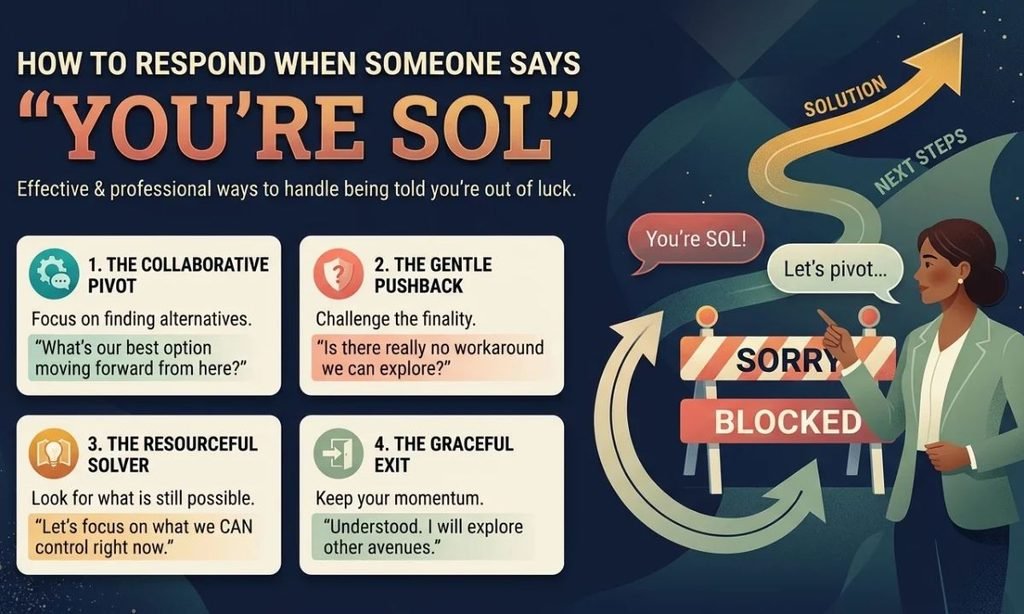
Match the speaker’s tone. If they’re joking, play along with “Yeah, pretty much!” or “Well, that’s one way to put it.”
If they’re serious, ask about your options: “Is there anything I can do?” or “What are my alternatives?”
If you don’t understand, there’s nothing wrong with asking, “What does SOL mean here?” Context solves most slang mysteries quickly.
A Real-Life Scenario: SOL in Everyday Conversation
Imagine three friends planning a concert trip. One assumes another bought the tickets. On the day of the concert, one asks, “Wait, none of us bought tickets?” Another replies, “Nope. They’re sold out now.” The first answers, “We’re SOL.”
The opportunity disappeared, and the group is stuck without a good option. Notice what the abbreviation doesn’t say. The concert isn’t ruined forever, and nothing catastrophic happened. That’s the heart of the slang expression.
Why SOL Works So Well in Casual Communication
Short slang expressions carry more emotional weight than their length suggests. Instead of writing “we missed our opportunity and there’s nothing we can do about it,” someone types “we’re SOL,” and the reader fills in the rest.
That efficiency is why abbreviations thrive in fast-moving digital conversations. They work like verbal shorthand. The downside is that shorthand turns unclear when the audience doesn’t know it or when the same letters have multiple meanings, which is the catch SOL carries everywhere it goes.
The Takeaway on SOL
Where you see it decides what it means. In texting and online slang, SOL most commonly means “Sh*t Out of Luck,” describing a situation where someone has no good options. It can also mean “Sooner or Later,” refer to Solana, or carry professional meanings in law and economics.
Check the context first. A casual chat, a crypto discussion, and a legal document can all use the same abbreviation in completely different ways. Once you’ve got the Sol meaning in text figured out, using it well mostly comes down to knowing your audience. Use it with friends, swap in a cleaner phrase at work, and ask when you’re unsure.
FAQs
What does SOL mean in text?
SOL most commonly means “Sh*t Out of Luck.” It describes someone stuck in a bad situation with few or no options left.
What does “you’re SOL” mean?
It means you’re out of luck and there’s little you can do to fix the problem. Friends often say it with a joking tone, like when you miss the last train.
Is SOL a bad word?
SOL itself is only three letters, but the full phrase behind it contains profanity. It’s fine among friends but best avoided in professional or formal settings.
What does SOL stand for in slang?
In slang, SOL stands for “Sh*t Out of Luck.” Online communities, gaming chats, and group texts use it as a quick way to say someone has run out of options.
Does SOL always mean “out of luck”?
No. It can also mean “Sooner or Later,” Standard of Living, or Statute of Limitations. Context tells you which meaning fits.
What does SOL mean in crypto?
In crypto, SOL is the ticker symbol for Solana’s native token. If the conversation is about prices, wallets, or trading, it has nothing to do with luck.
What does SOL mean on TikTok, Instagram, or Reddit?
On social media, SOL usually appears in comments as a reaction to someone’s bad situation. A single “SOL” under a post about a cancelled flight means “you’re out of luck.”
Is it okay to use SOL at work?
Usually not. It can come across as crude, and the abbreviation has multiple meanings that may confuse coworkers. Try “we have limited options” or “we’re facing a problem” instead.
What does SOL mean in gaming chat?
Gamers use SOL when a player loses progress, runs out of ammo, or faces a disadvantage. It quickly signals a bad position without slowing down the match.
What can I say instead of SOL?
Safer options include “out of luck,” “unfortunate situation,” “out of options,” and “we’re in trouble.” These carry the same idea without profanity.
How do I know which SOL meaning someone is using?
Check the surrounding words and the topic. Words like deadline, missed, or tickets point to slang, while price, token, or blockchain point to Solana.
What does SOL mean when someone texts it to you?
Most likely they’re saying you’re out of luck or in a tough spot. Look at the conversation, and if it’s still unclear, ask “Do you mean out of luck?”
What’s the origin of SOL?
SOL grew out of informal American English, where the full phrase came first and the abbreviation followed. The exact first use is hard to pin down.
What’s the difference between SOL and SNAFU?
SOL describes a person with no luck or options. SNAFU, short for “Situation Normal: All Fouled Up,” describes a messy or confusing situation.
How should I reply when someone says “you’re SOL”?
Match their tone. If they’re joking, play along with “Yeah, pretty much!” If it’s serious, ask “What are my alternatives?”
