

You’re texting a friend about weekend plans, and the replies stop. Then a message lands: “AFK, dinner time.” If that left you squinting, you’re in good company, because AFK meaning in text is one of those things people look up after bumping into it in a chat.
People search for it because it appears everywhere without any explanation: group chats, Discord lobbies, Slack, TikTok comments, and live streams. It also looks like it could stand for almost anything, and slang rarely ships with instructions. That gap is how mix-ups start.
This guide gives you the plain meaning first. Then it covers the origin, how people use it on different apps and at work, and how it differs from BRB, offline, and similar terms. You’ll also get ready-made replies and examples you can use today.
AFK stands for “away from keyboard.” In a text, chat, or game, it tells people you’ve stepped away from your device for a short time and won’t reply right away. It’s informal internet slang, it doesn’t mean you’re gone for good, and it works on phones and tablets as well as computers.
AFK Meaning in Text: The Full Definition
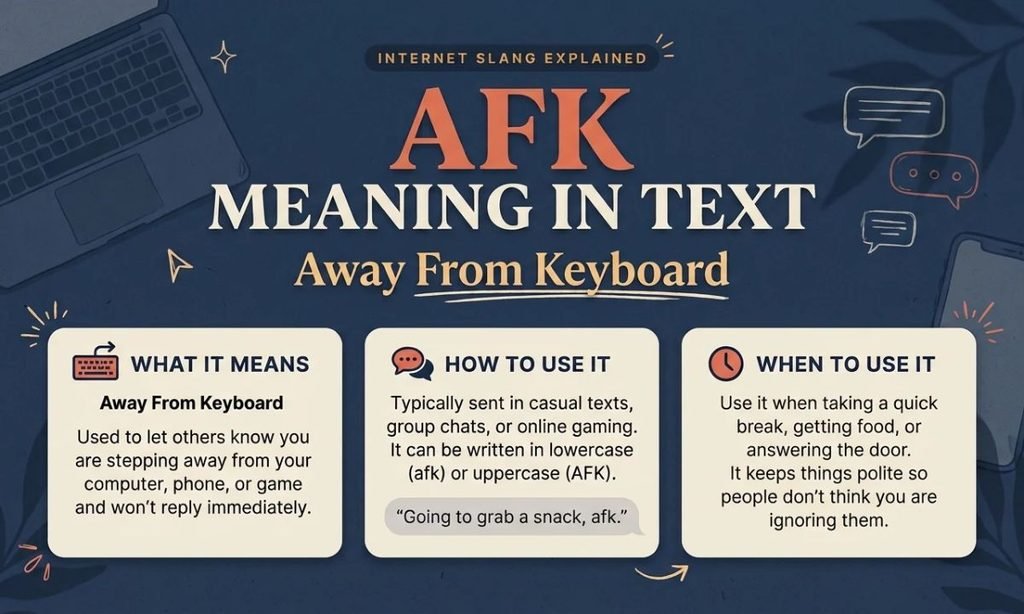
AFK stands for Away From Keyboard. It’s an abbreviation, often called an acronym, with one fixed meaning: the person isn’t at their device right now and won’t reply for a short time. Dictionary.com lists it the same way, as shorthand used mainly in texting and messaging. There’s no hidden tone behind it and no sarcasm to decode.
Plenty of slang terms depend on context, and you end up reading a whole thread to figure out what someone meant. AFK skips that problem. It’s universally understood, it’s quick to type, and a new player usually picks it up within their first week in a game.
What it signals is simple: you’re temporarily not active. Taken at face value, AFK in text means the person is temporarily away, not available and not actively responding online. It’s a way of telling others not to wait on you. The abbreviation says nothing about how long you’ll be gone, and that gap causes most of the confusion later.
The phrase originally referred to physically leaving a computer keyboard. Today it applies to all kinds of devices, smartphones and tablets included. I’ve typed it from my phone while walking to the kitchen, which would have made no sense in the dial-up era and makes perfect sense now.
What Does AFK Mean in Chat?
In chat, AFK means a person is temporarily away from the conversation or their device. “I’ll be AFK for 10 minutes” tells everyone they’ll be unavailable for a short time. “AFK, dinner time” does the same job in three words.
I mostly see it in real-time chat, where silence is noticeable. Friends use it, teammates use it in gaming chats, and group members use it in online group discussions. People reach for it for a short break, for stepping away to answer the door, or for pausing a conversation while they deal with something.
Online communities lean on it because inactivity otherwise looks like being ignored. Chat has no body language to explain a gap, so a short abbreviation fills in. Either way, nobody expects an answer until you’re back.
What Does AFK Mean in Gaming?
In gaming, AFK marks a player who is temporarily inactive or away from the game. Teammates use it to explain why someone isn’t responding or moving. “Don’t start the match, I’m AFK” is the version I’ve seen most, usually typed right as the doorbell rings.
Where Did AFK Come From?
The story behind AFK meaning in text starts in early internet culture, but nobody can point to the first message, so the exact origin is debated. The background is clearer. It came out of the 1990s, when chat rooms and multiplayer computer games were where people gathered.
Typing “I am away from my keyboard” took too long, and in a live game, leaving the conversation hanging could cost your team. Gamers and chat users shortened it. The abbreviation caught on fast in MMORPGs, short for Massively Multiplayer Online Role-Playing Games, and in other online gaming communities where real-time teamwork decides whether a raid succeeds.
Players needed a quick way to tell teammates they were stepping away from computers. That way nobody expected immediate action or a reply while they were gone, and it was simple courtesy even for a brief break.
The rise of messaging apps and social media platforms carried it out of games and into everyday conversations. It became general internet slang, and these days you’ll even see it in professional online meetings when someone’s mic goes quiet. It’s popular with people who’ve never raided a dungeon in their lives.
What surprises me is how little it has changed. Smartphones have no physical keyboard in the traditional sense, yet the phrase remained in its original form. That’s typical of internet language: it holds its shape while technology evolves, and users adjust their expectations instead of rewriting the term. It’s a decent snapshot of early digital communication surviving into modern online language.
How People Use AFK in Different Situations
The usage shifts with the situation, but the core idea never does: a temporary absence.
General Use
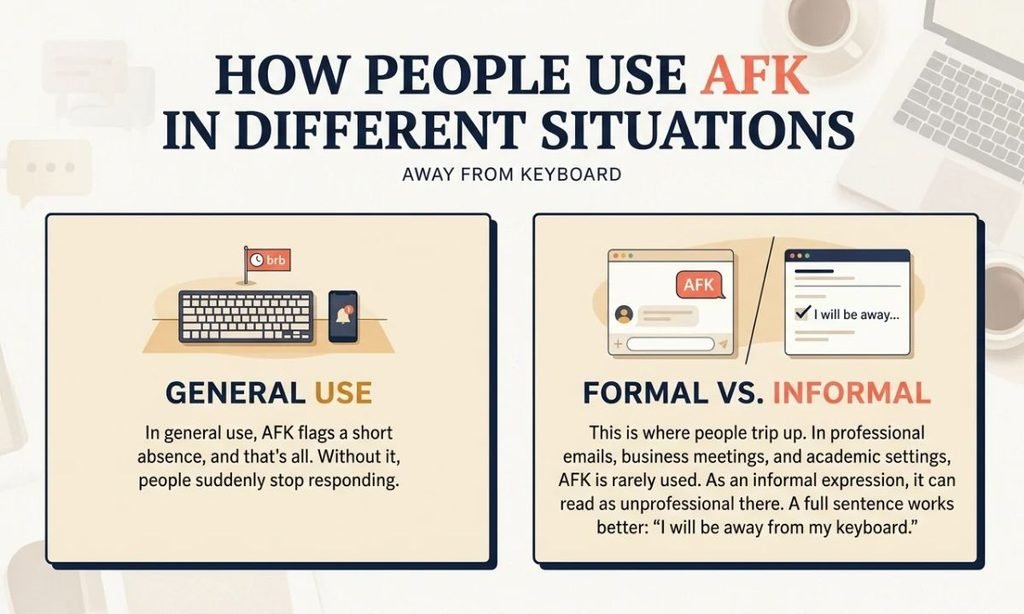
In general use, AFK flags a short absence, and that’s all. Without it, people suddenly stop responding, and the rest of the chat is left guessing whether you’re ignoring them, asleep, or gone. Typing “AFK for a few minutes” tells everyone you’ll return soon. It heads off confusion and small misunderstandings, and it keeps communication smoother than silence does.
Formal vs. Informal Use
This is where people trip up. In professional emails, business meetings, and academic settings, AFK is rarely used. As an informal expression, it can read as unprofessional there. A full sentence works better: “I will be away for a moment.” It’s a bit stiff, but nobody blinks.
Informal spaces are where AFK is extremely common. Think Discord servers, WhatsApp groups, group chats, gaming chats, and other social media platforms. Speed over formality is the unspoken rule, and AFK meaning in text lives mostly in these digital communication environments.
Remote work sits in the middle. I see it in work chats among colleagues who already know each other, and “AFK for lunch, back in 30 mins” is a typical line. Now picture that same message landing in a thread with a client who has never seen it. That’s the workplace mistake I’d steer you away from: a harmless slang term becomes a mix-up, and you look careless.
With teammates it’s fine. With clients or senior managers, a short plain sentence is safer, though it depends on the workplace.
AFK Examples in Real Messages
These examples of AFK meaning in text show how flexible the abbreviation is. Here they are by situation.
| Situation | Example message | What it tells the reader |
| Casual chat | “I’ll be AFK for 10 minutes.” | A short break is coming |
| Casual chat | “AFK, dinner time.” | Meal break, no reply yet |
| Casual chat | “AFK, be right back.” | Back soon |
| Game lobby or family group chat | “Wait a sec, I’m AFK for dinner.” | Hold on, don’t wait on me |
| Gaming | “Don’t start the match, I’m AFK.” | Wait for me before starting |
| Gaming | “AFK for 5 minutes, don’t start without me.” | The classic gamer request |
| After the fact | “Sorry, I was AFK during the match.” | Apology for a missed call |
| After the fact | “Sorry, I was AFK earlier.” | Explains a delayed reply |
| Teammate reporting | “He went AFK, so we paused the game.” | Third-person status update |
| Work chat | “AFK for lunch, back in 30 mins.” | Informal note to colleagues |
| “AFK, call you later.” | Not available right now | |
| “Going AFK for a while.” | Longer, undefined absence | |
| Signing off | “Going AFK, talk later!” | Leaving the conversation for now |
| TikTok | “Me going AFK after one task” | A joke about burning out |
Read together, these sentences show that AFK can be a status, an apology, a report, or a request.
Can You Use AFK on WhatsApp, Instagram, TikTok, and Snapchat?
Yes. AFK meaning in text barely changes from app to app. It started in online computer culture, but it’s now at home on messaging apps and other social media platforms, always as a quick way to say you’re stepping away.
On WhatsApp, it mostly appears in group chats as a quick note of temporary absence, sent before someone goes to cook. On Instagram, it turns up in DMs, captions, and live sessions when a host steps off camera for a second.
TikTok is the odd one. People use it humorously in comments, videos, and live chats. Snapchat is the quietest: it’s rare there, though I’ve seen it in streak conversations and quick replies as a sign of short inactivity. Discord, as you’d expect, is full of it.
Across all of them, users use it to indicate they’ll leave temporarily. It’s informal, easy to use, and widely understood. It can also pop up in places you wouldn’t expect, which is part of why it has lasted.
Does AFK Mean Something in Physics, Medicine, or Aviation?
Outside casual texting, AFK meaning in text gets thin quickly. In physics there’s no standard or widely accepted meaning, and it isn’t part of scientific terminology. In the medical field, it’s not a common medical abbreviation.
In aircraft and aviation terminology, it may show up in rare cases as an airport code or an internal abbreviation. It isn’t widely recognized there, so I wouldn’t rely on it.
Technology is the exception. In online systems and gaming platforms, it’s commonly used as an inactivity status, the label a system sticks next to your name when you’ve gone idle. Other meanings exist mostly on paper. AFK is primarily an internet and communication term, not a technical one.
Common Misconceptions About AFK
The same few mix-ups come up again and again. Each one treats a plain abbreviation as something more dramatic.
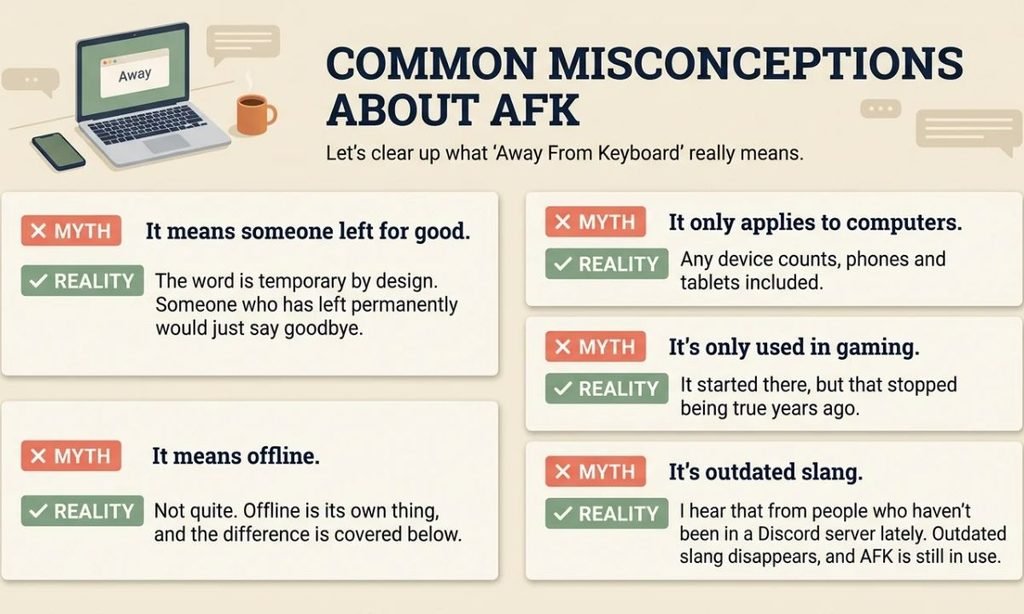
- It means someone left for good. The word is temporary by design. Someone who has left permanently would just say goodbye.
- It means offline. Not quite. Offline is its own thing, and the difference is covered below.
- It only applies to computers. Any device counts, phones and tablets included.
- It’s only used in gaming. It started there, but that stopped being true years ago.
- It’s outdated slang. I hear that from people who haven’t been in a Discord server lately. Outdated slang disappears, and AFK is still in use.
In reality, it’s a temporary absence on any device, in any kind of chat.
AFK vs. BRB, GTG, Offline, and Busy
Several alternatives sit near AFK, and they differ more in tone than in meaning. All of them convey unavailability. Pick by tone, not by habit.
| Term | What it says | How it differs from AFK |
| BRB (Be right back) | You’re leaving briefly | Promises a quick return |
| GTG (Got to go) | You’re leaving | Often means leaving completely |
| Offline | Not connected to the internet at all | Completely disconnected |
| Busy | You’re occupied | You may still be replying |
| Stepping out | You’ve left the room | Sounds more physical |
| Not available | You can’t respond | Flatter, with no hint of why |
| Pause | A temporary stop in activity | Like pausing a game |
| BRB AFK | A combination for emphasis | Doubles up to say you’re temporarily away |
Is AFK the Same as BRB?
Not exactly. Both flag a temporary absence, but BRB usually means you expect to return soon. AFK can run longer, and how long is left undefined.
Where BRB and GTG imply a plan, either an intent to return or a decision to leave completely, AFK stays neutral. If you’ve also seen vague-timing slang like TBD, our guide to TBD meaning in text explains how it works. In gaming, that gap matters. If a teammate types AFK, I plan around them. If they write BRB, I just hold position.
AFK vs. Offline
AFK means temporarily away. Offline means completely disconnected, with no connection to the internet at all. Someone who is AFK is usually still logged in, just not at their device.
AFK vs. Busy
Busy doesn’t always mean away, since you can be busy and still replying. AFK clearly indicates absence.
How to Respond When Someone Says AFK
When AFK meaning in text shows up in your inbox, the best response is short. Acknowledge it and wait for them to return. “Okay, no problem” works, and so does “Sure, take your time” or “Alright, I’ll wait.”
There’s no need for a detailed reply. A long answer to a three-letter message just adds noise, and a simple response keeps the chat easy to rejoin. If the conversation is important, pick it back up when they’re available again.
Why AFK Still Works in Online Conversations and Dating Apps
The relevance in online conversations comes down to trust. In active conversations, a delay reads loudly. A short note helps manage expectations and avoid confusion, and AFK does that with almost no typing. It tells others that a delayed reply is not intentional.
On dating apps, silence has a way of getting read as disinterest, so a quick “Going AFK, talk later!” or “Sorry, I was AFK earlier” helps maintain smooth, respectful communication. AFK is less common there, though, and I’ve mostly seen it occasionally, when two people are mid-flow and one has to step away briefly. In romantic or personal communication, clearer phrases like “I’ll be right back” usually land warmer, because slang can feel clipped when feelings are involved.
This all traces back to internet culture’s taste for speed and efficiency. Short abbreviations replace long explanations, and the real-time interaction keeps a smooth flow, because when someone isn’t responding instantly, everyone else knows why. Digital etiquette here is simple: say you’re stepping away, even for a minute.
The Takeaway on AFK
AFK is a simple yet powerful abbreviation and a standard part of online communication. Rooted in gaming culture, it expanded into everyday use across chats, social media, and even professional conversations. Its meaning has stayed consistent while technology evolves, which is why AFK meaning in text still works the same on a phone in 2026 as it did in a 1990s chat room.
Here’s the practical version. Use it freely with friends, teammates, and group chats. Keep it out of emails to clients and senior managers. When someone else uses it, say “no problem” and wait.
Understanding how and when to use it sharpens your digital communication skills and helps you interact effectively, whether you’re talking to friends, playing games, or posting on social platforms. It’s a small term, but it plays an important role in expressing availability.
FAQs
What does AFK mean in text?
AFK means “away from keyboard.” It tells people you’ve stepped away from your device and won’t reply right away.
It’s informal internet slang, and it works in texts, chats, and games.
What does AFK stand for?
AFK stands for Away From Keyboard.
It’s an abbreviation people use to say they’re temporarily unavailable.
Does AFK only apply to computers?
No. The phrase started with computer keyboards, but it now covers any device, including phones and tablets.
Typing it from your phone is completely normal.
Is AFK the same as BRB?
Not quite. BRB means “be right back” and promises a quick return.
AFK just says you’re away, without saying how long.
Does AFK mean offline?
No. AFK means you’re temporarily away, often still logged in.
Offline means you’re fully disconnected from the internet.
What does AFK mean in gaming?
In gaming, AFK means a player is inactive or away from the game.
Teammates use it to explain why someone isn’t moving or responding.
How do you respond when someone says AFK?
Keep it short. “Okay, no problem” or “Sure, take your time” works fine.
You can also just wait and pick the conversation up when they’re back.
Can I use AFK in a work chat?
It’s fine with teammates you know well in casual remote chats.
For clients or senior managers, a short plain sentence like “I’ll be away for a moment” is safer.
Where did AFK come from?
It grew out of 1990s chat rooms and multiplayer games, where players needed a fast way to say they were stepping away.
No one can point to the very first use, so the exact origin is debated.
Is AFK still used today?
Yes. It’s still common in gaming chats, group chats, Discord, and on social media.
It has barely changed since it first appeared.
Can I use AFK on WhatsApp, Instagram, or TikTok?
Yes. It appears in WhatsApp group chats, Instagram DMs and captions, and TikTok comments.
Snapchat is the one place it’s rare.
