

A friend sends you a message: “Just grab it from APKPure.” You nod along, then quietly open a browser to figure out what that even means. If that sounds familiar, you are in good company, because the APKPure meaning trips up a lot of people the first time they run into the word.
The confusion makes sense. It shows up in group chats, gaming forums, tech threads, and sometimes in security reports, and each place uses it a little differently. It looks like a file name, sounds like slang, and is actually something else entirely.
This article explains what the name stands for, how people use the platform, and where the risks sit for everyday users and for companies. You will also see how the platform differs from an APK file, what XAPK adds, and when it is smarter to skip it altogether.
Answer Block: APKPure is a third-party Android app store and downloader. It is a website and an app where people find, download, and update Android apps outside Google Play, often older versions or apps not offered in their region. It is a brand name, not slang and not a file type.
What Does APKPure Mean?
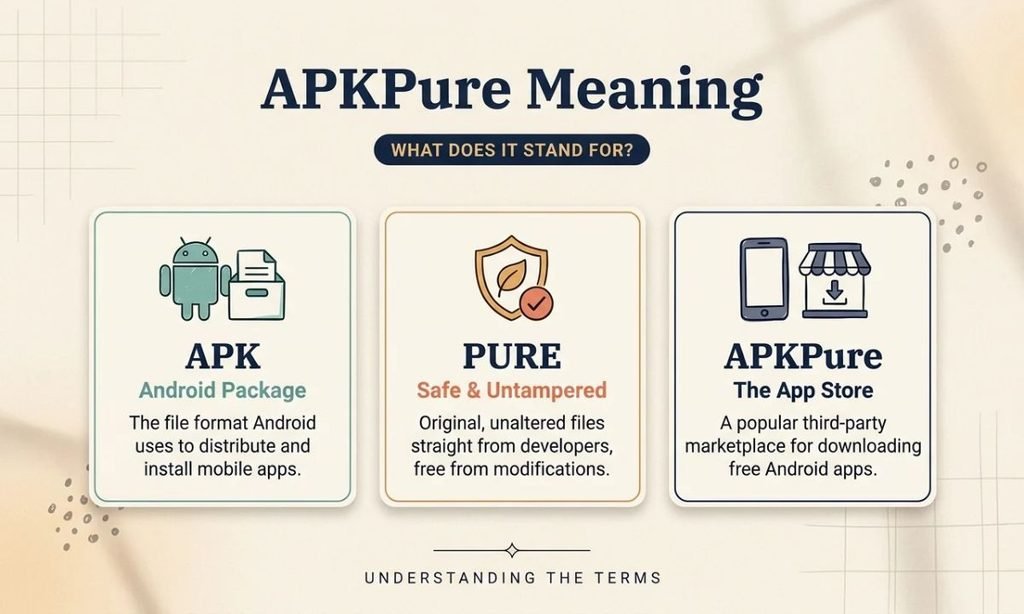
The word is a brand name. In English it points to one specific platform, an Android app repository that describes itself as a place to find apps and games from around the world, including some that Google Play does not offer in your area. It is not a grammar term, and it is not really slang, although I have seen people use it loosely to mean “installing something the unofficial way.” If you are after real texting slang instead, see our guide on IDGAF meaning in text.
The files it hands out arrive as .apk and .xapk packages. Security people also describe it as a dual-use platform, which is a polite way of saying it is helpful for researchers and a bit awkward for everyone else.
Where the Name Comes From
The name reads like “APK” plus “pure,” which hints at clean, untouched files. That is an inference. I have not seen the company explain the origin, so treat it as a reasonable guess and not recorded history.
You may also see write-ups that call it an open-source platform. I would read that label loosely. What matters in daily use is simpler: if an app is missing from your region, or you need an older build, you can usually find it there.
How People Say It in Real Life
In forums and group chats, the line you will hear most is “I downloaded it from APKPure.” The speaker means they used the store. Nobody means the file was “an APKPure,” and that mix-up is one of the most common ones I come across.
APKPure vs. APK: What’s the Difference?
The key difference is easy to remember. APKPure is the platform, and an APK is the standard Android package file that the platform gives you. The term APK refers only to that file type, the one that lets you install apps on Android.
Android requires every APK to be digitally signed before it can be installed or updated. That is why signature checks matter most when a file comes from outside an official store. The distinction sounds picky until you are helping someone who thinks they need to “get an APKPure” to run a game.
What XAPK Adds
XAPK is a package format for apps that need more than one file. It can carry extra pieces such as OBB assets or split-package components, which is common with big games. A plain APK cannot always do that.
| Term | What it is | Example use |
| APKPure | A third-party Android app platform | Finding an older version of an app |
| APK | The standard Android install file | Installing an app manually |
| XAPK | A package with the app plus extra data (OBB or split APKs) | Installing a large game |
What Does APKPure Actually Do?
According to its app listing, the platform helps people discover, download, and update apps and games. The listing highlights global access past regional limits, along with support for installing APK and XAPK files. In practical terms, that comes down to three things:
- Finding apps that are harder to get through Google Play
- Grabbing older versions of an app
- Installing packages by hand when they do not come through the official store
Update checks exist too, but there is a catch. Updates stay manual, so do not expect the automatic flow you get from Google Play. Treating manual updates as the same thing as Play Store updates is a mistake I see often.
How It Handles APK and XAPK Files
An APK can be installed directly once your device allows installation from that source. XAPK is more complicated. The platform explains it as the app plus extra data, such as OBB files or split APK components, and it typically needs a special installer instead of the default one on your phone.
The installation guide boils down to this: download the file, switch on unknown sources if your phone asks, then install it manually. Simple enough. But you are stepping outside the normal Google Play flow, and that changes who is checking what.
Why Do People Use APKPure?
People rarely open it out of curiosity. They show up with a specific need. The common reasons are an older version after an update breaks something, an app held back by local catalog limits, or direct installs that skip the Play Store ecosystem entirely.
I have watched people go hunting for an older version after a redesign removed a feature they relied on. That is the classic case. A region-limited app sitting beyond your local catalog is the other one.
That matches how the platform markets itself, since it positions itself around exactly those situations. For everything else, Google Play is still the better choice. Normal everyday installs get lower friction and stronger default protections there. Sensitive apps like banking or payments also get a controlled update path and lower risk.
How Security Analysts Use APKPure
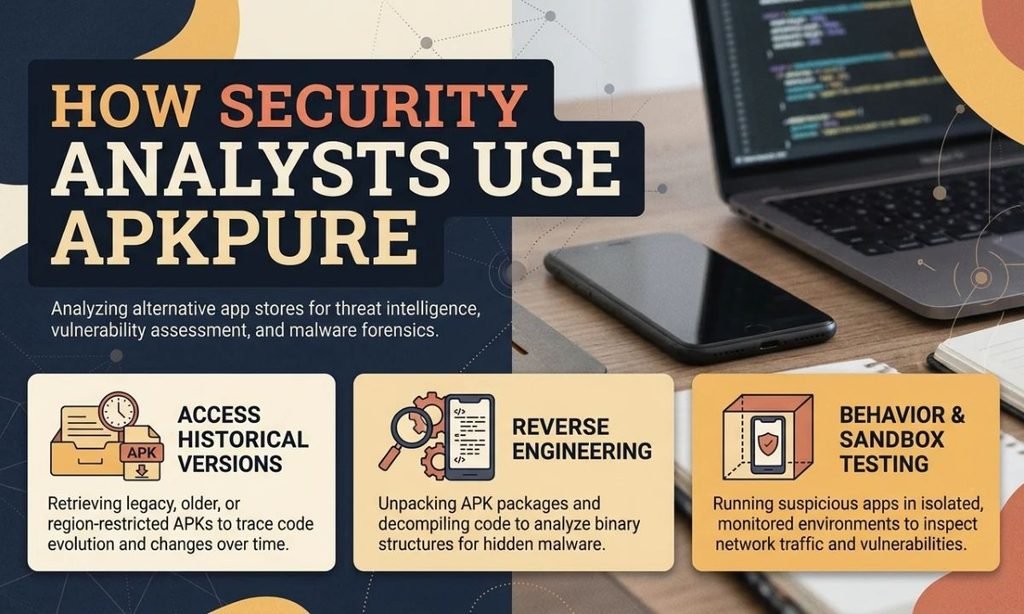
Security analysts and threat researchers use the platform for several purposes, and most of them are defensive or investigative. Threat intelligence teams treat it as a place to safely download potentially malicious APKs for analysis.
Historical Vulnerability Analysis
Because the platform keeps older versions, analysts can pull legacy builds and track how a flaw tied to a CVE (Common Vulnerabilities and Exposures entry) behaved before developers patched it. Comparing builds shows how an app’s security posture changed over time and what a fix actually did.
Malware Sandboxing and Reverse Engineering
Teams run files in isolated sandboxes and read the application code. They look for hardcoded API keys, exposed backend infrastructure, and hidden malware payloads. For a thorough look at an app, the file itself beats any description of it.
Getting Around Geo-Restrictions
Region-specific apps are often missing from a researcher’s local Google Play Store, and researchers frequently need them anyway. The platform offers broad global access, which helps with threat hunting.
Is APKPure Safe?
The most accurate answer is that it is not automatically unsafe, but it is not as safe as the official store either. The platform says it rejects debug certificates and checks trusted digital signatures. When the developer signature matches official records, the file gets a trusted badge.
Signature verification confirms that a file matches the original developer’s release. What it lacks is the behavioral analysis and malware scanning that official app stores run. Any third-party source carries built-in risk, and sticking to official stores is the safest habit for mobile security.
Google still warns about apps from outside Google Play. Play Protect scans apps during installation, periodically checks what is already on your phone, and may warn you, disable an app, or remove it if it looks harmful. Google recommends keeping Play Protect switched on.
The 2021 Malware Incident
There is a historical reason for caution. In April 2021, Kaspersky reported malicious code in version 3.17.18 of the official client app. The fix arrived in version 3.17.19 after developers were notified. Other reports describe the infection as a malicious module, reported as the Triada trojan, that deployed adware and downloaded extra malware onto devices. .
That does not make every download dangerous. It does mean no third-party store is completely free of risk.
Where the Risks Sit
The same openness that makes the platform handy also creates distinct problems. Google Play leans on Play Protect. The platform’s verification process relies mainly on matching digital signatures.
Outdated Apps and Known Exploits
People often visit for older versions with deprecated features. Those legacy apps naturally lack security patches, which leaves users exposed to known, publicly documented exploits.
Typosquatting and Fake Sites
Cybercriminals target people hunting for third-party app stores by building counterfeit lookalike websites. These fraudulent sites trick users into downloading malware disguised as the real client, and phishing campaigns steer people toward them. Consumers and organizations both get caught.
Shadow IT in the Workplace
Employees who grab enterprise apps from the platform instead of approved corporate portals bypass Mobile Device Management (MDM) policies. That kind of sideloading means security teams cannot confirm an unverified app is up to date or free of unauthorized changes.
Is APKPure Legal?
This is a harder question than it looks. Using the website and app is not automatically illegal. The service has a published copyright policy and a process for handling infringement claims.
The catch is that because it is often described as an open-source platform, it may host cracked, pirated, or unauthorized apps uploaded by third parties. Downloading copyrighted software without permission infringes copyright law and violates intellectual property rights. Whether a particular app is lawful depends on whether it is distributed with proper rights and permissions.
In practice, I would avoid anything that looks unofficial, tampered with, pirated, or suspicious, even on a third-party platform. That is the safest approach.
When to Avoid APKPure
If an app is easy to get on Google Play, skip the third-party route. It is a poor default there, and the official store is simpler, safer, and easier to keep updated. Sideloaded apps trigger extra warnings and security checks for a reason.
Be especially careful with anything that touches money, identity, private messages, or sensitive personal data. A compromised app in that category has consequences far worse than a casual game or a utility would. Those are high-trust apps, and Google’s guidance points the same way. If something goes wrong, you are the one cleaning it up.
How Companies Reduce the Risk
Enterprise security teams can lower the danger by enforcing strict MDM policies that prohibit sideloading. They restrict app installs to authorized company portals or the Google Play Store. Mobile threat defense tools can also help detect and block malicious APKs that try to run on corporate devices.
The Attack Surface View
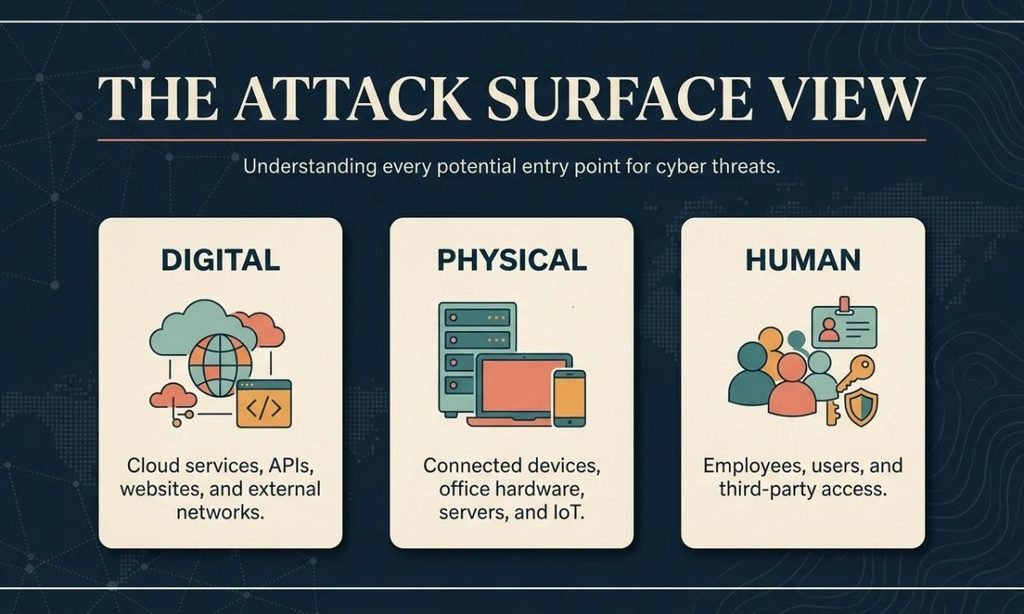
Third-party Android repositories like APKCombo and APKPure represent a dual-use attack surface. They serve as archives for historical app packages, yet they pose serious risks: shadow IT, corporate data exposure, and targeted typosquatting.
ThreatNG is one vendor in External Attack Surface Management that addresses these threats with a deterministic, outside-in approach. It describes its goal as turning mobile app exposure from a blind spot into a visible, manageable area. Everything below is the vendor’s own account, so read it as a description and not a verdict.
External Discovery
ThreatNG works as an unauthenticated external scout. It claims connectorless visibility, meaning no internal agents, API connectors, or manual seed data, so there is little friction to start. It explores the clear web, deep web, and third-party forums, and recursively maps the global domain registry to find shadow infrastructure.
That mapping feeds impersonation discovery. Threat actors register lookalike domains designed to mimic sites like APKCombo, hoping to trick employees or customers into installing repackaged versions of a corporate app. Defending against that takes full visibility into where an organization’s mobile assets are hosted across the internet, including APKs sitting outside official channels. The vendor calls the result a mobile footprint.
External Assessment
The vendor says its assessment moves mobile risk from subjective guesswork to mathematical certainty. It evaluates real-world risk on exposed mobile infrastructure using Known Vulnerability Exposure Verification (KVEV) and a proprietary 4-Dimensional (4D) Data Model.
Take its brand impersonation example. An attacker hosts a repackaged corporate app, along with other unauthorized APK files, in a cloud storage bucket tied to a dangling DNS record. The platform checks Subdomain Takeover Susceptibility and verifies whether the CNAME points to an inactive third-party resource. The security team then knows what it needs to reclaim routing before the asset is weaponized in a phishing campaign.
The infrastructure example involves a legacy corporate app that talks to a forgotten, public-facing developer API. The 4D Data Model cross-references the API’s technical flaws with the Exploit Prediction Scoring System (EPSS) and searches for active Proof-of-Concept (PoC) exploit code. If the endpoint is under active attack, the risk is prioritized right away. That extra intelligence separates a theoretical flaw from an urgent one.
Strategic Reporting
ThreatNG replaces raw lists of exposed files with structured reporting built to drive action and remediation. Its Forensic Evidence Packages bundle URLs, hosting providers, and visual proof of brand abuse, such as a typosquatted domain pushing a fake version of a corporate app. Legal and security teams get the proof they need for a fast Digital Millennium Copyright Act (DMCA) takedown.
Legal-Grade Attribution adds data-driven proof of ownership and exposure. It helps Chief Information Security Officers (CISOs) justify resource priorities and show external due diligence to regulators. The point is to equip people to act, which a spreadsheet of findings rarely does.
Continuous Monitoring
Repositories keep archiving new app versions, and threat actors spin up phishing infrastructure quickly. Point-in-time scanning cannot keep pace, so the vendor runs monitoring around the clock across the external attack surface.
The moment an unauthorized version of a corporate app lands on a third-party repository, or a typosquatted domain is registered, it flags the exposure in real time. Constant visibility prevents configuration drift and shuts down shadow distribution channels before they cause wider damage.
Investigation Modules
The deeper investigation modules analyze mobile exposures and build deterministic threat models that show how a mobile weakness could breach the core network.
Developers sometimes leave hardcoded access tokens or deprecated API keys in an app’s manifest file. Because sites like APKCombo archive older versions permanently, attackers dig for secrets in those historical files. The Sensitive Code Exposure module investigates these public footprints. If an old corporate APK holds an exposed AWS S3 key, it detects the leaked secret so the security team can revoke the token before an attacker signs in to the cloud environment. A Mobile Application Exposure module covers the wider app picture.
DarChain, short for Digital Attack Risk Contextual Hyper-Analysis Insights Narrative, maps the multi-step exploit path an adversary would follow. The attacker downloads the APK, reverse-engineers it for a hardcoded database credential, matches that credential to a shadow API endpoint on the corporate perimeter, and pulls data from the backend. The vendor says this gives security engineers the exact blueprint for the choke point, and it shows why one forgotten file matters.
Intelligence Repositories
ThreatNG grounds its assessments in the DarCache intelligence ecosystem, which supplies real-world threat data. The DarCache Rupture and Dark Web repositories connect mobile app exposure with threat-actor chatter. They confirm whether hardcoded secrets from a decompiled APK are being traded on dark web forums or actively used by ransomware groups.
DarCache eXploit acts as the validator by locating active PoC exploit code tied to the infrastructure behind exposed mobile apps.
How It Works With Other Security Tools
The vendor positions ThreatNG as an external intelligence source that cooperates with enterprise security tools for a fuller defense against mobile threats. It works as a feed, not a replacement.
- With MDM: it passes hashes, developer signatures, and distribution URLs of rogue APKs into the platform. MDM then uses that intelligence to update corporate policies and block employees from sideloading those apps onto company-managed devices.
- With SOAR (Security Orchestration, Automation, and Response): it sends pre-correlated Context Objects and verified exploit paths through a Decision Ready API. If an exposed API key sits inside an archived APK, an automated playbook can revoke the key and block outside traffic without manual triage.
- With SAT (Security Awareness Training): it supplies typosquatted domains, rogue app interfaces, and other visual evidence. Training platforms use these to teach staff to spot the phishing campaigns actually targeting their organization, which is far more specific than generic training.
What It Can and Cannot Do
According to the vendor, it finds corporate apps on unofficial sites through unauthenticated external discovery. It maps the global internet, analyzes domain records, technology stacks, and third-party hosting, and identifies where branded apps live outside official marketplaces. The vendor also says its Sensitive Code Exposure and Mobile Application Exposure modules check whether legacy apps on third-party archives contain hardcoded secrets, exposed backend developer URLs, or deprecated authentication tokens that threaten current infrastructure.
It does not remove malicious apps itself. As an intelligence engine, it builds the case file with Forensic Evidence Packages and Legal-Grade Attribution. Internal legal and security teams then use that evidence to push third-party hosts to act, which is what a solid takedown request needs.
Common Mistakes About APKPure
One common mistake is saying “APKPure is an APK.” That is incorrect. The platform is the store, and the APK is the install file.
Another is assuming third-party means malicious. That is too simple. The platform has verification and signature-checking steps, yet security researchers still give people good reasons to be careful. A fairer view is that third-party app stores ask for more trust and carry more risk than the official channel.
A third is treating manual updates as the same as Play Store updates. Update checks exist, but you apply them by hand.
Example Sentences
Here are a few lines in the style I actually hear:
- “I used APKPure to find an older version of the app.”
- “APKPure is a platform name, not the APK file itself.”
- “That game was not available in my local Play Store, so I checked APKPure.”
- “For banking apps, I would rather stick with the official store.”
So, Should You Use It?
I reach for official stores first. A manual APK or XAPK install from this downloader makes sense when you need an older version or a region-limited title and you understand exactly what you are downloading and why. Google will still scan apps from outside its store, and the security history shows added risk.
The APKPure meaning comes down to this: a useful platform, but not a shortcut. The safest rule is to start with official stores and treat it as the exception.
FAQs
What does APKPure mean?
APKPure is a third-party Android app store and downloader. People use it to find, download, and update apps outside Google Play. It is a brand name, not slang.
Is APKPure the same as an APK?
No. APKPure is the platform, and an APK is the install file for Android apps. The platform also supports XAPK packages.
What is the difference between APK and XAPK?
An APK is the standard Android install file. An XAPK bundles the app with extra data like OBB files or split APK parts, which is common with large games. It often needs a special installer.
Why do people use APKPure instead of Google Play?
Mostly for older app versions and apps not offered in their region. Some people also use it after an update removes a feature they liked. For everyday apps, Google Play is still the easier choice.
Is APKPure safe to download from?
It is not automatically unsafe, but it is not as safe as Google Play. It checks developer signatures, yet it lacks the full malware scanning that official stores run. Its own app also had a malware incident in 2021.
Has APKPure ever had malware?
Yes. In April 2021, Kaspersky reported malicious code in version 3.17.18 of the APKPure app. The issue was fixed in version 3.17.19.
Is APKPure legal to use?
Using the website and app is not automatically illegal, and it has a copyright policy. But third parties may upload cracked or pirated apps. Downloading copyrighted software without permission breaks copyright law.
Does APKPure update apps automatically?
No. It can check for updates, but you install them by hand. That is different from the automatic updates you get on Google Play.
How do you install an app from APKPure?
Download the APK file, allow installation from that source if your phone asks, then install it manually. XAPK files may need APKPure’s installer or a similar tool. Keep Google Play Protect turned on.
Should I use APKPure for banking or payment apps?
No. Apps that handle money, identity, or private messages are high-trust, so stick with the official store. A compromised app in that category can cause serious damage.
Why do security researchers use APKPure?
It keeps older app versions, so analysts can study past vulnerabilities and test suspicious files in sandboxes. It also gives access to region-locked apps. Most research use is defensive.
What is typosquatting in relation to APKPure?
It is when criminals build fake lookalike websites to imitate third-party app stores. These sites push malware disguised as the real client. Always check the web address before downloading.
How do companies reduce the risk of APKPure downloads?
They use Mobile Device Management (MDM) policies to block sideloading. App installs are limited to approved company portals or Google Play. Mobile threat defense tools can also block malicious APKs.
