

You open a message, and the only thing it says is “ohrd.” No punctuation. No emoji. Just four letters that look like a keyboard accident.
Don’t worry, you’re not the only one staring at it. The OHRD meaning in text is one of those things people ask about because it isn’t in any dictionary, and the explanations online don’t always agree.
Here’s the short version: in most chats, OHRD works as a quick acknowledgment, closest to “oh, heard” or “okay, heard.” The rest of this guide covers where that reading comes from, the other meanings you might run into, and how to reply without making things awkward.
What Does OHRD Mean in Text?
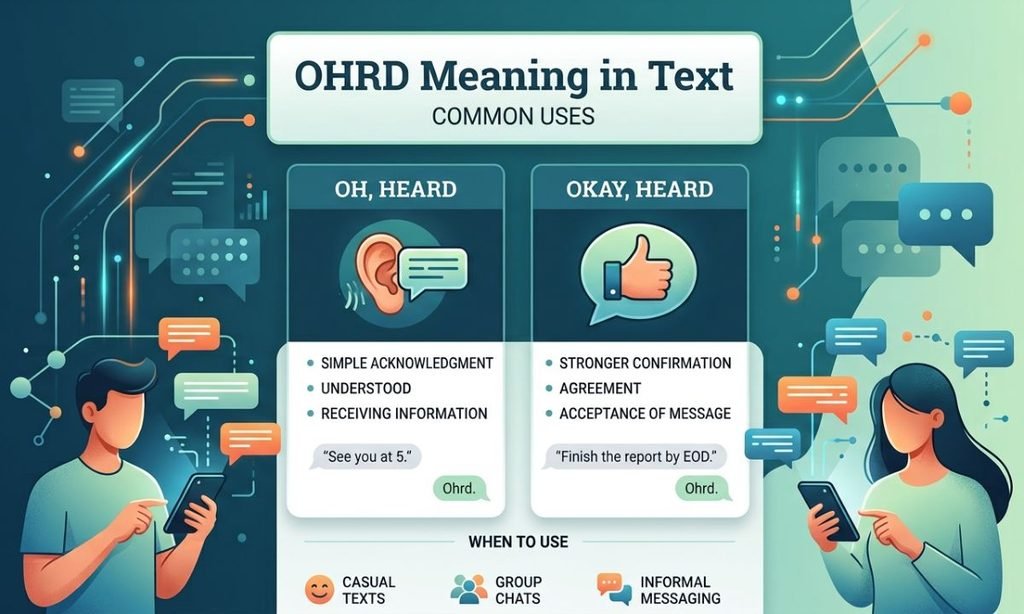
OHRD most commonly means “oh, heard” or “okay, heard.” People send it to show they received a message and understood it. Think of it as a faster, more casual version of “got it” or “understood.”
That’s the best-supported reading, but it isn’t an official one. OHRD isn’t a standardized abbreviation like LOL or BRB. It’s informal slang, and its meaning leans heavily on who’s sending it and what they’re replying to.For a broader look at how informal expressions develop and are used, see Merriam-Webster’s explanation of slang.
Here’s how it plays out in a normal exchange:
You: Meeting moved to 3:30.
Friend: ohrd
Your friend isn’t asking a question. They’re saying, “Cool, I saw that and I’m on it.”
Why OHRD Has More Than One Meaning
Slang doesn’t come from a committee. It spreads through group chats, gaming lobbies, and comment sections, and everyone adds their own spin. That’s why you’ll find several explanations for the same four letters.
“Oh, Heard” or “Okay, Heard”
This is the version you’ll see most. It’s built on “heard,” a casual reply many Americans use to mean “I understand” or “message received.” You’ve probably said or seen it in forms like “heard, thanks” or just “heard.”
Add “oh” or “okay” in front, squish it together while typing fast, and you get something like OHRD. The letters R and D come straight from the sound of “heard,” which is how a lot of texting shorthand works: people type what they hear, not what the dictionary says.
Other Readings You May See
Some sources attach different meanings to OHRD. These are less common, and you should treat them as possibilities rather than rules:
- “Alright” or “all right.” Some people use it as a loose, phonetic stand-in for “alright,” especially when wrapping up a conversation.
- “Oh, really dude?” A few sites claim this one. If a friend sends it with a skeptical emoji, that reading might fit. Without those clues, it’s a stretch.
- “Overheard.” Occasionally used when someone is passing along second-hand information. It’s rare.
If you’re keeping score at home, the first meaning is the most consistently supported. The others tend to show up in small circles or one-off situations.
When OHRD Is Just a Typo
Sometimes a typo is just a typo. On a phone keyboard, “O,” “H,” “R,” and “D” aren’t far apart from letters in words like “ordered,” “hard,” “other,” and “order.” If the message makes no sense even with an acknowledgment reading, the sender may have fumbled a word and moved on.
A quick follow-up like “Did you mean hard?” usually settles it.
OHRD Meaning in Text: A Quick Comparison Table
Here’s a snapshot of the possible meanings, how likely each one is, and the vibe that goes with it.
| Possible Meaning | Likelihood | Typical Tone | Example |
| Oh/Okay, heard | Most common | Casual, easygoing | “ohrd, see you then” |
| Alright | Occasional | Neutral, relaxed | “ohrd, sounds good” |
| Oh, really, dude? | Rare | Skeptical or teasing | “ohrd 🙄” |
| Overheard | Rare | Gossipy, informal | “ohrd she’s moving” |
| Typo | Possible | Unintentional | “ohrd to tell” |
The takeaway: when in doubt, start with “oh, heard” and let the conversation confirm it.
Real Text Message Examples
Seeing OHRD in action makes it much easier to read. Here are a few realistic scenarios.
Confirming Plans
Maya: Running 10 mins late, start without me.
Jordan: ohrd
Jordan is saying, “Got it, no problem.”
Group Chat Updates
Coach: Practice is at 6 tomorrow, not 5.
Tyler: ohrd
Sam: ohrd 👍
Both teammates are confirming they saw the change. Short, quick, done.
Gaming Voice or Text Chat
Teammate: Rotate left, I’ll cover mid.
You: ohrd, moving
In games, speed matters. OHRD works like a quick “copy that.”
Learning Something New
Dana: The store closes at 8 on Sundays.
Chris: oh ohrd, I thought it was 9
This one’s a little different. Chris is showing a small moment of realization, closer to “oh, I see.”
A Skeptical Reply
Ben: I never put things off until the last minute.
Alex: ohrd 😂
Here the emoji flips the meaning. Alex isn’t acknowledging anything. They’re teasing Ben, and the “oh, really dude” reading fits better.
How to Read the Tone Behind OHRD
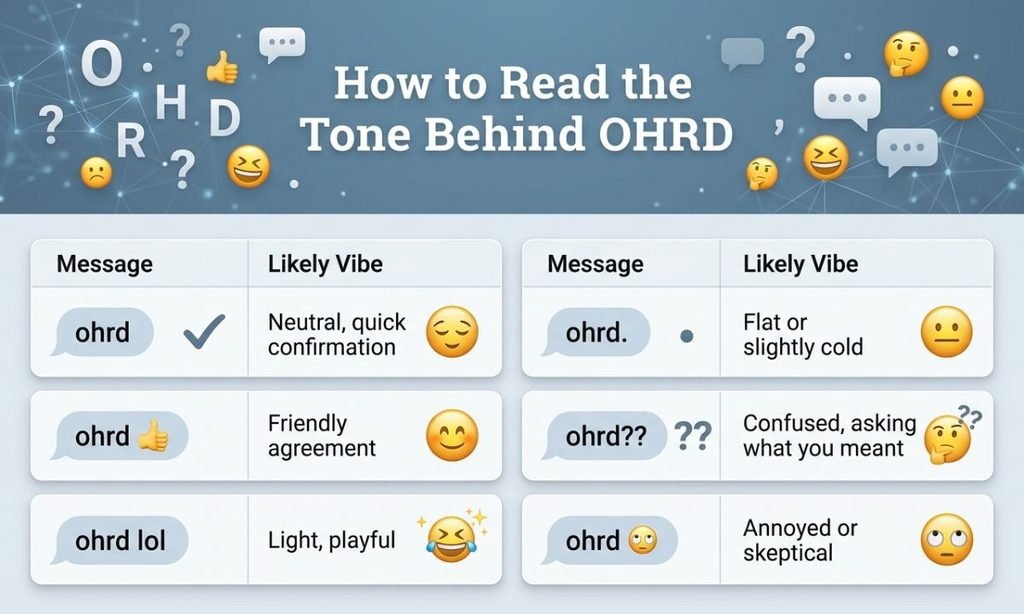
Text strips out voice, facial expressions, and body language. All you’re left with is a few letters, so clues matter.
Look at what came before it. If OHRD answers a statement or instruction, it’s almost always an acknowledgment. If it answers a claim that sounds a little too good to be true, it might be sarcasm.
Check the punctuation and emoji. Compare these:
| Message | Likely Vibe |
| ohrd | Neutral, quick confirmation |
| ohrd 👍 | Friendly agreement |
| ohrd lol | Light, playful |
| ohrd. | Flat or slightly cold |
| ohrd?? | Confused, asking what you meant |
| ohrd 🙄 | Annoyed or skeptical |
Consider the person. A friend who texts in lowercase shorthand all day probably isn’t being cold. A coworker who normally writes full sentences and suddenly sends “ohrd.” might be rushed or mildly irritated.
Notice the platform. Quick shorthand is normal on Snapchat, Instagram DMs, and gaming chats. It’s less expected in an email thread or a work Slack channel.
OHRD vs. Similar Acknowledgment Words
OHRD sits in a crowded neighborhood of short replies. Here’s how it stacks up.
| Reply | What It Signals | Formality | Best Used When |
| OK / K | Agreement or acceptance | Low | Anytime, but “K” can read as curt |
| Got it | Understanding | Low to medium | Work and personal chats |
| Heard | I understand and acknowledge | Low | Friends, teammates, group chats |
| Copy that | Message received | Medium | Teams, gaming, work |
| Noted | I’ve taken this in | Medium to high | Professional settings |
| OHRD | Casual “oh, heard” | Very low | Close friends, quick chats |
One real difference: “OK” mostly says you agree, while OHRD mostly says you understood. You can hear something and still not love it, which is why OHRD can feel more neutral than a cheerful “okay!”
How to Reply When Someone Sends OHRD
Most of the time, you don’t need to reply at all. OHRD is usually the end of an exchange, the digital version of a nod.
Still, here’s how to handle the common cases.
If it’s a simple acknowledgment: Leave it, or send a thumbs-up or a quick “Thanks!” if you want to close the loop.
If you’re not sure what they meant: Ask. Something light works best:
- “Ha, wait, was that an ‘okay’ or a ‘seriously?'”
- “Does that mean you’re good with the plan?”
If it seems sarcastic: Match their energy, or clarify what you meant.
- “I’m being serious! Check the screenshot.”
If it came from someone important: Don’t guess. Confirm directly: “Just making sure we’re on the same page. Does 3:30 still work?”
A quick clarifying question costs you ten seconds. A misread message can cost you a lot more.
Should You Use OHRD Yourself?
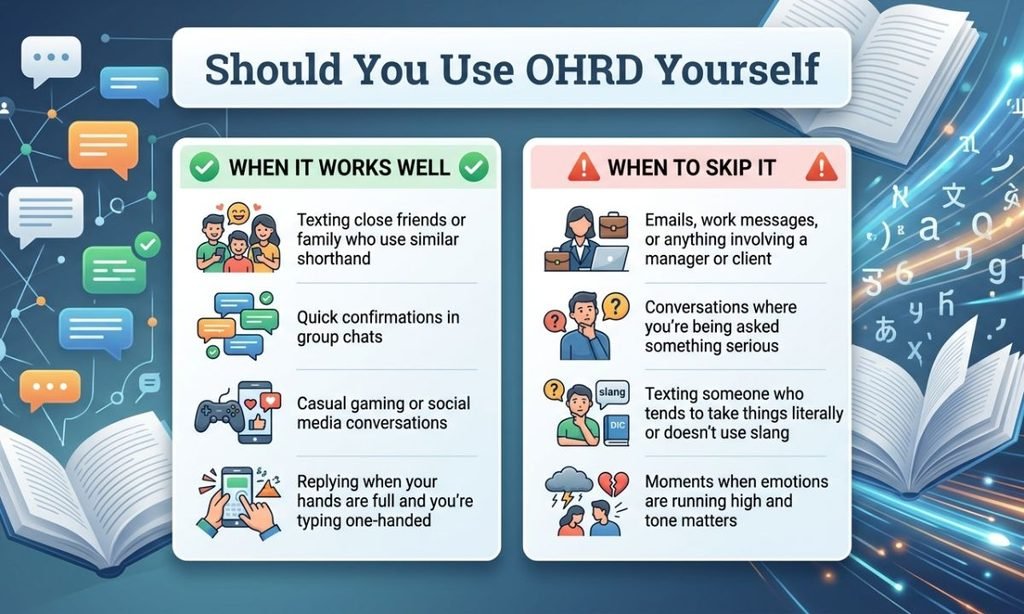
Sometimes, yes. But with some awareness.
When It Works Well
- Texting close friends or family who use similar shorthand
- Quick confirmations in group chats
- Casual gaming or social media conversations
- Replying when your hands are full and you’re typing one-handed
When to Skip It
- Emails, work messages, or anything involving a manager or client
- Conversations where you’re being asked something serious
- Texting someone who tends to take things literally or doesn’t use slang
- Moments when emotions are running high and tone matters
Common Mistakes to Avoid
- Assuming everyone knows it. Because OHRD isn’t standard, some people will have no idea what it means. If you get a “huh?” in return, just spell it out.
- Using it as a reply to an emotional message. If a friend shares bad news and you send “ohrd,” it can feel cold. Say something warmer.
- Reading too much into it. One short reply doesn’t mean someone is upset. Check the pattern before you spiral.
- Treating it like a formal abbreviation. It’s casual shorthand. Keep it out of anything official.
Where You’ll See OHRD
OHRD pops up in the kind of places where fast, loose typing is the norm.
- Text messages and iMessage: Quick confirmations between friends.
- Snapchat and Instagram DMs: Short reactions that keep a conversation moving.
- TikTok comments and replies: Casual responses under videos.
- Gaming chats and Discord: Acknowledging strategy or instructions.
- Group chats: Teams, families, and friend groups confirming plans.
It’s rarely seen in more formal spaces, and you won’t find it in professional writing or customer communication.
When OHRD Isn’t Slang at All
Here’s a wrinkle worth knowing. Four-letter combinations sometimes belong to organizations, departments, or internal codes. If you see OHRD in an email signature, a company directory, a form, or a work document, it may be an internal acronym tied to a specific team or office, with nothing to do with texting.
How can you tell the difference?
- Capital letters and a professional setting usually point to an organizational abbreviation.
- Lowercase letters, an emoji, and a friend’s name on the chat point to slang.
If it shows up in a formal document and you’re unsure, ask the sender or check the context around it. Don’t assume it’s slang just because that’s what you searched for.
Why Slang Like OHRD Keeps Appearing
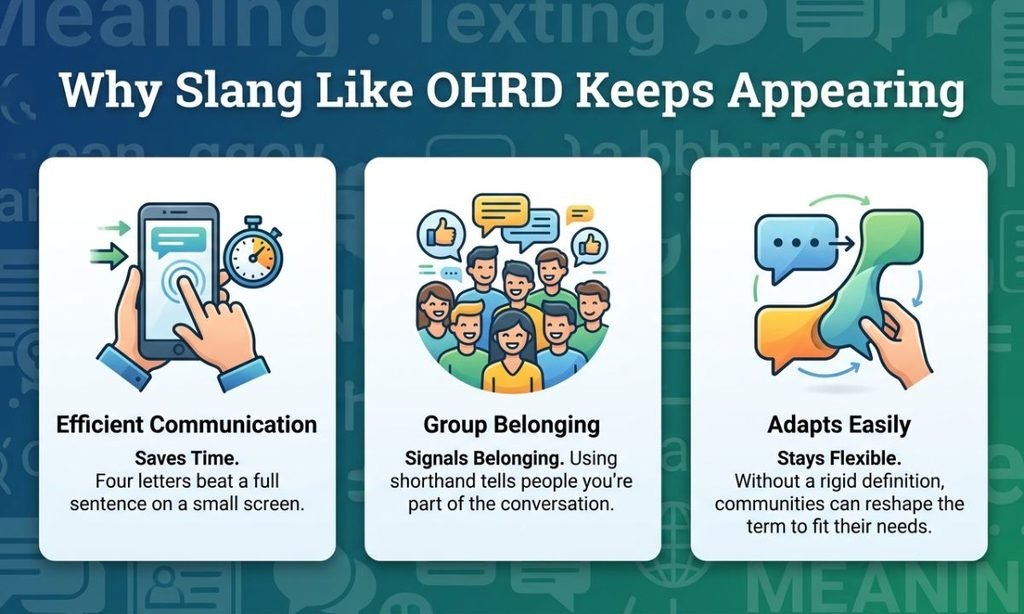
Texting has always rewarded speed. A few decades ago it was “u” for “you” and “gr8” for “great.” Today people drop vowels, mash words together, and spell things the way they sound.
Slang like OHRD thrives for a few reasons:
- It saves time. Four letters beat a full sentence on a small screen.
- It signals belonging. Using shorthand tells people you’re part of the conversation.
- It stays flexible. Without a rigid definition, communities can reshape the term to fit their needs.
The flip side is confusion. A term with no official definition can mean different things to different people, which is exactly why the OHRD meaning in text depends so much on context.
A Simple Way to Decode Any Unfamiliar Slang
OHRD won’t be the last mystery abbreviation you see. Here’s a quick routine that works for most of them:
- Read the message above it. What was the sender responding to?
- Say it out loud. Many abbreviations are phonetic. “Ohrd” sounds a lot like “oh, heard.”
- Check the tone clues. Emoji, punctuation, and capitalization all tell you something.
- Consider the sender. Their usual texting style is the best guide.
- Ask if you’re still unsure. Nobody minds a quick “what does that mean?”
Final Thoughts
So, what is the OHRD meaning in text? In most conversations, it’s a relaxed way of saying “oh, heard,” a small signal that your message landed and was understood. Other interpretations exist, from “alright” to a sarcastic “oh, really, dude?” but they depend heavily on tone, emoji, and the relationship between the people chatting.
Because the term isn’t standardized, the smartest move is to read the context first and guess second. If you’re the one sending it, use it with friends, skip it in professional settings, and don’t be shy about spelling things out when clarity matters.
Next time those four letters land in your inbox, you’ll know exactly what to look for.
FAQs
What does OHRD mean in text?
OHRD most commonly means “oh, heard” or “okay, heard.” It’s a quick way to say you saw a message and understood it. It’s informal slang, not an official abbreviation.
What does OHRD stand for?
There’s no official full form. The most widely used reading is “oh, heard,” with “alright” and “oh, really dude?” showing up less often. Context and tone decide which one fits.
Is OHRD a real word or just a typo?
It’s not in any dictionary, so it isn’t a standard word. Most of the time it’s intentional slang, but it can also be a typo for words like “hard” or “order.” If the message makes no sense as an acknowledgment, ask the sender.
What does OHRD mean on Snapchat or Instagram?
On Snapchat and Instagram DMs, OHRD usually works as a casual acknowledgment, like “got it.” With a skeptical emoji, it can read as teasing or doubt. Check the emoji and the message before it.
What does OHRD mean in gaming chats?
In gaming, it typically means “copy that” or “heard, moving.” Players use it to confirm a call or instruction without typing a full sentence.
Is OHRD the same as OK?
Not exactly. “OK” usually signals agreement, while OHRD mainly signals that you heard and understood. You can send OHRD even if you’re neutral about the plan.
Is OHRD rude or friendly?
It’s usually neutral to friendly, especially with an emoji like 👍. A lone “ohrd.” with a period can feel flat or cold. Judge it by the sender’s normal texting style.
How do I reply when someone texts me OHRD?
Usually you don’t need to reply, since it’s often the end of the conversation. A thumbs-up or “thanks!” works if you want to close the loop. If the tone seems unclear, ask a quick question like “Does that work for you?”
Can I use OHRD in a work email or professional message?
It’s best to avoid it. OHRD is very casual and not widely recognized, so it can confuse or come across as unprofessional. Use “noted,” “understood,” or “got it” instead.
What is a good alternative to OHRD?
Casual options include “heard,” “got it,” “okay,” and “sounds good.” For work, “noted” or “understood” are safer choices.
Can OHRD mean something other than slang?
Yes. In a formal document, email signature, or company directory, OHRD could be an internal acronym for a team or office. Capital letters and a professional setting are the clue.
Why do people say “heard” in texts?
“Heard” is casual American slang for “I understand” or “message received.” Adding “oh” or “okay” and compressing it into OHRD is just a typing shortcut.
