

You got a text with “TM” in it, and now you’re stuck staring at your screen like it’s a riddle. That’s fair. The TM meaning in text isn’t fixed the way most abbreviations are — it bends depending on who typed it, what app they used, and what you two were already talking about.
Most guides treat this like a vocabulary flashcard: here’s TM, here’s the definition, moving on. That’s not how real texting works. You don’t decode slang in a vacuum. You decode it with context, tone, and a little bit of gut instinct — and that’s exactly what most articles on this topic skip.
So let’s actually fix that.
What Does TM Mean in a Text?
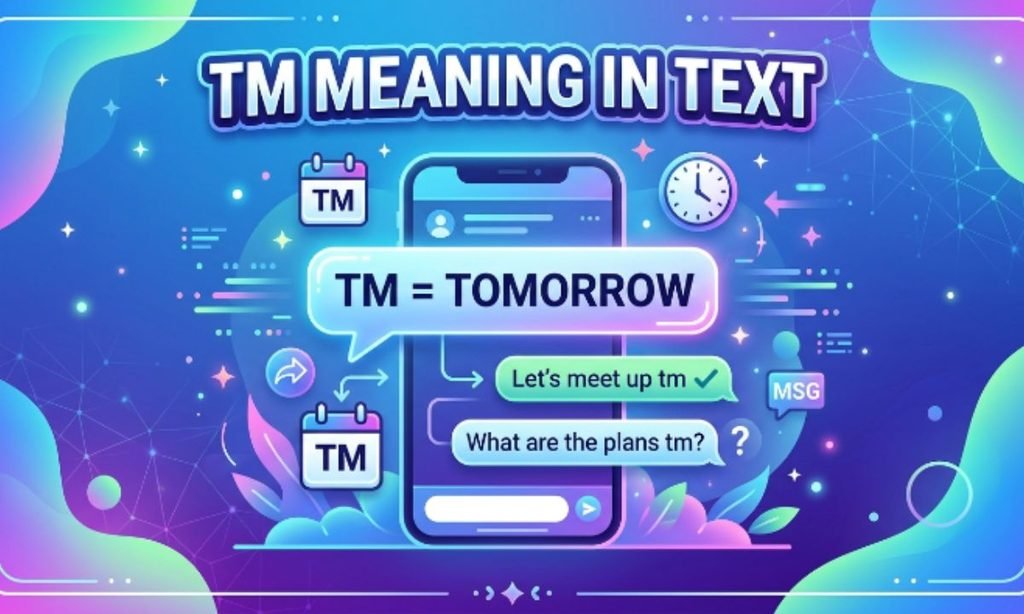
In most everyday texting, TM means “trust me.” It shows up when someone’s backing up a claim, giving advice, or trying to sound convincing without typing the full phrase.
Example: “Don’t order the fish there, TM.” That’s someone saving three words and a little dignity.
But TM meaning in text shifts hard depending on the setting. In a business or product-related message, TM usually means “trademark” — the legal symbol, not slang at all. In some group chats and older texting circles, TM still means plain old “text message,” especially from people who grew up texting before emoji took over.
Here’s the part nobody tells you: all three of these are correct at the same time. There’s no universal winner. Context picks the meaning, not the dictionary.
The Quick-Decode Table
Before we go deeper, here’s the fast version. Bookmark this if you just need an answer right now.
| Context You See It In | Likely Meaning | Confidence |
| End of a casual opinion or tip | Trust Me | High |
| Business text, product name, ad copy | Trademark | High |
| Older relative or coworker over 40 | Text Message | Medium-High |
| Gaming chat or Discord | Trust Me / Team | Medium |
| Dating app conversation | Trust Me | High |
| Regional British/Irish slang thread | Tomorrow Morning | Medium |
| Late-night message, vague tone | Too Much | Low-Medium |
That table alone answers 80% of the confusion. The other 20% is where things get genuinely interesting.
Why TM Confuses People More Than Other Texting Abbreviations
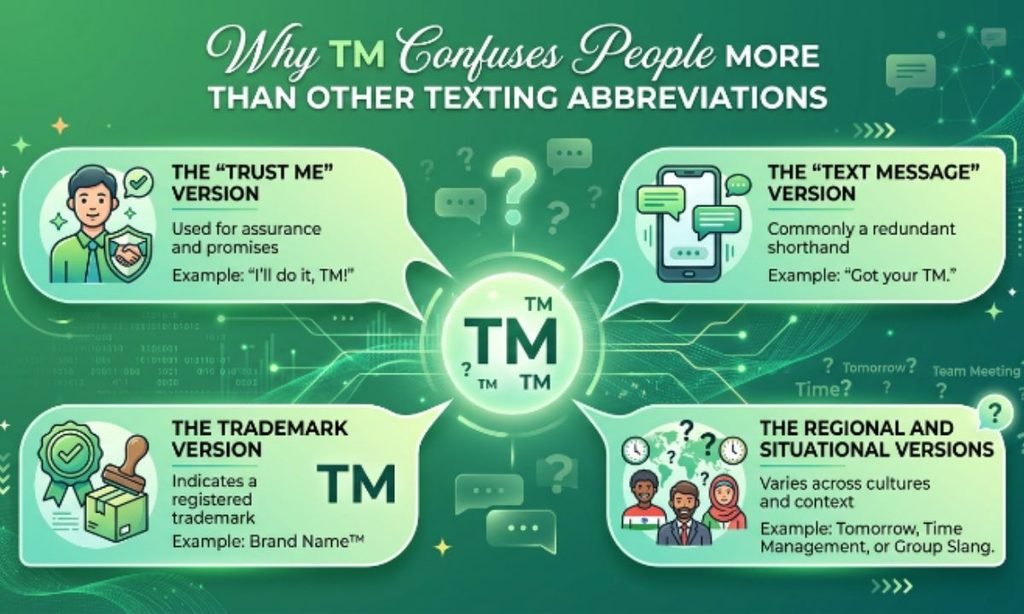
Most slang abbreviations map to one dominant phrase. LOL is laughing out loud, full stop. TM doesn’t work that way, and there’s a real reason for it.
TM is short, made of two of the most common consonant-vowel-adjacent letters in casual English phrases, and it predates modern texting slang by decades — “TM” was stamped on products as a trademark symbol long before phones existed. When texting culture borrowed it for “trust me,” nobody bothered inventing a new abbreviation. They just recycled one that already existed.
That’s the actual content gap here: TM isn’t ambiguous by accident. It’s ambiguous because it’s doing double duty across two completely unrelated eras of communication — legal shorthand and modern slang — and nobody ever forced a split.
The “Trust Me” Version
This is the dominant meaning in casual texting among people under 40. It’s used to add weight to a statement, almost like a verbal wink.
- “This show gets so much better after episode 3, TM.”
- “Don’t text him back first, TM.”
- “TM, that restaurant is not worth the wait.”
Notice the pattern: TM almost always comes at the end of a sentence, not the beginning. That placement is your biggest clue.
The “Text Message” Version
Less common now, but still alive in certain circles — particularly people who started texting on flip phones, customer service scripts, and some older workplace communications.
- “I’ll send you a TM with the details.”
- “Did you get my TM about the schedule change?”
If TM shows up at the start or middle of a sentence acting like a noun, this is probably it.
The Trademark Version
This one isn’t slang at all — it’s the actual trademark symbol written in plain text because most keyboards don’t have the ™ symbol easily accessible.
- “We just launched BrightWave TM as our new product line.”
You’ll see this almost exclusively in business texts, marketing copy, or messages about branding and products.
The Regional and Situational Versions
This is where most competitor articles stop short, and it’s genuinely useful territory.
- Tomorrow Morning — used in some UK, Irish, and Australian texting circles, almost never in the US. “See you TM for the meeting.”
- Too Much — rare, but shows up in venting texts or late-night conversations. “That party was TM, ngl.”
- Team — occasionally used in gaming or sports group chats. “TM meeting at 6.”
None of these dominate US texting, but if you’re getting a text from someone overseas or in a gaming Discord, keep them in your back pocket.
A Simple Decision Framework: How to Actually Figure Out Which TM You’re Looking At
Here’s the tool nobody else gives you — a real way to think through it in five seconds, instead of just listing definitions and hoping you guess right.
- Check the sentence position. End of sentence usually means “trust me.” Start or middle, acting like a noun, usually means “text message.”
- Check who sent it. Gen Z or millennial friend, casual tone → trust me. Coworker, older relative, formal tone → text message.
- Check the topic. Product, brand, business pitch → trademark, no question.
- Check the platform. Snapchat and Instagram DMs skew toward “trust me.” Email-adjacent texting (work Slack, formal SMS) skews toward “text message.”
- Check the country code or accent in the conversation. If someone’s clearly texting from the UK, Ireland, or Australia and TM shows up near a time or event, consider “tomorrow morning” before anything else.
Run through those five checks, and you’ll be right almost every time — no dictionary required.
TM Meaning in Text by Platform
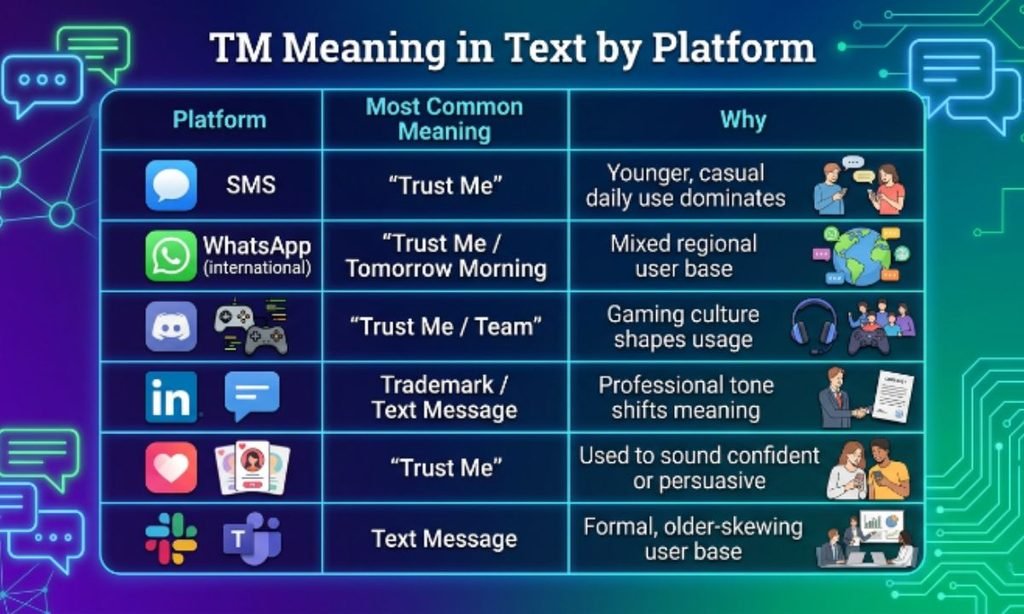
Different platforms actually skew the meaning of TM in ways worth knowing, especially if you use several apps daily.
| Platform | Most Common Meaning | Why |
| iMessage / SMS | Trust Me | Younger, casual daily use dominates |
| WhatsApp (international) | Trust Me / Tomorrow Morning | Mixed regional user base |
| Discord | Trust Me / Team | Gaming culture shapes usage |
| LinkedIn messages | Trademark / Text Message | Professional tone shifts meaning |
| Dating apps | Trust Me | Used to sound confident or persuasive |
| Work Slack/Teams | Text Message | Formal, older-skewing user base |
Common Mistakes People Make With TM
- Assuming it’s always “trust me.” It’s the most common meaning, not the only one — especially in business or older-generation texts.
- Missing the trademark version entirely. People sometimes think a coworker is being weirdly casual when they’re actually just typing a brand name shorthand.
- Ignoring sentence position. This single detail resolves most confusion, and almost nobody checks it consciously.
- Overthinking short, low-context texts. If someone sends just “TM” alone with no other words, it’s usually a typo, a copy-paste error, or shorthand for “text me” — which is close to “trust me” but not identical, and worth asking about directly.
How to Respond When You’re Genuinely Not Sure
Honestly? Just ask. Nobody’s offended by “wait, what do you mean by TM” in 2026. Texting shorthand isn’t a test, and a quick clarifying question saves you from replying to “trust me, don’t go” with “okay I’ll send you the text message details,” which is its own special kind of awkward.
If you want to avoid asking outright, mirror the tone. Reply with something in the same register as their message — if they’re being casual and joking, respond casually. If they’re being formal, keep it formal. That usually smokes out the real meaning within one more exchange.
TM vs. Similar-Looking Abbreviations
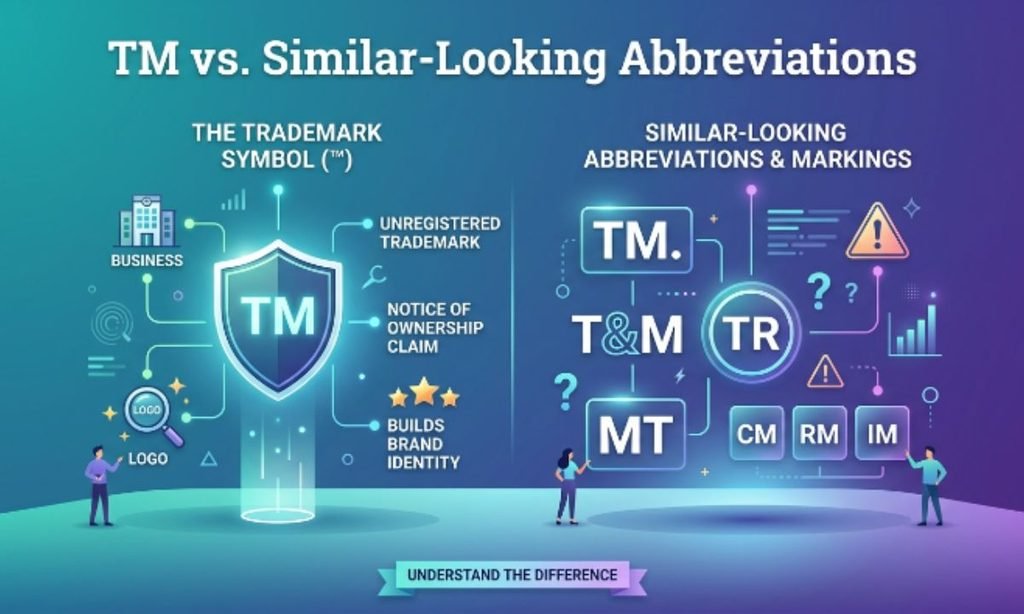
Part of what makes the TM meaning in text so slippery is that it sits right next to a handful of other short abbreviations that look almost identical at a glance. Mixing these up is easy, especially when you’re skimming a fast-moving group chat.
| Abbreviation | Common Meaning | How It Differs From TM |
| TM | Trust me / text message / trademark | Meaning shifts by context, sender, and platform |
| TMI | Too much information | Always negative, always about oversharing |
| TY | Thank you | Fixed meaning, no ambiguity |
| TBH | To be honest | Signals opinion, not confidence-boosting like TM |
| TTYL | Talk to you later | Sign-off, not used mid-conversation |
Once you see TM next to these, its flexibility stands out even more. Most texting shorthand locks onto one meaning and stays there. TM is one of the rare abbreviations that genuinely refuses to settle down — which is exactly why it deserves more than a one-line definition.
Final Thought
TM meaning in text isn’t confusing because it’s complicated — it’s confusing because two entirely different generations and use cases claimed the same two letters. Once you know that, decoding it stops being guesswork and starts being pattern recognition. Check the sentence, check the sender, check the platform, and you’ll never freeze up over “TM” again.
Most people never bother breaking it down this way. They see “TM,” feel a flash of uncertainty, and just guess based on gut instinct. Sometimes that works. Sometimes you end up replying about a text message to someone who was clearly asking you to trust them, and now the conversation’s just a little bit weird. The five-second checklist above exists so you don’t have to leave it to chance.
FAQs
What does TM mean from a girl in a text?
Usually “trust me.” It’s commonly used to add confidence to advice or opinions, especially in casual conversations between friends or in dating app messages.
Does TM ever mean something negative?
Not inherently. In rare cases it can mean “too much,” which carries a slightly negative or exasperated tone, but this usage is uncommon in everyday US texting.
Is TM the same as TMI?
No. TM stands alone as its own abbreviation, while TMI specifically means “too much information” and is used when someone overshares.
Why do older people use TM differently than younger texters?
Older texters often learned TM as shorthand for “text message” back when texting first became common, while younger texters picked it up later as slang for “trust me.” Both meanings coexist without either group realizing the other exists.
Can TM mean “trademark” in a casual text?
Yes, but only when the conversation is about a product, brand, or business name. If someone’s texting about launching or naming something, TM is standing in for the ™ symbol, not slang.
