

You’re chatting with a friend about her third date when she sends three words: “Got the ick.” If you’ve ever stared at a message like that and wondered about the ick meaning in text, you’re in good company. One small habit, like a weird laugh or an odd text reply, can flip someone’s feelings in seconds.
People search for this word because it looks like a typo or a mild insult, and nobody explains it. It turns up in group chats, dating apps, TikTok videos, and comment sections, usually with zero context. That leaves readers guessing whether it means disgust, hate, or something else.
This guide gives you the plain meaning first, then the origin, real chat examples, the psychology, and ten types of ick people talk about. You’ll also learn when to use the word, when to skip it, how it differs from a red flag, and how to reply.
The ick is slang for a sudden drop in attraction caused by something small. In a text, saying someone “gave you the ick” means a minor habit or moment made you feel disgust or discomfort toward them, often out of nowhere. It is usually mild, not hateful, and common in dating chats.
What Does Ick Mean in Text?

The ick is a sudden, overwhelming wave of disgust or repulsion toward someone you’re dating or attracted to. A specific habit, behavior, or moment sets it off, and the attraction collapses almost instantly. That’s the whole definition, and it works as a one-line explanation in any group chat.
The trigger is almost always small, harmless, and objectively no big deal. The other person didn’t do anything wrong or hurtful. Something minor simply kills the vibe, and the reason isn’t always easy to explain. Once it lands, recovering attraction is very difficult, because the feeling tends to stick.
You’ll see three versions of the word, and each carries a slightly different meaning.
| Term | Meaning |
| Ick | A sudden dislike or discomfort toward someone |
| The ick | The moment, or the whole experience, of feeling it |
| Getting the ick | Losing attraction to someone suddenly |
Most of the time the word isn’t about hate. It sits closer to annoyance or disappointment, a small trigger that suddenly feels huge. People scale it with words like “instant,” “huge,” and “major,” which shows how strong the reaction felt in the moment.
A common question is what ick means for girls. The meaning is the same for everyone. When a girl says someone gave her the ick, a small habit, an awkward moment, or some quirky behavior made her romantic interest fade almost instantly. And if you like slang with a story behind it, Side Quest Meaning is a good related read.
Simple Text Examples
Real examples make the meaning click faster than any definition. Here are four short texts, typed the way people actually type them:
- “he texted me wyd with no punctuation. instant ick.”
- “she called her mom mommy in front of everyone. big ick.”
- “idk why but I got the ick from him today”
- “the way he chews gives me the ick every single time”
Notice what’s missing. There’s no setup and no long explanation. One line carries the whole reaction, and the habit is just the excuse.
The informal style is the giveaway: lowercase abbreviations like wyd, idk, and smth Meaning In text, almost no punctuation (not even a dash meaning ), and a short burst that stops once the point lands. Linguists call that colloquial grammar. I’d call it normal. To really grasp ick meaning in text, quoted examples read in context teach more than any dictionary line.
Where Did the Word Ick Come From?
It Started as a Sound of Disgust
The word isn’t new. It began as a simple sound of disgust, in the same family as yuck and eww. Linguists call that kind of word an interjection. The exact etymology is murky enough that I’d distrust anyone who pins it on a single source. It probably works like onomatopoeia, where the sound itself carries the reaction.
Kids have used it for decades around bugs, bad smells, and other gross things. A parent steps in mud and says it. A child pushes away a vegetable they hate and says it. None of that had anything to do with relationships. It was an expression of instant dislike, close to “gross” or “nasty,” and a long way below hate.
From Reality TV to TikTok
Over time the internet gave the word a new job. Instead of reacting to a beetle, people started using it for how they felt about another person. The romantic sense is often credited to the reality show Love Island UK, and Dictionary.com’s slang entry on the ick says the show helped popularize it. Contestants used it for that specific feeling of inexplicable repulsion that ends attraction. Some people trace it back further, to 1990s television, so the exact origin is debated.
What isn’t debated is how fast it spread. Love Island had a massive audience, so the term traveled quickly. From there it jumped to TikTok, where ick content became a huge genre. Creators posted videos listing their personal icks, and many pulled millions of views because they felt relatable and funny. Twitter and Instagram joined in around the early 2020s.
Viewers began tagging friends and sharing their own icks in the comments, which turned the word into a shared joke. User-generated content and meme culture did the rest. By 2023 it had gone mainstream, and through 2026 it has stayed common slang that almost everyone recognizes, even outside dating apps.
Real Ick Examples From Everyday Life
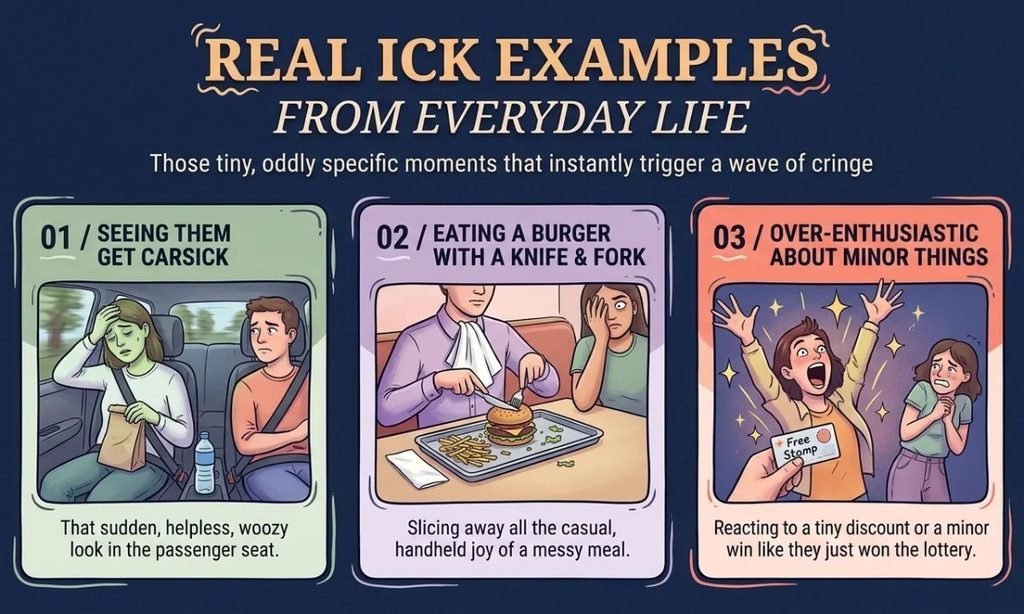
The best part of ick content is how specific the triggers get. These are the classic examples that went viral, starting with the minor ones:
- Watching someone run to catch a bus
- Seeing someone wave at a waiter
- A partner being bad at mini golf
- Someone mispronouncing a common word
- Watching them struggle to parallel park
- Seeing them get carsick
- Watching them eat a burger with a knife and fork
- Someone being overly enthusiastic about something minor
And the more serious ones:
- Baby talk in a serious context
- Being rude to service workers
- Over-explaining things you already understand
- Acting different around other people
- Laughing too hard at their own jokes
That’s a wide spectrum, from insignificant (running for a bus) to concerning (being rude to service workers). Most of these are behavioral triggers, and the humor comes from the gap between a harmless habit and a total loss of interest. The silly ones go viral. The heavier ones usually involve how someone treats other people.
How People Use Ick in Real Chats
Short chat samples show the tone better than any explanation. Nobody stops to define the word, because the readers already understand it.
WhatsApp Chat
Sara: how was the date?
Maya: good until he asked the waiter for extra sauce three times
Sara: lol why does that matter
Maya: total ick. couldn’t focus after that
Nothing dramatic happened. The date went off after one tiny thing, and Maya’s reply makes that clear without spelling anything out.
Instagram DM Conversation
User1: he commented on my story with a fire emoji five times in a row
User2: that’s giving ick, not romance
User1: exactly, that’s why I didn’t reply
“That’s giving” sets two things side by side, ick versus romance, so the sentiment is clear without a single explanation. Too many emojis can be the trigger itself, and User1’s choice to say nothing is how plenty of these moments end.
TikTok Comment Thread
Comment 1: when he says “I’m not like other guys” 💀 instant ick
Comment 2: talks about his ex the whole date, huge ick
Comment 3: anyone else get the ick from overly matching outfits lol
Words like “instant” and “huge” scale the feeling up, and the skull emoji does half the work. These public comments land because strangers keep confirming the same feeling under the same video.
Why Does the Ick Happen?
The ick is a real emotional response, but I’d be careful with big claims. You’ll read online that psychologists have studied it for years, and I haven’t found solid research under that name. What does exist is plenty of psychology about sudden disgust and shifting attraction, and the ick sits close to it. The concept is older than the word, and most explanations are theory, not proven findings.
Here are the ideas I find most believable.
Attraction is holistic. We don’t find one quality attractive. We find a whole person attractive. A single behavior that doesn’t fit the image we’ve built can disrupt the whole picture, even when the person looks perfect on paper.
Expectation meets reality. In early dating, attraction rests partly on projection, which means seeing what you want to see. New relationship energy is fragile, and one unexpected moment can shatter that image. The person shifts from admired to overly familiar in a second.
The ick can reveal incompatibility. Sometimes the trigger is a value difference or a social incompatibility, something that doesn’t line up with what you want in a partner. Your brain flags it even when your rational mind calls it trivial.
It can work as a defense. Some people read the ick as a subconscious defense mechanism that protects you from getting too close too fast. Others point to small stress or anxiety about the relationship showing up as sudden dislike. That’s hard to prove, but it fits how fast and uncontrollable the feeling is.
Some icks are just personal. Certain triggers say more about your own sensibilities than about anything wrong with the other person.
You could also call part of this cognitive dissonance, where two ideas about the same person can’t sit together. Whatever the label, it’s an emotional reaction first, and the analysis only comes afterward.
People often ask whether the ick is a real feeling or just a joke. It’s both. The online version is exaggerated for laughs, but the feeling underneath is real. Almost everyone has felt a sudden drop in attraction at least once, and seeing a video about it makes people think, “that happened to me too.” That shared experience is why the word spread so fast. One short word replaces a long, confusing explanation, which makes it handy emotional shorthand.
The Ick vs Red Flags and Other Similar Terms

People mix these two up, and the mix-up can cost them. The ick is a feeling, a sudden, visceral repulsion that may or may not connect to anything significant. A red flag is a warning sign, a behavior or quality that’s potentially harmful, incompatible, or unhealthy in a relationship. Red flags are usually genuinely important.
The two overlap in one spot. Someone rude to a waiter can give you the ick, and it’s also a red flag about their character. Someone mispronouncing a word can give you the ick, but that says nothing meaningful about them. A quick test: is it only how it feels, or does it show how this person treats other people?
Knowing the difference matters. Acting on every ick would mean never dating anyone, while ignoring every red flag is dangerous.
Here’s how the ick compares with nearby slang.
| Term | Meaning | Example |
| Ick | Sudden loss of attraction | “he chews loud, big ick” |
| Red flag | A warning sign of a serious problem | “he lied twice, that’s a red flag” |
| Green flag | A positive sign in a person | “he’s kind to waiters, green flag” |
| Cringe | Feeling embarrassed for someone | “that joke was so cringe” |
| Turn off | A general dislike, not always sudden | “bad hygiene is a turn off” |
A green flag is the closest thing to an opposite, since it’s a positive trait that raises attraction instead of lowering it. Cringe is secondhand embarrassment, so the two overlap when an awkward moment kills the mood, but they aren’t the same thing. A turn off is a general dislike, while the ick tends to be instant. And an ick is usually smaller and more random than a red flag, which tends to point at a real problem.
Common Misunderstandings About the Ick
People misuse this word all the time. Three mistakes show up most.
“It Means Hate”
It doesn’t. When someone gets the ick, attraction dropped suddenly, but deep dislike or anger isn’t necessarily involved. The feeling is closer to disappointment. The other person didn’t do anything awful, and the ick isn’t a verdict on them.
“It Has to Make Sense”
It rarely does. You can list every good quality someone has and still feel the ick over something tiny. The reaction is emotional, not a rational decision, and people who expect feelings to follow a checklist are usually confused by it.
“It Always Ends the Relationship”
Not every ick ends a relationship. Sometimes the feeling passes quickly. Other times it builds across several small moments before someone decides to walk away, which is why a breakup line like “I’m done” often shows up after months, not after one incident.
Can You Get Over the Ick?
It’s possible, but difficult. Once the ick sets in, it tends to compound. Now that you’ve noticed the thing, you see it more, so the feeling grows instead of fading.
Outcomes vary a lot. Some people find the feeling fades if the relationship has real depth, a genuine connection, and time. Others find it never goes away. So, if the trigger is truly trivial and the relationship is otherwise strong, it’s worth giving it time and perspective. If the ick is covering a deeper issue, treat it as useful information instead of an obstacle to push through.
A practical way to start is to name the trigger out loud, decide whether it’s trivial or something real, and give it a few weeks. That’s coping, not a cure, but it helps you decide with a clearer head.
Where the Word Ick Fits: Social Media, Friends, and Work
Context changes how the word lands, and the same sentence can mean something a little different in a group chat than in a meeting.
Social Media
On TikTok and Instagram, creators list random icks for fun, from loud eating to bad grammar. It’s light and playful, and entertaining followers is the whole point.
Friends and Relationships
Among friends, the word usually describes a dating experience. One friend texts another about a date that suddenly felt off, and the story gets shared privately in group chats. Yes, you can get the ick from a friend too. It’s less common than in romance, but a friend’s habit can set it off.
Work and Professional Settings
At work it’s almost never used, because it’s too casual for emails or formal chats. With close coworkers, in a joking tone, it might slip out. Anything serious calls for a more professional word, and this is one case where the ick meaning in text and the ick meaning at the office don’t match.
Playful, Genuine, or Sarcastic
Tone changes the meaning, so read the tone before you read the word.
| Tone | Example | Meaning |
| Playful | “the way he opens soda cans gives me the ick lol” | A light joke, not serious |
| Genuine | “I actually can’t date him anymore, I got the ick” | Real loss of attraction |
| Sarcastic | “oh the ick? so dramatic” | Teasing someone for overreacting |
When Not to Use the Word Ick
It’s fun, but it isn’t always the right word. Skip it in serious conversations about someone’s feelings or mental health. Keep it out of formal writing, resumes, and professional emails. Don’t use it about physical disabilities or other things a person can’t control. And don’t use it to bully or mock someone in public comments.
Careless use can hurt feelings even when it’s meant as a joke. Save it for light chats between friends. My rule of thumb is short: if the target can’t change the thing, don’t call it an ick.
Ten Types of the Ick

People have sorted the ick into loose categories based on where or how it happens. It’s not a formal classification, and new ones keep appearing online.
- Instant ick. It lands within seconds of meeting someone. One look or one sentence, and the feeling is already there.
- Silent ick. It builds quietly over time. The person says nothing but slowly pulls away without explaining why.
- Public ick. It happens in front of other people, at a party or group hangout, and feels more intense because others notice too.
- Social media ick. It comes from something seen online, like a strange caption, an odd photo pose, or a cringy comment on someone’s post.
- Dating app ick. A bio, opening message, or profile photo that feels off before you’ve even met in person.
- Conversation ick. It shows up during a text or call, from odd word choices, too many emojis, or a strange tone, even a cold one-word reply like hmm meaning In text.
- Humor ick. A joke falls flat or feels forced, especially when it’s repeated too many times.
- Confidence ick. Someone seems overly confident or brags too much, which feels unattractive instead of impressive.
- Hygiene ick. This is one of the most common types, tied to bad breath, dirty nails, or unwashed clothes.
- Oversharing ick. Someone shares too much personal information too soon, and the interaction turns uncomfortable.
How to Reply When Someone Says They Got the Ick
Knowing how to reply keeps the chat smooth. Match your answer to the mood of the conversation.
Casual replies work for quick agreement: “lol I get that,” “same honestly,” or “okay that’s fair.”
Funny replies land with close friends: “bro really lost the game in one text 💀,” “that’s a certified ick moment,” or “RIP that situationship.”
Mature or confident replies are calm and non-judgmental: “Everyone has small things that turn them off, that’s normal,” “It happens, no judgment here,” or “I get it, attraction can be unpredictable.”
Private or respectful replies matter when someone confides in you: “I won’t share that publicly, but I get why you feel that way,” “That’s between us, no need to post,” or “I understand, let’s just move on from the topic.”
How the Word Ick Travels Across Cultures
The word gets used a little differently depending on region and communication style.
In the United States and United Kingdom, it’s extremely common, especially among younger users on TikTok and Twitter. People use it openly and turn it into jokes and memes.
In many Asian countries, the word is gaining ground through social media, often mixed with local slang. Younger users who spend time on global platforms understand it well.
In the Middle East, it’s used mostly by younger, internet-savvy users. It stays casual and is rarely used in front of older family members, because it’s so informal.
Across the world, it has become part of a shared internet language. Even where English isn’t the first language, many young users know it thanks to TikTok and Instagram. It spread mainly through Gen Z creators, though people of all ages use it now.
What to Remember About Ick Meaning in Text
Ick took one human moment, the sudden shift from attraction to discomfort, and gave it one short word. That’s a confusing feeling turned into something quick and easy, and almost everyone recognizes it.
The core facts are simple. The ick is a sudden, intense feeling of repulsion toward someone you’re attracted to, set off by a specific behavior or moment. Love Island UK is often credited with popularizing it, and TikTok is where it went viral. In recent years it has become one of the most widely recognized pieces of dating slang.
Whether your trigger is running for a bus or something more meaningful, the word captures a very real dating experience. It describes the fragile quality of early attraction, and how one unexpected moment can change everything. Use it with friends, skip it at work, and reply with kindness when someone shares theirs.
FAQs
What does ick mean in text?
Ick is slang for a sudden drop in attraction caused by something small. It points to a quick feeling of disgust or discomfort toward someone you were interested in.
People usually type it in one short line, like “instant ick.”
What does “gave me the ick” mean?
It means someone did something minor that suddenly turned you off. A habit, a text reply, or an awkward moment is often enough.
The feeling hits fast and is hard to explain.
Where did the word ick come from?
It began as a sound of disgust, like yuck or eww, used by kids for decades. The romantic meaning is often credited to Love Island UK, though some trace it to 1990s TV.
TikTok then made it mainstream.
Is the ick a real feeling or just a joke?
It’s both. People exaggerate it online for laughs, but the feeling is real.
Most explanations come from theory, not proven research.
What is the difference between the ick and a red flag?
The ick is a gut feeling, often set off by something harmless. A red flag is a warning sign of real harm or incompatibility.
Being rude to a waiter can be both, while mispronouncing a word is only an ick.
What are some common examples of the ick?
Popular triggers include watching someone run for a bus, seeing them wave at a waiter, or hearing baby talk in a serious moment.
Others are being rude to service workers or laughing too hard at their own jokes.
Can guys and girls both get the ick?
Yes. The meaning is the same for everyone.
It simply describes attraction fading over a small habit or moment, no matter who feels it.
How do you get over the ick?
It’s possible but difficult, since noticing the trigger tends to make it grow. If the relationship is otherwise strong, give it time and perspective.
If it points to a deeper mismatch, treat it as useful information.
Does getting the ick mean the relationship is over?
Not always. Some icks pass quickly, while others build over several small moments.
It depends on whether the feeling fades or keeps growing.
How do you reply when someone says they got the ick?
Match their mood. Try “lol I get that” for casual chats or “it happens, no judgment here” for a more supportive tone.
If they shared something private, keep it between you.
Does ick mean cringe?
Not quite. Cringe is secondhand embarrassment, while the ick is losing attraction to someone.
The two overlap when an awkward moment kills the mood.
Is it okay to use ick at work?
It’s usually too casual for emails or formal chats. With close coworkers in a joking tone, it might pass.
For anything serious, pick a more professional word.
