

A buddy texts you a gym selfie with nothing but “PWHP coming soon,” and you stare at the screen for a second. If you’ve ever searched for the PWHP meaning in text, you know that feeling. Four letters, no explanation, and no obvious clue.
People look this one up because it doesn’t behave like LOL or BTW. It shows up in DMs, comment sections, and captions on Instagram and TikTok, and plenty of readers have never seen it before. A look-alike abbreviation, PWYP, makes the confusion worse.
This guide covers what PWHP stands for, where it likely came from, and how people actually use it. You’ll also get reply ideas, the most common mix-ups, and the situations where spelling things out is the smarter move.
PWHP most often stands for Post Workout Happy Picture, a photo someone shares right after finishing exercise. It’s informal fitness slang, not a standardized abbreviation, so its meaning depends on context. The photo usually shows mood or progress, and the message behind it is pride in finishing a tough workout.
What Is the PWHP Meaning in Text?
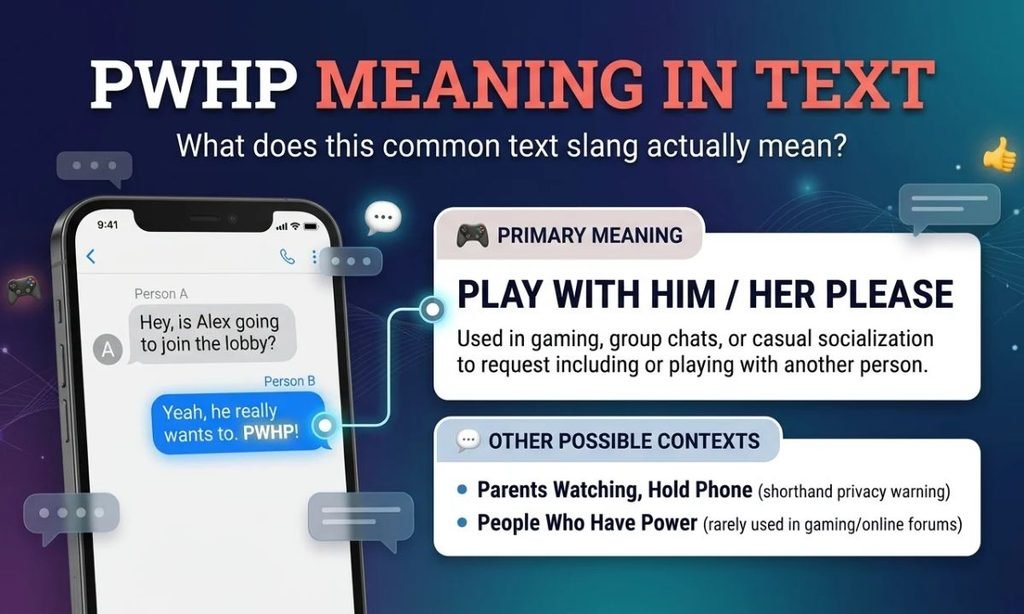
PWHP stands for Post Workout Happy Picture. It’s a photo someone shares right after finishing a workout. The picture might show a mood, a body, or a bit of fitness progress, but the real point is the proud moment behind it. It’s less about looks and more about pride, happiness, and a small win after exercise.
You’ll usually see it attached to gym selfies and other fitness photos. Typical messages look like “Finished leg day, PWHP coming soon,” “PWHP because I didn’t quit today,” or “Sunday motivation PWHP.” In each one, the sender pairs the photo with a little motivation, usually just after finishing.
Is PWHP Standard Slang?
No. It isn’t standardized and it isn’t universally recognized. It’s a niche slang term with limited use, closer to a private shorthand than to LOL (Laughing Out Loud), BTW (By The Way), IDK (I Don’t Know), or BRB. One texting community may know it well while another has never seen it.
That’s why the meaning depends on context. If a text from a friend arrives with only those four letters, guessing from the letters gets you nowhere. The surrounding conversation does the work.
In a fitness chat, the workout reading is the primary meaning. Secondary and rare meanings can pop up when readers assign a meaning that seems to fit the moment, and that’s risky. If the conversation has nothing to do with exercise, don’t assume you know what the sender intended. The safest move is to ask.
Is PWHP Positive or Negative?
Positive. It signals happiness and pride about a workout, and I’ve never seen it used as an insult. It’s also informal. Keep it for friends and fitness communities, not formal writing.
It’s tied mostly to gym and fitness settings, so it sounds odd anywhere else. Beginners use it often, and it’s popular among fitness-focused people.
Where Did PWHP Come From?
I’ll be straight with you: the origin is murky. The version most guides repeat says the term started appearing in the early 2020s, when fitness culture grew rapidly online. Social platforms like Instagram and TikTok filled up with transformation pictures and workout progress photos. I couldn’t trace it to a dictionary entry or a first post, so treat that dating as claimed, not proven.
The logic is believable, though. Users wanted short captions, and “happy picture after workout” is a mouthful, so it got shortened. That’s slang evolution in miniature. A caption becomes a habit, and the habit becomes modern fitness slang.
The people who picked it up were gym beginners, fitness influencers, and everyday people trying to stay motivated. It’s still used in private chats and public posts. It’s popular in pockets rather than everywhere, which is typical of texting slang. Online usage like this tends to spread through small groups first.
PWHP Text Examples From Real Conversations
Real usage is easier to see than to describe. The chats below are real-style examples I wrote to show the pattern, not screenshots. They reflect the kind of conversations you’d expect around this term.
WhatsApp: Person A writes, “Finally completed my first full workout.” Person B answers, “Really? Show PWHP.” Person A replies, “Sending now.”
Instagram DM: Person A says, “You look different these days.” Person B says, “Yes, gym life.” Person A pushes with “Send PWHP,” and Person B closes it with “Just posted one.”
Plain text message: Person A admits, “I didn’t want to go today.” Person B asks, “But you did?” Person A says, “Yes.” Person B answers, “Respect. PWHP please.”
TikTok comments: One user comment reads, “Where is PWHP?” The creator reply is “Posting tonight.”
Why These Chats Work
“Show PWHP” works as a request phrase, and the reply is usually a photo or a promise of one. The dialogue stays short, friendly, and tied to the messaging context. Nobody explains the acronym because everyone in the chat already knows it. That’s what natural, real-life chat slang looks like.
What PWHP Says About the Sender
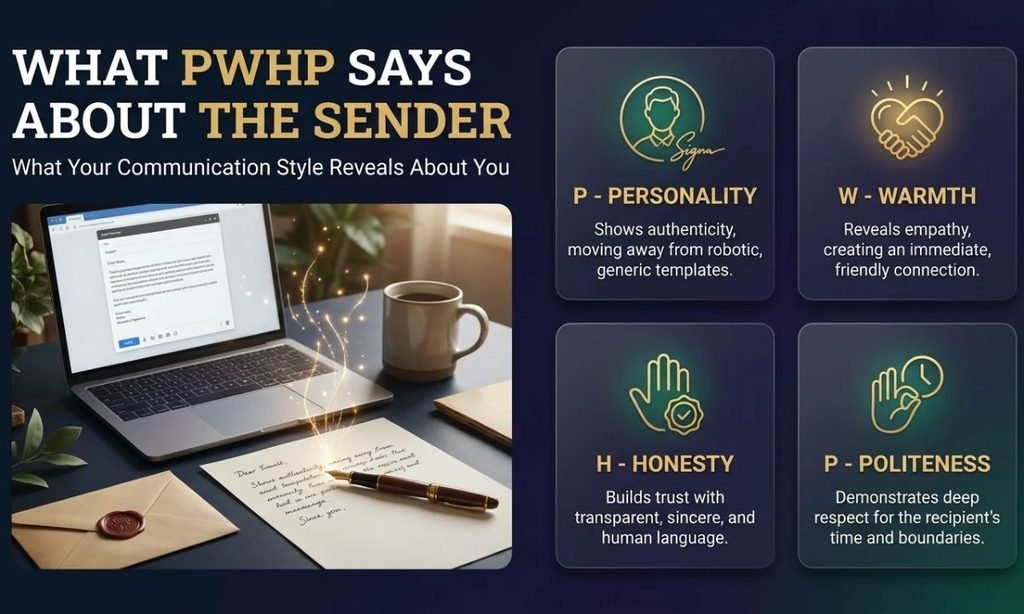
The meaning goes past the photo. When someone sends one, the unspoken line is “I did something difficult.” That’s a personal victory, and the picture is its proof.
I’ve watched this play out with friends. Seeing your own progress builds confidence, and seeing someone else’s creates motivation. Positive energy spreads, because other people see the effort and feel inspired to go next.
There’s a bigger idea underneath. People like documenting a journey, so the photo becomes a kind of personal storytelling. It reflects a modern identity built around self-improvement and becoming better, one workout at a time. As self-expression, the symbolism is simple: proud, tired, still standing.
Read the sentiment and it’s a clearly positive connotation. The emotional and psychological meaning both point the same direction. There’s more going on than the letters suggest.
Why People Shorten Phrases Like This
The plain reason is that it’s quick to type and easy to reuse. That’s the whole motive, and it doubles as a small piece of social signaling. PWHP signals pride and routine. An abbreviation like PWYP in a promotional post signals a casual, flexible approach to payment.
The emotional layer in the abbreviation itself is thin. It carries no fixed tone. “PWYP!” in a promotional post can feel friendly and inviting, and in a business message it reads as neutral. An unexplained one in a serious conversation just feels confusing.
Here’s a rule I use: the words around an abbreviation reveal more emotion than the abbreviation does. The sentiment comes from the wording, not the shortening.
How PWHP Changes Depending on Context
Same four letters, different job. Here’s how it shifts from place to place.
Texting and Messaging
In everyday messaging, the fitness reading wins when workouts come up. “Finished my run, PWHP incoming” is about a photo. If money comes up instead, the letters might be a different look-alike entirely, which I’ll cover below.
Social Media Platforms
Social media is the most common home for it. There, the purpose is to show progress and inspire followers, and the caption often adds a line like “PWHP because consistency matters.”
The platform hints at meaning, but it doesn’t settle it. On Instagram, a seller might use PWYP in a caption for artwork or digital products. On TikTok, it could sit in a video about a flexible-price product or a fundraiser. Snapchat users often drop abbreviations into a story or quick note, and Threads can carry both conversational and informational posts.
Friends and Relationships
Among friends, the tone is friendly and fun. A friend writes “PWHP now,” and you answer “Wait, I look tired.” Nobody minds.
Neither PWHP nor PWYP is a standard romantic abbreviation. If you spot one in a dating conversation, don’t read a flirtatious meaning into it. “The date night event is PWYP” is about the event’s pricing, not the relationship. With no workouts or money in view, ask for clarification rather than inventing something sweet.
Fitness Communities
Fitness communities take it more seriously. Dedication and consistency are the currency here. A post might say “PWHP coming” before the workout is even done, or “Day 30 complete” after a streak.
Work and Professional Settings
Work is another story. In professional settings, PWHP is rarely used and not appropriate in formal conversations. I’d avoid sending it to a boss, no matter how proud you feel.
Professional communication gets trickier with look-alike acronyms. A charity might use PWYP informally for flexible contributions, while an industry discussion, even a LinkedIn-style one, uses Publish What You Pay. In workplace emails, contracts, reports, and client messages, I spell out the phrase the first time. Acronyms should save time, not create ambiguity.
Casual vs. Serious Tone
Context decides the register. The same letters can read casual or serious, and the tone shifts with the situation. It’s informal throughout, and whether it fits comes down to who is reading and what example you’re setting.
PWHP vs. PWYP: Why People Mix Them Up
One letter separates PWHP from PWYP, and the two get confused constantly. Plenty of people searching for what PWYP means are really chasing a typo of the other term, or the reverse. Since it’s an ambiguity trap, a little disambiguation helps. Check whether the conversation involves workouts or money.
Pay What You Please (or Want)
PWYP has a casual pricing reading. It can mean “Pay What You Please” or “Pay What You Want,” a flexible payment setup where you choose how much to pay instead of facing one fixed price. In a money-related conversation, that’s the natural interpretation. “Pay What You Want” is a bit more direct, and the two phrases are closely related.
Publish What You Pay
PWYP also has an established professional use: “Publish What You Pay.” It’s tied to transparency around payments and revenues in extractive industries such as mining, oil, and gas, including government revenue and corporate transparency. You can see how the global coalition describes its work on the Publish What You Pay website. That’s very different from a ticket price. A talk about mining changes the meaning completely, so the surrounding words matter more than the letters.
PWHP and PWYP Examples Side by Side
These are explained examples I wrote to show the pattern. Each has a meaning, a tone, and a plain-language read.
| Message | Meaning | Tone | Interpretation |
| “Leg day done. PWHP coming tonight.” | Post Workout Happy Picture | Relaxed, proud | The sender is promising a photo |
| “The gallery is PWYP tonight.” | Pay What You Please | Friendly | Admission has flexible pricing |
| “PWYP for the digital download.” | Pay What You Want | Casual | The buyer chooses the price |
| “How much should I charge?” “PWYP.” | Pay What You Please | Relaxed | The customer decides the amount |
| “The fundraiser is PWYP.” | Flexible payment or donation | Welcoming | People contribute as they prefer |
| “PWYP tickets are available at the door.” | Pay What You Please | Informational | There’s no mandatory ticket price |
| “Our pricing model is PWYP.” | Pay What You Want/Please | Business-casual | Customers get pricing flexibility |
| “The report mentioned PWYP initiatives.” | Likely Publish What You Pay | Professional | The subject is transparency |
| “Want to buy my old prints? PWYP.” | Pay What You Please | Friendly | The seller lets the buyer choose |
| “PWYP? What does that mean?” | Reader doesn’t recognize it | Neutral | Clarification is needed |
| “She just wrote PWYP with no explanation.” | Ambiguous acronym | Confused | The recipient needs more context |
Acronym recognition varies from reader to reader, even when the spelling is identical.
Common PWHP Mistakes and Mix-Ups
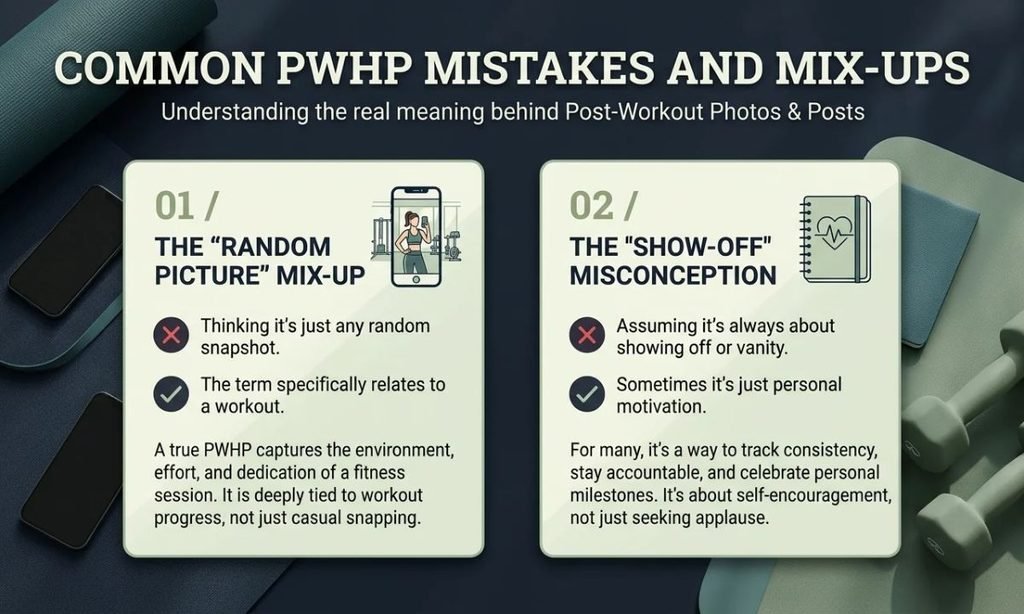
Most errors come from one habit: assuming the meaning without checking the subject. Here are the usual ones.
Thinking it means a random picture. Wrong. The term specifically relates to a workout.
Assuming it’s always showing off. Not always. Sometimes it’s just personal motivation.
Using it outside a fitness context. “PWHP after eating pizza” is an incorrect example. It sounds unnatural because the happy picture belongs to exercise, not food. Treat it as a fitness-related abbreviation, not general slang.
Confusing it with look-alikes. Other abbreviations look similar, and PWYP is the best example. If you’re unsure, ask for clarification, because guessing leads to semantic confusion.
Where Misunderstandings Happen
Context confusion is the big one. When there’s more than one possible expansion, someone discussing an affordable event may mean Pay What You Please, while a professional article means Publish What You Pay. Read the entire message before deciding.
The generational gap plays a part too. Younger users often work out unfamiliar abbreviations from context, while other readers prefer complete phrases. Neither approach is unusual, but a quick clarification prevents an unnecessary misunderstanding.
Platform differences count as well. A commercial Instagram post and a LinkedIn-style discussion can use the same four letters for different things. Platform expectations offer clues, but that isn’t proof of meaning.
PWHP Compared With Similar Terms
Fitness Photo Terms
A gym selfie is simply a photo taken in the gym. It has a similar meaning, but PWHP adds the happiness after the workout. A progress pic or transformation photo tracks a longer journey and often shows physical appearance. A before pic marks the fitness start, so it’s the opposite of an after pic, which is the related result.
A flex pic means showing muscles, which is slightly different in intent. A no filter pic is a natural photo, with a different purpose again.
| Term | Meaning | Usage |
| PWHP | Post Workout Happy Picture | Fitness photo |
| Gym selfie | Photo taken in the gym | Similar meaning |
| Progress pic | Transformation photo | Longer journey |
| Before pic | Before fitness start | Opposite of after |
| After pic | After transformation | Related |
| Flex pic | Showing muscles | Slightly different |
| No filter pic | Natural photo | Different purpose |
Here’s the key insight. The focus of PWHP is the feeling, not the physique. Among fitness photo terms, it’s the mood-first one. If you’re hunting for synonyms and antonyms, the synonyms are loose at best.
Similar Abbreviations
This table puts PWHP next to other short forms. The point isn’t to hand you synonyms. It’s differentiation, so you can tell them apart faster.
| Term | Meaning | How it differs from PWYP |
| PWHP | Post Workout Happy Picture | A fitness photo, unrelated to pricing |
| PWYW | Pay What You Want | More directly tied to flexible pricing |
| PWP | Pay With Purchase | Usually relates to purchasing conditions |
| LOL | Laughing Out Loud | Expresses amusement, not pricing |
| BTW | By The Way | Introduces additional information |
| IDK | I Don’t Know | Expresses uncertainty |
| FYI | For Your Information | Signals informational content |
| OBO | Or Best Offer | Indicates a negotiable selling price |
| DM | Direct Message | Refers to a private social message |
Setting term and meaning side by side shows these aren’t interchangeable. If you like decoding short forms, you can also read the BYI meaning in text guide.
Types of PWHP Posts
Most variations are compound terms: PWHP plus a descriptor. The label tells the reader what to expect.
| Type | What it shows |
| Morning PWHP | Photo after a morning workout, signals discipline |
| First Day PWHP | First gym experience, the beginning of something |
| Leg Day PWHP | After leg workout misery, exhaustion mixed with pride |
| Transformation PWHP | A major change and long-term progress |
| Sweaty PWHP | Effort and authenticity, which people value |
| Mirror PWHP | Taken in a mirror, very common |
| Gym Partner PWHP | A photo with a friend, a shared journey |
| Home Workout PWHP | Taken at home, popular since the lockdown era |
| Funny PWHP | Includes humor, shows personality |
| Late Night PWHP | Less common but meaningful, says dedication |
How to Reply When Someone Sends PWHP
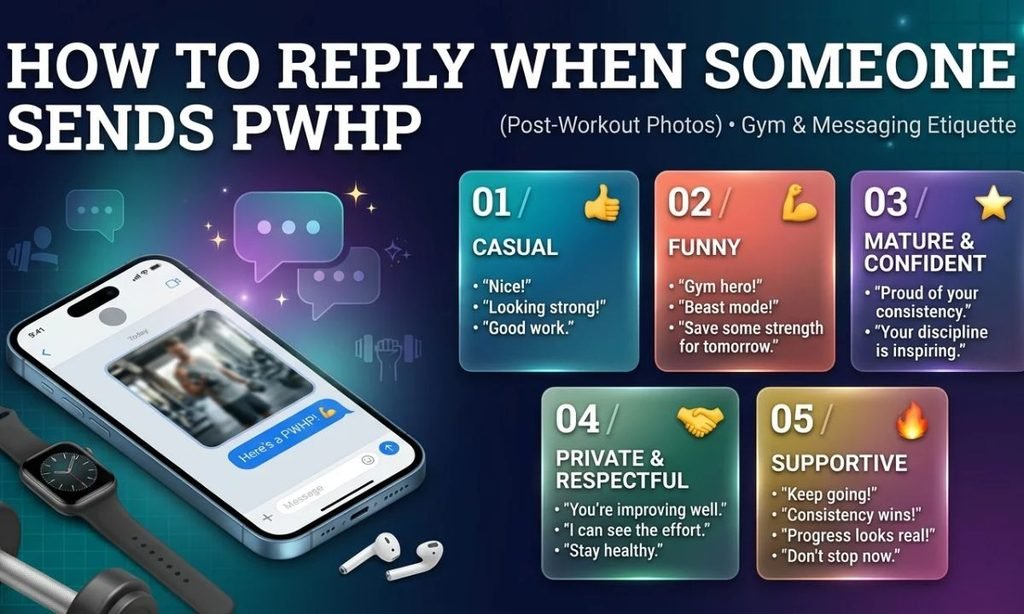
Replies work best when they match the sender. Here are some I’d actually send, grouped by style.
- Casual: “Nice,” “Looking strong,” “Good work.”
- Funny: “Gym hero,” “Beast mode,” “Save some strength for tomorrow.”
- Mature and confident: “Proud of your consistency,” “Your discipline is inspiring.”
- Private and respectful: “You’re improving well,” “I can see the effort,” “Stay healthy.”
- Supportive: “Keep going,” “Consistency wins,” “Progress looks real,” “Don’t stop now.”
All of these work as natural, conversational replies. Good encouragement is specific, and politeness matters most when the sender is a beginner. Mirror their tone and respond to the effort rather than the body.
If the message shows up with no context at all, a simple “What do you mean by PWHP?” is perfectly fine. Same goes for PWYP. If someone says an event is PWYP, you could ask what payment amount is customary.
Is PWHP Used the Same Way Around the World?
The meaning stays mostly the same globally, but attitude differs. I don’t have hard data on this, only what I’ve seen in different groups, so take it as a pattern, not a rule.
In Western culture, it’s very common. Fitness culture is strong, and people proudly share these photos publicly. In Asian culture, growing popularity shows up among the younger generation, with more private sharing. In Middle Eastern culture, it’s used carefully, mostly in private groups, with less public posting.
The term travels well because language matters little when the point is a photo. Fitness motivation is universal. Abbreviation habits also shift with age, community, profession, and region, and something familiar in one online group can be unfamiliar in the next. There’s a gap between texting shorthand and established organizational acronyms, too. A sociolinguistics view would call PWHP internet slang with a stable core and flexible attitude. The global meaning holds, and cultural differences shape the public side of it.
Why PWHP Caught On
A few reasons, all based on real behavior.
People want accountability. Posting makes it easier to stay consistent. Social validation helps too, since positive comments increase motivation and online communities support growth. That’s the engine of digital fitness culture.
People also love documenting things. Tracking progress turns the photo into a personal record, and it does that faster than any journal. The causes are simple: user motivation, easy sharing, and low effort. It never needed to go viral. Small drivers inside real behavior carried it.
When You Should Not Use PWHP
Think of this as etiquette more than a rule. Avoid it in formal workplace chats, professional emails, and serious conversations. A job interview chat is clearly not the place. It’s also a poor fit with strangers, since they have no context to decode it.
Formal settings create a register mismatch, and the term looks unsuitable there. Plain words work better. Your comfort level counts too, and whether you post publicly or keep it private is your call. If in doubt, skip it.
The same thinking applies to look-alikes, with a few extra risks:
- Professional risks: In formal documents, an unexplained PWYP leaves a client guessing whether you mean Pay What You Please or Publish What You Pay. Write the full phrase when accuracy matters.
- Cultural risks: An abbreviation can be unfamiliar outside your social circle. Assuming everyone gets it makes a simple message harder to follow.
- Tone risks: Shortcuts can look overly casual in a formal proposal, legal document, invoice, or customer-service reply. When money is involved, clear language wins.
A Real Experience Example
The story I hear most often goes like this, and I’m treating it as an anecdote, not a verified testimonial. A university student who hated the gym at first posts a PWHP the first time. Friends encourage them, and it changes everything.
I won’t dress it up as a direct quote, because I can’t vouch for one. As a user story, though, it rings true. The emotional power sits in simple words and one shared photo.
What mattered wasn’t the picture. It was that it got shared, and the habit started with one post. Many people recognize that experience, even when the details change.
Expert Tips for Reading and Using PWHP
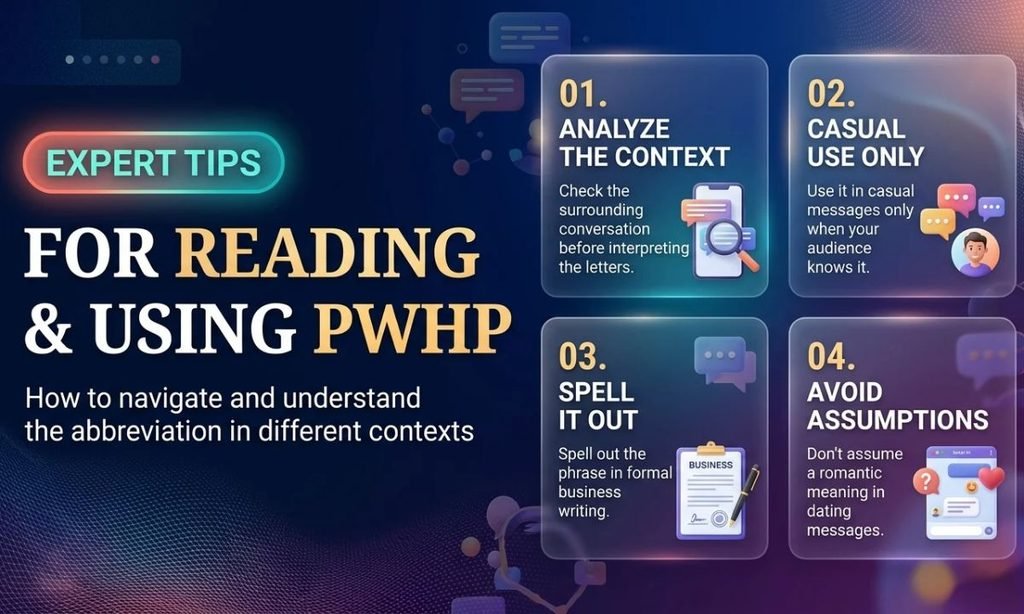
These are the habits I’d stick to for the PWHP meaning in text, and for any abbreviation like it:
- Check the surrounding conversation before interpreting the letters.
- Use it in casual messages only when your audience knows it.
- Spell out the phrase in formal business writing.
- Don’t assume a romantic meaning in dating messages.
- Look for clue words: workout, gym, and leg day point to PWHP, while prices, tickets, sales, and donations point to PWYP.
- In professional contexts, consider whether Publish What You Pay makes more sense.
- If someone sends it with no context, simply ask what they mean.
- Don’t invent a definition from four letters.
- When posting publicly, remember that unfamiliar acronyms reduce clarity.
- Choose plain language whenever a misunderstanding could affect money or business decisions.
Final Takeaway
The PWHP meaning in text is simple: Post Workout Happy Picture, a photo shared after a workout to show pride, effort, and a small win. Underneath, it stands for growth and self-respect. It’s about effort, not perfection, and it helps people stay motivated.
It’s also niche, informal slang with no single universal definition. Context decides what it means, and the look-alike PWYP is the easiest way to get it wrong. In casual chats, the shorthand is fine when the meaning is clear. In workplace messages or anything involving money, clarity should come first.
So next time a friend sends PWHP, you’ll know what’s coming. Reply to the effort, and maybe send one back.
FAQs
What does PWHP mean in text?
PWHP most often stands for Post Workout Happy Picture. It’s a photo someone shares right after exercise to show their mood or progress. It’s informal fitness slang, so the meaning depends on context.
What does PWHP stand for?
PWHP stands for Post Workout Happy Picture. Think of a gym selfie sent with pride after a tough session. It isn’t an official abbreviation, just niche texting slang.
Is PWHP a real slang term?
Yes, but it’s niche and not standardized. You’ll mostly see it in fitness chats, DMs, and captions on Instagram and TikTok. Many people have never come across it.
Where did PWHP come from?
The exact origin isn’t documented. Some guides link it to the early 2020s, when gym selfies and progress photos filled social media. That dating is claimed, not proven.
Is PWHP positive or negative?
It’s positive. People use it to show pride, effort, and a small win after a workout. It isn’t meant as an insult or a joke at anyone’s expense.
How do you reply when someone sends PWHP?
Match their tone and respond to the effort, not the body. Simple replies like “Good work,” “Proud of your consistency,” or “Keep going” work well. If you’re unsure what it means, just ask.
Can I use PWHP at work or in professional messages?
It’s best to avoid it. PWHP is informal and rarely appropriate in work emails, formal chats, or with a boss. Use plain words in professional settings.
Is PWHP the same as PWYP?
No. PWHP is a fitness photo term, while PWYP usually means “Pay What You Please” or “Pay What You Want.” In some industries, PWYP also means “Publish What You Pay.” Check whether the chat is about workouts or money.
Does PWHP have a romantic or flirty meaning?
No. It isn’t a standard romantic abbreviation. If it shows up in a dating chat, it most likely refers to a workout photo, so ask if you’re unsure.
What should I do if I get a PWHP text with no context?
Look at the surrounding conversation first. If it’s about the gym or fitness, it likely means Post Workout Happy Picture. If it’s still unclear, a quick “What do you mean by PWHP?” is perfectly fine.
