

Your friend texts you five minutes before a big interview, and you want to cheer them on fast. You type two letters, hit send, and the nerves ease a little. That tiny message is the whole story behind GL meaning in text, and it works better than most people realize.
People search for it because two-letter abbreviations are slippery. You might spot GL in a WhatsApp chat, a TikTok comment, a game lobby, or even a finance meeting, and the meaning isn’t always the same. That’s where the confusion starts.
This article covers what GL stands for, where it came from, and how people use it on different apps. You’ll also see the other things it can mean, when it sounds sarcastic, and when to skip it.
GL means “Good Luck.” It’s an informal texting abbreviation used to wish someone success before an exam, interview, match, or any moment that matters. People use it in chats, social media comments, and gaming lobbies. Outside casual conversation, GL can also stand for terms like General Ledger, so context decides the meaning.
What Does GL Stand For in Texting?
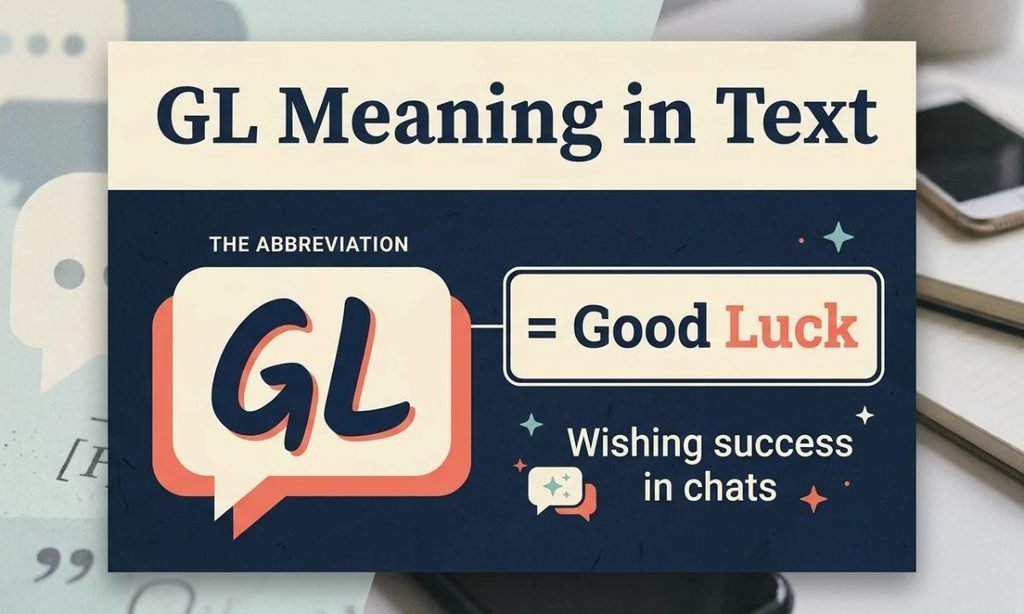
GL stands for Good Luck. That’s the full form, and the definition fits on one line.
Here’s the quick version:
| Abbreviation | Meaning | Usage |
| GL | Good Luck | Wishing success in chats |
The abbreviation sticks around because it’s short, positive, and easy to read. Think of it as a handshake before a challenge or a pat on the back. You’re rooting for someone, and you don’t have to type a full sentence to say so.
I like to think of it as doing four small jobs at once: wishing success, showing support, encouraging someone, and sending good vibes. Few expressions manage all four in two letters. It also mirrors real-world body language, like a nod, a thumbs-up, or a hand on the shoulder. Before an exam or any important life event, it tells the other person you’re on their side.
Intent is rarely unclear with GL. Context settles most doubts, especially on social media.
How Is GL Used in Text Messages?
People send GL when something is at stake. The usual moments are before exams, interviews, competitions, games, and important tasks.
Here are the kinds of messages that fill American phones every week:
- “GL for your exam tomorrow.”
- “GL in your interview.”
- “GL in the match.”
- “GL with your project.”
These are informal, and they’re the backbone of everyday texting. The classic pairing is “GL bro, you got this.” Spelled out, that’s “Good luck, friend,” with a little nudge attached.
GL in Sentences
Seeing the abbreviation inside a sentence explains it faster than any definition. This table maps each example to its expanded version.
| Sentence | Meaning |
| GL for your test | Good luck for your test |
| GL in your match | Good luck in your match |
| GL bro | Good luck, friend |
| GL with your work | Good luck with your work |
| GL tomorrow | Good luck tomorrow |
Every example follows the same pattern: GL, a small connecting word, and the thing at stake. The tone stays warm even when the message is only two words long.
Real Chat Examples You Can Copy
The easiest way to learn GL meaning in text is to watch it in a real thread. Say a friend writes, “Heading into the exam hall now, super nervous!” A reply like “GL bro, you’ve got this!” fits perfectly.
Or take a job interview. Someone texts, “Wish me luck, my interview starts in 5 minutes.” A close friend answers, “GL, kill it!”
Both exchanges show why the abbreviation works. The message is short, the reply is warm, and the encouragement lands before the nervous person walks in. A reply like this slides into the conversation because the casual tone matches the moment. Most of the time you don’t need more than a few words.
Where Does GL Come From?
GL traces back to the early 1990s, when IRC chat rooms and bulletin boards were taking off. Nobody can name the first person who typed it, and the exact origin is still debated. Early internet chat and online games are the usual suspects.
The pressure was practical. People wanted to keep up with real-time conversation, and full phrases slowed them down. Long phrases got squeezed into initials. By the mid-2000s, GL had crossed over into mobile texting and gone mainstream.
That’s the short history: roots in early chat, a slow ride through digital culture, and a clear case of language change driven by thumbs and impatience. It’s one of the oldest internet abbreviations still in daily use.
How GL Is Used on Social Media Platforms
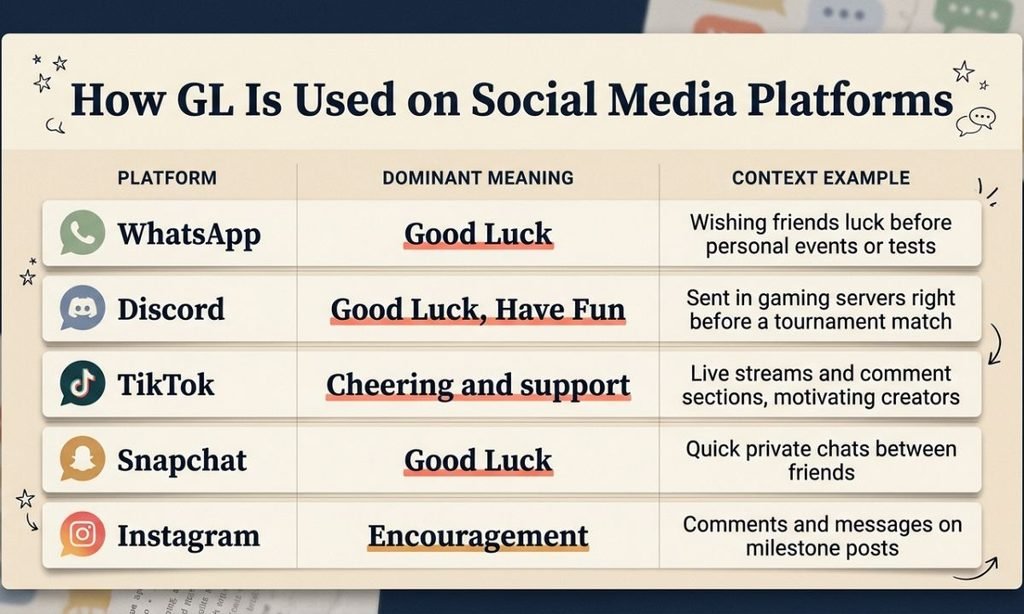
GL shows up across social media to signal encouragement and positivity. The usage looks similar from app to app, but each platform adds its own flavor. Here’s a quick comparison.
| Platform | Dominant meaning | Context example |
| Good Luck | Wishing friends luck before personal events or tests | |
| Discord | Good Luck, Have Fun | Sent in gaming servers right before a tournament match |
| TikTok | Cheering and support | Live streams and comment sections, motivating creators |
| Snapchat | Good Luck | Quick private chats between friends |
| Encouragement | Comments and messages on milestone posts |
The same letters carry slightly different weight depending on where you see them. Check the app first, and the platform will tell you most of what you need.
GL on TikTok
On TikTok, viewers use GL in comments, captions, and live streams to support creators or contest participants. You might see “GL with your challenge” under a dance video, or “GL, hope you win” on a contest entry. The usage is almost always cheering.
GL on Snapchat
Snapchat chats are private and fast. “GL bro” might land right after a quick snap, or “GL for your exam” the night before. The success being wished is usually small and personal, and the tone stays light.
GL on Instagram
Instagram users drop GL in comments or direct messages. Think “GL on your new journey” under an announcement post, or “GL with your goals” on a fitness update. The meaning leans toward milestones, and it’s more often public than private.
GL on WhatsApp
On WhatsApp, GL is common in personal and group chats. “GL for tomorrow” works before a big day, and “GL with everything” fits when someone is juggling too much. Group chats turn it into a one-to-many cheer, while personal chats keep it between two people. The words stay the same, but the feel shifts with the audience.
GL on Discord
On Discord, GL usually means “Good Luck, Have Fun.” It gets sent in gaming servers right before a tournament match, which brings us to the place where this abbreviation earned its reputation.
GL in Gaming: Pre-Match Etiquette
Gaming is where GL became legendary. In gaming communities, players type GL, or the expanded GLHF, at the moment a competitive match begins. I’ve lost count of the lobbies that filled with “GL everyone” within seconds of a game loading, before anyone moved.
GLHF stands for Good Luck Have Fun. It’s a gesture of sportsmanship and mutual respect between opponents, and it tells everyone the fight is friendly. Messages like “GL everyone” and “GL in the game” are more of a polite ritual than a prediction. It works almost like a handshake among players.
Regular players barely register it as slang at all. The habit has also spread beyond games, and plenty of casual text messages borrow it now. Its partner, GG (Good Game), has a different job: it belongs strictly at the end of a match, as a nod of respect for the play.
Other Meanings of GL (and Why They Cause Mix-Ups)
Good Luck is the dominant meaning, but GL is a flexible acronym. A few other readings live in technical corners, and context is what separates them. Here’s the full list from everyday and specialist use.
| GL | Meaning | Where you’ll see it |
| GL | Good Luck | Texting, social media, gaming |
| GL | Good Looking | Casual descriptions of appearance |
| GL | General Ledger | Accounting and finance |
| GL | Graphics Library | Technology and software |
| GL | Global | Business and general writing |
| GL | Grenade Launcher | Military forums and loadout talk |
| GL | Glide Level | Aviation systems and flight path data |
| GL | Get Lost | Heated, sarcastic exchanges |
| GL | Girl’s Love | Certain East Asian media communities |
This is polysemy in action: the same two letters carry several meanings, and the ambiguity is real. Short abbreviations pick up extra meanings all the time. In practice, these full forms rarely compete inside a single thread, so a quick bit of disambiguation usually does the job.
GL Meaning in Different Contexts
Meaning shifts by domain. In texting, GL is Good Luck. On social media, it’s encouragement. In gaming, it’s a pre-match ritual. In business, it’s General Ledger, the core record book where a company logs every transaction. In technology, it’s Graphics Library, the term behind OpenGL.
I once sat in corporate finance meetings where “GL” came up constantly and nobody was wishing anyone anything. That’s why I check the setting before replying. It takes a glance, not an investigation.
When GL Turns Sarcastic
GL relies on context for its mood. Sent to a friend or teammate, it’s warm and supportive. Dropped bluntly after a heated online argument, it can read as a passive-aggressive “Get Lost.” The same two letters can sting.
I watched this happen in a group chat. Two people were sniping at each other, and then one posted “gl” with a cold period. The words didn’t change, but the mood flipped. If you’re trying to read sarcasm, check the tone before the message, and ask whether it went to a friend or got fired off in anger. Blunt timing is the giveaway.
So is GL friendly or rude? It’s almost always friendly. Sarcasm is the only thing that makes it rude, and the intent lives in the surrounding tone, not in the letters.
Regional Variations
In Western and South Asian digital spaces, GL almost universally means Good Luck. In some East Asian media communities, though, fans use it for “Girl’s Love,” a genre with its own following. That’s regional meaning in action. The common reading in one community can be rare in another, and these differences are easy to miss. Keep the platform and its culture in mind.
Is GL Formal or Informal?
GL is informal. It belongs in text messages, social media, gaming chats, and casual conversations. It isn’t a formal abbreviation, and some people see it as too casual for serious settings.
Formality is really a question of register. Casual settings accept the shortcut. Official, business, and professional settings expect the full phrase, and writing it out costs you about three seconds.
When to Use GL in Text
The rules are short. Use GL when you’re wishing someone success, encouraging a friend, or supporting someone emotionally. It also fits right before an event or a competition. Casual DMs, gaming lobbies, and social media comments are the best spots.
These settings share one trait: a fast-moving chat where nobody wants long explanations. A quick GL gives quick support, helps build community, and lets you show you care without breaking the flow. It keeps the chat light.
When to Skip GL
Skip it in formal emails, official presentations, academic writing, and deep emotional conversations. In professional spaces, a two-letter shortcut can look lazy or careless. If someone shares bad news, they need a thoughtful reply, spelled out in full.
I once saw a junior colleague sign off a client email with “GL,” and it landed badly. If the tone is professional, write “Good luck” in full. It shows you took the time. Can you use GL on WhatsApp? Yes, with no rules against it. Just save it for friends, not for your boss.
Who Should Use GL? Reading Your Audience
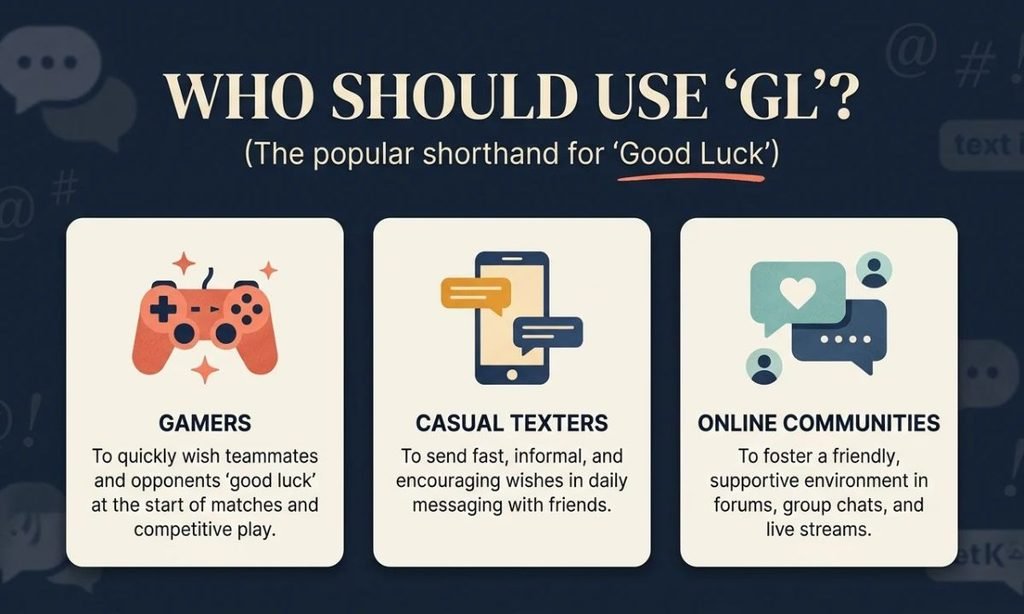
Slang only works when you read the room. Before sending GL, I take a quick look at who’s in the chat, what the culture is, and what register everyone uses. It takes about two seconds, and it keeps you from sounding off.
Picture a quick profile for GL. The main meaning is Good Luck. The style is fast texting. The tone is supportive, friendly, and highly positive. It works as a texting filler and a conversational interjection, closer to “go get it” than to a full sentence. The ideal audience is close friends, internet peers, and social media followers.
Good slang usage comes down to pragmatics, meaning what the words do rather than what they say. Audience fit matters more than the letters themselves.
Why People Use GL in Text
The reasons are practical. GL is short, positive, quick to type, and easy to understand. It shows support, saves time, and fits right into online culture.
Typing efficiency drives the habit, while warmth and popularity keep it alive. That’s also why anyone who types “GL meaning in text” into a search box usually finds the answer in one sentence.
Advantages of Using GL
The benefits are easy to name:
- It’s a positive message by default.
- It makes communication easy and saves time.
- It’s widely understood, so nobody needs a footnote.
- The tone stays friendly.
That last point is rare for a two-letter message.
Disadvantages of Using GL
The limits are the flip side:
- It isn’t formal.
- It has multiple meanings.
- It can confuse people in a business context.
- It isn’t suitable for professional writing.
The ambiguity matters most at work, where a finance team and a gamer might read the same letters differently. Using it in a formal setting is the other risk. Spot these early, and they’re easy to avoid.
Similar Slang and Alternatives to GL
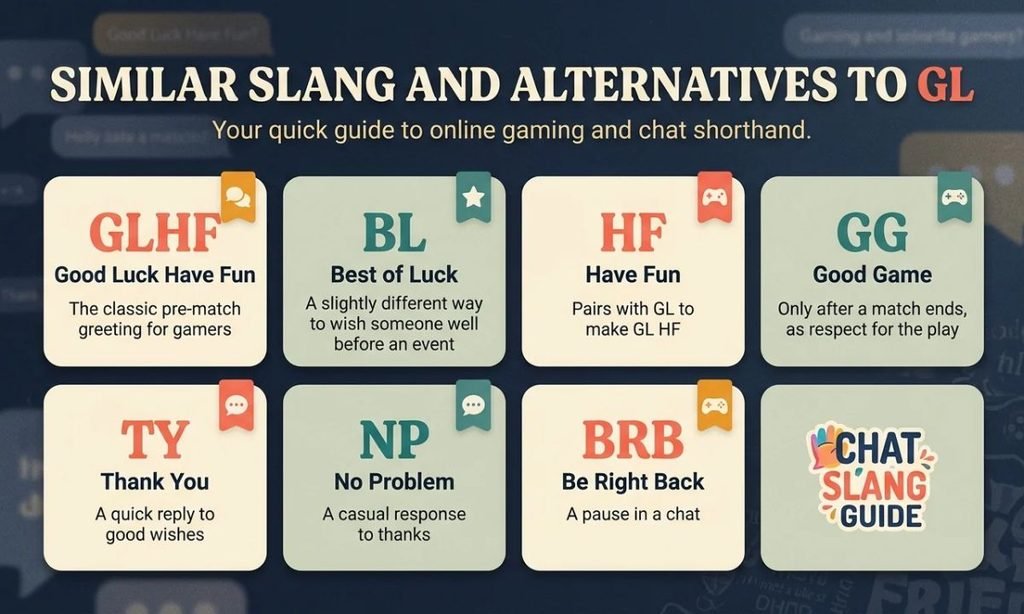
GL travels with a crowd of related abbreviations. They aren’t synonyms, but they share the same texting habit.
| Slang | Meaning | How it’s used |
| GLHF | Good Luck Have Fun | The classic pre-match greeting for gamers |
| BL | Best of Luck | A slightly different way to wish someone well before an event |
| GG | Good Game | Only after a match ends, as respect for the play |
| HF | Have Fun | Pairs with GL to make GL HF |
| TY | Thank You | A quick reply to good wishes |
| NP | No Problem | A casual response to thanks |
| BRB | Be Right Back | A pause in a chat |
If you want variety, mix these in. Knowing the variants is a bit like swapping synonyms. Pair HF with GL and you get GL HF. Put GG at the end of a match, and you’ve closed the loop. Curious about other texting shortcuts? Check out what DK means in text next.
How to Reply When Someone Texts You GL
Someone sends you GL. Now what? Match the sender’s mood and keep it short. A warm reply keeps the good energy moving.
Simple phrases work well:
- “Thanks, you too!”
- “Thank you!”
- “Appreciate it!”
- A quick “TY!”
Tone matching is the whole trick. A polite reply is just a quick acknowledgment, and it never needs more than a line. When a friend texts me GL, I answer fast and move on. The conversation stays friendly either way.
The Psychological Value of a Two-Letter Message
A quick GL meets a basic human need: feeling supported before facing pressure. It can ease anxiety and build quiet confidence. I’ve felt it myself, when a two-letter message lit up my screen minutes before a presentation. The emotional effect was bigger than the message.
The need for support doesn’t vanish online. A message sent over a screen still counts as real support. It can reduce performance anxiety, help someone’s emotional state settle, and shift their mindset a little. That’s the psychological value. It makes a person feel they’re not alone.
Is GL Still Popular? A Few Interesting Facts
Yes, GL is still widely used. It’s understood worldwide, and I still see it on TikTok, Snapchat, and Discord in 2026. Its popularity has stayed steady rather than fading, though how often people use it varies by group.
A few facts worth keeping in mind:
- It’s one of the oldest internet abbreviations in use.
- Its first use is debated, but its history stretches back to early online chat.
- It’s common in gaming culture.
- It’s simple and positive in meaning.
- People use it in daily chats around the world.
Slang facts don’t have to be flashy to stick. The rule is the same as it was decades ago: say it before the thing happens.
Using GL Well
GL means Good Luck in texting, chat, and online communication. Whether you’re in a game lobby, a comment section, or a chat with a friend, it helps you encourage people with warmth and speed. It delivers a real message in two letters.
Its main meaning holds in almost every texting situation. Other readings, like General Ledger or Graphics Library, depend on context. Keep it casual, read the room, and spell it out when the setting turns formal. Texting habits and slang trends keep shifting, but a good read of the conversation keeps your messages quick, warm, and well received.
FAQs
What does GL mean in text?
GL means “Good Luck.” People send it to wish someone success before an exam, interview, game, or any big moment. It’s casual shorthand for texts, social media, and gaming chats.
What does GL stand for?
GL stands for “Good Luck.” That’s the full form and the most common meaning by far. Other meanings, like General Ledger, depend on the setting.
What does GL mean on Snapchat?
On Snapchat, GL means “Good Luck.” Friends use it in quick chats to cheer each other on, like “GL for your exam.” The tone is light and friendly.
What does GL mean on TikTok?
On TikTok, GL usually means “Good Luck.” Viewers drop it in comments and live streams to support creators or contest entries. It’s almost always meant as cheering.
What does GL mean on Instagram?
On Instagram, GL is a short way to say “Good Luck” in comments and DMs. It often appears under milestone posts, like a new job or fitness goal. It’s friendly and encouraging.
What does GL mean on WhatsApp?
On WhatsApp, GL means “Good Luck” in both personal and group chats. You might send “GL for tomorrow” before a big day. Using it there is completely normal.
What does GL mean in gaming?
In gaming, GL means “Good Luck,” sent at the start of a match. It’s a sign of sportsmanship between players. You’ll often see it as GLHF, short for “Good Luck Have Fun.”
What is the full form of GLHF?
GLHF stands for “Good Luck Have Fun.” Gamers type it before a match begins to show respect for opponents. It’s a classic pre-game greeting.
Can GL mean something other than Good Luck?
Yes. GL can also mean General Ledger in accounting, Graphics Library in tech, or Grenade Launcher on military forums. Context tells you which meaning fits.
Is GL a rude or sarcastic message?
Usually not. GL is almost always friendly and supportive. After an argument, though, a blunt “gl” can come across as sarcastic or even “Get Lost.”
Is GL formal or informal?
GL is informal. It works for texts, social media, and gaming chats, but not for business emails or academic writing. In professional settings, write out “Good luck.”
Can I use GL in a work email?
It’s best to avoid it. A two-letter shortcut can look careless in a professional message. Spelling out “Good luck” shows you took the time.
How do I reply when someone texts me GL?
Keep it short and warm. “Thanks, you too!” or “Appreciate it!” works well. A quick “TY!” is fine with close friends.
What is the difference between GL, GLHF, and GG?
GL means “Good Luck” and is sent before something happens. GLHF adds “Have Fun” and is common at the start of a game. GG means “Good Game” and is only used after a match ends.
Where did the abbreviation GL come from?
GL goes back to the early 1990s, during the rise of IRC chat rooms and bulletin boards. The exact origin is debated. It spread to mobile texting by the mid-2000s.
Is GL still used in 2026?
Yes. GL is still widely understood and common on TikTok, Snapchat, Discord, and WhatsApp. Its popularity has stayed steady rather than fading.
