

You get a message that says “STSU 😂” and freeze for a second. Is your friend laughing with you, or telling you to be quiet? The STSU meaning in text depends on who sent it and why, and I’ve watched the same four letters land as a laugh in one group chat and as a slap in another.
People search for this one because it looks like a school abbreviation, a business acronym, or maybe a university name. It usually turns up in text messages, Snapchat, Instagram DMs, TikTok comments, Discord, and gaming chats, with no explanation attached. The sender’s tone is invisible in text, so the reader has to guess, and that is where the mix-ups start.
This article covers what STSU stands for, where it likely came from, and the ways people use it. You’ll also see when it’s friendly, flirty, or rude, how to reply, and when to leave it out of your own messages.
Quick answer: STSU is an informal texting acronym that most commonly stands for “Shut The Stuff Up,” a softened form of STFU. Some sources read it as “Shut The Sh*t Up.” Either way it tells someone to stop talking, though among friends it usually means playful disbelief. Tone and relationship decide whether it sounds funny or rude.
What Does STSU Mean in Text?
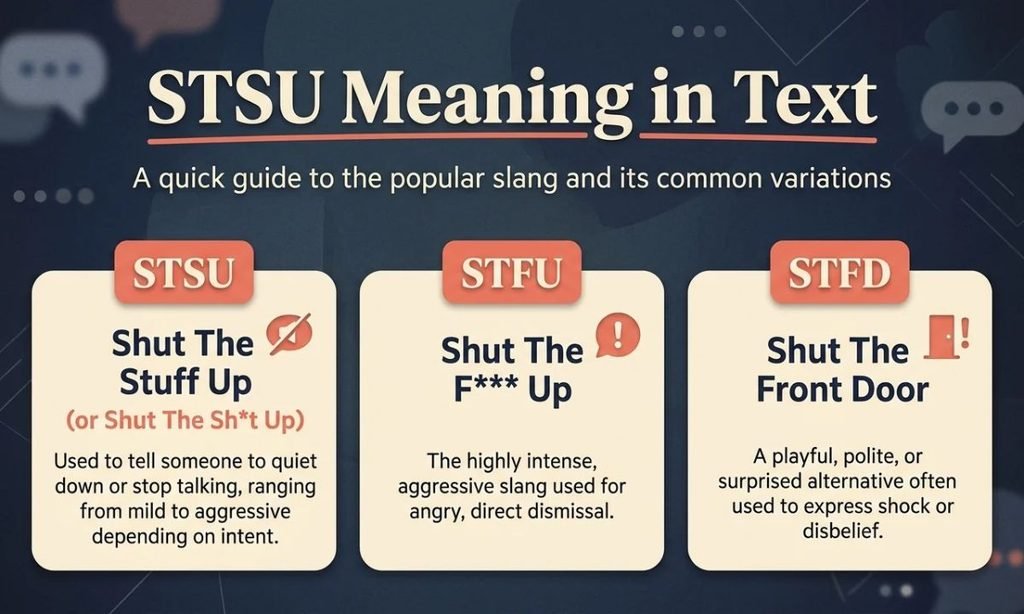
In texting, STSU is an internet abbreviation for telling someone to stop talking or stop saying something. Many people swap an offensive word for a milder one, so STSU works as a cleaner cousin of the better-known STFU. It can be used jokingly, sarcastically, or playfully, and it can also be meant literally.
Take a friend who sends, “STSU 😂 You’re making me laugh too hard.” The sender isn’t angry. The laughing emoji does the work of a smile.
Context still matters a lot. The same letters can sound like an insult in the middle of an argument. Because the sender’s intent doesn’t show up on screen, the reader fills it in, and that’s where things go wrong. If you’ve been wondering what does STSU mean, that’s the short version. The rest of this guide is about reading it correctly.
Is STSU the Full Phrase “Shut the Stuff Up” or “Shut the Sh*t Up”?
Two expansions float around, and they don’t fully agree. Some sources say STSU stands for “Shut The Stuff Up,” a polite stand-in for the harsher phrase. Others say it stands for “Shut The Sh*t Up,” which is blunt internet slang and a close relative of a plain “shut up.” The “stuff” reading is the one some people treat as debated.
My own guess is that the clean version is a retrofit, a nicer reading added later to make the slang easier to say out loud. I can’t prove that, and nobody can. What matters in practice is that most people receive it as a version of “shut up,” and that the profanity behind it makes some readers uncomfortable whatever the intent.
Is STSU an Acronym?
Yes. STSU is an internet acronym that belongs to casual digital communication, part of the wider world of internet slang. Unlike official acronyms used in business or education, nobody sets its rules, and its common meaning shifts with the crowd using it.
It helps to see it next to its neighbors:
| Term | Stands for | Tone |
| STSU | Shut The Stuff Up (or Shut The Sh*t Up) | Informal, softer than STFU |
| STFU | Shut The F*** Up | Very rude |
| STFD | Shut The Front Door | Playful surprise |
STFD is a close cousin in spirit even though the words differ. All three express shock or tell someone to stop talking, but the level of heat changes a lot from one to the next.
Where Does STSU Come From?
The exact origin is unclear. There is no verified source identifying its first use, and anyone who hands you a specific date is guessing.
The likeliest story is that STSU grew out of STFU, which has been around since the early days of online forums, instant messaging, and gaming communities. Change one letter and you get something that feels lighter. STSU is much less common than STFU, so it never left the kind of paper trail that would let anyone trace it. What is certain is that the habit of swapping a harsh word for a gentler one is old.
What Are the Most Common Meanings of STSU?
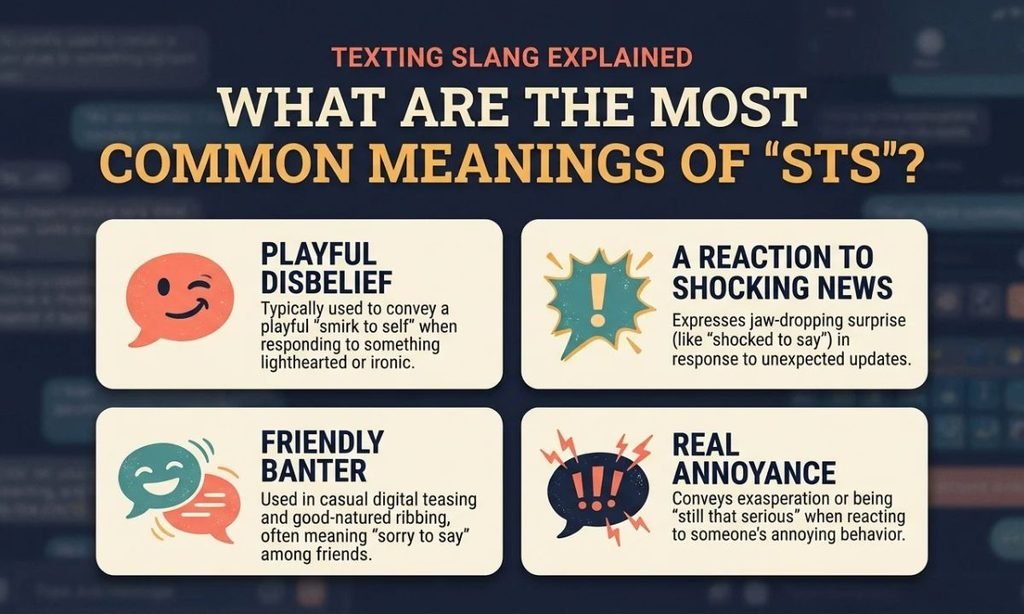
STSU rarely carries only one meaning. The usage in one chat may not match another, so treat the list below as a guide, not a rulebook. Each meaning comes from context more than from the letters themselves.
Playful Disbelief
This is the version I see most. Picture one friend texting, “I just won free concert tickets,” and the other firing back, “STSU no way.” That isn’t anger. It’s surprise, the texting version of “you must be joking.”
Among friends, this is the main meaning, and it spreads across social media because it’s fast and punchy. It often comes with a laughing emoji. If you expect it to mean “please stop talking” in a case like this, it won’t.
A Reaction to Shocking News
Say someone writes, “I met my favorite singer today.” The reply “STSU, are you serious?” reads as excitement, not an order. It works like saying “you’re lying” or “that can’t be real,” only with a grin.
People use it for anything unbelievable, funny, or a little confusing. A wild rumor is exactly the kind of news that triggers it.
Friendly Banter
Close friends tease constantly. One says, “I’m clearly the smartest one here,” and another replies, “STSU, you failed the test.” That’s playful sarcasm. Nobody takes it as a fight, and it can even be a sign of closeness.
Real Annoyance
Then there’s the literal version. Imagine a group chat where someone keeps arguing round after round, and a frustrated member types “stsu already.” They want the conversation to stop.
You can usually tell when it’s meant literally. The situation is tense, the tone is flat, and the message is rude rather than funny. Sometimes the person is simply done, and nobody has to decide whether it was a joke.
Real Conversation Examples of STSU
Examples show the range better than definitions do. Here are five I’ve seen versions of, with the names changed to the usual placeholders. Notice how much the mood swings even though the letters stay the same.
Example 1: Friends joking
Emma: “I just ate an entire pizza.”
Sarah: “STSU 😂 No way.”
This is the classic friendly use. Sarah isn’t asking for silence. She’s reacting to the pizza, and the laughing emoji does the heavy lifting.
Example 2: Gaming
Player 1: “You’re stealing all the loot.”
Player 2: “STSU and keep playing.”
Here it’s blunt. Player 2 wants Player 1 to drop the complaint and stay in the match, so it’s closer to a command than a joke.
Example 3: A funny story
Jake: “I accidentally wore two different shoes today.”
Liam: “STSU 🤣 That’s impossible.”
Liam doesn’t mean “be quiet.” He means “I can’t believe it,” and he’s enjoying the story.
Example 4: Siblings
Brother: “Mom already knows.”
Sister: “STSU! Don’t tell her anything else.”
Siblings talk like this all the time. It sits somewhere between panic and teasing, which fits a secret that’s already half out.
Example 5: A heated argument
Person A: “You always blame everyone else.”
Person B: “STSU.”
This one sounds much more aggressive. There’s no emoji and no warmth, and the line before it is an accusation. This is the example that stings.
How Is STSU Used on Different Platforms?
The platform changes the feel of the word. It can read as friendly in one place and aggressive in another, so here is where I’ve watched the meaning shift.
Friends and Casual Text Messages
Texting between friends is the most common home for STSU. People use it to react to jokes, gossip, or surprising news. “I ate an entire pizza.” “stsu you did not.” That’s playful disbelief with a close relationship behind it, so it’s rarely offensive.
“STSU 😂 You’re unbelievable” reads as playful. Take the emoji away and the tone changes, which is why I always check for one before deciding how a message was meant. Friends often send it without a second thought because the tone is obvious to both of them.
Snapchat
Snapchat is casual and fast. Someone might send, “STSU, you actually did that?” It usually expresses surprise mixed with humor, and the speed of the app means nobody overthinks it.
On Instagram it mostly lives in DMs, comments, and quick replies. You’ll see it under viral videos, prank clips, and comment sections full of teasing friends. A typical comment looks like this: “STSU that prank was wild.”
Here it acts like a stronger version of “no way,” reacting to a shocking clip. It usually appears alongside an emoji.
TikTok
TikTok comments sometimes include STSU when people react to funny videos. A comment like “STSU 😭 This is the funniest thing I’ve seen today” means “Stop! You’re making me laugh.” In this case it’s pure praise.
Dating Apps and Dating Chats
On dating apps, STSU can show flirtatious disbelief. One person says, “You look even better in person,” and the other answers, “stsu stop it.” It’s playful, maybe a little shy.
If the tone is off, though, it can sound rude. Because tone is so hard to read in text, I’d be careful early in a conversation, before you know how the other person jokes.
Gaming and Online Communities
Gaming chats are direct and blunt. Players type fast slang during matches because nobody has time for nuance. Here’s a typical exchange:
Player 1: “Stop blaming the team.”
Player 2: “stsu and play.”
It means “be quiet and focus,” and it can land harsher than it would elsewhere. Competitive games involve quick messages between teammates and opponents, and players use STSU both when joking with their own team and when arguing with the other side. Gaming chats can turn toxic, so it may be read as rude, and often it’s meant that way. Sometimes both readings are true at once.
Work and Professional Chat
At work it’s rarely appropriate. I can’t remember ever seeing it in Microsoft Teams or in workplace Slack channels, and I’d be surprised if you did. Formal communication rather than slang is the norm there.
Imagine a boss writing, “Please update the report,” and getting “stsu” back. Even if it was a joke, it would be misread as disrespectful and could cause real problems. I’d avoid it completely in professional spaces.
Is STSU Rude, Flirty, or Offensive?
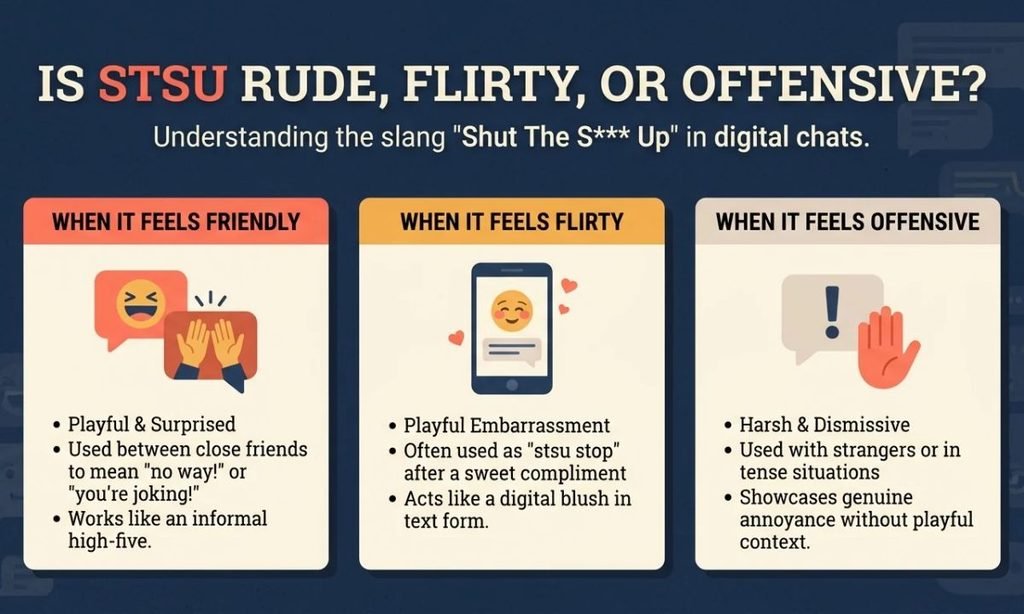
Three things decide it: the relationship, the context, and the emotional tone. Those three factors explain most of the confusion, and understanding them helps you dodge awkward moments. STSU is informal slang, and in formal or professional settings it may be considered crude.
When STSU Feels Friendly
Between close friends, it can mean “no way,” “you’re joking,” or “stop teasing me.” It’s playful and carries surprise. When both people know each other well, a line like “STSU, you really did that?” can mean pure amazement. Because there’s trust, it works like a high five.
When STSU Feels Flirty
Sometimes it works as playful embarrassment. Someone tells the cutest person in the room, “You’re adorable,” and the reply is “stsu stop.” That reads as shy but happy, a bit of light teasing after a compliment. It sometimes acts like a blush in text form.
When STSU Feels Rude
With strangers, or during arguments, it turns harsh. Say someone posts an opinion and gets “stsu” back. Now it clearly means “shut up,” and the sender is saying the opinion makes no sense. During a fight it sounds cold.
During disagreements it becomes a command. “STSU. I don’t want to hear it” is a good example. Without emojis or a friendly relationship, many people will consider it disrespectful, and I think they’re right to.
When STSU Feels Offensive
It becomes offensive when it’s an insult, when it’s used in heated arguments, or when it’s aimed at authority figures. The profanity behind it makes things worse, since some people find it disrespectful whatever the intent. Check the setting and think before you send it.
How Does STSU Compare to Similar Texting Slang?
The biggest difference between these terms is tone. STSU is softer and less offensive than STFU, which carries strong profanity. OMG, short for “Oh My God,” expresses surprise. IDC, short for “I Don’t Care,” shows indifference. LOL, short for “Laugh Out Loud,” expresses laughter. So STSU tells someone to stop talking, while the other terms in this group simply put an emotion on the table.
Related slang turns up in the same chats, and knowing it helps you read faster. If you’ve also come across other confusing abbreviations, our guide on BBW meaning in text is another useful one to check. Here are the terms you’ll see most often alongside STSU:
| Slang | Meaning |
| FR | For real |
| ONG | On God, used to stress that something is true |
| SMH | Shaking my head, showing disappointment |
| NGL | Not gonna lie |
| IKR | I know, right |
| LMAO | Laughing very hard |
| BRUH | A reaction to something ridiculous |
| TBH | To be honest |
| IDC | I don’t care |
| LOL | Laugh out loud |
| WTW | What’s the move, asking what people are doing |
| STFU | The stronger version, “shut the f*** up” |
STSU is also easy to mix up with STG, which means “Swear To God.” The two look similar when you’re skimming a chat but mean very different things.
Is it a popular abbreviation? It exists in online slang but is much less common than LOL, BRB, OMG, or STFU. It’s popular in some friend groups and nearly invisible in others.
How Do You Respond When Someone Says STSU?
The best reply depends on tone. Read first, answer second.
Casual Replies
If the message is friendly, keep things light. Try “You know it’s true,” “I am serious,” or “Why are you shocked?” These keep the exchange natural and easy.
Funny Replies
Humor works well with slang and keeps the playful energy going. Try “Never,” “Too late now,” or “You love hearing my stories.” They work because they match the mood.
Neutral Replies
If you can’t tell what the sender meant, stay neutral and avoid conflict. Ask, “What do you mean?” or “Did I say something wrong?” or just send “Okay.” These buy you time when the tone is truly unclear.
Professional Replies
If someone somehow uses the phrase in a work chat, stay calm and keep your tone professional. You could say, “Let’s keep the discussion respectful,” “Please clarify your point,” or “We should stay professional.” That helps prevent escalation without escalating yourself.
What Are the Most Common Misunderstandings About STSU?
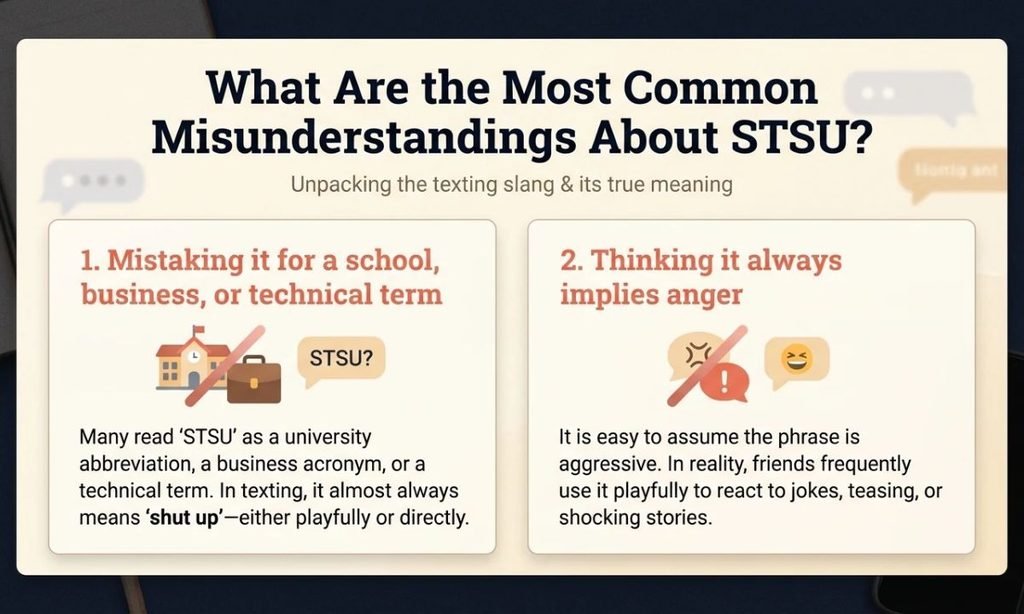
Internet slang spreads fast, and the mistakes follow a pattern.
Mistaking it for a school, business, or technical term. Many people read STSU as a school abbreviation, a business acronym, a technical term, or a university name. In texting, it almost always means “shut up,” either playfully or directly.
Thinking it always means anger. Plenty of people assume it’s aggressive. In reality it’s often playful, and friends frequently use it to react to jokes and shocking stories. Many people read it as harsh before they’ve read the room. It’s not always offensive, and plenty of people say it with a grin.
Mixing it up with similar acronyms. Some people confuse it with STFU or STG, and the mistake can make a reply feel off.
Missing the sarcasm. Online, sarcasm is everywhere. Someone might write, “STSU that is amazing,” and the real meaning is excitement, not anger. Missing the sarcasm is one of the most common slip-ups.
Assuming it’s always Gen Z slang. The phrase spreads fast on youth platforms, but older users pick it up too. Slang crosses age groups quickly, so don’t guess a sender’s age from four letters.
When Should You Avoid Using STSU?
In casual chats, slang feels normal. Even so, there are times when it doesn’t belong.
Professional and Formal Settings
Avoid it with teachers, employers, clients, customer support, older relatives, and coworkers you don’t know well. Business emails, meetings, and office chats call for respectful language, and even a joke can be taken as dismissive. Simple wording works better. Instead of “stsu,” say, “Let’s pause the conversation.”
Friendlier alternatives work too: “You’re hilarious,” “Stop, you’re making me laugh!” “No way!” “Seriously?” or “You’re kidding!” They carry the same playful reaction without sounding cold.
Cross-Cultural Conversations
In international conversations, not everyone knows internet slang. The phrase might sound insulting, and clear language prevents confusion. If you want to be understood, say it plainly.
Sensitive Situations
Never use it when someone shares serious news, such as personal struggles, emotional topics, or conflicts. It can come across as dismissive or hurtful. A respectful response is always safer.
Key Takeaways on STSU
- STSU usually means “Shut The Stuff Up,” though some sources read it as “Shut The Sh*t Up.”
- It’s an informal internet acronym used in texting and social media.
- Friends often use it jokingly, especially with laughing emojis.
- During arguments or with strangers, it can sound rude or disrespectful.
- It’s much less common than STFU, and its origin can’t be traced.
- Skip it in professional or formal conversations, especially when you’re not sure how it will be received.
Reading the Room Before You Send It
Most of the time, STSU is a milder stand-in for stronger expressions like STFU. People use it with friends to react to something funny or unbelievable, and the mood decides everything. Among friends, it signals excitement or disbelief. In tense conversations, it can easily come across as rude or dismissive.
Before you send it, think about your relationship with the other person and the setting. It works when both sides are relaxed, and understanding that difference helps you read it and use it properly. New slang appears almost daily, and choosing the right words at the right moment beats knowing every acronym. The next time STSU lands in your messages, you’ll know how to read the tone and how to answer. When in doubt, say something else.
FAQs
What does STSU mean in text?
STSU most commonly stands for “Shut The Stuff Up,” a softer version of STFU. Some sources read it as “Shut The Sh*t Up.” Among friends, it usually signals playful disbelief rather than anger.
What does STSU stand for?
It stands for “Shut The Stuff Up” in its cleaner form. A cruder reading, “Shut The Sh*t Up,” also circulates online. Both tell someone to stop talking, though the tone depends on context.
Is STSU the same as STFU?
No. STFU contains stronger profanity and sounds much harsher. STSU is a toned-down alternative, though the basic message is similar.
Is STSU rude or offensive?
It can be. Between close friends it often reads as a joke, but in arguments or with strangers it can sound disrespectful. Tone, emojis, and your relationship with the sender usually decide how it lands.
Does STSU always mean someone is angry?
No. Many people use it while laughing or reacting to surprising news, like “STSU no way!” A laughing emoji or friendly context usually shows the sender is excited, not annoyed.
Can STSU be flirty?
Yes. In dating chats, it can show shy, playful embarrassment after a compliment. If the tone is unclear, wait until you know how the other person jokes.
Where is STSU most commonly used?
You’ll mostly see it in text messages, Snapchat, Instagram DMs and comments, TikTok comments, Discord, and gaming chats. It’s rare in professional apps like Microsoft Teams or workplace Slack.
Why do people say STSU instead of “shut up”?
Many people prefer a milder, funnier way to react to shocking or silly news. Using an acronym feels quicker and more casual, especially in fast-moving group chats.
Is STSU an acronym or slang?
It’s both. STSU is an informal internet acronym, which makes it a type of texting slang. No official rules govern it, so its meaning shifts with the people using it.
Where did STSU come from?
The exact origin is unclear, and no verified source shows its first use. It most likely grew out of STFU, which has been around since early forums and instant messaging.
How do you reply when someone texts STSU?
Match the mood. For a friendly message, try a playful reply like “Too late now” or “I’m serious!” If you’re unsure, ask “What do you mean?” before responding.
Can I use STSU at work?
It’s best not to. The term is informal slang with profanity behind it, so coworkers, bosses, or clients may find it disrespectful even as a joke.
What can I say instead of STSU?
Try “No way!”, “You’re kidding!”, “Seriously?”, or “Stop, you’re making me laugh!” These show the same playful reaction without sounding cold or rude.
Is STSU Gen Z slang?
It spreads fast on youth platforms, but people of all ages use it. Slang crosses age groups quickly, so you can’t guess someone’s age from the acronym alone.
Is STSU a popular abbreviation?
It exists in online slang but is far less common than LOL, OMG, BRB, or STFU. In some friend groups it’s everywhere, and in others you’ll almost never see it.
