
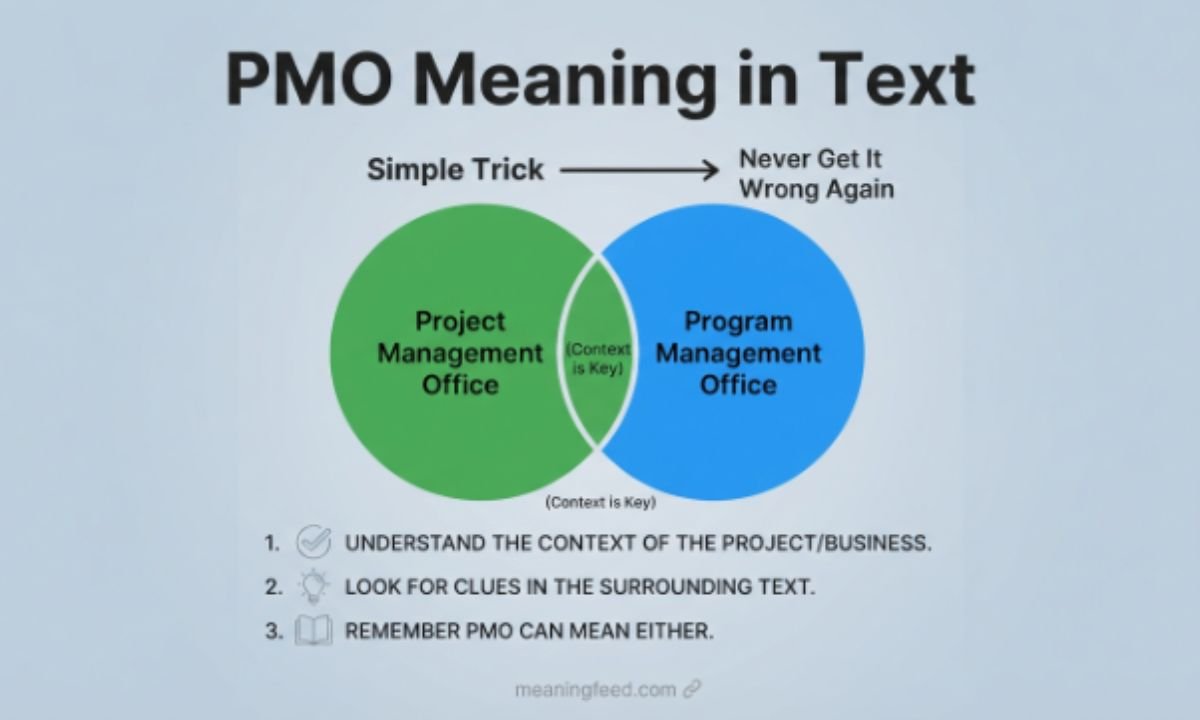

Someone just texted you “pmo” and now you’re stuck. Are they annoyed with you, or are they asking you for something?
That’s the whole problem with this acronym. The PMO meaning in text changes completely depending on who sent it and what came before it — and unlike most slang, the letters themselves give you zero clues. There’s no winking emoji built in. No obvious tone.
So instead of just listing the definitions (you can get that from a dozen other pages), let’s actually fix the real problem: how to know which one someone means, in real time, before you reply with the wrong energy.
What Does PMO Mean in Text? The Quick Answer
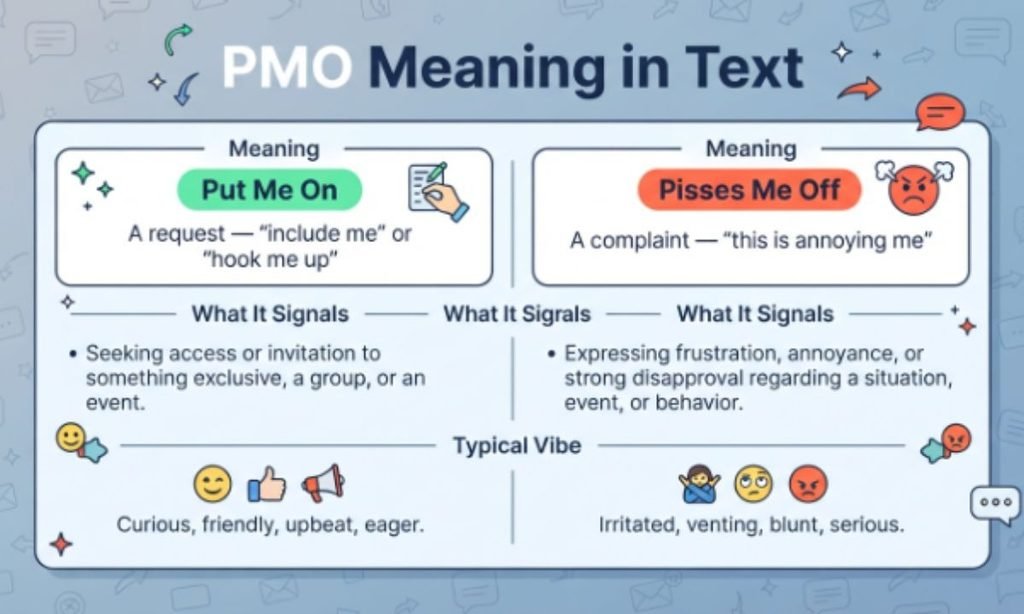
In most texting and social media conversations, PMO stands for one of two things:
| Meaning | What It Signals | Typical Vibe |
| Put Me On | A request — “include me” or “hook me up” | Curious, friendly, upbeat |
| Pisses Me Off | A complaint — “this is annoying me” | Irritated, venting, blunt |
Outside of texting, PMO also stands for Project Management Office in business settings, which we’ll get to later — because it causes more mix-ups than people realize.
But here’s what almost nobody tells you clearly: you don’t have to guess. There’s a fast, repeatable way to tell these apart, and it has nothing to do with vibes.
The 3-Second Context Check
Before you reply to a text that says “pmo,” run it through these three quick checks. In practice, this takes less time than it takes to read this sentence.
1. What came right before it?
PMO almost never shows up alone in a real conversation. It’s a reaction to something. Look at the message directly above it.
- If the previous message was a link, a photo, a playlist, or a mention of an event → it’s almost always Put Me On.
- If the previous message described a problem, a delay, a person being annoying, or bad news → it’s almost always Pisses Me Off.
2. Is there a verb attached, or is it standing alone?
This is the detail every other guide skips, and it’s the single most reliable signal.
- “pmo with that” or “pmo to her” → this only works grammatically as put me on. You can’t say “pisses me off with that” the same way.
- “that pmo” or “he pmo” → this only works as pisses me off, functioning as a verb replacing “annoys.”
- A bare “pmo” with nothing attached is the only genuinely ambiguous case — and even then, tone usually settles it (see below).
3. Punctuation and capitalization
People don’t type in full sentences when they’re venting, and they don’t type carefully when they’re excited either — but the patterns differ.
| Signal | Leans “Put Me On” | Leans “Pisses Me Off” |
| Emoji used | 👀 🙏 🔥 | 😤 💀 🙄 |
| Punctuation | Question mark, ellipsis | Period, exclamation point |
| Sentence length | Short request, often a fragment | Often followed by more venting |
| ALL CAPS | Rare | Common (“PMO SO BAD”) |
Run a message through those three checks and you’ll rarely get it wrong — which is more than any single definition list can promise you.
“Put Me On” — Where It Actually Comes From
This meaning didn’t start on TikTok. It’s rooted in African American Vernacular English and hip-hop culture, where “put me on” meant something bigger than slang — it meant someone was vouching for you, giving you access to an opportunity, a connection, or a scene you couldn’t get into on your own. Rappers used it to describe mentors who got them into the industry.
Texting culture shortened that phrase into three letters, but the underlying meaning stuck: you’re asking someone to share access. That could be:
- A playlist, song, or artist (“pmo with that playlist”)
- A person or their social handle (“pmo with her Snap”)
- An event or opportunity (“y’all going? pmo”)
- Information you don’t have yet (“wait what happened, pmo”)
How to Reply When Someone Says “PMO” to You
Most guides stop at defining it. Here’s what actually matters — how to respond so you don’t look like you missed the request:
- If you have what they’re asking for, just send it. No explanation needed. That’s the whole culture around this phrase — quick, no fuss.
- If you don’t have it, a simple “I got you, lemme find it” keeps the exchange casual.
- Ignoring it or responding with “what?” reads as cold, since the person already made themselves a little vulnerable by asking.
“Pisses Me Off” — When PMO Is a Complaint
In this sense, PMO functions like a verb bolted onto whatever is bothering someone. It’s less a defined phrase and more an emotional stand-in for “this is annoying.”
- “The wifi keeps cutting out, pmo.”
- “She left me on read for three days, pmo.”
- “When the app crashes right before you save your progress, pmo.”
It’s popular precisely because it’s flexible. You don’t need a full sentence to explain why you’re annoyed — three letters carry the tone for you.
How to Reply to a Frustrated PMO
This is the part competitors gloss over. A frustrated PMO is a small emotional cue, and how you respond matters more than people think:
- Acknowledge it before problem-solving: “ugh that’s annoying” lands better than jumping straight to advice.
- Don’t ask them to clarify what PMO means — that reads as dismissive in the middle of someone venting.
- If it’s genuinely minor (a typo, a slow app), matching their energy with a laugh emoji is usually fine. If it’s about a person, take it a little more seriously.
The Mix-Up Nobody Warns You About: PMO at Work

Here’s the gap almost every other page on this topic misses entirely, and it’s a genuinely useful thing to know if you work in an office that uses Slack, Teams, or email threads alongside casual group chats.
PMO is also the standard abbreviation for a Project Management Office — the internal team that sets project standards, tracks timelines, and reports on delivery across an organization. It’s a completely ordinary, decades-old business term with no relation to the slang meaning at all.
The problem is that both meanings now live in the same inboxes. A younger employee texting a coworker “that meeting pmo” and a project lead writing “loop in the PMO before Friday” can appear in the same week, sometimes the same thread if people cross-post between Slack and personal chats.
| Setting | Likely Meaning | Why |
| Group chat, DM, social captions | Slang (Put Me On / Pisses Me Off) | Informal tone, lowercase, no full sentence |
| Company email, project docs, meeting notes | Project Management Office | Formal tone, capitalized “PMO,” often paired with terms like “governance” or “stakeholders” |
| Slack message from a manager | Almost always business meaning | Even casual managers rarely use the slang term in writing to reports |
The practical advice: if PMO shows up capitalized, in a formal sentence, or next to words like “audit,” “milestone,” or “governance,” it’s the business office — not slang. If it’s lowercase and sitting next to an emoji, it’s not.
Other Meanings You’ll Occasionally Run Into
PMO isn’t only a two-way fork. A few less common meanings show up depending on where you’re chatting:
| Meaning | Where You’ll See It | Notes |
| Private Message Only | Comment sections, forums | Someone signaling they’d rather talk in DMs, not publicly |
| Prime Minister’s Office | News, international contexts | Common outside the US, especially UK, India, and Commonwealth countries |
| A self-discipline acronym | NoFap and self-improvement forums | Refers to habits people are trying to reduce; rarely used in everyday texting |
If a message doesn’t fit “put me on” or “pisses me off” and it’s coming from a comment thread or a formal source, one of these three is probably the real answer.
PMO Combos You’ll See in the Wild
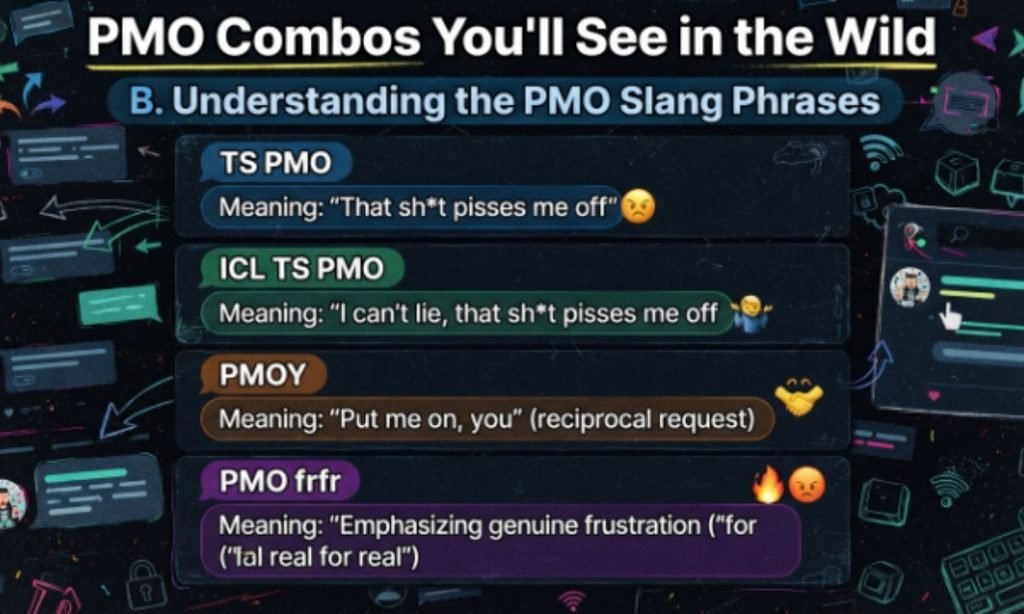
Gen Z slang rarely travels alone. PMO frequently gets stacked with other abbreviations, and if you’ve never seen these combos before, they can look like a completely different language.
| Combo | Likely Meaning | Example |
| TS PMO | “That sh*t pisses me off” | “He canceled again, ts pmo” |
| ICL TS PMO | “I can’t lie, that sh*t pisses me off” | Used to add emphasis or honesty to a complaint |
| PMOY | “Put me on, you” (reciprocal request) | Response to someone else’s PMO |
| PMO frfr | Emphasizing genuine frustration (“for real for real”) | “That pmo frfr” |
You don’t need to memorize every combo. Once you know the base meaning, most of these are just intensifiers stacked on top.
When an Older Relative Texts You “PMO”
This is worth its own section because it happens constantly and nobody explains why. If your mom, dad, aunt, or older manager sends you “pmo,” there’s a good chance they don’t mean either slang definition at all.
Older adults are far more likely to have encountered PMO through work — as in the Project Management Office — or to have picked it up secondhand without knowing the newer slang meanings exist. If a message from someone over 40 says “pmo” with no other context, it’s worth a quick clarifying text rather than assuming Gen Z slang. Conversely, if a teenager in the same family group chat drops “pmo,” assuming the business meaning will make you the one who looks out of the loop.
Age is genuinely one of the fastest ways to guess correctly — faster than punctuation, faster than emoji. It’s just something no acronym guide thinks to mention because it seems obvious once you say it out loud.
Quick Reference Cheat Sheet
Save this if you want the short version without scrolling back through the article.
| If you see… | It probably means… |
| “pmo with that” | Put Me On |
| “that pmo” or “he/she pmo” | Pisses Me Off |
| PMO in a work email, capitalized | Project Management Office |
| PMO in a comment thread | Sometimes Private Message Only |
| PMO from someone over 40, no context | Probably not slang — ask |
| PMO with 😤💀🙄 | Pisses Me Off |
| PMO with 👀🔥🙏 | Put Me On |
Final Thoughts
PMO is a good example of how three letters can hold three or four entirely different conversations depending on who’s typing them. The good news is that once you know the pattern — check what came before it, check the grammar, check who sent it — you’ll almost never misread it again.
Language like this moves fast, and by next year PMO might mean something slightly different again. That’s fine. The habit of reading context instead of memorizing a fixed definition is the part that actually keeps you fluent, no matter what the next three-letter acronym turns out to be.
FAQ
What does PMO mean in a text from a guy or girl?
It depends entirely on context, not gender. If it follows a link, song, or photo, it’s a request (“put me on”). If it follows a complaint or bad news, it’s frustration (“pisses me off”).
What does PMO mean on Snapchat?
On Snapchat, PMO usually means “pisses me off” when it’s a solo reaction to something annoying, and “put me on” when it’s attached to a request, like sharing a Snap or a story.
Is PMO always a bad or negative word?
No. “Pisses me off” is negative, but “put me on” is a friendly, casual request. The same three letters can mean something upbeat or something annoyed depending on the sentence around them.
What does TS PMO mean in text?
TS PMO usually means “that sh*t pisses me off,” used to add emphasis to a complaint. It’s common in Gen Z texting on TikTok, Snapchat, and Twitter/X.
What does PMO mean in business or at work?
In a professional setting, PMO almost always stands for Project Management Office, a team that sets standards and oversees project delivery. It has no connection to the texting slang meaning.
How do you respond when someone texts you “PMO”?
If it’s a request, share what they asked for or say you’ll find it. If it’s a complaint, acknowledge the frustration first before offering advice or moving on.
Is PMO the same as FOMO or SMH?
No. FOMO means “fear of missing out” and SMH means “shaking my head,” both fixed in meaning. PMO is unusual because it swings between two unrelated meanings depending on context.
