

You send a group chat a simple question about dinner, and one person fires back “idc.” Is that a friendly shrug or a cold brush-off? The IDC meaning in text trips up more people than you’d expect, mostly because three lowercase letters carry no tone at all.
People search for this one because it shows up everywhere and means different things in different places. A friend might send it in a text, a coworker might mention it in an IT meeting, and a news article might quote it as a source. Same letters, very different messages.
This article walks you through what IDC means in everyday messaging, what else it can stand for, and when it comes across as rude. You’ll also see real examples, close lookalikes like IDK and IDGAF, and softer ways to say the same thing.
Quick answer: IDC in text almost always means “I Don’t Care.” It’s an informal acronym used in texting, social media and casual chat to say you have no preference, you aren’t bothered, or you’re done talking about something. Outside of chat, it can also name a research firm, a server facility or an electronics part.
What Does IDC Mean in Text?
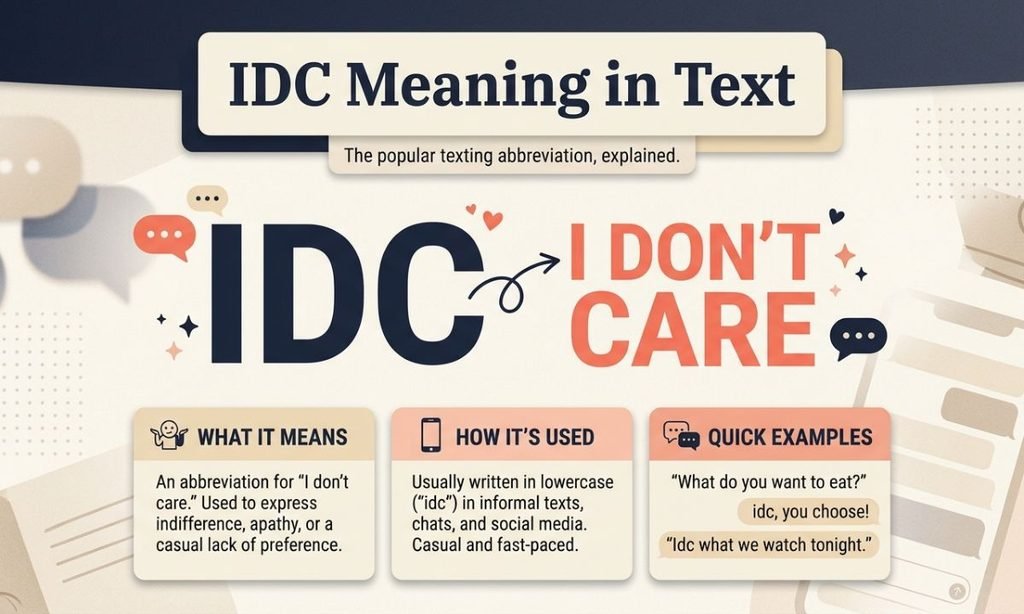
If you typed “what does IDC mean in text” into a search bar, you already have the answer: I Don’t Care. That’s the meaning you’ll meet in texting, online slang and most casual messaging.
The phrase covers a small cluster of feelings. It doesn’t matter to me. I’m not bothered. I have no preference. Sometimes it signals a real lack of concern. Other times it means the sender is frustrated and finished with the topic.
That’s where the confusion starts. Depending on how it’s used, the same three letters can read as easygoing or as emotional detachment. “You pick the movie, IDC” is a shrug. “IDC what people think” is about ignoring other people’s opinions. “Do whatever, IDC anymore” is someone who has checked out.
In writing, a neutral tone, a casual tone and a rude tone all look identical. A sender who is merely uninterested and a sender openly showing indifference type exactly the same letters. Only the context tells you which one you’re dealing with.
IDC Full Form and Other Meanings
The IDC full form isn’t fixed. The most common slang meaning is I Don’t Care, and that’s what people mean when they use it as text slang. But IDC has multiple meanings, and the major definitions come from outside chat altogether.
Main Meanings Outside of Slang
International Data Corporation is a technology research company that sells market intelligence. You’ll see it in tech reports, market research, business articles and IT industry discussions, usually as “according to IDC” followed by a line about cloud spending.
Internet Data Center is a facility full of servers, networking equipment and data storage that runs cloud infrastructure. It turns up in web hosting, cloud computing and IT operations. A sysadmin who says the team migrated servers to a new IDC isn’t annoyed at anyone.
Insulation Displacement Connector lives in electronics and hardware engineering. Picture an IDC ribbon cable plugged into a motherboard connection.
Rarer Meanings People Mix Up With IDC
There’s also a tail of niche meanings that people sometimes mistake for IDC:
- Identity Document Code
- Initial Distribution Center
- Industrial Development Corporation
- Integrated Drive Controller
They exist, but they rarely cause a mix-up in everyday chat.
How Common Is Each Meaning?
Choosing between slang and the other meanings is seldom a hard call. If a friend sent it, it’s I Don’t Care. Here’s roughly how the usage ranks:
| Meaning | Where you’ll see it | How common |
| I Don’t Care | Texts, social media, gaming chat | Very common as text slang |
| International Data Corporation | Tech reports, business articles | Common in business and technology |
| Internet Data Center | Web hosting, cloud computing, IT operations | Common in business and technology |
| Insulation Displacement Connector | Electronics, hardware engineering | Less common |
If you want the IDC full form for a slang question, it’s I Don’t Care. For anything else, check the surrounding words.
Is IDC Rude, Offensive or Neutral?
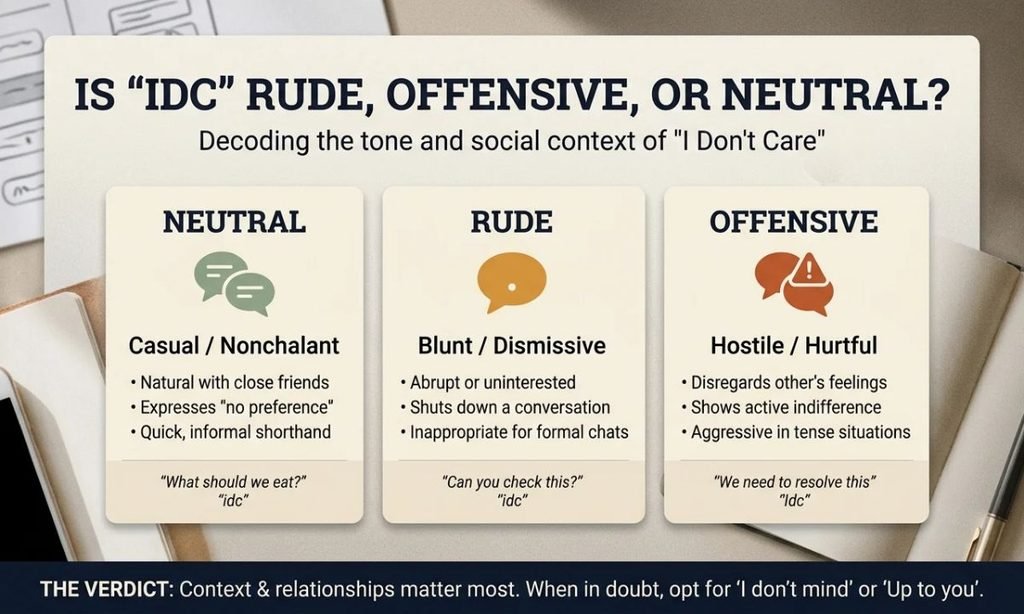
It depends. IDC can be harmless, or it can be dismissive, and the words around it do most of the work.
Neutral use looks like “IDC where we eat” or “IDC which color you choose.” Both just mean no preference, and nobody gets hurt.
It can sound rude when the thing you’re dismissing belongs to someone else. “IDC about your problems” or “IDC what you think” comes across as cold and disrespectful. In arguments, “IDC, leave me alone” can sound angry, and the frustration underneath is usually obvious.
I’ve watched a perfectly friendly group chat turn tense over one lowercase “idc.” Nothing was wrong with the word. The sender was just brief at a moment when the other person wanted engagement.
So is it offensive by itself? No. It’s common slang, and the offense comes from how you aim it. Keep that in mind for the social media section below.
Where Is IDC Commonly Used?
Mostly in text messages, Snapchat, Instagram DMs and gaming chats. It also shows up in social media comments, captions and online arguments, and it’s the everyday chatting default for a lot of people.
In gaming it’s casual. “IDC who picks support” is a player saying any role works. Players also use it to wave off drama. In comments, “IDC what haters say” is a flex, and “IDC bro” is usually someone signing off a debate, often dismissively.
What about the IDC meaning on Snapchat? It’s the same as in a regular text message. Nothing changes between apps except the audience reading it.
Why Do People Type IDC?
It’s short, fast to type and casual. It’s also emotionally expressive for something so small. It saves people from writing out “I don’t really mind what happens,” and that’s the main reason they reach for it instead of the full sentence. Most popular internet slang survives for the same reason.
Where Did IDC Come From?
IDC is shorthand slang that grew out of early internet chatrooms and SMS texting. Character limits made brevity useful, and shortcuts became necessary when every message cost effort and money. It followed the same internet slang evolution as LOL, TBH, IDK and IMO, and it spread as chat, messaging and social media grew.
Nobody can point to the first person who typed it. The exact origin isn’t documented, so treat any source that names one with caution. What we can say is that it belongs to the same family of letter-based abbreviations from that era.
IDC vs IDK: What’s the Difference?
IDC vs IDK causes more confusion than it should. IDC is I Don’t Care. IDK is I Don’t Know.
- “IDC what we eat” means you’ll eat anything.
- “IDK what we should eat” means you’re stuck.
That’s a huge difference. One is indifference and the other is uncertainty. Swap them by accident and you can leave a friend thinking you’re ignoring the question when you simply had no idea.
Similar Slang Terms Related to IDC
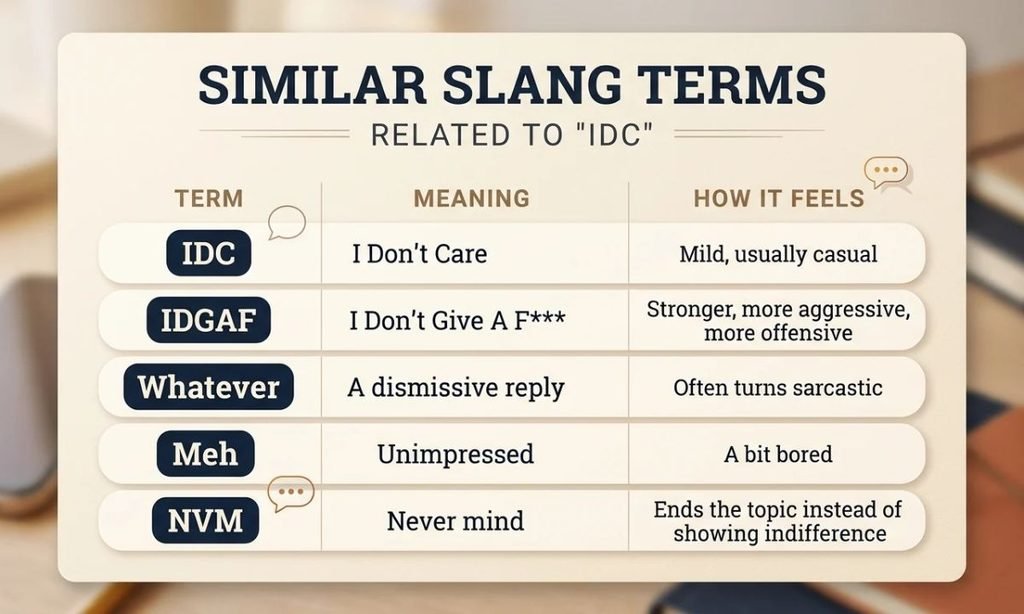
A few other slang terms sit close to IDC, and the difference between them matters more than it looks. They overlap with IDC without being the same thing, so “similar” doesn’t mean you can swap one in for another.
| Term | Meaning | How it feels |
| IDC | I Don’t Care | Mild, usually casual |
| IDGAF | I Don’t Give A F*** | Stronger, more aggressive, more offensive |
| Whatever | A dismissive reply | Often turns sarcastic |
| Meh | Unimpressed | A bit bored |
| NVM | Never mind | Ends the topic instead of showing indifference |
| I’m good | No, thanks | A polite refusal |
IDGAF is the one to be careful with. It’s crude, which is why IDC feels milder and IDGAF reads as more offensive. The difference between all of these is mostly tone.
If you spend time in the same chats where IDC pops up, you’ll probably see WBU meaning in text too. It’s another quick reply acronym, and it works very differently from the indifference of IDC.
Real-Life Examples of IDC in Different Tones
The same letters change with the person using them, so a few examples help. Different tones show up in different settings.
Friendly. A friend asks “pizza or burgers?” and you answer “IDC, you choose.” The meaning is no preference. A playlist works the same way, and so does dinner.
Casual. Someone brings up a trend or celebrity gossip and you say “honestly IDC.” You’re relaxed and uninterested, not angry.
Argumentative. “IDC, I’m done arguing” or “IDC what you say anymore.” This is dismissal, and a teammate or friend will feel it. If someone says “keep arguing then,” replying “IDC anymore” ends things coldly.
Gaming. A teammate asks which map, and you say “IDC, queue anything.” In the same setting, “IDC if we lose, let’s play” is a relaxed call about rank.
Social media. A caption like “IDC what people think, be yourself” is confident, not mean.
Polite Alternatives to IDC
If IDC sounds rude in your message, softer options are easy to find. Instead of IDC, try one of these:
- “I don’t mind”
- “Either option is fine”
- “I have no preference”
- “I’m okay with anything”
- “Your choice works”
They’re longer, but they sound softer and more respectful. I switch to them whenever the other person seems to care about the outcome more than I do.
When to Avoid Using IDC
Skip IDC in professional messages. It’s too casual, and it can read as careless. “IDC about the deadline” is bad. “I’m flexible on the deadline” is better, and it says the same thing in workplace wording. The same goes for customer communication and any other work message.
Serious conversations are the other place to leave it out. If someone shares their feelings and you answer “IDC,” it’s insensitive and can hurt the relationship.
Can IDC be used professionally? Usually no, unless you mean International Data Corporation or Internet Data Center. Professional use of the slang meaning is rare, and in a work setting people notice it.
The Trade-Off With Slang in Communication
Slang has an impact on communication, and it cuts both ways. It makes messages faster and more efficient. It can sound casual and relatable among friends in a text. But it can also create misunderstanding, because tone is easy to lose and a short reply can feel rude.
Is IDC Safe to Use on Social Media?
Yes, it’s generally safe. It’s common slang and not offensive by itself, and it’s perfectly normal in TikTok captions, Instagram comments, Snapchat, X posts and gaming chats. Because people use it so often in these places, it rarely gets noticed.
A post like “IDC what anyone says, I love this song” is completely fine. The only thing that makes it offensive is aiming it at someone.
Why Context Changes the IDC Meaning
Context changes meaning, and that’s why the same acronym carries different meanings depending on where you meet it.
- In a text message, “IDC what movie we watch” means I don’t care.
- In a tech article, “IDC predicts AI growth” means the research firm.
- In a hosting discussion, “the data moved to a secure IDC” means the facility.
Whether you search IDC meaning slang, IDC full form or IDC meaning in text, the surrounding words tell you which one fits. Once you know where you are and who you’re talking to, the confusion goes away.
The Takeaway
IDC means “I Don’t Care” in almost every chat you’ll ever have, and it’s harmless when it’s about dinner, a playlist or a game map. It gets risky when it’s aimed at someone’s feelings, someone’s problem or a work deadline. When the other person seems to care more than you do, take the extra second to type “I don’t mind” instead. You’ll sound the same on the inside and a lot kinder on the screen.
FAQs
What does IDC mean in text?
IDC stands for “I Don’t Care.” People use it in texts, DMs, and social media comments to say they have no preference or aren’t bothered by something.
What is the full form of IDC?
In slang, the full form is “I Don’t Care.” Outside of chat, IDC can also mean International Data Corporation, Internet Data Center, or Insulation Displacement Connector.
Is IDC rude in a text message?
Not by itself. “IDC where we eat” is harmless, but “IDC about your problems” sounds cold. Tone and the words around it decide how it lands.
What is the difference between IDC and IDK?
IDC means “I Don’t Care,” so it shows indifference. IDK means “I Don’t Know,” so it shows uncertainty. Mixing them up can change your whole message.
Is IDC the same as IDGAF?
No. IDGAF is a stronger, cruder version of the same idea. IDC feels milder and is more acceptable in casual chat.
What does IDC mean on Snapchat?
It means the same thing as in any text message: “I Don’t Care.” Only the audience changes, not the meaning.
What does IDC mean in gaming?
In gaming chat, IDC usually means any option works for the sender. “IDC who picks support” simply tells teammates the player is flexible.
Can I use IDC in a work email or professional message?
Usually no. It reads as careless in a professional setting. Try “I’m flexible on this” or “either option works for me” instead.
What can I say instead of IDC to sound more polite?
Try “I don’t mind,” “either option is fine,” “I have no preference,” or “your choice works.” They take a few more seconds to type but sound warmer.
Is IDC safe to use on social media?
Yes. It’s common slang on TikTok, Instagram, Snapchat, and X, and it isn’t offensive on its own. It only becomes a problem when aimed at a person.
Where did the slang IDC come from?
It grew out of early internet chatrooms and SMS texting, where short messages saved time and money. No one knows who used it first, so the exact origin isn’t documented.
How can I tell which IDC meaning someone is using?
Check the context. In a friend’s text it means “I Don’t Care.” In a tech article it’s likely the research firm, and in a hosting discussion it’s probably the data facility.
