


You open a chat and see “BYA” tucked into a friend’s message. Is it a goodbye, a snarky comeback, or something else entirely? The BYA meaning in text isn’t fixed by any official source, so people read it from context.
People search for it because it’s short, it doesn’t look like a normal word, and it turns up where nobody stops to explain: group chats, comments, replies, and DMs. It’s also easy to mix up with company names or other acronyms that share the same three letters. And since a few acronym dictionaries list different meanings, the confusion only grows.
This guide covers the four likely meanings, where the abbreviation might have come from, and how to tell which version a sender intends. You’ll also get real chat examples, reply ideas, and clear rules for when to use it and when to skip it.
BYA most often means “Before You Ask,” a quick way to answer a question before someone types it. It can also mean “because you asked,” “before you assume,” or a casual “bye ya.” No official standard exists, so the sender, the tone, and the conversation around the abbreviation decide which meaning fits.
BYA Meaning in Text: The Four Likely Readings

BYA has no single official meaning. In texting, this slang term most often points to one of four readings, and the conversation around it tells you which one fits. Here they are at a glance:
- Because you asked: the sender is answering something you raised.
- Before you ask: the sender is giving information early.
- Before you assume: the sender is heading off a wrong guess.
- Bye ya: a playful, stylized goodbye.
Three quick examples show how different they feel. “Yes, I finished it. BYA 😄” is because you asked. “BYA, I’m not mad, just tired” is before you assume. “Gotta go, bya!” is the goodbye.
One caution about sources. Several acronym dictionaries list BYA, but many of them rely on user submissions. A listing proves the phrase is in use. It doesn’t crown one reading as the official one.
So which one are you most likely to see? I couldn’t find usage data that ranks these meanings by popularity, and I won’t pretend one is the clear winner. Many texting guides lead with “before you ask,” so I’ll start there, but that order reflects what the sources I checked mention, not a count of what people actually type.
Before You Ask
At least one texting-meaning site lists this reading. The sender gives you the answer to a question they expect you to have. In everyday language, it says, “I’m telling you this before you ask me about it.”
I first noticed it in a group message where a friend wrote, “BYA, I’m already on my way.” Nobody had asked anything yet. But the sender knew someone would soon type “Where are you?”, so the answer arrived first. That’s the whole trick: you anticipate the question and hand over the information before it’s needed. It usually opens the message, and it only works when the sender guesses correctly about what the reader wants to hear next.
Think of it as a shorter way to say “Just so you know,” “In case you’re wondering,” “Before you ask…,” or “To answer your question before you ask it.” None of those is as short, which is the appeal. Instead of waiting for questions to show up one at a time, the sender answers right away. It works as a quick heads-up that saves a back-and-forth. The definition fits on one line. The habit behind it is the part worth understanding.
Because You Asked
This reading appears in acronym dictionaries such as AcronymFinder and AcronymsAndSlang. The sender is responding to a question or a request for information.
The tone can go either way. With a smiley it sounds friendly. Without one it can sound sharp, like “you wanted to know, so here it is.” In chats I’ve been part of, the smiley did most of the work. That’s also why a flat version can feel rude: the same three letters carry a different attitude.
Before You Assume
AllAcronyms lists BYA with this meaning in its slang category. The sender is correcting a likely misunderstanding before it starts, as in “BYA, this isn’t about you.” Think of it as stopping a wrong guess early. The tone leans slightly defensive or clarifying, depending on who’s typing.
Bye Ya
Some sources treat bya as a casual spelling of bye ya, in the same family as see ya. It usually sits at the end of a message, often with an emoji or an exclamation mark, and it reads as a goodbye.
There’s no documented origin for the spelling, which I’ll come back to below. It looks like a typing shortcut that people made up independently.
Other Uses You Might Run Into
A TikTok discovery page describes one more reading as playful banter between friends or partners: “beat your ass.” It’s a mildly vulgar idiom, so it isn’t suitable for every audience, and it’s another reason BYA can feel crude in professional settings. If you aren’t sure the sender is joking, ask.
Outside slang, BYA shows up in science writing as a standard unit-of-time abbreviation for billion years ago, mostly in geology. You won’t see that in casual chats. It also appears as the name or code of an airline, a school, and a railway station. Those are reference entries, not texting slang.
Closer to home, you may run into less common interpretations: a business-related abbreviation, one of several organization names, or personal shorthand inside specific groups. In texting and online conversations, the four readings above cover what most people intend. As with other internet abbreviations, always consider the context before assuming. Assuming the meaning without checking is how small mix-ups start.
Quick Comparison Table
| Reading | Full phrase | Typical tone | Where you’ll see it |
| Because You Asked | Because you asked | Friendly or snippy | Replies to questions |
| Before You Ask | Before you ask | Helpful, light | Opening a message |
| Before You Assume | Before you assume | Clarifying, defensive | Correcting a guess |
| Bye Ya | Bye ya | Light | End of a chat |
| Beat Your Ass | Beat your ass | Teasing, jokey | Close-friend banter |
Where BYA Comes From
No dictionary or reference source I looked at gives a documented origin. Nobody can say who first typed it or when, and the bye ya spelling has no traceable start either. So the BYA meaning in text comes with an origin story that doesn’t exist yet.
My best guess, and it’s only a guess, is that it follows the usual pattern for internet abbreviations: the initials of a phrase people already said out loud, picked up by lots of typists independently. For the goodbye reading, it looks like a shortcut people invented on their own. That’s why the same three letters can mean different things in different corners of the internet.
How to Tell Which BYA Someone Means

Look at three things: the position of BYA in the message, what was said just before it, and who is saying it. Those clues settle most cases. Work through them in order:
- At the end of a goodbye, it’s almost certainly bye ya.
- Right after you asked something, think because you asked.
- At the start of a message, before an explanation, think before you ask or before you assume.
- Check the emoji and punctuation. A laughing emoji points to teasing, while a flat period can read as a clipped tone.
- Weigh your relationship with the sender. Banter between close friends reads differently from a note from someone you barely know.
Where it sits in the message and who sent it matter more than the letters, and context almost always points to the right one. If none of this settles it, send a quick question instead of guessing. “Wait, what does BYA mean here?” beats guessing wrong, and it stops a small mix-up from turning into an awkward argument or a workplace mistake.
BYA Meaning in Text From a Guy, a Boy, or a Girl
Many people search for this, so let me be direct: I found nothing showing that BYA means something different depending on the sender’s gender. The possible meanings are the same for a guy, a boy, or a girl. What shifts is the relationship and the tone.
If a crush ends a chat with “bya ❤️,” a warm goodbye is the natural read. If a friend answers your question with “BYA 😂,” they’re probably teasing. Searches like “BYA mean in text from a guy” are common, and the rule never changes: avoid reading romance into an abbreviation alone. Someone who sends BYA once in passing is rarely sending a coded message. If you’re puzzling over the whole conversation and still can’t tell, ask them directly.
BYA on TikTok and Snapchat
I couldn’t confirm a TikTok-specific or Snapchat-specific meaning. A TikTok discovery page connects the term to playful banter, but that doesn’t prove it’s an established platform trend.
On fast-moving platforms, people send short messages typed quickly, and bye ya is a natural reading for a sign-off. Treat that as a reasonable guess, not a rule. Check the surrounding comments or Snaps before you settle on it.
What Does “Ima BYA” Mean?
Ima is common shorthand for I’m gonna, so ima BYA reads as I’m gonna followed by whatever BYA stands for in that chat. I found no documented meaning for the full phrase.
It could be a joking threat among friends, or a clumsy way of saying I’m going to say bye. Depending on context, the tone and relationship will tell you most of it, and a quick question will tell you the rest.
Is BYA a Gen Z Term?
No source I found ties BYA to a particular generation, and I found no usage data by age group. Younger people tend to use more abbreviations in general, so you may see BYA in teen and young-adult chats. That isn’t proof it belongs to Gen Z.
Where You’ll See BYA
You may see BYA on several platforms, including text messages, social media, group chats, online gaming, and messaging apps. The tone shifts a little with each one.
Text Messages
Friends tend to use BYA in casual conversations, usually when one person already knows what the other is about to ask. A typical line is “BYA, yes, I finished the project.” The “yes” answers a question nobody has typed yet, and the finished project is the news. It reads like speech: relaxed and a little playful.
Social Media
People use BYA in captions, comments, and replies. Creators often open a post with it, as in “BYA, the outfit is from my favorite store.” Someone scrolling past gets the answer to the obvious question before they type it, and the creator dodges a pile of identical comments.
Group Chats
In busy group chats, BYA helps avoid repeated questions. If a dozen people are about to ask when things start, one message settles the schedule and the time for everyone: “BYA, the meeting starts at 7 PM.” When a thread moves fast, that single line keeps it from filling up with the same question. Of all the shortcuts I’ve tried, it does this job best.
Online Gaming
Gamers sometimes use BYA when sharing information with teammates. A player might type “BYA, I already upgraded my character” so nobody has to ask about gear mid-match. Fast games leave little room for repeating yourself, and an upgraded character is the sort of detail players want early.
Messaging Apps
You’ll find BYA on platforms such as WhatsApp, Messenger, Telegram, Snapchat, Instagram DMs, and Discord. I’ve seen it on all of them, though I can’t offer usage numbers. The direct messages and chat threads that include it don’t follow one pattern, and the app matters less than the people typing. On every messaging platform, the meaning travels with the sender.
Why People Use BYA
Several reasons explain why the BYA meaning in text has stuck around in some circles, and they’re mostly practical. Its popularity has more to do with conversation habits than with fashion.
- It saves time. Instead of answering the same question again and again, you give the information upfront. Across a busy week those minutes add up, and you don’t retype the same line three times.
- It keeps conversations moving. BYA reduces unnecessary back-and-forth. A quick exchange with fewer messages means a chat doesn’t stall on clarifications.
- It shows awareness. Using it signals that you already know what others are likely wondering. Someone anticipating questions comes across as considerate. In my experience, that lands well, especially in workplace threads.
- It feels casual. Like many texting abbreviations, it makes messages shorter and more conversational. The tone is informal and relaxed, and nobody reads it as stiff.
BYA in Real Chats

Seeing it in context beats any explanation, so here are scenarios written to match the conversations I tend to run into.
Everyday and Workplace Examples
Tonight’s plans. A friend writes, “Are you coming tonight?” You reply, “BYA, yes, I’ll be there around 8.” You’ve answered the expected question before anyone asked for details, so the follow-up never happens. The coming part is settled, and the timing arrives with it.
Dinner reservations. In a group message, someone posts, “BYA, the restaurant requires reservations.” The sender shares useful information before anyone asks. Nobody had raised booking yet, but somebody would have, and everyone planning to go now has what they need.
An edited photo. A creator uploads a photo with the caption, “BYA, I edited this photo myself.” They anticipate questions about the editing process, so the post answers them first. Whether the claim is true isn’t the point. The format is.
A workplace update. A colleague types, “BYA, I’ve already submitted the report.” That prevents coworkers from asking about the report’s status and spares the sender a round of pings. I like this one most, since it turns a possible interruption into a closed loop.
Examples From Social Apps
On WhatsApp, Sam asks, “Dinner at 8?” Maya replies, “Yep, see you there. bya! 👋” That’s a casual goodbye.
In an Instagram DM, Leo writes, “Wait, did you actually finish the project?” Nora answers, “Yes, BYA 😂 it’s submitted.” Her reply answers Leo’s question with a teasing edge.
Under a TikTok comment calling a video a staged video, the creator replies, “BYA, filmed in one take.” That corrects a guess before it spreads, which is the cheapest way I know to shut down a wrong assumption.
On Snapchat, Jay sends, “BYA, yes still coming. Just running late.” Jay answers the question he expects you to have.
Tone and Hidden Meaning
The tone of BYA depends on the reading and on how it’s typed. Because you asked can feel cheerful or sharp. Before you assume can feel defensive. Bye ya is nearly always light.
Punctuation and emoji matter. “BYA!” with a smiley feels friendly, while “BYA.” on its own can feel curt. Text strips out tone of voice, so avoid over-reading a three-letter abbreviation. If a message seems off, check the rest of the conversation before deciding someone is annoyed.
Here’s a habit that helps: reread the message with each possible meaning swapped in. If because you asked sounds rude but bye ya sounds natural, the second is probably the right one. It takes a few seconds, and it prevents most misunderstandings about the BYA meaning in text.
BYA vs Similar Terms
Several better-known abbreviations overlap a little with BYA, but none is an exact match. Each has its own meaning and usage, so here’s how they differ.
FYI (for your information) is widely recognized and neutral. BYA, in the before you ask reading, is similar but far less established. BTW (by the way) adds a side note, while BYA answers or heads off a question. IMO (in my opinion) shares a personal view. TBH (to be honest) signals honesty and an honest opinion, not an answer or a goodbye. And Bye is the standard form, which makes bya a playful, casual spelling of it.
BYA vs FYI
These two get confused often, and the difference is subtle but important. BYA suggests a question is expected: “BYA, I already paid the bill.” FYI simply provides information: “FYI, the bill has been paid.” Same facts, different posture. One answers; the other just informs.
Similar and Related Terms
These abbreviations often appear in the same kinds of chats as BYA. If you also keep seeing ICL (“I can’t lie”) in messages, our ICL text meaning guide covers it in detail. Here are the others worth knowing:
- FYI: for your information
- BTW: by the way
- TBH: to be honest
- IMO: in my opinion
- ICYMI: in case you missed it
- IYKYK: if you know, you know
- AFAIK: as far as I know
- BRB: be right back
- BBL: be back later
- TTYL: talk to you later
- GTG: got to go
- L8R: later
When to Use BYA (and When Not To)

Use BYA only when the person you’re texting is likely to understand it. It isn’t a widely standardized abbreviation, so spelling out the phrase is safer when clarity matters. A sender who knows the BYA meaning in text may assume you do too, and that gap is where most confusion starts. It works best in casual situations and informal chats, and when you want to be proactive.
Good Times to Use BYA
Use it when you expect someone to ask a question and you want to clarify right away. It suits sending information proactively and chatting informally with friends or colleagues. Casual chats with close friends who know your texting style are ideal, along with quick sign-offs where bye ya is obvious and playful banter where the tone is clear.
A few quick ones: “BYA, I’m already home.” “BYA, the tickets are sold out.” “BYA, I finished the assignment yesterday.”
Times to Avoid BYA
Avoid BYA in formal business emails, academic papers, professional reports, and official communications. It’s an informal expression, and in those settings it can look unprofessional. That’s a classic workplace mistake. Skip it in work emails, school assignments, notes to teachers, and chats with parents, grandparents, or anyone who may not know the abbreviation. Skip it anywhere a misread could cause confusion or hurt feelings.
In casual workplace chats it’s fine. In formal business communication, it’s generally best to avoid. And since one reported reading is a mildly vulgar joke, spelling things out is the safer path with people you don’t know well.
Other Ways to Say It
In formal writing, it’s usually better to write “Before you ask…” or “To clarify…” instead of the abbreviation. “Just so you know” and “In case you’re wondering” also work as replacement phrases. None is an exact synonym, and the written-out versions often sound more natural. If writing it out sounds better to you, use the full phrase.
How to Reply When Someone Sends BYA
Match your reply to what you think the sender meant, and ask when you don’t know. A short thanks that acknowledges the information closes the loop, and your response can stay as brief as the message.
For quick, casual replies, “Haha okay!” or “Got it, thanks!” are enough. If a friend writes “BYA, I’m running late,” a plain “Thanks for letting me know” works. For “BYA, the game starts at 6,” try “Good to know.” And for “BYA, I already completed it,” something like “Great, that saves us time” fits.
If the message has a teasing edge, play along: “Wow, thanks for the preview” or “Okay okay, I asked for it.” For more polite situations, such as work threads, “Appreciate the heads-up” is a safe pick. When you’re not sure what the sender meant, send a quick question: “Does BYA mean bye or because you asked here?”
Common Misunderstandings About BYA
These are the mix-ups I run into most. In nearly every case, context matters more than the letters.
- Thinking it has one universal meaning. Many people assume every abbreviation has only one definition. In reality, context matters, and no single meaning of BYA works in every chat.
- Confusing it with other acronyms. Some users mistake BYA for company names, organizations, or industry-specific abbreviations that happen to share the same three letters.
- Assuming everyone knows it. BYA is not as common as LOL or BRB. If you’re talking to someone unfamiliar with slang, they may not understand it, and you’ll end up explaining the thing you meant to save time on.
- Using it in formal settings. While BYA is useful in casual chats, it may appear unprofessional in official communication. Spell it out and nobody blinks.
Pro Tips for Using BYA Correctly
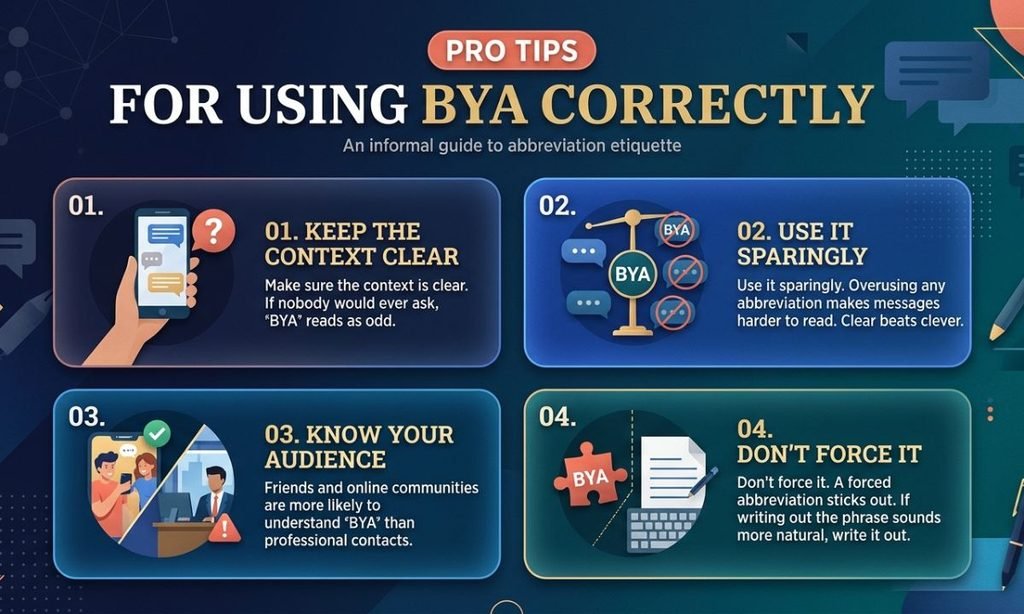
Getting the BYA meaning in text right is one thing. Using it well is another. These tips come from watching how it goes wrong and right.
- Keep the context clear. Make sure the information is something people would realistically ask about. If nobody would ever ask, BYA reads as odd.
- Use it sparingly. Overusing any abbreviation makes messages harder to read, and clear messages beat clever ones every time.
- Know your audience. Friends and online communities are more likely to understand BYA than professional contacts. That gap is worth a thought before you hit send.
- Don’t force it. A forced abbreviation sticks out more than a full sentence. If writing out the phrase sounds more natural, write it out.
- Pair it with helpful information. BYA works best when it immediately answers an expected question, like “BYA, the event was postponed until Friday.” An event postponed at the last minute is exactly the kind of news people ask about. My rule of thumb is short: answer the expected question, then stop typing.
How Popular Is BYA?
BYA is considered a niche texting abbreviation. People often ask whether it’s common, and the fair answer is moderately: it shows up in plenty of chats but isn’t nearly as common as LOL, BRB, IDK, BTW, or IMO. It still appears in texting, online forums, gaming communities, and social media conversations. As internet language evolves, abbreviations like this one might gain recognition among frequent online users, though I can’t point to hard numbers either way.
Is BYA Worth Learning?
The BYA meaning in text is usually simple once you check the context: most often “before you ask,” sometimes “because you asked,” “before you assume,” or a casual “bye ya.” It’s a convenient, casual abbreviation that helps people communicate more efficiently, even if it isn’t one of the most common internet slang terms.
Knowing it helps you follow online conversations without stopping to guess. The practical takeaway: when you see it, check where it sits in the message, notice the tone, and ask if you’re unsure. When you send it, use it with friends, answer a question people would really ask, and spell it out anywhere that needs to sound professional. Used that way, it makes conversations quicker and smoother, whether you’re texting friends, family, or members of online communities.
FAQs
What does BYA mean in text?
BYA most often means “Before You Ask.” The sender answers a question before you can type it. It can also mean “because you asked,” “before you assume,” or a casual “bye ya.”
What does BYA stand for?
BYA has no single official meaning. The most common reading is “Before You Ask.” Context decides whether it means that or one of the other three.
How do I know which BYA meaning someone is using?
Check where it sits in the message. At the end of a chat it usually means “bye ya.” Near the start, before an explanation, it usually means “before you ask” or “before you assume.”
What does BYA mean from a guy or a girl?
It means the same thing no matter who sends it. Gender doesn’t change the abbreviation. Tone, emoji, and your relationship with the sender are better clues.
What does BYA mean on TikTok or Snapchat?
There’s no confirmed platform-specific meaning. On both apps it most plausibly works as a quick sign-off or a short reply. Check the surrounding comments or Snaps.
What does “ima BYA” mean?
“Ima” is shorthand for “I’m gonna,” but there’s no documented meaning for the full phrase. It could be a joking threat among friends or a clumsy way to say goodbye. Ask the sender if you’re unsure.
Is BYA rude?
Not by itself. “Because you asked” can sound sharp without a friendly emoji, and one reported reading is a mildly vulgar joke. Read the whole conversation before assuming anything.
Is BYA the same as FYI?
No. FYI simply shares information, while BYA suggests the sender expects a question. “BYA, I already paid the bill” answers a likely question. “FYI, the bill has been paid” just informs.
Can I use BYA at work?
You can in casual workplace chats with people who know it. Avoid it in formal emails, reports, and official messages, where it can look unprofessional. Write “before you ask” or “to clarify” instead.
How do I reply when someone texts BYA?
Match your reply to the meaning you think they intended. “Thanks for letting me know” or “Good to know” works for most cases. If you’re not sure, ask: “Does BYA mean bye or because you asked here?”
Where did BYA come from?
No documented origin exists. It likely follows the usual pattern for internet abbreviations, with people typing the initials of a phrase they already say out loud. That part is a best guess, not a confirmed fact.
Is BYA a common texting abbreviation?
It’s moderately common in some chats but niche overall. It isn’t nearly as widespread as LOL, BRB, or BTW. Don’t assume everyone you text will recognize it.
