

A friend texts, “Just pin it so you don’t lose it,” and a minute later your bank sends a message that says “Your PIN is 482913.” Same word, two totally different jobs. If you have ever stopped mid-scroll wondering what does pin mean in text, you are in good company.
People search for this because the word wears so many hats. It shows up in group chats, map apps, banking alerts, Pinterest links, and even workplace Slack channels. Lowercase, capital letters, and one sneaky autocorrect error can all flip the meaning.
This guide gives you the one-line answer first, then walks through how pinning works on each major app, what the security PIN is, where the word came from, and how to figure out which meaning you are looking at.
Quick answer: In a chat app, “pin” means a message or conversation is fixed at the top so it stays visible while everything else scrolls past. The same word can also mean a map marker, a saved Pinterest post, a secret code (written PIN), an idiom like “pin down,” or a typo for “ping.”
Pin Meaning in Text: The Quick Reference Table
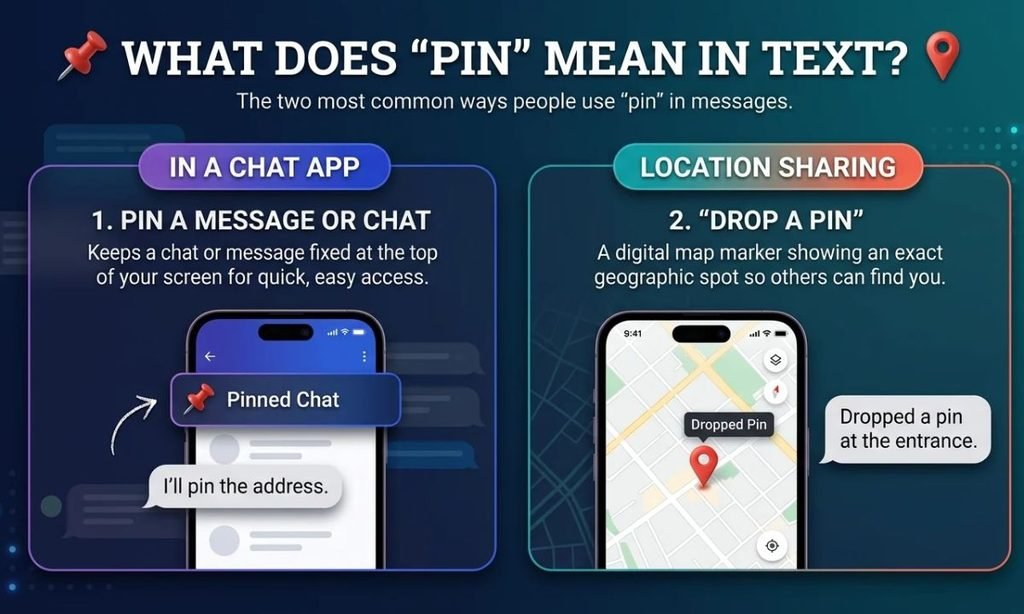
Before the details, here is the short version. Each row is a real way you might see the word, and the meaning changes with capitalization and context.
| What you see | What it means | Example |
| “pin” in a chat app | Keeps a message or chat fixed at the top | “I’ll pin the address.” |
| “drop a pin” | A map marker showing an exact spot | “Dropped a pin at the entrance.” |
| “send me the pin” | A saved Pinterest post | “Send me that recipe pin.” |
| “PIN” in capitals | Personal Identification Number, a secret code | “Enter your PIN.” |
| “pin down” or “pin on” | An idiom: settle a detail, or assign blame | “Let’s pin down a time.” |
| “pin me” | Often a typo for “ping me” | “Pin me when you land.” |
One of those rows is just a misspelling, and I will get to it. The rest each get their own section below.
What Does Pin Mean in a Chat App?
To pin something in a messaging app is to stop it from sliding out of sight. A pinned item stays in a fixed spot while the conversation keeps moving. I think of it as sticking a note to the front of the fridge.
In casual texting, people pin a conversation to keep things organized, or pin an important message for later reference. You can attach a pinned detail to a thread so it never scrolls away, share it with the whole group, and keep it easy to find. Most messaging apps now have the feature built in.
Sometimes someone will ask you to pin something simply because they keep losing it. A typical exchange goes like this:
A: “Send me the address again.”
B: “Just pin it so you don’t lose it.”
A: “Oh good idea.”
Here, pin works as a verb and an action word, and the address is the thing being kept. As a noun, pin can also mean the marker on a map, which we will cover shortly. Apps use the idea in two main ways.
Pinning a Message
A pinned message sits at the top of a single conversation. It works well for details people keep asking about, such as a meeting time, a venue address, a Wi-Fi password, or house rules in a group chat. Everyone in the chat can usually see it, which saves repeated questions.
Think of it as a noticeboard with one slot. Visibility is the whole point.
Pinning a Whole Conversation
Pinning a conversation moves the chat itself to the top of your list. It is a personal shortcut for the people you message most, and it changes nothing on the other person’s screen. From a user’s point of view, it is a private tidy-up.
A Typical Online Chat Example
In an online chat, pin usually means attaching a message to the top so everyone sees it without scrolling. Saving it there helps people remember details, and nobody has to forget the time or place.
A: “What time is the meeting?”
B: “7 PM. I’ll pin the message.”
A: “Perfect.”
The message stays visible, and anyone can find it easily.
Is Pin an Acronym or Slang?
Unlike many internet abbreviations, pin is not an acronym. It is a short action word that settled into digital conversations. As slang goes, it is an ordinary word, not a shortened form of something longer.
Its word type changes with the sentence. “To pin a message” is a verb. “A location pin” is a noun. A PIN code refers to a secret number, and that capitalized version is the only one that really is an acronym, short for Personal Identification Number. Part of speech tells you most of what you need to know.
How Pinning Works on Popular Apps
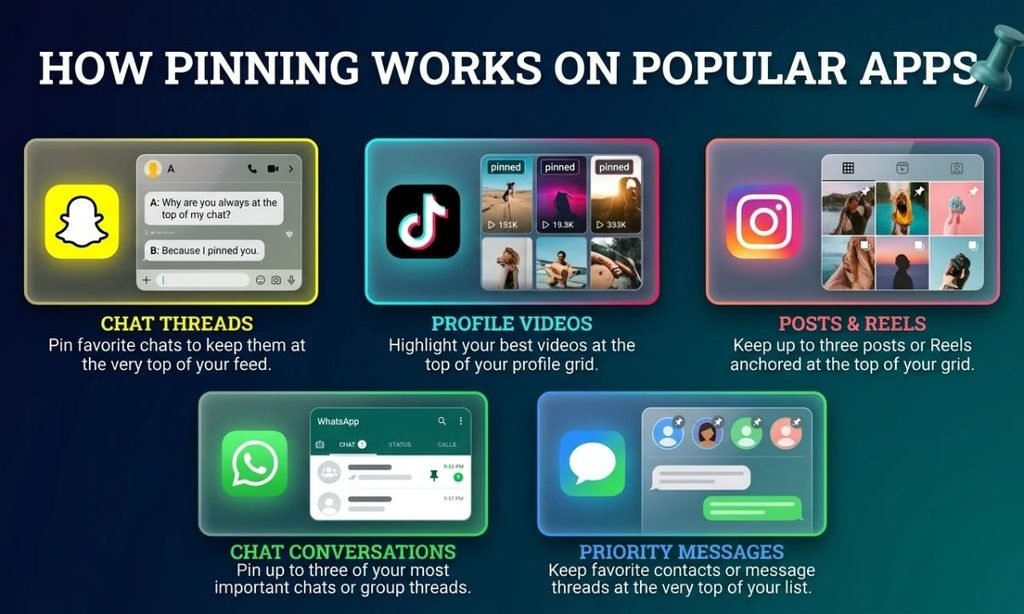
Different platforms use the word pin slightly differently, and the usage variation is small but real. I notice it most when someone jumps between apps in the same afternoon. Here is how each one handles it.
Snapchat
On Snapchat, pinning a conversation means locking it at the top of your chat list. People often pin best friends, important contacts, and active conversations, so those chats are always one tap away.
A: “Why are you always at the top of my chat?”
B: “Because I pinned you.”
“Pinned” is the past tense of the verb here, and it carries a slightly cheeky edge.
TikTok
On TikTok, pin usually refers to comments and, less often, videos. Creators pin a funny comment, pin important information, or pin replies to highlight engagement. It is how they steer a thread.
A viewer wonders, “Why is that comment at the top?” The answer: “The creator pinned it.” A creator might pin the one reply that sums up the joke.
On Instagram, pinning is used for comments and chats. Users pin favorite comments, creators pin announcements, and people pin important direct messages they do not want to lose.
A: “Did you see my comment?”
B: “Yeah, the creator pinned it.”
On WhatsApp, pinning chats keeps conversations at the top of the chat list. Common uses are family chats, work groups, and important contacts, the ones you open ten times a day.
A: “I can’t find our chat.”
B: “Just pin it so it stays on top.”
SMS
In traditional SMS, pin usually refers to a numeric security PIN. Here it is the acronym again, used as a noun, and the security side matters more than the slang.
A: “What’s the PIN for the card?”
B: “I’ll send it privately.”
The safer habit is to send privately, never in a group thread.
App-by-App Limits and Menus
Every app does this a little differently. Treat the table below as a snapshot, because limits and menus change when apps update. Confirm them in your own app before relying on them.
| App | What you can pin | How it works and the limits |
| iPhone Messages | Conversations | Swipe right on a chat. Up to nine conversations, and pins sync across Apple devices when Messages in iCloud is on. |
| Google Messages | Conversations | Touch and hold a chat, then tap the pin icon. Menus vary between Android brands. |
| Messages inside a chat, and chats in your list | Up to three messages per chat, kept for 24 hours, 7 days, or 30 days. Group admins can limit pinning to themselves. | |
| Snapchat | Conversations | Currently up to three. People are not notified when you pin them. |
| Comments on your posts, and DMs | Up to three comments per post. The commenter gets a notification. | |
| TikTok | A comment on your own video | Creators use it to highlight a funny reply or a common answer. |
| Discord and Slack | Messages saved to a channel’s pinned list | Handy for rules, links, and announcements. Discord has capped pins per channel, so check the current limit. |
Will the Other Person Know You Pinned Something?
It depends on the app, and it matters more than most people expect. In WhatsApp groups, members see a notice showing who pinned a message. On Instagram, the person whose comment you pin gets a notification.
Pinning a friend’s conversation on Snapchat does not alert them. On iPhone and Android, conversation pins are private to you. I would check how each notification works before pinning anything sensitive, because an alert you did not intend can be awkward.
Pinned vs. Starred or Saved Messages
Pinned messages are for information the whole chat needs to see right now. Starred or saved messages work more like a private bookmark list. The difference is audience: a pin is for everyone, a star is for you.
WhatsApp pins expire after the time you choose, so permanent details belong in a starred message or a saved note. My rule is simple. Pin what is urgent, star what is permanent.
What Does “Drop a Pin” Mean? Map Pins vs. Pinterest Pins
Dropping a pin means placing a marker on a map and sending it to someone. In Google Maps or Apple Maps, you touch and hold a spot, and the app creates a marker you can share. The recipient taps the pin and gets directions.
It is more reliable than an address when you are meeting at a park entrance, a beach, or a street with unclear numbers. Picture a friend saying, “Dropped a pin at the entrance,” while you circle a parking lot.
A Pinterest pin is something else: a saved image, idea, or link on a board. If a friend says “send me the pin,” they probably mean a Pinterest post, like a recipe or a room-decor idea. Same words, different app.
What Does PIN Mean as a Security Code?
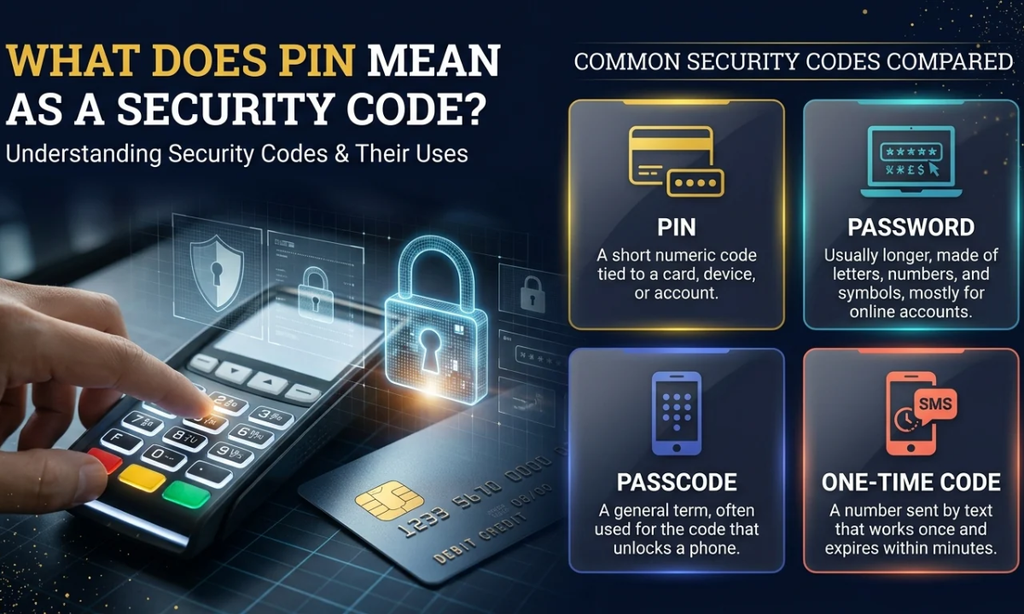
Now the banking meaning. A PIN is a private, secret code, and it has nothing to do with chat. It is a homonym of the chat verb, which is why the mix-up happens. The first clue is always the capital letters.
What PIN Stands For
PIN stands for Personal Identification Number. It is a short secret code that proves it is really you, whether you are at an ATM, paying at a card terminal, unlocking a phone, or opening a banking app.
PIN vs. Password vs. Passcode vs. One-Time Code
These terms get mixed up constantly, so here is a side-by-side view.
| Term | What it is |
| PIN | A short numeric code tied to a card, device, or account |
| Password | Usually longer, made of letters, numbers, and symbols, mostly for online accounts |
| Passcode | A general term, often used for the code that unlocks a phone |
| One-time code | A number sent by text that works once and expires within minutes |
The last one trips people up. A message saying “Your PIN is…” is sometimes just a one-time code, and the safe reaction is slightly different for each.
How to Protect Your PIN
Never share it, even with someone who claims to work for your bank. Banks generally state that they will never ask for it. Here are the habits I would give to family:
- Treat a one-time code like a PIN, and never read it aloud to a caller.
- Avoid obvious choices such as repeated digits or sequential digits.
- If you receive a code you did not request, do not reply.
- Contact the company, card provider, or bank through its official app or phone number.
That is basic scam prevention more than anything clever.
Why Do People Say “PIN Number”?
The N in PIN already stands for number, so “PIN number” technically means “personal identification number number.” Writers call this pattern RAS, short for redundant acronym syndrome. The name is a joke, because “RAS syndrome” repeats the word syndrome. The term appeared in a New Scientist column in 2001.
It is common because people stop hearing an acronym as separate words. Once PIN feels like an ordinary word, adding “number” feels natural. Other examples include “ATM machine,” “HIV virus,” “ISBN number,” and “VIN number.” Linguists call this redundancy, tautology, or pleonasm. Habit beats logic.
Is It Wrong to Say PIN Number?
In everyday speech, hardly anyone minds. In formal writing, such as a bank notice or an academic paper, “PIN” on its own is tidier. In a quick text, either version works. The formal versus informal split does most of the work.
A Short History of the PIN
The PIN emerged from cash-machine development in 1960s Britain. Scottish engineer James Goodfellow filed a patent for a PIN-based system in May 1966. In 1967, John Shepherd-Barron’s team opened a Barclays cash machine in Enfield, London.
Shepherd-Barron reportedly wanted six digits but chose four after his wife said four was the most she could remember. Treat that as an anecdote. Who deserves the credit for the invention is argued over, and I would rather say so than pick a winner.
The international banking standard, ISO 9564-1, allows four to twelve digits and recommends no more than six.
The BlackBerry PIN
On BlackBerry phones, a PIN was a unique ID for the device. You could share it to be added on BlackBerry Messenger (BBM) without revealing your phone number or email address. The BBM consumer service shut down on May 31, 2019, so this meaning is now historical. It still pops up in older texts and forum posts.
Other Ways “Pin” Shows Up in Messages
Sometimes pin has nothing to do with apps or banking. A few idioms appear in texts all the time, and each is figurative language.
- Pin down: settle a detail. “Can we pin down a time for Saturday?”
- Pin the blame on: hold someone responsible. “Please don’t pin this on me.”
- Pin your hopes on: rely heavily on one outcome.
- Hear a pin drop: the room is completely silent.
Pin vs. Ping: The Autocorrect Mix-Up
“Ping” means a nudge or quick message, as in “Ping me when you get home.” Autocorrect or fast typing can turn it into “pin.” If a text says “pin me when you arrive” and nothing was pinned, the writer almost certainly meant ping.
It is a typo more than a second meaning, and I have seen it happen more than once. A pin keeps something visible, while a ping is a quick message or alert.
How to Tell Which Meaning You Are Looking At
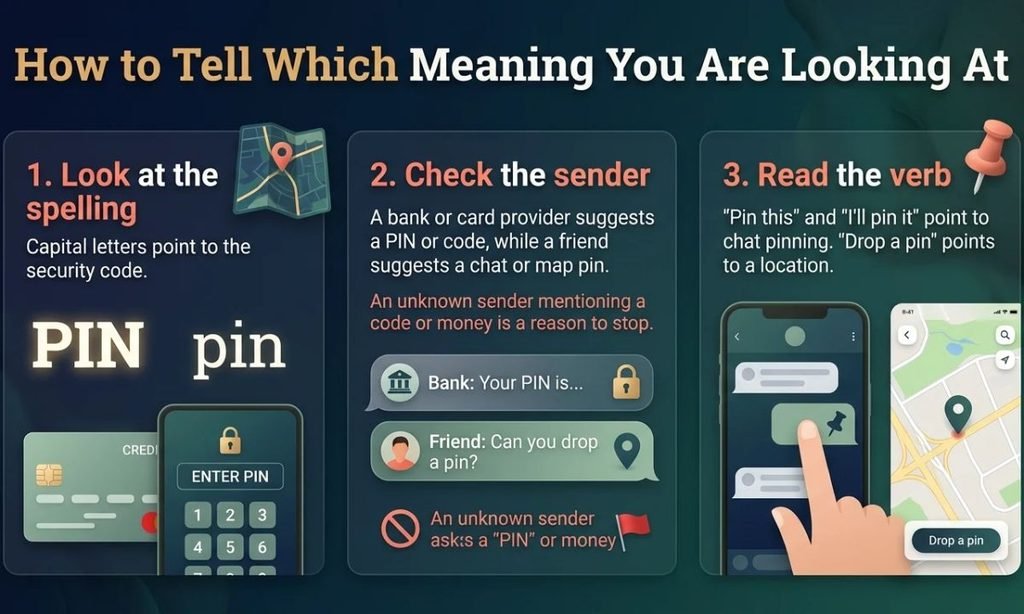
When you are unsure, run through these quick checks:
- Look at the spelling. Capital letters point to the security code.
- Check the sender. A bank or card provider suggests a PIN or code, while a friend suggests a chat or map pin. An unknown sender mentioning a code or money is a reason to stop.
- Read the verb. “Pin this” and “I’ll pin it” point to chat pinning. “Drop a pin” points to a location.
- Consider the app. In Pinterest it is a saved idea, in Maps a marker, and in WhatsApp or Discord a highlighted message.
- Test for a typo. If pin makes no sense and the message seems odd, try ping.
Context almost always settles it. If it still does not, ask the person, as long as you know them. If the message came from an unknown sender and mentions a code or money, do not reply.
Where Does the Word “Pin” Come From?
Dictionaries such as Merriam-Webster trace the word to before the 12th century, first as a small fastener. The exact root is not perfectly tidy, so I would not oversell any single story.
The chat meaning follows the bulletin-board idea, where people pinned notices so everyone would see them. In early forums, moderators began pinning important posts to the top of discussion boards. The same concept spread to chat apps, comment sections, and group conversations, and today it is a standard feature across almost all social platforms. It is a small piece of internet culture that grew out of modern messaging.
Grammar: How “Pin” Works in a Sentence
In texting, pin functions mainly as a verb, though it can also act as a noun. Its role is a quick command: put this where everyone can see it.
Part of Speech
Verb examples: “Pin this message.” “Pin the link.” “Pin our chat.” Noun examples: “Send a location pin.” “Share the pin.”
Sentence Role
It usually appears as a command in the imperative: “Pin this.” In the past tense it reports what happened: “I pinned the message.” And “Check the pinned chat” points the reader to the result.
Sentence Position
Pin can sit at the beginning (“Pin this message please”), the middle (“Can you pin the address?”), or the end (“I already pinned it”). Word placement barely changes the meaning.
How Tone Changes What “Pin” Means
One word can flip with tone. I have watched pin change character three times in a single group chat, and the shift is almost always about attitude, not definition.
- Funny: “Don’t forget the meme I sent.” “I’m pinning it for emotional support.”
- Sarcastic: “Remember to do your homework.” “Sure, I’ll pin that reminder forever.” The sarcasm lives in the word “forever.”
- Romantic: “Why am I always first in your chat list?” “Because I pinned you.”
- Angry: Someone tired of repeating instructions tells the group to pin them so people stop asking.
- Playful: “Send the party address.” “I’ll drop the location pin.”
Real Chat Examples of Pin in Text
Here are fifteen realistic exchanges from daily texting, the kind you would see in any group chat.
- “What time is the event?” “6 PM. I’ll pin the message.”
- “Send your location.” “I just dropped a pin.”
- “Why is our chat at the top?” “I pinned it.”
- “Don’t lose that link.” “I’ll pin it.”
- “Where’s the meeting again?” “Check the pinned message.”
- “Send the restaurant location.” “Sending a pin now.”
- “I keep forgetting the date.” “I pinned it in the group chat.”
- “Why did you pin my comment?” “Because it was funny.”
- “I can’t find your address.” “Look at the pinned message.”
- “Keep this info safe.” “Don’t worry, it’s pinned.”
- “Where do we meet?” “I sent a location pin.”
- “Your chat is always first.” “Yeah, you’re pinned.”
- “I keep losing the link.” “Just pin it.”
- “Why did the creator pin that comment?” “Because it’s the best comment.”
- “Don’t forget the password hint.” “I pinned the message already.”
How to Reply When Someone Says “Pin”
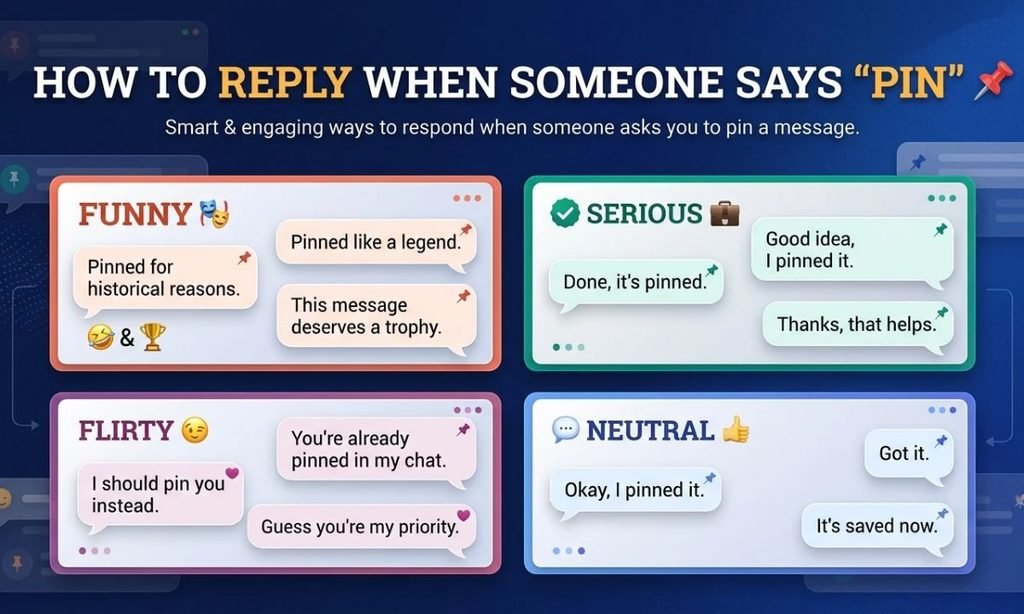
Your reply depends on the situation and the tone.
| Reply type | Examples |
| Funny | “Pinned for historical reasons.” “Pinned like a legend.” “This message deserves a trophy.” |
| Serious | “Done, it’s pinned.” “Good idea, I pinned it.” “Thanks, that helps.” |
| Flirty | “I should pin you instead.” “You’re already pinned in my chat.” “Guess you’re my priority.” |
| Neutral | “Okay, I pinned it.” “Got it.” “It’s saved now.” |
For a simple response, “Done,” “Pinned it,” “Good idea,” or “Okay, I saved it” all work. In my experience, the one-word answer is what most people actually send.
Is Pin Rude, Disrespectful, or a Bad Word?
No. Pin is not rude or offensive. It is a completely normal word used in messaging apps, and its tone is neutral. It is simply a technical action word, safe and harmless, and it is not slang in a negative sense. The answer is the same whether you ask about rude, disrespectful, or bad.
The only caution is register. Pin is informal digital language, so it can feel out of place in formal writing.
Formal vs. Informal Usage: School and Work
Pin is mostly informal, though it is acceptable in team chats, online groups, and messaging apps. It only feels stiff when you carry it outside a chat.
At school, teachers and students often say, “Please pin the assignment message.” At work, a line like “Let’s pin the meeting schedule” is typical in workplace chats. Pin is commonly used in professional group chats and school communication platforms to highlight important messages, so both are fine. A workplace mistake would be using it in official documents or professional reports, where plain wording works better.
Who Uses “Pin” in Text?
The word is widely used across different age groups, and the audience is broad.
- Age groups: Most common among Gen Z, Millennials, and online creators. The apps people live in matter more than the generation.
- Regions: Used globally, including the United States, United Kingdom, Canada, Australia, and international internet communities.
- Platforms: Snapchat, TikTok, Instagram, WhatsApp, and Discord are the most common homes for the word.
Pin vs. IDK and Other Texting Abbreviations
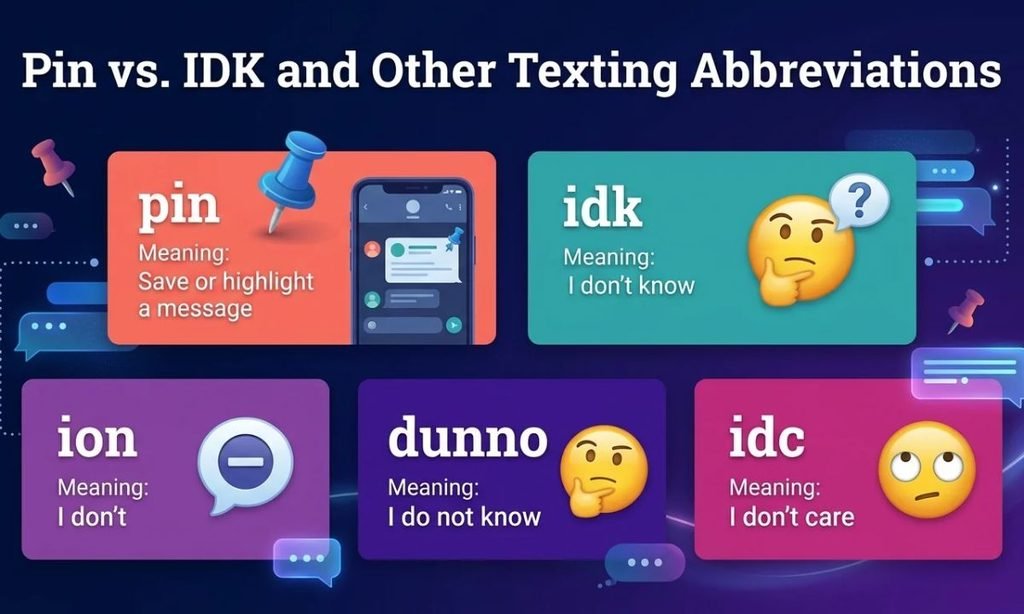
Pin and IDK are completely different. Pin means saving a message, and IDK means “I don’t know.” People lump them together because both are short and casual. If you keep running into other confusing abbreviations, our guide on PWHP meaning in text is a good next read.
| Term | Meaning | Formal/Informal | Tone | Popularity | Confusion Risk |
| pin | Save or highlight a message | Informal | Neutral | High | Low |
| idk | I don’t know | Informal | Casual | Very High | Low |
| ion | I don’t | Informal slang | Casual | Medium | Medium |
| dunno | I do not know | Informal | Casual | Medium | Low |
| idc | I don’t care | Informal | Dismissive | High | Medium |
The popularity column is my rough read, not measured data. Pin is the only one here that acts as a feature name rather than a shortened sentence.
What I Notice in Real Chats
In real conversations, people rarely say the full phrase “pin this message.” They write “Pin it,” “Just pin that,” or “Check the pinned message.” That shorthand shows how modern texting prioritizes speed and clarity.
In group chats, pinning prevents repeated questions, keeps important information visible, and keeps things organized.
Common Mistakes, When to Use It, and When to Avoid It
People sometimes confuse pin with PIN codes, location pins, and social media pinning. Most mix-ups come down to noun versus verb, or lowercase versus capital letters. Always rely on context.
Use pin in messaging apps, social media comments, group chats, and online communities. The platform has to support it, and the context has to call for it. Avoid it in formal writing, official documents, and professional reports. The restriction comes from formality, not from any rudeness.
Final Thoughts and Practical Takeaways
The word is tiny, but it carries real weight, and context is your best guide. Lowercase pin keeps important messages and conversations easy to find. Capital PIN is a secret code that belongs only to you. A dropped pin shows friends exactly where to meet on a map.
Use pin when you want to save important messages, help others find information easily, or organize group chats. Pin the things people keep asking about, and let the rest scroll.
Every app handles limits and privacy differently, so check what the other person can see before you pin anything. If a message mentions a PIN or code you never requested, do not reply, and contact the company through its official channel instead. Next time the word shows up, check the spelling, read the setting, and you will know the answer. Bookmark this guide for reference.
FAQs
What does pin mean in text?
In a chat app, “pin” means a message or conversation is fixed at the top so it stays visible. It can also mean a map marker, a Pinterest post, a secret code (written PIN), or a typo for “ping.”
What does it mean when someone pins a message?
Their message stays at the top of the chat while newer messages scroll past. It is used for details people keep asking about, like a meeting time, an address, or group rules.
What does “drop a pin” mean?
It means placing a marker on a map and sending it to someone. You touch and hold a spot in Google Maps or Apple Maps, share it, and the other person taps it for directions.
What does PIN stand for?
PIN stands for Personal Identification Number. It is a short secret code that proves it is really you at an ATM, a card terminal, a phone, or a banking app.
Is it wrong to say “PIN number”?
It is technically redundant, since the N already stands for “number.” Most people say it anyway, and it is fine in casual speech. Use “PIN” alone in formal writing.
What does “pin me” mean in a text?
It is usually a typo for “ping me,” which means send me a quick message. If nothing was pinned and the text says “pin me when you land,” the sender almost certainly meant “ping.”
Does the other person know when I pin their chat?
It depends on the app. Snapchat and iPhone Messages do not notify them, while Instagram notifies a commenter whose comment you pin. WhatsApp groups show a notice about who pinned a message.
How many messages can you pin on WhatsApp?
Currently, you can pin up to three messages per chat. Each stays for 24 hours, 7 days, or 30 days. Limits can change with app updates, so confirm in your own app.
What is the difference between pinned and starred messages?
Pinned messages are for information the whole chat needs to see right now. Starred or saved messages work like a private bookmark list. Pins on WhatsApp expire, so keep permanent details starred.
What does pin mean on Snapchat, TikTok, and Instagram?
On Snapchat, pinning locks a conversation at the top of your chat list. On TikTok and Instagram, creators mostly pin comments so they appear first under a post.
Is pin a rude word in texting?
No. It is a neutral, harmless word that is safe in school chats, workplace channels, and family groups. It is informal, so avoid it in formal writing or official documents.
What does “pin down” mean in a text?
It is an idiom meaning to settle a detail, as in “Can we pin down a time for Saturday?” It has nothing to do with chat pinning or PIN codes.
How can I tell which meaning of pin someone is using?
Check the spelling first, since capital letters point to the security code. Then look at the sender, the verb, and the app. If an unknown sender mentions a code or money, do not reply.
Should I ever share my PIN or a one-time code?
No. Banks generally state they will never ask for your PIN. Never read a one-time code aloud to a caller, and contact your bank through its official app or phone number if a request seems off.
