


You ask a friend if the party drama is about to blow up, and the reply comes back as three letters: “IWK.” No punctuation, no explanation. If you have ever stared at that message wondering what it means, the IWK meaning in text is simpler than it looks.
People search for it because it shows up out of nowhere in WhatsApp threads, Instagram DMs, Snapchat replies, TikTok comments, and dating apps. It is not as famous as LOL or BRB, so it feels like a code you were never taught. It also doesn’t behave like a textbook abbreviation, which adds to the confusion.
This guide explains what the three letters stand for, where this kind of slang comes from, and how people use it on different platforms. You will also see how it differs from IDK, how to reply, and when it’s smarter to type the full sentence instead.
Quick answer: IWK is an informal texting acronym that most often stands for “I wouldn’t know.” People send it when they lack the information, weren’t present for the situation, or simply don’t want to weigh in. Its exact tone depends on the conversation, the platform, and who sent it.
What Does IWK Stand For in Text?

At the simplest level, IWK is an acronym built from the phrase “I wouldn’t know.” That reading shows up in the large majority of chats. It works as a shorthand way of saying, “No idea, and it’s not my area.”
Why Three Letters Instead of a Full Sentence
Typing on a phone screen takes effort. Shortening a full phrase to three letters saves time, and it keeps the conversation moving. Concise often beats polite when you’re replying one-handed in a hurry.
I think of IWK as a conversational shortcut. It stands in for a longer sentence, something like, “I don’t have the specific information to answer that, so I’m going to stay out of it.” Instead of explaining why you lack an answer, you send three letters and the digital dialogue keeps rolling.
A Quick Example
Say a friend texts, “Do you think Sarah is going to be mad about the party?” You reply, “IWK.” You’ve made a plain statement of fact: you have no basis for an opinion.
It fits best in two situations. One is a question about a topic you are unfamiliar with. The other is a situation you weren’t there for.
How Tone Changes the Meaning of IWK
Here is where it gets interesting. IWK moves across different emotional registers, and the letters alone don’t tell you which one you’re getting.
It can read as neutral, a simple, honest “I can’t help with that.” It can come across as a little sarcastic, depending on what was said before it. In a heated moment, it can sound defensive. Same letters, different heat.
How I Read the Context
IWK isn’t a fixed dictionary term the way LOL or BRB is. It isn’t a formal English word or a grammar term, and it has no globally standardized meaning. That makes it context-driven, so I check three things before deciding what a sender means:
- The surrounding messages, since the sentences around it usually settle the question.
- The sender, including how they normally text and how well you know them.
- The conversation flow, meaning whether things were light, tense, or rushed.
Tone does the rest. Understanding it is always about context-based meaning, so read the whole thread and not just the three letters.
Acknowledgment More Than Answer
I also see IWK as an acknowledgment more than a real answer. The sender read your message and is telling you they can’t help. Short reactions like this keep fast-paced conversations moving, and they often work as statements of awareness more than replies to the actual question.
Where Did IWK Come From?
Nobody has documented exactly when or where IWK first appeared, so treat any confident origin story with suspicion. What we can say is that the history of internet acronyms goes back to chat rooms and SMS messaging. Abbreviations like this grew out of mobile texting culture.
The Early Days of Texting
Before smartphones, mobile phones relied on T9 predictive text and tight character limits on every SMS. That pushed people to get creative. When every character cost effort, they shortened phrases into initials to save time and effort.
As technology evolved, terms like LOL, BRB, and IDK became the foundation of a new digital language. IWK sits in that family tree.
From SMS to Social Media
The move from early SMS to Twitter, Instagram, and TikTok accelerated adoption. Platforms that reward rapid-fire communication, or cap how much you can write, made shorthand the standard. The timeline from texting to social feeds is short.
The rise of social media messaging apps, gaming chats, and live communication platforms pushed the habit further. Fast messaging rewards minimal typing, and digital communication platforms made it feel normal.
An Evolution of IDK
Many people see IWK as an evolution of the older and more universal IDK, which stands for “I don’t know.” IDK is a blanket statement. IWK carries a more specific nuance: if you did know, you might have an opinion, but you lack the data, so you’re staying out of it.
Unlike older slang terms that spread globally through pop culture, IWK seems to have developed organically in small online communities. It may have started as a personal shorthand that later reached broader conversations among younger users. That is a likely explanation for why it isn’t standardized and why the meaning may vary from person to person.
How Slang Gets Tracked
If you’re curious how informal language is defined and eventually makes its way into the dictionary, Merriam-Webster’s entry on slang is a good starting point. It’s a good reminder that vocabulary shifts because we want both efficiency and connection. People keep finding ways to communicate quickly and effectively, and slang is how it shows up.
How People Use IWK in Everyday Chats
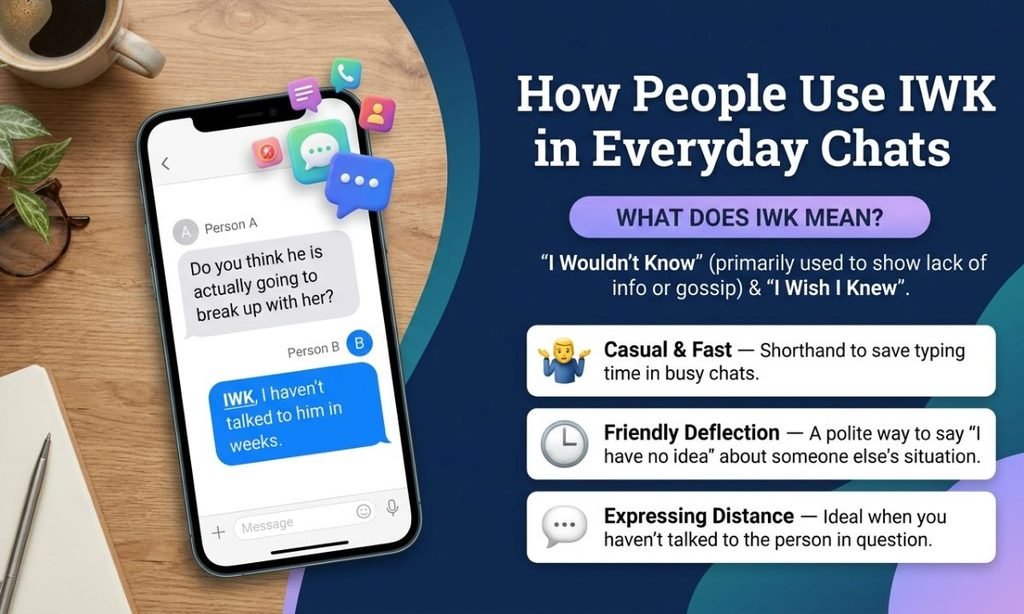
Usage varies significantly by setting, and a message is interpreted differently depending on where it lands. In general texting, IWK is a quick reaction. I see it most in casual chats between friends and in memes, where a full sentence would kill the joke.
In texting, it’s often a quick deflection. If a guy or girl asks for your take on a friend’s drama, “IWK” is a polite way to avoid getting involved. Here is a typical exchange:
Person A: Do you think he is actually going to break up with her?
Person B: IWK, I haven’t talked to him in weeks.
Here it’s a neutral, helpful response. Person B makes clear they have no inside information and offers the reason.
The conversation structure stays simple: question, three letters, move on. The informality is the whole point. The abbreviation is easy to type, but it only works when the reader knows what it means.
On WhatsApp and Snapchat
On WhatsApp, IWK mostly shows up in private chats as a quick shorthand message. People send it alone or with an emoji. On Snapchat, where communication is instant and snaps and captions are short, it fits naturally into playful exchanges.
On TikTok, Instagram, and Twitter
On TikTok, IWK appears in video comments and reactions to videos. Sometimes it signals agreement, surprise, or simple engagement. On Instagram, you’ll find it in DMs and comment sections, often paired with casual slang.
You’ll spot it in the comments section of both platforms. People use it to say they aren’t part of the current trend, or that they’re confused by whatever a video is referencing. I call it a badge of honesty. Admitting you don’t know invites others to explain the context, which is a decent way of engaging with a post even when you feel lost.
It’s most common on platforms built for quick, informal interaction, such as Twitter, TikTok, and direct messaging apps. Across all of them, speed over clarity wins, and the meaning stays platform-specific in tone. I’ve seen it work as a lone reply, sent alone or with emojis, and tucked inside longer sentences next to other slang. Casual conversation threads are where it’s easiest to read.
In Gaming Chats
A gaming environment changes things. Say you’re in a team-based game and a teammate asks why a strategy failed. A bare “IWK” can come across as defensive, as if you’re shrugging off the question. Same letters, different heat again.
In gaming communities, IWK also shows up during intense gameplay. When you’re focused on winning, there’s no time for long sentences. If a teammate asks for your status on a specific item or objective, IWK is a quick, functional response that acknowledges the question without pulling your eyes off the screen.
Real Examples of IWK Meaning in Text
Here are the patterns I see most. Treat these as sample sentences, not quotes from real people.
- “IWK, but weren’t you talking about that yesterday?”
- “Iwk lol, didn’t expect that to happen 😂”
- “IWK, give me a second, I’ll check.”
- She said IWK and left the chat quickly.
The first is a casual reply with a hint of teasing. The second uses “lol” and an emoji to soften the shrug. The third is honest: I don’t know offhand, but I can find out. The fourth shows how a cold-sounding IWK can end a chat.
IWK vs. IDK and Other Similar Terms
Most texting abbreviations have a standardized definition. IWK is the odd one out because it has no fixed meaning. It’s context-based, adaptable, and a bit confusing, which also makes it flexible in casual conversations.
The comparison below shows how it stacks up against common slang.
| Term | Stands for | What it signals |
| IWK | I wouldn’t know | No knowledge of this specific situation or person |
| IDK | I don’t know | A general statement of ignorance |
| IMO | In my opinion | You’re about to share a view |
| BRB | Be right back | You’re stepping away briefly |
| LOL | Laugh out loud | Something was funny |
| SMH | Shaking my head | Disappointment or disbelief |
The difference between IWK and IDK is subtle but real. IDK says you don’t know. IWK suggests you wouldn’t know because you weren’t there or aren’t involved. IDK is a statement of ignorance, while IWK is a statement of having no knowledge of the specific situation or person involved, which draws on personal knowledge.
Try it with a trivia question. If someone asks, “What is the capital of France?” and you answer “IDK,” that makes sense. “IWK” would sound odd, because the capital of France doesn’t depend on your personal experience. The reply would make people stop and reread the message.
Most abbreviations don’t carry that nuance, which is why IWK stands out.
Common Mix-Ups and Misconceptions About IWK
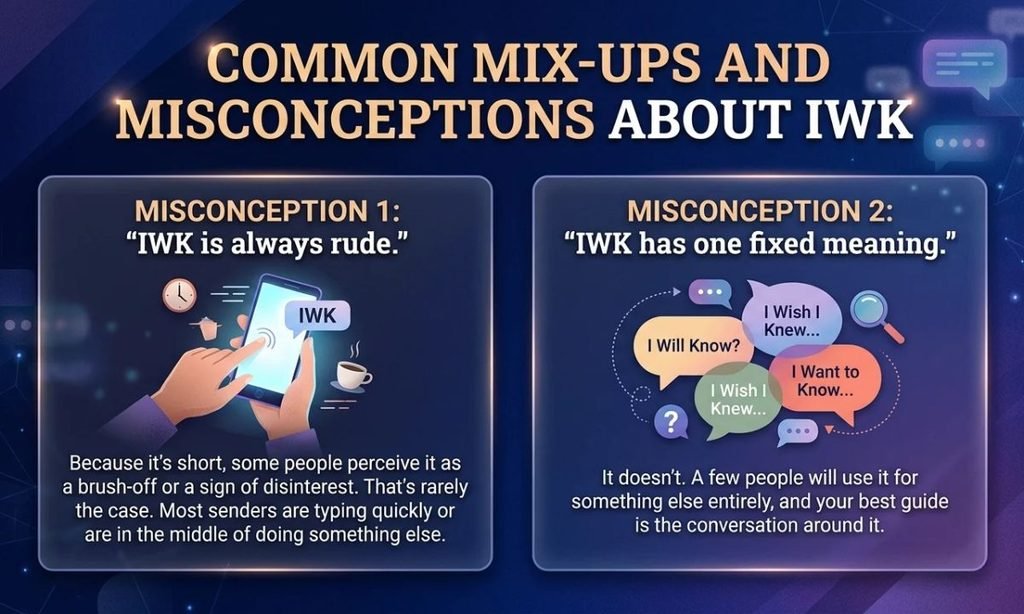
A few wrong ideas keep circulating about this term. Clearing them up can save you from an awkward misread.
“IWK is always rude.” Because it’s short, some people perceive it as a brush-off or a sign of disinterest. That’s rarely the case. Most senders are typing quickly or are in the middle of doing something else.
“IWK has one fixed meaning.” It doesn’t. A few people will use it for something else entirely, and your best guide is the conversation around it.
“IWK is a formal acronym.” It’s informal slang, and only informal. It isn’t an official abbreviation in any style guide.
“IWK means the same thing as another look-alike abbreviation.” People do confuse it with similar-looking abbreviations that have completely different meanings. A good example is IFK meaning in text, a swear-boosted way of saying “I know” that has nothing to do with “I wouldn’t know.” When you assume, you get it wrong, which is why I always say the answer depends on context.
“Everyone knows it.” The term isn’t universal. Older generations, or anyone who isn’t tech-savvy, may not recognize it. Send it to a family member or in a professional email and you may get confusion back.
Know your audience. If there’s any chance of misinterpretation, type out the full phrase and keep things clear and professional.
Does IWK Mean Something Else in Other Fields?
Outside chat, IWK doesn’t carry much weight. Medical language has no recognized medical meaning for it. IWK Health is the name of a hospital system in Halifax, Canada, but that’s a proper name, not a term for a symptom or procedure.
Physics doesn’t use it either, so it’s not a standard physics abbreviation. Technology is the only field where it may appear, as internal shorthand in coding or private systems. Even there it isn’t widely standardized, and the recognized meaning is whatever that team decided.
For general text usage, “I wouldn’t know” is still the safe bet. Other meanings can pop up in different fields, but they rarely apply to the message on your screen.
Alternatives to IWK When You Don’t Know
When you want to say you don’t know something, you have options. Choosing the right term depends on your relationship with the person you’re talking to.
- IDK: The most common alternative. It’s universal and understood by everyone.
- I have no idea: A bit more expressive, and slightly clueless-sounding.
- Not sure: Softer and more polite when you want to deflect a question.
- No clue: Casual, similar to “I have no idea.”
- Beats me: Very informal and slightly dismissive.
With a close friend, IWK or “no clue” works fine. In a more formal setting, “I am not sure” is the safest bet. I like mixing them up so my language stays fresh and responsive to the tone of the conversation. Variety conveys a lot about mood, so compare the options before you hit send.
How to Reply When Someone Sends IWK
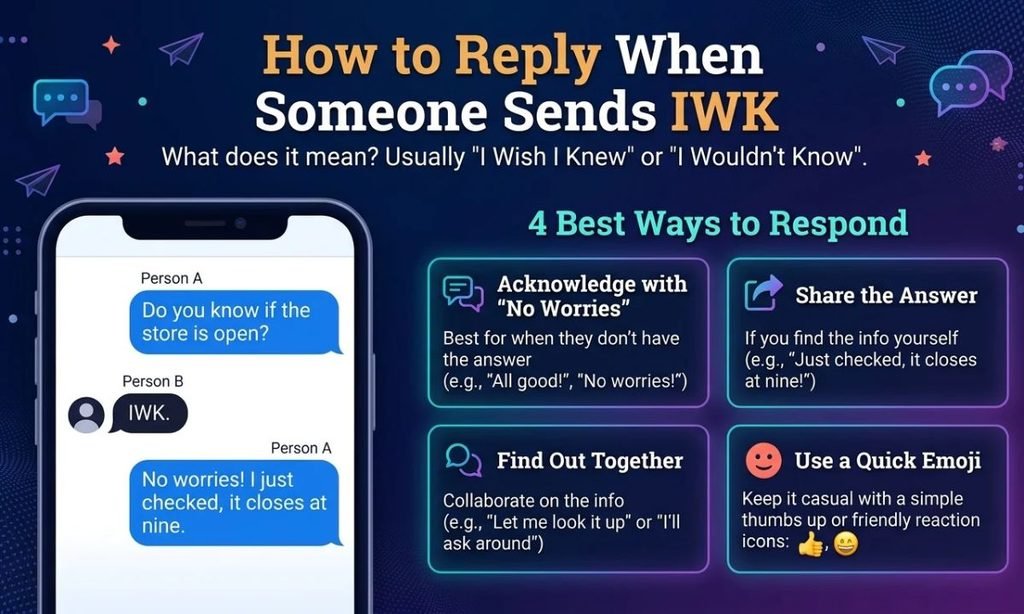
Your response depends entirely on context. First, ask yourself whether the meaning is clear. If it is, a quick “got it 👍” is enough, and you can supply the information they needed or move on to a different topic.
If you’re unsure, ask. “Can you explain that?” or “What do you mean by IWK here?” are both fine. I’ve asked the second more than once, and nobody minded.
Casual Chats
In a casual conversation, don’t overthink it. Provide what they need or change the subject.
Person A: Do you know if the store is open?
Person B: IWK.
Person A: No worries! I just checked, it closes at nine.
When the Sender Is Joking
If the sender is being funny or sarcastic, play along with the brevity.
Person A: Why is he acting so weird today? IWK.
Person B: Truly a mystery for the ages.
When a Colleague Sends It
At work, avoid the acronym. If a colleague sends you an IWK, I’d answer with, “I am not certain, let me look into that for you.” That turns a moment of not knowing into something helpful and proactive.
Whatever you choose, match the energy of the sender while keeping your own communication style in mind.
Using IWK on Dating Apps
On dating apps like Tinder or Hinge, brevity rules. Right after a match, you want the conversation light and easy. If someone asks about your preferences or a shared interest you’re not familiar with, IWK helps keep the ball rolling without forcing you to write a paragraph.
People prefer short expressions on dating apps, messaging platforms, and social media because they keep things moving. IWK can be a quick reaction, a way of acknowledging a message without a full reply, and it keeps responses simple while maintaining engagement.
Be careful, though. Use it too often and it can look like you’re not putting in much effort, or that you’re not interested in the conversation. I’d use it sparingly.
If you catch yourself reaching for it frequently, shift the conversation toward topics you actually know. If the other person is unfamiliar with the term, the meaning is not universally fixed and your message may fall flat. Overusing unclear abbreviations looks like low effort, so it’s not always a smart move.
Can You Use IWK at Work?
The short answer is no. Professional communication needs clarity, respect, and some formality. Slang and acronyms like IWK can look unprofessional and dismissive of the task at hand. A job interview or professional email is the last place to try it. Stick to formal language there.
At a workplace, the best approach is to be honest but professional. Try one of these lines:
- “I do not have the information at the moment, but I will find out.”
- “I am not familiar with that particular process.”
Those read as competent, dedicated, and reliable, and they avoid brushing off the question.
Even in internal team chats on Slack or Microsoft Teams, I’d err on the side of caution. The exception is an office culture that’s very laid back and comfortable with overly casual messages, and even then I’d lean toward full words. Full words cut down ambiguity, misunderstandings, and errors in your work. That’s the hallmark of a good professional, and a quiet way to avoid a workplace mistake.
Can IWK Sound Rude or Offensive?
IWK is generally harmless. Does it have hidden or offensive meanings? In most cases, no. It’s a straightforward slang term. It is informal, though, and it can be perceived as dismissive depending on tone.
Tone is everything. Use it when someone wants serious help or is showing vulnerability, and it can sound cold and uncaring. Picture a friend describing a difficult personal struggle and asking your view on a complicated matter. A bare “IWK” there would hurt.
Even if you truly don’t know what to say, offer a supportive response and a listening ear. Try something like, “I am not sure what the right answer is, but I am here for you.”
Context is the ultimate filter. Before you hit send, think about how your message will land. Ask yourself whether it’s the right time for a shorthand acronym or whether the moment calls for a thoughtful, full-sentence reply. Being mindful of that protects your relationships, online and offline, and helps keep them strong and healthy.
Who Uses IWK, and Can You Say It Out Loud?
IWK is gender-neutral. Guys and girls use it alike, and so does anyone active in digital communication.
Can you say it in face-to-face conversation? You can, but it may sound strange. It’s a written acronym, so in person it’s better to say the full phrase out loud.
The Takeaway on IWK
Learning terms like IWK is a bit like picking up a new language, and this one is a small piece of a much bigger, evolving world of digital slang. Most of the time it means “I wouldn’t know,” and most of the time it’s harmless. The skill is in reading the situation: the surrounding messages, the platform, the sender, and the tone.
Shorthand buys speed, but it shouldn’t replace the warmth and clarity of a well-crafted sentence when a moment calls for it. Keep your tone in check, think about your audience, and make sure your message is received as intended. Whether you’re texting, gaming, or scrolling, a little attention to context turns the IWK meaning in text from a puzzle into a quick, easy read.
FAQs
What does IWK mean in text?
IWK most often stands for “I wouldn’t know.” People send it when they lack the information, weren’t there for the situation, or don’t want to weigh in.
What does IWK stand for on WhatsApp, Instagram, and Snapchat?
It carries the same meaning on all three: “I wouldn’t know.” On WhatsApp it shows up in private chats, on Instagram in DMs and comments, and on Snapchat in quick, playful replies.
What is the difference between IWK and IDK?
IDK means “I don’t know” and is a general statement of ignorance. IWK suggests you have no knowledge of the specific situation or person involved, often because you weren’t there.
Is IWK rude?
Not usually. Most people send it because they are typing fast or busy. Tone matters, though, and it can sound cold if someone is asking for serious help.
How do you reply when someone texts IWK?
If the context is clear, move on or give them the information they needed. A simple “got it” works. If you’re unsure what they meant, ask, “What do you mean by IWK here?”
Can I use IWK at work or in a professional email?
No. Slang and acronyms can look unprofessional in a workplace. Try “I am not familiar with that particular process” or “I do not have the information at the moment, but I will find out.”
Does IWK have another meaning?
It has no fixed meaning in everyday texting, so context decides. Outside chat, IWK Health is the name of a hospital system in Halifax, Canada. Some teams may also use it as private shorthand in coding or internal systems.
Where did IWK come from?
Nobody has documented its exact origin. It likely grew out of SMS and early chat room abbreviations. Many people see it as an evolution of IDK that developed in small online communities.
Should I use IWK on dating apps?
Occasionally, yes. It keeps a chat light and quick. Used too often, it can look like low effort or a lack of interest.
Can you say IWK out loud?
You can, but it may sound strange. IWK is a written acronym, so saying “I wouldn’t know” is the better choice in face-to-face conversation.
