
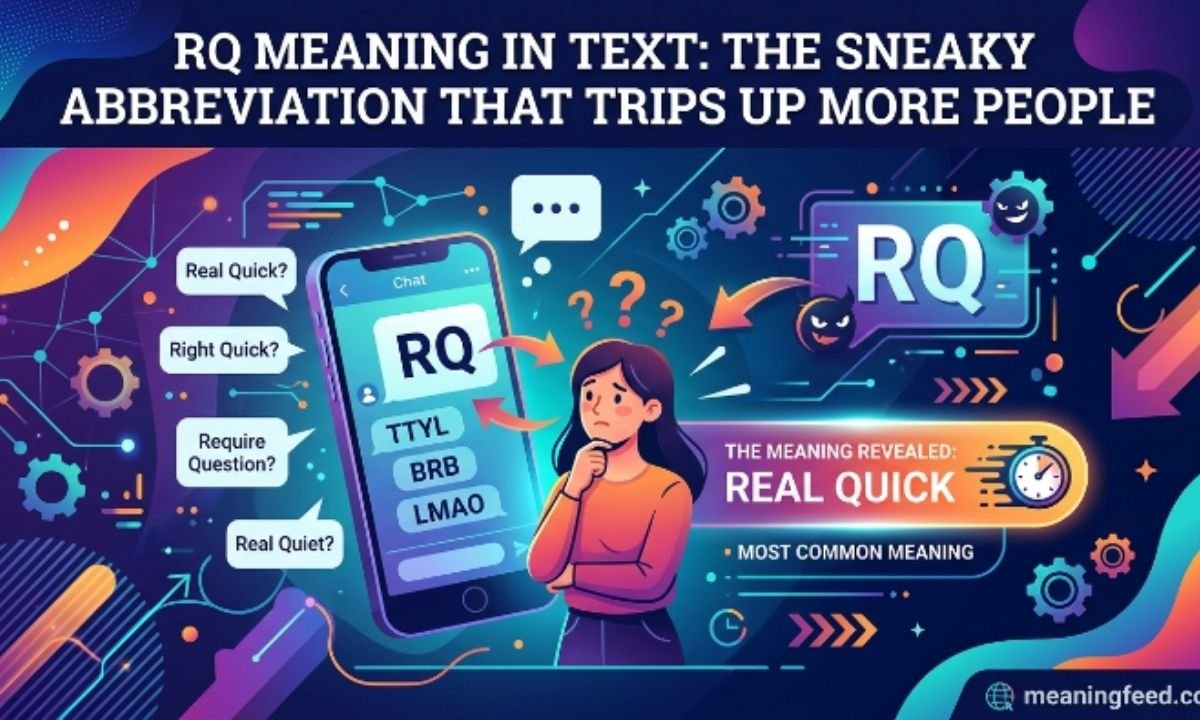

You’re scrolling through a group chat and someone drops “RQ” with zero context. No punctuation. No follow-up. Just… RQ.
If you’ve ever paused mid-scroll wondering about the RQ meaning in text, you’re not alone — it’s one of those abbreviations that looks simple but shifts meaning depending on who sent it, what came before it, and the vibe of the conversation. Get the read wrong and you’ll either look confused or accidentally ignore a genuine question someone asked you.
This guide breaks down the full RQ meaning in text, gives you an actual method for decoding it in the moment, and covers the stuff most articles gloss over — like how to reply without sounding awkward and when using RQ yourself can backfire.
What Does RQ Meaning in Text? (Quick Answer)
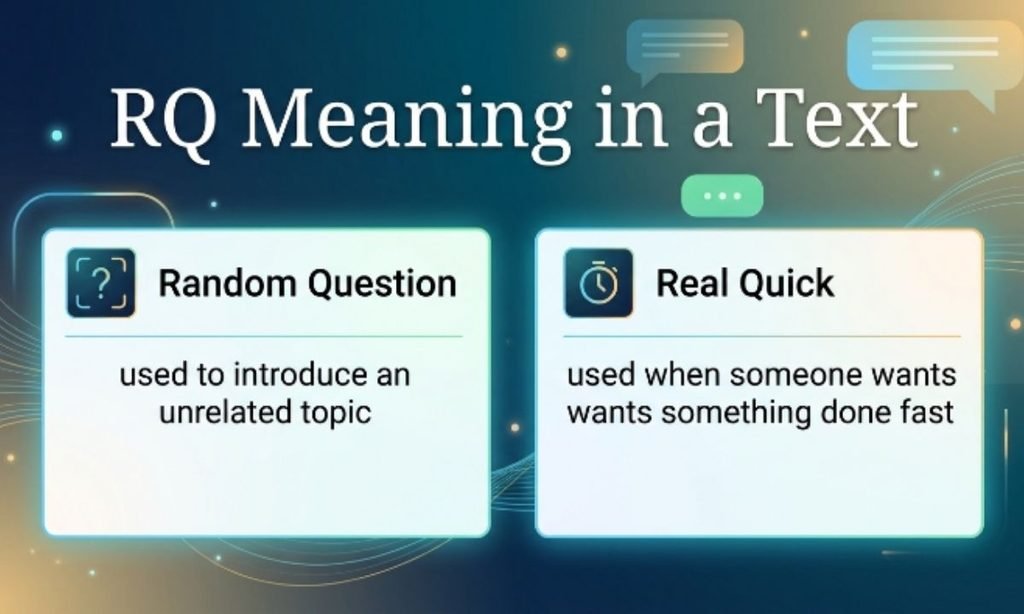
In most texts, RQ stands for “Rhetorical Question.” It’s used when someone asks something they don’t actually expect an answer to — often to make a point, express frustration, or add a little sarcasm.
Example:
“Why is my Wi-Fi always down when I have deadlines, RQ”
That person isn’t asking you to explain their internet provider’s outage history. They’re venting.
But RQ has two other common meanings depending on context:
- Random Question — used to introduce an unrelated topic
- Real Quick — used when someone wants something done fast
The tricky part is that all three show up in casual texting, and the abbreviation looks identical every time. So the real skill isn’t memorizing the definition — it’s learning to read the room.
The Three Real Meanings of RQ (And How to Tell Them Apart)
Most guides stop at “RQ means rhetorical question” and call it a day. That’s only a third of the picture. Here’s a side-by-side breakdown of all three meanings, with the clues that separate them.
| Meaning | What It Signals | Typical Sentence Pattern | Do They Want a Reply? |
| Rhetorical Question | Frustration, sarcasm, or emphasis | Question ends with “…RQ” or “RQ” tacked on after a complaint | No — replying seriously can feel awkward |
| Random Question | Shifting topics, casual curiosity | “RQ” starts the message, followed by an actual question | Yes — this one genuinely wants an answer |
| Real Quick | Urgency, a fast favor or task | “Can you RQ…” or “gonna RQ do this” | Sometimes — depends on the request |
Notice the pattern: placement matters almost as much as the letters themselves. RQ at the start of a message behaves completely differently than RQ tacked onto the end.
The Placement Rule
Here’s a shortcut nobody talks about:
- RQ at the beginning → almost always “Random Question.” People use it as a verbal nudge, like clearing their throat before changing subjects.
- RQ at the end → almost always “Rhetorical Question.” It’s the texting equivalent of an eye-roll emoji.
- RQ in the middle, next to a verb → “Real Quick.” Think “lemme RQ check something” or “can you call me RQ.”
This one rule solves the confusion in probably 80% of real conversations, and it’s something most competing articles never mention.
A 5-Second Decode Framework for RQ
If placement alone doesn’t settle it, run through this quick mental checklist:
- Is there already an answer implied in the sentence? If yes, it’s rhetorical.
- Does the sentence feel incomplete without a reply? If yes, it’s a genuine random question.
- Is there a task, favor, or action word nearby (call, send, check, look)? If yes, it means “real quick.”
- Still stuck? Look at their punctuation. A period or no punctuation at all usually signals rhetorical. A question mark almost always signals a real question.
Run those four checks and you’ll rarely misread it again.
RQ Means Something Different Depending on Who’s Texting You
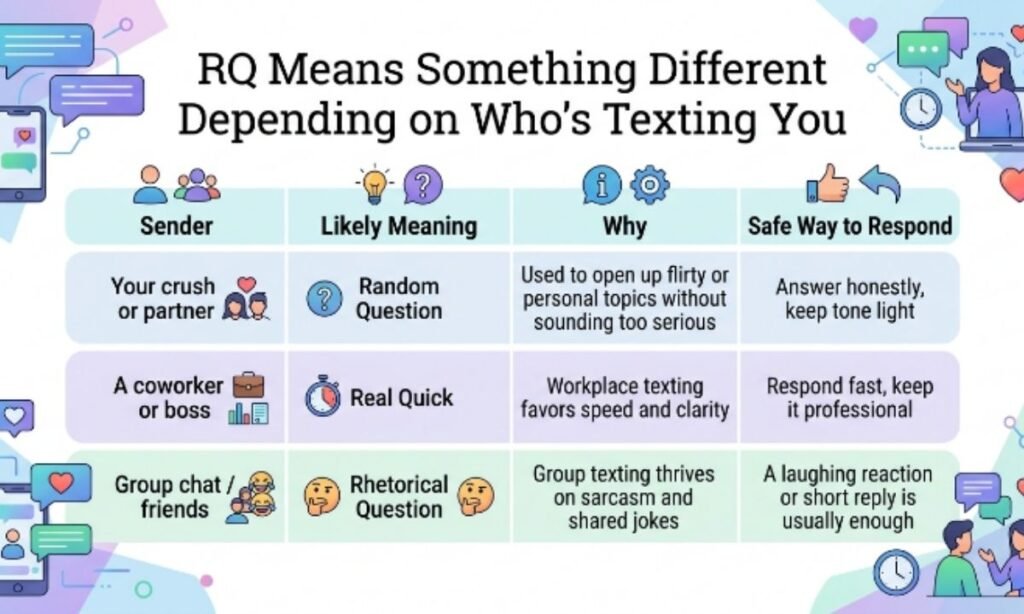
This is the part almost every other article skips entirely, and it’s arguably the most useful section here. RQ carries different social weight depending on the relationship.
| Sender | Likely Meaning | Why | Safe Way to Respond |
| Your crush or partner | Random Question | Used to open up flirty or personal topics without sounding too serious | Answer honestly, keep tone light |
| A coworker or boss | Real Quick | Workplace texting favors speed and clarity | Respond fast, keep it professional |
| Group chat / friends | Rhetorical Question | Group texting thrives on sarcasm and shared jokes | A laughing reaction or short reply is usually enough |
| A stranger or new match on a dating app | Random Question | Used to test conversational chemistry | Treat it as an actual icebreaker |
If you only remember one thing from this table: workplace RQ almost never means rhetorical question. Professional texting doesn’t really have room for sarcasm-by-abbreviation, so if your manager sends “can you RQ send that file,” they mean immediately, not “rhetorically speaking.”
How to Actually Reply When Someone Sends You “RQ”
This is where a lot of people freeze up. Here’s a simple do’s and don’ts list.
Do:
- Ask “wym?” if the message genuinely could go either way
- Answer directly if it’s clearly a Random Question
- Move fast if it’s clearly Real Quick — delaying defeats the point
- Use a reaction emoji for rhetorical ones instead of typing out a full response
Don’t:
- Overthink a rhetorical RQ by writing a paragraph explaining your Wi-Fi provider
- Ignore a Random Question just because you weren’t sure — that reads as rude
- Assume “real quick” means “whenever you get a chance”
RQ vs. Similar Texting Abbreviations
RQ often gets lumped in with other short-form texting habits, but it behaves differently from all of them. Here’s how it stacks up.
| Abbreviation | Meaning | Tone | Expects a Reply? |
| RQ | Rhetorical/Random Question or Real Quick | Depends on context | Sometimes |
| JK | Just Kidding | Playful, softens a previous statement | No |
| TBH | To Be Honest | Sincere, adds weight to an opinion | Sometimes |
| IB4TL | I’ll Be Back To This Later | Neutral, sets an expectation | No |
| NGL | Not Gonna Lie | Sincere, similar to TBH | Sometimes |
The key difference: most texting abbreviations have one job. RQ is unusual because it’s doing three different jobs depending entirely on context — which is exactly why it confuses people more than something like JK or NGL.
When You Shouldn’t Use RQ Yourself
Since this guide is also for people who want to use RQ correctly (not just decode it), here’s where it goes wrong:
- In formal emails or professional documents. RQ reads as too casual outside of texting or chat apps.
- When texting older relatives or new coworkers who may not be familiar with texting shorthand — you’ll just get a confused “what’s RQ?” reply.
- Right after a serious or emotional message. Tacking “RQ” onto something heavy can make it feel dismissive, even if that’s not your intent.
- When your question genuinely needs an answer. If you actually want input, skip RQ altogether and just ask directly — the abbreviation itself can make people assume you don’t need a real response.
Real Examples: RQ in the Wild
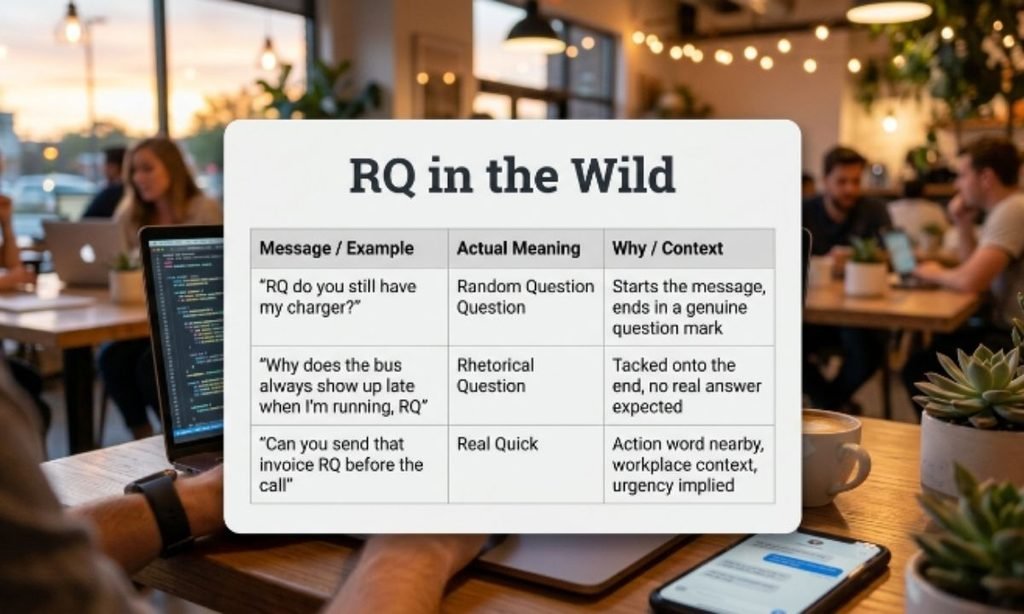
Reading rules is one thing. Seeing them play out in actual texts makes the pattern click faster. Here are a few real-style examples with the correct read attached.
| Text | Actual Meaning | Why |
| “RQ do you still have my charger?” | Random Question | Starts the message, ends in a genuine question mark |
| “Why does the bus always show up late when I’m running, RQ” | Rhetorical Question | Tacked onto the end, no real answer expected |
| “Can you send that invoice RQ before the call” | Real Quick | Action word nearby, workplace context, urgency implied |
| “RQ what’s your favorite pizza topping” | Random Question | Classic icebreaker-style opener |
| “Of course my package gets lost the one week I need it, RQ” | Rhetorical Question | Complaint format, sarcasm implied |
Notice how every rhetorical example follows a complaint. That’s not a coincidence — rhetorical RQ almost always rides along with venting, not neutral statements.
Where Did RQ Come From?
RQ isn’t a brand-new invention — “rhetorical question” as a phrase has existed in classic rhetoric and English composition for centuries. What’s newer is the texting shorthand version, which picked up steam alongside other clipped abbreviations like ngl, ikr, and tbh in the mid-2010s as messaging apps pushed people toward faster, shorter typing.
The “Random Question” and “Real Quick” usages came later, largely because RQ was already a familiar shape on the keyboard — two letters, quick to type, easy to tack onto anything. Language tends to reuse convenient shortcuts for multiple jobs, and RQ is a solid example of that in action.
Final Thoughts
RQ looks like a throwaway abbreviation, but it’s actually one of the more context-dependent shortcuts in modern texting. The letters never change — the meaning does, based entirely on placement, tone, and who’s on the other end of the conversation.
Next time you see it, don’t just guess. Run through the placement rule, check for urgency words, and look at your relationship with the sender. Once you’ve got that down, RQ stops being confusing and just becomes second nature — the same way LOL or TBH eventually did.
FAQs
Does RQ always mean rhetorical question?
No. It’s the most common meaning, but RQ can also mean “Random Question” or “Real Quick” depending on where it appears in the sentence and who sent it.
Should I reply to a rhetorical RQ?
Usually not with a full answer. A short reaction, laugh, or agreement works better than trying to genuinely answer the question.
Is RQ appropriate for work texts?
Yes, but it almost always means “Real Quick” in a professional setting, not “rhetorical question.”
How do I know if someone wants an actual answer?
Check the placement. RQ at the start of a message usually introduces a real question. RQ at the end usually means it was rhetorical.
Is RQ the same as JK?
No. JK softens a joke or statement. RQ signals a question style — either genuine, rhetorical, or urgent — and the two aren’t interchangeable.
