

You send a friend a long story about your terrible commute, and the reply comes back as two letters: “IK.” Is that sympathy, or are they tired of hearing about it? The IK meaning in text is simple, but the feeling behind it changes from chat to chat.
People search for this abbreviation because it looks like it could be anything. It shows up in text messages, Snapchat replies, TikTok comments, and gaming chats, usually with no explanation. Two letters with no context are easy to misread, especially when you can’t see the sender’s face.
This guide covers what IK stands for, where it came from, and how to use it without sounding cold. You’ll also see real chat examples, a few lookalike terms, and the mistakes that cause awkward moments.
Answer Block: IK stands for “I know.” People send it in texts and online chats to show they understand something, agree with it, or already knew it. It’s an informal abbreviation for casual conversations with friends, and it can sound cold or unprofessional when the tone or setting is wrong.
What Does IK Mean in Text?
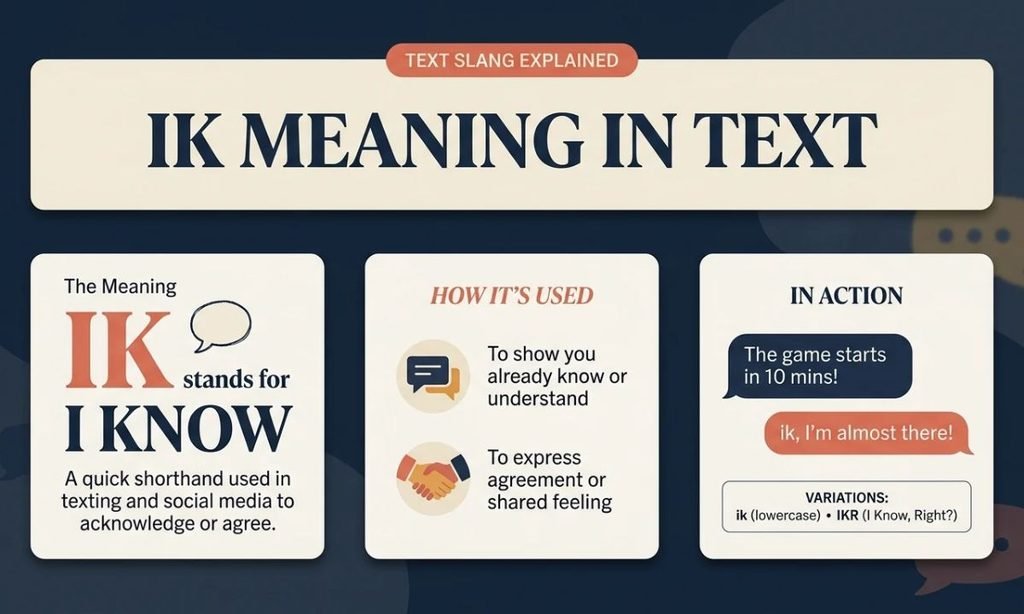
IK means “I know.” In nearly every chat you’ll see it in, that’s the whole story. Someone says something, and you reply IK to show you heard it, you agree, or it doesn’t surprise you.
The abbreviation is just “I know” with the spaces and vowels stripped out. Most of the confusion comes from people expecting a hidden code. There isn’t one.
Here’s a typical exchange:
A: the movie starts at 8 PM
B: IK, getting ready now
B isn’t surprised. B already knew the plan and wants A to see that things are on track. Repeating information the sender already has would waste everyone’s thumbs, so IK does the job in two keystrokes.
I’ve watched people use it a dozen times in one evening without thinking about it. That’s what a good abbreviation does. It disappears into the conversation.
IK Meaning as Agreement
IK isn’t only about knowing something. Sometimes it means “I agree with you.”
A: it’s so hot today 😩
B: IK
A’s message is a plain statement about the weather. B’s reply carries more than “I have that information.” It reads as “I agree” or “I know exactly how you feel.” The emoji matters here, because the 😩 invites a reply that matches the mood, and IK matches it in two letters.
IK Meaning as Relatability
Other times IK means “me too.”
A: I stayed up way too late last night 😂
B: IK
B isn’t claiming to know A’s sleep schedule. B can relate, and the 😂 keeps it light. That sense of shared experience is why many people reach for IK instead of typing “I can relate to that.” The words behind it never change. Only the situation does.
So IK does three jobs: it acknowledges, it agrees, and it relates. It works as acknowledgment when someone hands you information, as agreement when they share an opinion, and as a way of saying you’re on the same page. That makes it the shortest supportive reply available when a friend says something obvious or relatable.
Where Did IK Come From?
Nobody can point to the first person who typed IK, and I’d be skeptical of any site that claims to know. What we can say is where it belongs. It comes from early internet slang, the same era as SMS texting, instant messaging, and chat rooms, when every character cost time, money, or patience.
People kept shortening common phrases, and “I know” was an easy target. The longer form “IKR” (I know, right) is often mentioned alongside it. Which one came first is debated, but plain IK most likely grew out of the same habit of typing fewer letters.
It stuck because it’s simple and flexible. Teenagers use it, and so do their parents. Once texting moved onto social media platforms, speed mattered even more, and nobody needs a full sentence to say “I get it.” The chat keeps its rhythm, and the habit never really faded.
Where Is IK Commonly Used?
You’ll spot IK across messaging apps and online platforms: text messages, Snapchat, Messenger, WhatsApp, and plain direct messages. Between friends and family it fits into everyday conversations because it saves time.
Each app gives it a slightly different flavor:
- WhatsApp: a staple of everyday chats with friends and family.
- Snapchat: dropped into quick replies, often when reacting to a story.
- Instagram: common in story replies and in DMs, where it’s an easy way to acknowledge a message or agree.
- TikTok: lives in comments, where viewers relate to a video and want the creator to know.
- Gaming chats: another stronghold. Gamers type with one hand on a controller, so quick replies like IK work well, whether they’re agreeing or reacting to a teammate’s callout.
Across all of these, the meaning stays the same. People agree, or they understand. IK is a social-media-friendly abbreviation that fits private chats, friendly chats, and online communities. It doesn’t belong in formal business communication, professional emails, or academic writing.
How Do You Use IK in a Text?
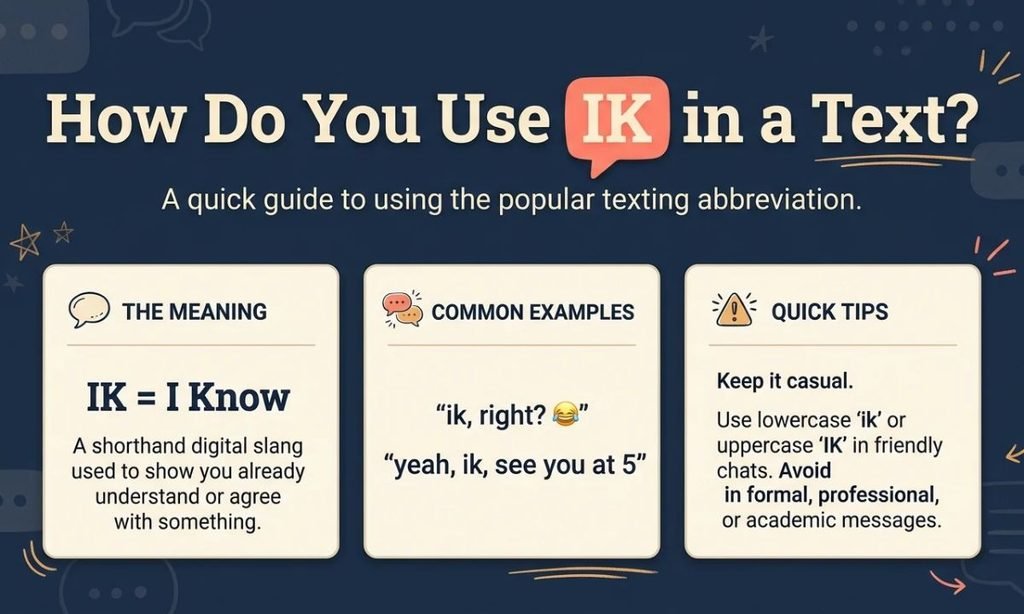
In general, IK lives in casual conversation. When I’m texting friends, it’s the quickest way to say “yep, got it,” and the mood stays relaxed. It suits short messages best, especially when someone tells you something you already know or feel strongly about too.
When to Use IK
Treat it as slang. It’s fine when you’re talking with friends, messaging family, replying on social media, commenting on TikTok videos, or hanging out in gaming communities. It works anywhere you’re agreeing or reacting quickly. Keep the message short and the tone easy.
When Not to Use IK
Skip it in professional emails, messages to clients, and formal business notes. Academic papers, official reports, and other serious settings are off limits too. I avoid IK completely with clients and managers.
The meaning isn’t the problem, since everyone understands it. The problem is that IK signals a casual mood where a formal one is expected. In a work email it looks unprofessional and, to some readers, unclear. Full phrases do the job better, like “I understand” or “I am aware.”
Usage Comparison Table
This table shows how the same idea changes with context.
| Context | Example Phrase | Why It Works |
| Friend chat | IK 😄 | Casual and natural |
| Group chat | IK, that’s funny 😂 | Shows agreement |
| Snapchat | IK right? | Common slang usage |
| Work chat | I understand. | More professional |
| Business email | I am aware of the information. | Formal and clear |
| Academic writing | I understand the concept. | Appropriate tone |
The pattern is simple. The closer the setting is to a chat with friends, the shorter and looser the phrase gets.
IK Examples in Sentences and Conversations
Examples make this clearer than definitions do. Here are some realistic ones from everyday chats, where emojis tend to show up naturally.
Start with the four moods IK can carry:
- A friend texts, “This weather is so hot today.” You reply, “IK, it’s unbearable 😩.” That’s agreement.
- Someone says, “That movie was amazing!” and you answer, “IK! I loved it too.” Here IK expresses excitement.
- A parent writes, “You need to finish your work on time,” and you reply, “IK, I’ll do it soon.” That’s acknowledging an instruction, with a touch of defensiveness.
- A coworker says, “This is getting confusing,” and you answer, “IK, we need to figure it out.” That’s shared understanding.
Four sentences, one abbreviation, four slightly different jobs.
Now some quick back-and-forth chats:
A: this song is so good 🎵😍
B: ik right
A: you need to watch that show, it’s amazing
B: IK, I’m halfway through
A: so tired today 😴
B: same lol
A: traffic was horrible 😭
B: IK, took forever
A: she’s really funny 😂
B: IK
A: don’t forget the meeting tomorrow
B: IK, thanks though 👍
A: this game is addictive, can’t stop playing 😅
B: IK
Notice that “same lol” isn’t IK at all. It’s a reminder that plenty of replies can do a similar job.
Is IK Rude?
IK is not rude by itself, but tone matters. In a friendly exchange it’s fine. In the wrong setting it can turn potentially rude.
Say someone texts, “don’t forget your keys.” If you reply “IK.” with a period and nothing else, it can read as annoyed, especially with no friendly context. A reply like “ik 😂 thanks” lands much warmer.
Emojis and extra words soften the response. I’ve noticed the period does most of the damage, so drop it if you want to stay on good terms. A bare IK can feel like waving the other person off, and a few extra words or an emoji make it friendly and more engaging. The IK meaning in text never changes, but the situation decides how it lands.
Is IK Flirty?
Not on its own. IK is a neutral abbreviation for “I know,” and it doesn’t carry any romantic signal. In flirty conversations, the flirtiness comes from the conversation itself.
A: you’re really cute 😏
B: ik 😘
The IK isn’t doing the flirting. The emoji and the setup are.
IK on Dating Apps and Online Chats
On dating apps, quick and clear replies matter, and IK fits that rhythm. The risk is that a lone IK can feel dry, like you’re not investing in the other person.
Adding context solves it. Something like “IK, that sounds really interesting!” keeps the interaction going. In general chats on messaging apps, IK protects the flow, especially when long messages would slow things down. As digital communication keeps evolving, short abbreviations like this stay useful because they make online conversations fast and easy.
Does the meaning change if a girl sends it? No. The meaning doesn’t depend on who sends it.
How to Respond When Someone Texts IK
When someone uses IK, they’re offering agreement or understanding. Your reply should keep the conversation going or add something, not just echo them.
- If you’re excited: “Right? It’s crazy!”
- If you want to match their energy: “Exactly, that’s what I was thinking.”
- If they seem to be nodding along to something you explained: “Yeah, glad you get it.”
I usually answer with a small piece of new information. A one-word reply to a one-word reply is how chats die.
IK vs Similar Terms
The cleanest contrast is IDK. “I don’t know” signals uncertainty, while IK signals certainty. They’re opposites, and mixing them up flips your whole message.
“Exactly” overlaps with IK on understanding, but it feels more formal and complete. IK is shorter and more casual, which makes it better for quick chats. IK is also a pure acknowledgment, while “Exactly” adds emphasis. If you want a full-word alternative, “Exactly” works well, and the right choice depends on how much effort you want to put into the reply.
Similar Slang Words and Alternatives
IK has plenty of cousins, and each one does a different job:
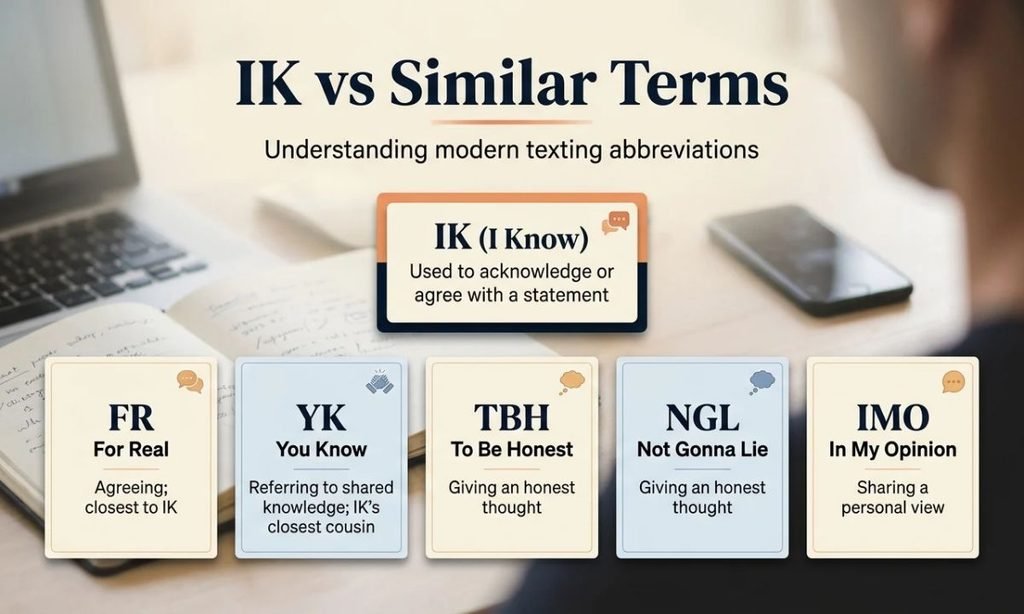
| Abbreviation | Stands For | What It’s Used For |
| FR | For Real | Agreeing; closest to IK |
| YK | You Know | Referring to shared knowledge; IK’s closest cousin |
| TBH | To Be Honest | Giving an honest thought |
| NGL | Not Gonna Lie | Giving an honest thought |
| IMO | In My Opinion | Sharing a personal view |
| IDK | I Don’t Know | Showing uncertainty |
| IDC | I Don’t Care | Showing indifference |
Online conversations mix these constantly, and knowing when to use each one keeps you from sounding off. I’d never swap IDC in for IK, for example, because the mood is completely different. If you want to see how another blunt, informal abbreviation works in chats, check out our guide on STSU meaning in text.
What Does GMFU Mean?
If you landed here searching for IK, you’ve probably seen GMFU in the same chats, since both pop up when people react to what someone said. GMFU stands for “Got Me F*ed Up.” It’s a slang expression for being shocked, disrespected, annoyed, confused, or just surprised by someone’s behavior.
A: he made me finish all the work alone
B: nah, he got you GMFU 😭
Because of the profanity, it hits stronger and feels more informal than IK. It’s also crude enough that I’d keep it out of anything professional.
Other Meanings of IK
Outside texting, IK stands for a few other things. Technology gives it the best-known second life. Inverse kinematics is the math that lets a character’s arm or a robot’s limb move naturally once you place the hand where you want it. You’ll meet it in animation, game development, and robotics. Some people link it to physics because the idea deals with motion.
In medical lists, you may see IK expanded as “intraocular,” meaning within the eye. I’ve never run into that in real life, so I’d call it a niche claim. IK can also be someone’s initials, so context matters. In a normal chat, you’re almost certainly not dealing with tech or medicine.
Common Misconceptions and Mistakes With IK
Three misconceptions come up again and again:
- “IK always sounds rude.” It doesn’t. Tone and context decide.
- “IK has many meanings in everyday chat.” It really doesn’t. “I know” is the main one, and the tech and medical uses almost never show up in texts.
- “IK is outdated.” I still see it all the time in modern chats, and it’s used across age groups.
Then there are the mistakes that trip people up:
- Using it in professional emails. “IK about the meeting” looks sloppy. “I know about the meeting” is what you should send instead.
- Adding extra letters, like IKK. The standard abbreviation is just IK, and the extra letters usually read as a typo or exaggeration.
- Forgetting it can mean something else. Initials are the usual culprit, so check the context.
- Misreading tone. Many arguments start because someone read a flat IK as cold. Add a word or an emoji, and when you’re unsure how a message was meant, ask instead of guessing.
Why Is IK So Popular?
It comes down to simplicity. Two letters, no effort. Short messages save typing time on mobile devices, and they keep conversations moving. A fully typed “I know” can sound stiff in a fast exchange, and people prefer replies that feel natural. Social media culture rewards that speed.
Texting habits keep changing and abbreviations keep spreading, and the staying power of IK looks like part of that same drift.
Reading IK in the Wild
Once you’ve seen the IK meaning in text a few times, it’s easy to read. It shows up across texting, Snapchat, TikTok, Instagram, gaming chats, and other social platforms, and it stays quick, casual, and friendly.
The one real risk is tone. Without context it can come across as dismissive, so add a word or an emoji whenever you want to stay warm. When someone replies IK, they understand, agree, or relate, and the situation tells you which.
Use it naturally with friends, skip it in formal emails, and you’ll sound like you’ve been online a while. You’ll also know exactly what it means when it lands in your inbox.
FAQs
What does IK mean in text?
IK stands for “I know.” People use it to show they understand, agree, or already knew what was said.
What is the full form of IK?
The full form of IK is “I know” in nearly every chat. Other meanings exist, like inverse kinematics in animation, but they rarely show up in texts.
Is IK the same as IKR?
Close, but not identical. IKR means “I know, right?” and adds extra emphasis or excitement. IK is shorter and more neutral.
Does IK mean agreement or relatability?
Both. Depending on the message, IK can mean “I agree” or “me too.” The context and any emoji tell you which one the sender intends.
Is IK rude in a text message?
Not by itself. A bare “IK.” with a period can feel annoyed or dismissive, though. Adding a word or an emoji, like “ik 😂 thanks,” keeps it friendly.
Is IK formal or informal?
IK is informal slang. It fits chats with friends and family, but it looks unprofessional in work emails or academic writing.
What can I say instead of IK in a work message?
Try “I understand,” “I’m aware,” or “Got it.” These sound clearer and more professional than an abbreviation.
How do I reply when someone texts IK?
Keep the chat going with something new. Try “Right? It’s crazy!” or “Exactly, that’s what I was thinking.”
What’s the difference between IK and IDK?
IK means “I know,” which signals certainty. IDK means “I don’t know,” which signals the opposite. Mixing them up flips your whole message.
Is IK used on Snapchat, TikTok, and Instagram?
Yes. It appears in Snapchat chats and story replies, TikTok comments, and Instagram DMs. It also shows up on WhatsApp and in gaming chats.
Is IK flirty when someone sends it?
No. IK is a neutral abbreviation with no romantic meaning. Any flirty feeling comes from the emojis and the conversation around it.
Does IK mean something different when a girl sends it?
No. The meaning stays the same no matter who sends it. Tone and context matter more than the sender.
Is IK still used today?
Yes. It’s common across age groups in texting and on social media, and it hasn’t gone out of style.
Is IKK a real abbreviation?
Not a standard one. The correct form is IK, and the extra K usually reads as a typo or an exaggeration.
What does GMFU mean, and is it related to IK?
GMFU stands for “Got Me F*ed Up,” slang for being shocked, annoyed, or confused. It isn’t related to IK, but both appear when people react to what someone said. GMFU is stronger and more crude.
