

Picture this: you’re scrolling through a group chat on a Sunday night, and a friend replies to your dating update with just “KYP first.” No explanation, no emoji, nothing else. If you’ve ever wondered about the kyp meaning in text, you know how quickly that little acronym can make you second-guess everything.
People search for it because it shows up in WhatsApp threads, Instagram DMs, TikTok comments, and plain old text messages, usually with zero context. The confusion comes from the fact that these three letters can stand for more than one phrase. One version sounds caring and the other can sound like a put-down.
This guide explains what KYP means, where the slang term probably came from, and how to tell the meanings apart. You’ll also get real examples, reply ideas, and a few rules for when to skip it altogether.
Quick Answer: In texting, KYP most commonly stands for “Know Your Partner” or “Know Your Place.” The first is relationship advice about understanding someone before trusting them. The second tells a person to stay humble or within limits. In professional settings, it can also mean “Know Your Product” or “Know Your Patient.”
What Does KYP Mean in Text Messages?
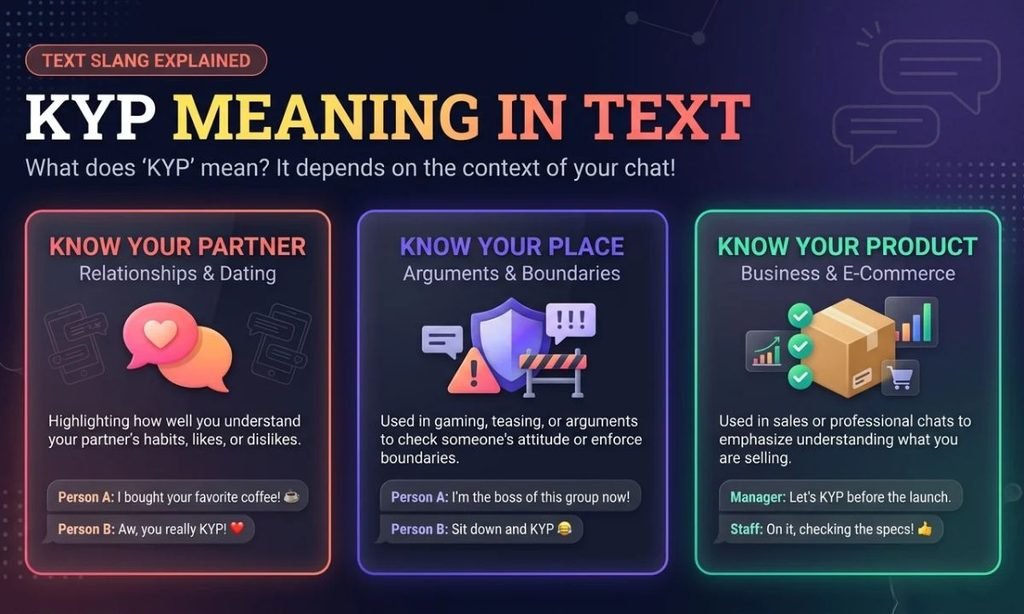
KYP is an acronym, and like most informal expressions, its meaning depends on the situation and the tone of the sender. The same three letters can be friendly dating advice in one chat and a sharp warning in another. Reading the room solves most of the confusion.
Here are the four readings at a glance:
| KYP Meaning | Where You See It | Vibe |
| Know Your Partner | Relationships and dating | Wise, protective, encouraging, cautious |
| Know Your Place | Arguments, teasing, boundaries | Sharp and corrective, or playfully setting limits |
| Know Your Product | Business, sales, E-commerce | Professional, educational, brand-focused |
| Know Your Patient | Healthcare and medical settings | Clinical, administrative, patient-care oriented |
In everyday chat, I’d bet on the first two almost every time. The work versions are narrower and rarely leave their industries.
Know Your Partner
This is the relationship reading, and it works as popular dating advice. The idea is to learn who someone really is before you invest in them. That means their values, background, red flags, and emotional tendencies, ideally before serious commitments or sharing sensitive personal details.
A friend might text it when you’ve just started seeing someone and they want you to slow down. It carries caution, but it’s usually kind.
Know Your Place
This is the other big one, and it has a sharper, boundary-setting tone. It reminds someone to stay humble, respect hierarchies, and avoid overstepping authority or intimacy boundaries. Depending on who says it, it’s either a joke or rude.
Same letters, very different temperature.
Know Your Product and Know Your Patient
These are the work versions. Salespeople talk about knowing their product, and healthcare staff talk about knowing their patient. You’ll mostly meet them in business, sales, and medical settings, not in casual chats.
A few quick examples show the spread:
- “Before marriage, take time to KYP.” (Know Your Partner)
- “Relax bro, KYP.” (Know Your Place)
- “Good salespeople always KYP.” (Know Your Product)
Where Did KYP Come From?
I can’t point to a documented first use of KYP, and I haven’t found a reliable source that settles its origin. Treat any tidy origin story as informed guesswork. What is visible is the pattern behind it.
Internet culture loves shortening phrases. In the early days of texting, limited characters pushed people to save time and effort, which is how LOL (Laugh Out Loud), BRB (Be Right Back), and IDK (I Don’t Know) became popular. You can see more examples in this list of internet slang phrases on Wikipedia. KYP follows the same habit, though it never became as widespread as those.
How Relationship Advice Shaped KYP
Over the past decade, relationship advice online has leaned toward shorthand expressions about emotional protection, self-reflection, and emotional maturity. Relationship coaches, bloggers, creators, and everyday users like to boil advice down into something short enough to repeat in a comment.
There’s also a familiar template behind it. KYC, or Know Your Customer, is a security protocol in banking, and relationship creators appear to have borrowed that format for modern singles. “Know Your Partner” became a shorthand rule for dating safety. Underneath sits a kind of modern relationship awareness: understanding behavior before committing emotionally.
How Gaming and Social Media Spread It
Know Your Place probably spread through gaming communities and online debates. There it works as friendly teasing between friends when someone talks big, or as a serious warning once arguments heat up. From those spaces it drifted into everyday texting.
Comment sections and messaging apps reward brevity. As internet creators on TikTok and Instagram posted about modern red flags, boundary-setting, and humble pie moments, the abbreviation got popularized as both protective dating advice and a blunt reality check.
KYP Meaning on Different Social Media Platforms
Different platforms have different user bases and interaction styles, and those shape the tone. The meaning shifts a little depending on where you see it.
KYP on WhatsApp
WhatsApp chats are direct, personal, and end-to-end encrypted. Here, KYP usually means Know Your Partner. I mostly see it in private chats and friend group texts, where people trade dating updates, share advice, and debate romantic red flags.
KYP on Instagram
In Instagram DM threads, and in comment sections under reels or lifestyle content, KYP alternates. Sometimes it’s supportive relationship wisdom. Other times it’s sharp visual commentary, like a commenter spotting an overconfident claim and dropping “Know Your Place” underneath. I’d also say Facebook leans toward the dating-advice reading, though a cocky post can pull in the other one.
KYP on TikTok
TikTok comments lean on trend culture and storytimes. Creators telling dating disasters often use KYP as a caption or overlay text meaning Know Your Partner. In viral banter and debate videos, the comment threads use it as a quick burn meaning Know Your Place.
KYP on Snapchat
Snapchat is rapid, visual, and ephemeral. There, KYP works as casual shorthand in private Snaps and story replies, usually protective advice between close friends.
KYP Meaning in Relationships and Dating

KYP in dating carries real emotional weight, because the stakes feel significant to the people involved. It shows up around marriage decisions and the question of giving your heart to someone.
When Friends Say It
When a friend says KYP about someone you just started seeing, they’re urging caution. They mean Know Your Partner before diving in too deep, moving in together, or sharing financial secrets and deeply emotional ones.
In an Established Romantic Relationship
In a committed partnership, KYP points to understanding your partner: their love language, emotional triggers, and boundaries. But if it lands in the middle of an argument, “Know Your Place” signals boundary escalation and a serious breach of respect.
KYP From a Guy or a Girl
A guy might send it as straightforward advice to a friend, like “KYP before you fall too hard,” or as protective, sometimes competitive, boundaries. When a girl sends it, it often centers on emotional awareness, vetting potential partners, and safety in modern dating scenarios.
How KYP Changes With the Situation
The meaning moves with the setting. Among friends, it’s loose and often teasing. “You just joined and you’re acting like the boss. KYP.” That’s harmless joking.
At work, it shifts again. A salesperson or anyone in business may use it to mean Know Your Product, and that usage is formal and professional.
In Casual Conversations
In relaxed texting, KYP is used lightheartedly. Friends drop it when discussing mutual acquaintances, social dynamics, or everyday observations about relationships.
When Someone New Sends It
If a new acquaintance or dating prospect texts it, look closely at the context. It could be a trend about taking things slow, or a playful jab about personal boundaries.
In Serious or Emotional Conversations
During heavy discussions, KYP stands for personal growth, emotional intelligence, and staying humble. It works as a grounding reminder to assess a situation realistically before reacting emotionally.
Casual Tone vs. Serious Tone
A casual tone is friendly, funny, and playful. A serious tone carries advice, a warning, or criticism. When I can’t tell which one I’m reading, I look at the emotional tone of the whole conversation instead of the three letters.
KYP Text Message Examples
Examples clarify tone faster than any definition. In my experience, the people inside a chat rarely need KYP explained. It’s the outsider who gets lost.
Friend 1: “He wants to take a trip after two dates! Should I book the tickets?”
Friend 2: “Slow down! KYP first before going on a trip with a stranger.”
Meaning: Know Your Partner.
Instagram DM
User A: “I told my manager how to run his whole department today.”
User B: “Bro… KYP or you won’t have a job by Monday.”
Meaning: Know Your Place.
Instagram DM (joking tone)
Person A: “Bro, you just started the gym and you’re already giving advice.”
Person B: “Haha okay okay, I’ll KYP.”
Meaning: Know Your Place, said jokingly.
Plain text message
Person A: “I’m feeling insecure about why she reacted that way.”
Person B: “Talk to her. KYP and understand her triggers.”
Meaning: Know Your Partner.
Another text message
Person A: “Why are you trusting her so quickly?”
Person B: “You’re right. I need to KYP.”
Tone: caution and a little self-correction.
TikTok comment
Comment 1: “He ignored all the red flags.”
Comment 2: “Exactly. People need to KYP before falling in love.”
Meaning: Know Your Partner, as general relationship advice.
TikTok rule-style comment
“Rule #1 of modern dating: Always KYP before introducing them to your family.”
Meaning: Know Your Partner.
WhatsApp (advice to slow down)
Person A: “I think he likes me, but I’m not sure.”
Person B: “Take your time and KYP first.”
Meaning: Know Your Partner, with the advice to avoid a rush.
Workplace message
A coworker writes, “We need to update our KYP documentation.” That’s Know Your Product, not romantic advice.
Each example works because the setup tells you the meaning before KYP even appears.
The Emotion Behind KYP
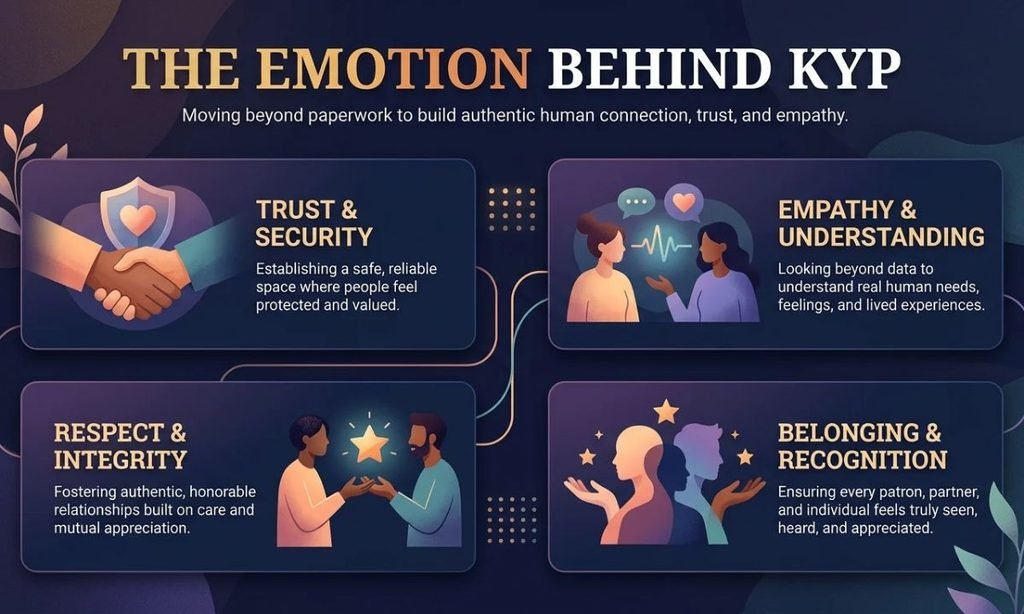
KYP is more than a shortcut. When it means Know Your Partner, the message underneath is usually: slow down, observe carefully, and protect yourself emotionally. That tends to come from experience. Plenty of people have been hurt by trusting too quickly, and nobody wants to repeat past mistakes.
It also says something about modern relationship fears. Someone who sends it often shows self-awareness and a bit of emotional intelligence. The phrase works as emotional protection in three letters.
The playful version points the other way. There it means stay humble and don’t act overconfident. Friends use it in a playful tone to keep each other grounded.
What KYP Says About the Person Sending It
Whoever sends it reveals something about their mindset and communication style.
A Cautious Mindset
People who advocate Know Your Partner tend toward deliberate decision-making. They value security and emotional protection, and they prefer vetting people carefully to rushing into commitments.
Self-Awareness
Used constructively, Know Your Place reflects high self-awareness, situational understanding, and respect for social and professional boundaries.
Modern Dating Concerns
Its spread says something about digital dating. With anonymity and fast-paced connections, verification and trust in relationships matter more, so it’s not surprising that a phrase like this caught on.
Is KYP Rude, Negative, or Helpful?
It depends on which phrase it replaces. As Know Your Partner, it’s caring advice that’s helpful, protective, and usually sound.
As Know Your Place, it can sound aggressive, arrogant, dismissive, or condescending, especially if the point is to silence someone or put them down. It can be offensive. But among close friends, during video games or banter, it works as friendly teasing.
So the answer is: it isn’t always negative. Sometimes it’s helpful advice, and sometimes it’s a joke between friends. Using it with strangers is risky because Know Your Place can come across as disrespectful. Dropped in abruptly, with no surrounding context, it can also sound cold or accusatory.
Common Mix-Ups and Mistakes With KYP
Because the acronym has multiple meanings, misinterpretations happen constantly.
- Assuming it has one meaning. Context decides. A coworker’s “KYP documentation” is not dating advice.
- Assuming it’s always rude. Check the prior messages before you jump to “Know Your Place.” The sender may simply want you to get to know someone better.
- Using it with strangers. Know Your Place can come across as disrespectful.
- Using it in formal settings. In professional environments, write out full phrases. Say Know Your Product, not KYP.
How to Interpret It Accurately
Weigh the sender, the platform, the relationship history, and the topic. That’s the whole checklist. Look at the tone, the situation, and the relationship between people. If a friend sends it while you’re discussing someone you’re dating, it almost certainly means understand your partner. If it follows a boast, it’s Know Your Place.
KYP vs. Similar Slang Terms
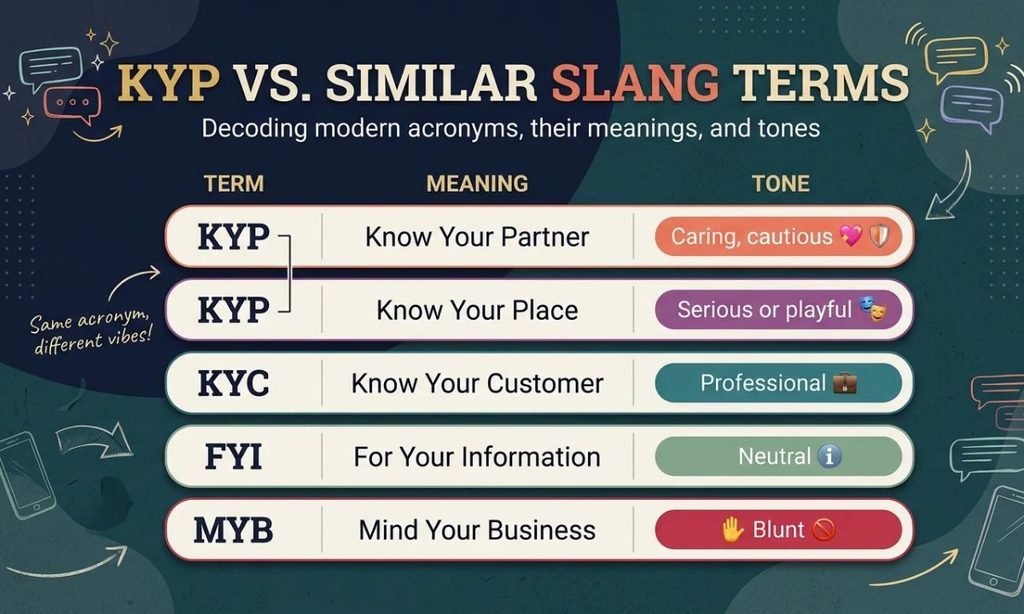
Comparing KYP with similar slang shows where it sits.
| Term | Meaning | Tone | Typical Use |
| KYP | Know Your Partner | Caring, cautious | Dating advice |
| KYP | Know Your Place | Serious or playful | Boundary setting and humility |
| KYC | Know Your Customer | Professional | Banking, financial and business security |
| FYI | For Your Information | Neutral | Work and casual chat |
| MYB | Mind Your Business | Blunt | Privacy enforcement |
| Mind Yourself | Stay within limits | Serious | Arguments |
| Stay Humble | Be modest | Positive | Motivation |
KYP is unusual because of the Know Your Partner and Know Your Place split. The key insight is that the emotional tone, not the usage, tells you which one you’ve got. A single term that swings between serious and playful is rare.
Common Variations of KYP
People stretch the abbreviation into a handful of related forms, and each leans a certain way:
- “KYP first”: understand before acting, such as “Don’t sign a lease together yet, KYP first!”
- “You need to KYP”: advice or a direct warning, such as “If you want this relationship to last, you need to KYP.”
- “Time to KYP”: self-reflection or checking boundaries, such as “Things are getting serious. Time to KYP.”
- “Learn to KYP”: personal growth.
- “KYP bro”: friendly teasing.
- “KYP yourself”: a stronger warning, such as “Before judging them, KYP yourself and your personal habits.”
- “Always KYP”: general advice and a permanent life rule, such as “Dating rule #1: Always KYP.”
- “KYP before trust”: emotional caution and verification before giving away trust.
- “KYP properly”: serious advice, usually about marriage or commitment.
- “KYP people”: understand personalities, or trusting the right ones.
How to Reply When Someone Texts KYP
Your reply should match the tone and intent of the sender.
Casual replies: “Fair point, I’m taking things slow.” “True, I agree.” “100%, getting to know them better every day.” “Yes, I will.” “Good point.”
Funny replies: “I tried to KYP, but they’re a complete mystery!” with a detective emoji helps it land. “My place is on the couch with snacks, so I know it well.” “I’m learning slowly.” “Teacher, guide me.” “Okay boss.”
Mature and confident replies: “I appreciate the advice. I’m being mindful and paying attention to red flags.” “I know where I stand, but thanks for checking in.” “You’re right, understanding matters.” “I’ll be more careful.”
Respectful replies in serious talks: “You’re right. I need to step back and look at this objectively.” “I hear you. Let’s talk through these boundaries so we’re on the same page.” “Thanks for looking out for me.” “That’s helpful advice.” “I’ll think about it.”
These replies show emotional maturity without making a scene.
Can You Use KYP in Professional or Formal Messages?
Mostly no. KYP is an informal expression, and in a formal or professional setting, colleagues may read it as crude internet slang or simply not understand it.
Some industries do give it an established business meaning. In Sales and Marketing, it means Know Your Product, as in “Our sales team needs better KYP training.” In Healthcare and Medicine, it means Know Your Patient, as in “Hospital protocol emphasizes KYP guidelines.” If you use it, make sure your reader works in that field. Otherwise, spell out the phrase or talk about knowing your customer or your product without the acronym.
When to Avoid Using KYP
- In formal emails where acronyms create ambiguity.
- During sensitive arguments, where Know Your Place will escalate conflict.
- With older family members or people who aren’t text-savvy.
- When you need exact clarity, like legal, financial, or emergency discussions.
KYP Usage Across Cultures and Regions

I’d read this as reported patterns, not measured facts.
- Western culture (North America and Europe): tied to modern dating, relationship podcasts, and TikTok comment culture, with a tone of independence and self-awareness.
- Asian online communities: often linked to respect, understanding roles, relationship seriousness, family expectations, and social boundary management.
- Middle Eastern conversations: often more serious, around marriage discussions, vetting potential spouses, family advice, and honoring community values.
- Global online communication: across international online communities and gaming communities, it works as a universal shorthand for situational awareness and self-restraint.
Meanings vary across cultures, but the abbreviation stays widely understood through context.
Is KYP Common Slang?
It’s moderately common, mostly on social media and messaging apps. You won’t see it as often as LOL, but often enough that it’s worth knowing.
Related Abbreviations: KYK and YK
KYK is a separate abbreviation with several meanings depending on the platform. In casual texting, it may stand for “Know You Know” or other context-specific expressions.
YK is simpler. Among Gen Z and on Snapchat, it usually means “You Know,” added casually, as in “YK what I mean” or “It’s hard, YK?” It’s an informal texting abbreviation, and the tone depends on the conversation. If you like decoding chat slang, you can also read our guide on ASB meaning in text.
Why Three Letters Carry So Much
At its core, KYP is a short abbreviation about awareness. It asks people to understand others before trusting them, and it leans on patience and a bit of wisdom. Sometimes it’s a joke between friends. Sometimes it’s serious life experience compressed into a message.
Slang like this lets people protect their emotions while staying connected. So next time you see it on WhatsApp, Instagram, TikTok, or in a private text, check the tone first. Relationship talk points to Know Your Partner, work talk points to Know Your Product or Know Your Patient, and a sharp vibe usually means Know Your Place. When in doubt, ask the sender. A quick “wait, which KYP?” beats a mix-up every time.
FAQs
What does KYP mean in text?
KYP most commonly stands for “Know Your Place” in texting and social media. It’s used to tell someone they’re overstepping or acting out of line. Tone matters, since it can sound joking or harsh depending on the conversation.
What does KYP stand for?
The most common meaning is “Know Your Place.” Other meanings include “Keep Your Perspective” and “Know Your Product” (a business term). Context usually makes the intended meaning clear.
Is KYP a rude thing to say in a text?
It can be. When someone says “KYP” seriously, it usually reads as a put-down or warning. Among close friends, it’s sometimes used as playful teasing.
How do I know which KYP meaning someone is using?
Check the conversation first. If it’s an argument or a disagreement, it almost certainly means “Know Your Place.” In a workplace or sales chat, it’s more likely “Know Your Product.”
What does KYP mean on TikTok, Instagram, or Snapchat?
On social media, KYP usually means “Know Your Place,” often used in comments or replies to call someone out. It can also appear in jokes or memes. Look at the post and replies around it for tone.
What does KYP mean from a girl or a guy?
The meaning is the same regardless of who sends it: “Know Your Place” in most casual chats. If it’s sent flirtatiously with emojis, it may be teasing rather than a real insult. Judge it by the tone and your relationship.
How should I respond if someone texts me KYP?
If it feels like an insult, you can ignore it, ask what they mean, or calmly set a boundary. If it seems playful, a lighthearted reply works fine. Avoid escalating if the situation is already tense.
What does KYP mean in business or sales?
In professional settings, KYP often means “Know Your Product.” It’s a reminder to understand what you’re selling or supporting before talking to customers. It’s most common in sales training and customer service.
Is KYP the same as KYC or KYS?
No. KYC usually means “Know Your Customer” in finance and business, while KYP is typically “Know Your Place” in texting. KYS is a different and harmful phrase, so don’t confuse the two.
What are some similar slang terms to KYP?
Similar phrases include “stay in your lane,” “mind your business,” and “check yourself.” They all carry a similar message of telling someone to back off or be more respectful.
