

You’re texting a friend, and they reply with “ASB.” You stare at your screen for a second, wondering if it’s rude, serious, or just slang. If you’ve ever searched for the asb meaning in text, you’ve landed in the right place.
People look this term up because three letters can mean very different things depending on who sends them. A teenager might use it in a group chat, a school might use it on a notice, and a UK council might use it in an official document. You’ll usually spot it in text messages, Instagram captions, Snapchat messages, TikTok comments, and replies on Twitter/X.
This guide gives you the plain answer first, then covers where the term came from, who uses it, how it compares to similar slang, and when it’s smart to leave it out of a message.
Answer Block: In casual texting, ASB most commonly stands for “as balls.” It’s an informal slang term that works as an intensifier, meaning “very” or “extremely.” For example, “I’m tired ASB” means “I’m extremely tired.” It can sound crude, so it fits friendly chats better than professional or formal messages.
What Does ASB Stand For in Text?
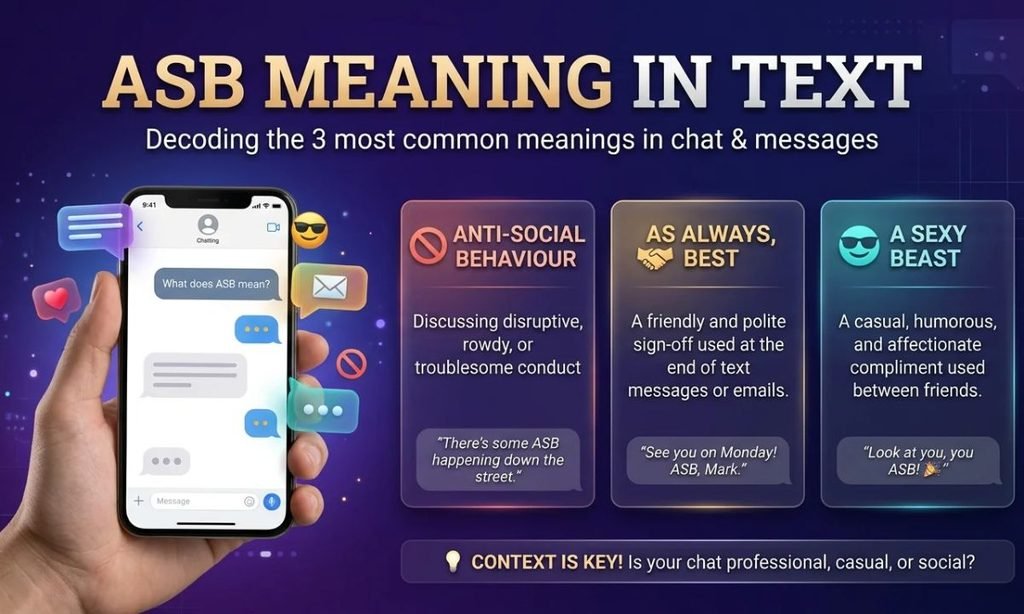
ASB stands for “as balls.” The phrase behind the acronym is crude, and that shapes how you should use it. It follows the same pattern as “as hell”: it attaches to a description and makes that description stronger.
It isn’t a standard English word, and it has no guaranteed meaning outside the groups that use it. Whenever I see it, I read the surrounding conversation first, because an abbreviation like this has to be interpreted in context.
The purpose is emphasis. “That exam was hard ASB” and “That exam was hard” share the same basic meaning, but the first one tells you how the writer felt. You can picture the intended meaning in a cold day outside that won’t quit, a movie funny enough to quote for days, or a tired friend home after a long trip who just needs rest.
The Simplest Way to Read ASB
Here’s a quick way to remember it: ASB = extremely / very. Instead of saying “I’m very hungry,” a friend types “I’m hungry ASB.” The meaning stays the same, but the sentence sounds more dramatic, more emotional, and more expressive.
Think of it as a volume knob. The slang adds volume, not new information. Once you understand that, you’ll read it correctly nearly every time. It also explains why the term is popular: a short word that carries strong feeling travels well in a text thread.
Simple Versions in Standard English
Swap ASB for “very,” “really,” or “extremely” and you get the standard English alternative. “I’m bored ASB” becomes “I’m extremely bored,” and “I’m hungry ASB” becomes “I’m very hungry.” You keep the meaning but lose the informal tone and the dramatic edge.
How the Intensifier Works
ASB doesn’t change the subject of a sentence. It turns up the strength of a description. Most often it follows a descriptive word such as tired, funny, hot, stressed, hungry, or difficult.
You’ll notice a pattern: it usually sits right after the adjective it intensifies, often at the end of the sentence. That’s a habit, though, not a strict grammar rule. I’ve seen it land mid-sentence too, as in “It’s hot ASB outside.”
Real Examples of ASB in Text
Here are four everyday lines and what they mean:
| Text message | What it means |
| “I’m tired ASB.” | I’m extremely tired (after a double shift, a long day, or a long trip). |
| “That movie was funny ASB.” | The movie was very funny. A quick recommendation without a long review. |
| “It’s hot ASB outside.” | It’s extremely hot, maybe hot enough to push a walk until later. |
| “I’m stressed ASB right now.” | I’m very stressed, often about exams, work, or other responsibilities. |
That last one deserves care. If a quiet friend sends it, answer the feeling, not the slang.
Here’s how it might look in a real chat:
- Friend 1: “Want to grab food after work?”
- Friend 2: “Yes, I’m hungry ASB.”
Or in a group chat during a game: “This match is stressful ASB.” Everyone in the chat understands it instantly.
Where You’ll See ASB Online
ASB shows up mostly in casual online conversations between people who already talk informally. The platform matters less than the relationship between the people using it. Teenagers and young adults use it most.
It’s rarely used in professional settings. I’ve never seen it in an email or any kind of formal writing, and if it turned up in a work thread, I’d assume someone hit send on the wrong chat.
Text Messages
Personal messages and quick replies are its home turf. Someone sleepy late at night types “I’m sleepy ASB” because a long explanation would take more effort than the feeling deserves. Lines like “That party was fun ASB” or “I’m bored ASB” are typical.
Social Media Platforms
On Instagram, it appears in captions and comments. On Snapchat, it shows up in direct messages. On TikTok, you’ll see it in replies under a funny video, and on Twitter/X it appears in short reactions. Public posts reach people who may not know the term, so anyone posting it there accepts that some readers won’t get it.
Group Chats
Group chats develop their own style, with inside jokes, quick reactions, and shared expressions that members reuse. A new member may not understand ASB right away. A friendly explanation works better than silence.
Why Do People Use ASB?
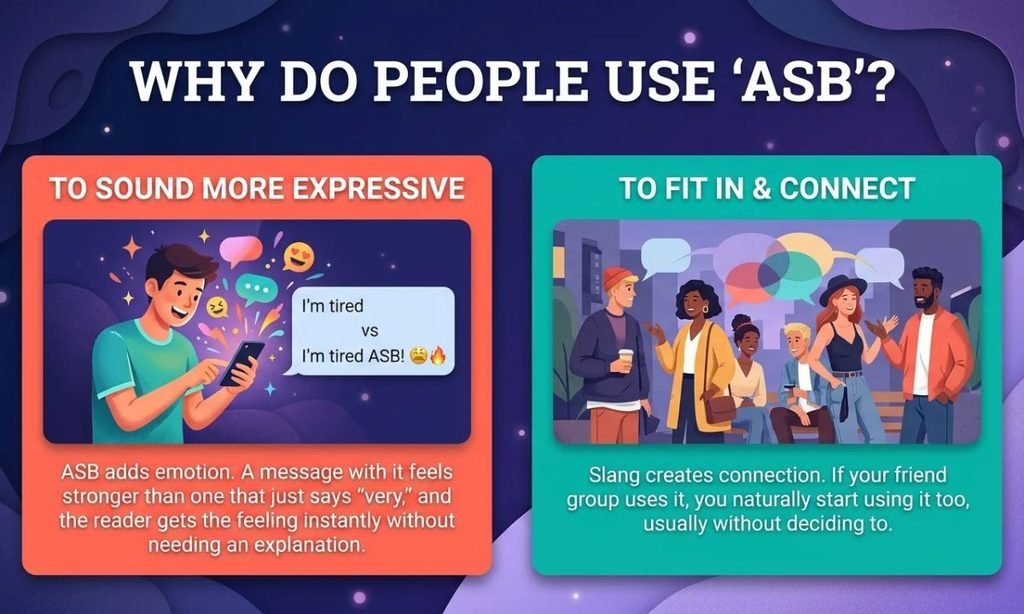
I’ve watched this play out in enough friend groups to see the same reasons repeat. None of them are complicated.
- To sound more expressive. ASB adds emotion. A message with it feels stronger than one that just says “very,” and the reader gets the feeling without needing an explanation.
- To fit in. Slang creates connection. If your friend group uses it, you naturally start using it too, usually without deciding to.
- To be short and quick. Three letters beat a long sentence. It keeps a reply short and punchy, which matters when you’re typing with your thumbs.
- To sound casual and cool. Let’s be honest: slang makes a conversation feel relaxed and playful. It also makes a message a little exaggerated, which is the whole point when you tell a friend you’re excited ASB for the weekend after waiting all week.
One caution from watching these chats: when someone copies slang they don’t naturally use, it reads as forced. Remember, it’s not appropriate everywhere.
Where Did ASB Come From?
Nobody has a verified origin or a documented first use, and I’d be wary of anyone who claims one. What can be said is that the “as + noun” intensifier pattern is old, and “as balls” sits in that family with “as hell” and “as f***.”
The abbreviation itself traveled the way most internet language does. It spread through social media trends, meme culture, group chats, and youth internet communities. It caught on because it’s short and expressive.
Slang evolves fast. What’s trending today can fade by tomorrow, and a term that feels everywhere one year can become less common the next. That’s also why I wouldn’t trust any article that gives you precise data on how widely it’s used. It’s part of how internet language works, and it’s why this hidden slang meaning catches people off guard when it pops up online.
ASB vs AF and Other Slang Terms
People mix these terms up constantly, so a simple comparison helps. ASB belongs to a crowd of short slang terms, and each has its own meaning and main function.
| Slang term | Meaning | Main job | Tone |
| ASB | As balls | Intensifies a description | Casual, crude |
| AF | As f*** | Intensifies a description | Strong, vulgar |
| FR | For real | Confirms or shows sincerity | Casual |
| Lowkey | Slightly, subtly, or secretly | Qualifies a statement | Casual |
| Highkey | Openly, obviously, or strongly | Emphasizes a feeling | Casual |
All five are casual, and none are formal. Tone is what separates them. A handy trick: ask what the word does to the sentence. Intensifiers turn up strength, while FR, lowkey, and highkey qualify it. If you enjoy decoding slang like this, our guide on What Does 5L Mean in Text is worth a read next. .
ASB vs AF
Both mean “very.” The difference is that AF is more explicit and can sound aggressive, while ASB feels slightly softer, though still crude. Neither belongs in professional communication, even if your office is relaxed.
Some uses overlap. “That match was intense AF” and “That match was intense ASB” are close. “FR, that match was intense” is a different move entirely, since FR expresses agreement rather than intensity.
Other Meanings of ASB

This is where people get tripped up. Outside texting slang, ASB can stand for several other things:
- Anti-Social Behaviour : a UK usage, common in community matters and official discussions.
- Associated Student Body: the student organization at a school.
- Academic Skills Builder: used in some educational settings.
Picture a school announcement that says, “The school ASB meeting is tomorrow.” Nobody there is talking about slang. If the message comes from a teacher or appears on a school notice, a student body meeting is the more likely reading.
So what does ASB mean? There isn’t one answer for every situation. The slang meaning dominates casual texting, while school and community settings point elsewhere. That’s why a mix-up happens so easily.
How to Tell Which ASB Meaning Applies
Start with the full sentence. Read the words around it, because a descriptive word right before ASB is a useful clue that it’s an intensifier.
Then consider the topic, the sender, and the relationship between the people involved. A friend, a teacher, and a colleague will each use the letters differently. Check whether the exchange is casual or formal. A report or an official notice points away from slang, while a quick message after work about being tired points toward it.
If the message is important and you’re still unsure, ask for clarification. Asking the sender beats guessing, and it beats assuming it’s always slang.
Is ASB Offensive?
It depends on the audience. Because “as balls” is crude, some people read it as inappropriate or awkward, even though plenty of friends use it without a second thought. In conservative settings, it can come across badly. Even among close friends, a request to skip crude language should be respected.
Many people stay neutral by default. If you’re unsure how someone will take it, choose neutral wording and move on. The fix is simply to know your audience.
When to Use ASB and When to Skip It
Use it only when the setting is right. It fits relaxed chats with close friends who use slang, casual social media posts, and joking around.
Avoid it in these situations:
- Work emails and messages to bosses
- School assignments and messages to teachers
- Professional social media and professional content
- Messages to people you don’t know well
Picture someone nervous before a presentation firing off a message to their manager with ASB in it. That’s a classic workplace mistake. A serious conversation calls for direct, respectful language.
I use a simple safe test: if you’d hesitate to say the phrase out loud to that person, switch to “very.”
Tips for Using ASB Without Sounding Forced

- Only use it with people who use slang. If they don’t use casual language, skip it. It works when everyone’s playing the same game.
- Don’t overuse it. Putting it in every sentence makes you sound like you’re performing and dulls the emphasis that makes it useful.
- Watch the context. In a serious discussion, leave slang out entirely.
- Understand tone. Text has no facial expressions, voice, or body language. A line meant as playful can land as rude on someone having a tough day. Emojis can help, but only when they clarify rather than decorate.
- Keep it casual. ASB belongs in relaxed, friendly conversations only.
Habits matter more than rules here. Notice how your friends write, use what feels natural to you, and leave it out when you’re not sure it fits. Using it so you don’t embarrass yourself in a group chat is a good enough reason to hold back.
Is ASB Popular Everywhere?
No. It’s mostly tied to American internet slang, and not everyone uses it, especially older adults. Don’t assume the person on the other end shares your vocabulary.
Is ASB Appropriate for All Ages?
Not really. Teens and young adults use it more often. Older generations may not understand it, or may find it unnecessary. Younger teens may pick it up without knowing the crude phrase underneath, which is worth explaining if you’re a parent or a teacher.
For family chats, a school class group chat, or anything involving professional contacts, use clear standard wording. The point isn’t to avoid slang forever. It’s to choose language that suits your audience.
What to Say Instead of ASB
When you want strength without the crude tone, several words work: “very,” “really,” “extremely,” “so,” and “incredibly.” “Incredibly hot” lands harder than most people expect, and “extremely tired” carries the same weight as the slang.
A message that’s clear to a wider audience is rarely a weaker one. Clear communication beats confusing someone, and that rule outranks any slang rule I know.
The Short Version
So, what does ASB mean in text? It usually stands for “as balls,” meaning very or extremely. It’s casual, playful, and expressive, but it isn’t professional. If you’re texting friends and want something dramatic, it works fine. If you’re emailing your boss, don’t even think about it. Language is powerful, so use it wisely.
FAQs
What does ASB mean in text?
ASB most commonly stands for “as balls” in texting. It’s an informal slang intensifier that means “very” or “extremely.” For example, “I’m tired ASB” means “I’m extremely tired.”
What does ASB stand for on Snapchat, Instagram, and TikTok?
On all three, it usually means “as balls” and is used to add emphasis. You’ll see it in Snapchat messages, Instagram captions and comments, and TikTok replies. It’s casual slang, so it mostly appears between friends.
Is ASB the same as AF?
They do the same job, since both intensify a description. AF stands for “as f***” and is more explicit, while ASB feels slightly softer but is still crude. Neither belongs in professional messages.
Is ASB a bad word or offensive?
It depends on who reads it. The phrase behind it is crude, so some people find it inappropriate, especially in conservative or formal settings. Among close friends who use slang, it’s usually taken casually.
Does ASB have other meanings besides slang?
Yes. ASB can also mean Anti-Social Behaviour (UK usage), Associated Student Body (schools), or Academic Skills Builder. The context tells you which one applies.
How do I know which ASB meaning someone is using?
Read the full sentence and look at who sent it. A descriptive word right before it, like “tired” or “hot,” points to slang. A school notice or official document points to one of the other meanings.
Can I use ASB in a work email or school assignment?
No, it’s best to skip it. ASB is informal and can sound crude, so use “very,” “really,” or “extremely” instead. A good rule is to avoid it if you wouldn’t say it out loud to that person.
What can I say instead of ASB?
Neutral options include “very,” “really,” “extremely,” “so,” and “incredibly.” “I’m extremely tired” carries the same weight as “I’m tired ASB.” These also work for a wider audience.
Who uses ASB the most?
Teens and young adults use it most, and it’s mostly tied to American internet slang. Older adults may not recognize it. Don’t assume everyone shares the same slang.
Where did ASB slang come from?
There’s no verified origin or documented first use. It follows the older “as + noun” intensifier pattern, like “as hell.” It spread through social media, meme culture, and group chats.
