

You’re scrolling through a group chat and someone drops “IMAO” right before a pretty spicy opinion. Your brain autocorrects it to LMAO. You laugh. Except… that’s not what they meant at all.
That one-letter difference changes everything. And it’s the reason so many people get confused, embarrassed, or send the wrong reply at the wrong moment.
Here’s the full breakdown — what IMAO actually means, where it came from, why it keeps getting mixed up with its more famous cousin, and how to actually use it without sounding off.
IMAO Meaning in Text: The Quick Answer
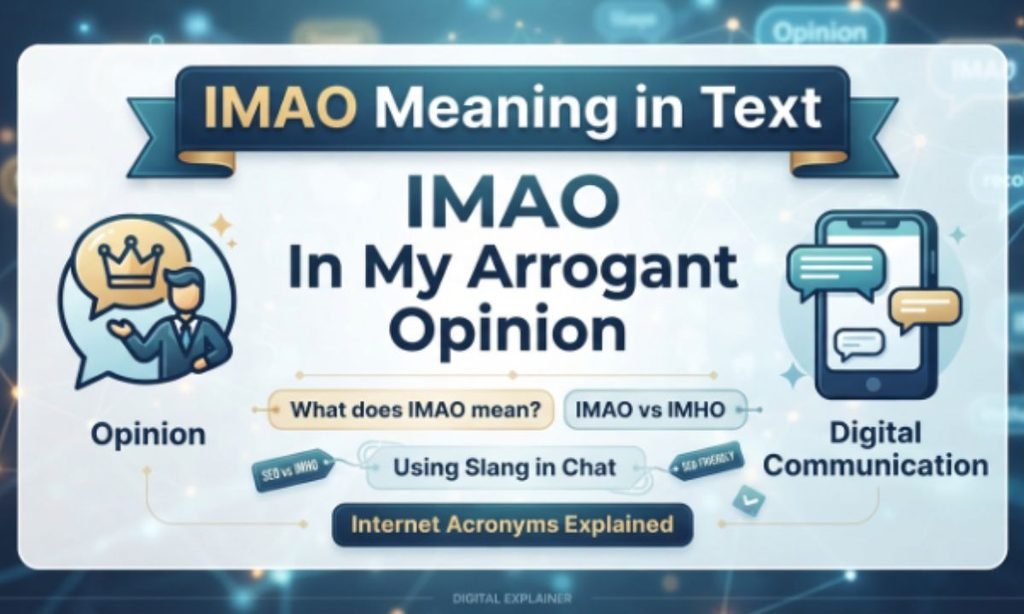
IMAO stands for “In My Arrogant Opinion.”
It’s a cheeky, self-aware twist on the more common IMO (In My Opinion) and IMHO (In My Humble Opinion). Instead of pretending to be humble, IMAO does the opposite — it leans into confidence, sarcasm, or a bit of playful cockiness.
Someone typing IMAO is basically saying: “I know this might sound a little full of myself, but here’s what I think — and I’m sticking to it.”
It’s not rude by default. It’s more of a wink. A verbal shrug that says “yeah, I’m being a little dramatic on purpose.”
The Real Reason People Confuse It With LMAO
This is the part almost nobody explains well, and it’s the actual root of the confusion.
LMAO (Laughing My Ass Off) is one of the most-used acronyms in texting history. Your thumbs have typed it a thousand times without thinking. So when IMAO shows up — same length, same ending, one swapped letter — your brain pattern-matches it to the acronym it already knows.
This isn’t a coincidence of spelling. It’s a texting-speed problem. Most people read the first and last letters of short acronyms and skim the middle, especially on a phone screen at 11 p.m. IMAO and LMAO share that same shape: three letters starting with a vowel-adjacent sound, ending in AO.
| Acronym | Meaning | Common Mix-Up |
| IMAO | In My Arrogant Opinion | Misread as “LMAO” |
| LMAO | Laughing My Ass Off | Misread as “IMAO” when skimmed fast |
| IMO | In My Opinion | Sometimes typed as IMAO by accident |
| IMHO | In My Humble Opinion | Confused with IMAO’s tone (opposite meaning) |
If someone replies “lol why” to your IMAO text, there’s a good chance they read it as LMAO and got confused by the context. That mismatch is genuinely one of the most common small miscommunications in modern texting — and almost no other article on this acronym actually walks through why it happens at the reading-pattern level instead of just saying “people confuse them.”
Where IMAO Actually Came From
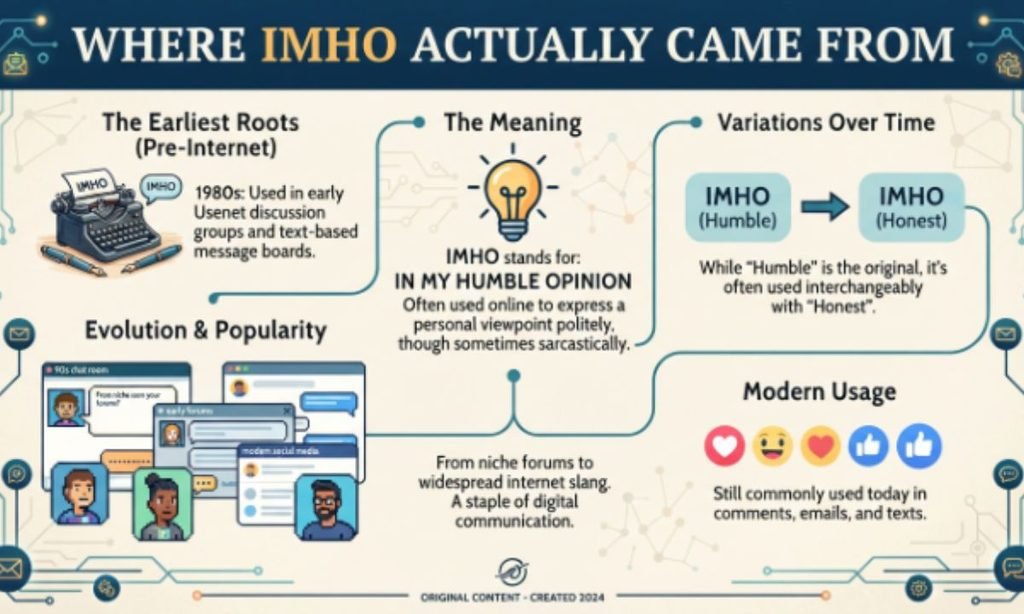
IMAO isn’t a brand-new Gen Z invention. It traces back to early internet forums and IRC chat rooms in the late 1990s and early 2000s, back when acronym culture was exploding across message boards.
At the time, IMHO (In My Humble Opinion) was already everywhere. Forum users being forum users, someone flipped it into a joke version — IMAO — as a sarcastic response to people who claimed to be humble but clearly weren’t. It caught on in gaming communities, comment sections, and eventually text messaging as phones got smarter and typing got faster.
So the acronym has always had a slightly ironic DNA. It was born as a joke about fake humility, and it still carries that same energy today.
IMAO vs. IMO vs. IMHO: The Full Opinion-Acronym Spectrum
This is the piece most guides skip entirely. They’ll define IMAO on its own and move on. But acronyms like this only make sense when you see where they sit on a tone spectrum — from genuinely humble to fully unapologetic.
| Acronym | Full Meaning | Tone Level | Best Used When |
| IMHO | In My Humble Opinion | Soft, deferential | You’re disagreeing gently or don’t want to sound preachy |
| IMO | In My Opinion | Neutral, plain | You’re just stating a take without extra flavor |
| IMAO | In My Arrogant Opinion | Confident, joking, or sarcastic | You want to be blunt but keep it light |
| TBH | To Be Honest | Direct, sometimes blunt | You’re about to say something a little unfiltered |
Think of it like a volume dial. IMHO is whisper-quiet. IMO is normal speaking voice. IMAO cranks it up with a smirk. Knowing where on that dial you’re sitting is what actually determines whether your text lands as funny or comes off as arrogant for real.
How People Actually Use IMAO in Texts
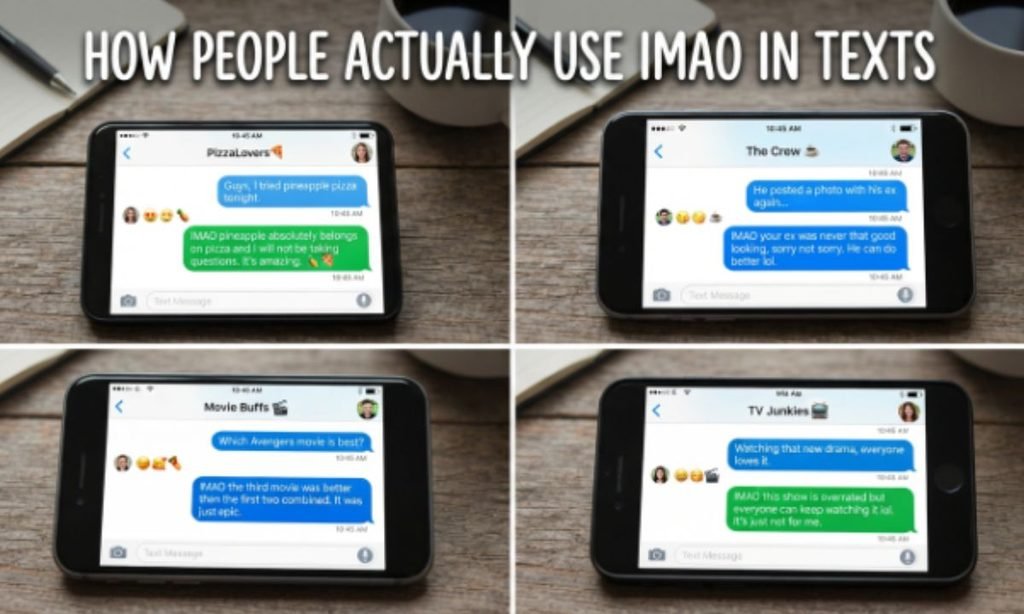
Here’s where it plays out in real conversations — not textbook examples, actual texting patterns.
Casual opinion drop: “IMAO pineapple absolutely belongs on pizza and I will not be taking questions.”
Self-aware disagreement: “IMAO your ex was never that good looking, sorry not sorry.”
Group chat debate: “IMAO the third movie was better than the first two combined.”
Softening a hot take: “IMAO this show is overrated but everyone can keep watching it lol.”
Notice the pattern — IMAO almost always sits at the start of a sentence, right before a strong or slightly exaggerated claim. It works like a verbal warning label: “opinion incoming, and I’m not going to pretend I’m being modest about it.”
When IMAO Works Well
- Group chats with friends where sarcasm is already the norm
- Comment sections and social media replies
- Texting someone you know well enough that tone won’t get lost
- Light debates about movies, food, sports, or pop culture
When IMAO Can Backfire
- Work Slack messages or professional emails
- Texting someone new who doesn’t know your humor yet
- Serious conversations (relationship talks, conflict resolution, bad news)
- Any context where sarcasm has a real chance of being taken literally
This last point matters more than people give it credit for. Because IMAO literally contains the word “arrogant,” using it with someone who doesn’t know you well can genuinely read as you calling yourself — or worse, sounding like — someone who thinks their opinion outranks everyone else’s. The acronym only works when the audience already knows it’s a bit.
Age and Platform Differences Nobody Talks About
Here’s a genuine content gap in how this acronym gets covered: IMAO doesn’t land the same way across every platform or generation, and that matters if you’re trying to use it correctly.
| Platform/Group | How IMAO Typically Reads |
| Text messages between close friends | Playful, sarcastic, low risk |
| Twitter/X replies | Common, used to soften hot takes |
| Reddit comment threads | Frequently used unironically as a debate-starter |
| Discord servers | Extremely common, often shortened further or paired with emojis |
| Workplace chat (Slack, Teams) | Risky — can be misread as genuine arrogance |
| Texting someone over 50 who’s newer to acronym culture | Often just confusing — may need to be spelled out |
If you’re texting a parent, a boss, or someone who didn’t grow up swimming in internet slang, IMAO is more likely to get a confused “what does that mean?” reply than a laugh. In that case, it’s genuinely better to just type “in my opinion” and skip the acronym gamble altogether.
A Quick Reality Check: Is IMAO Rude?
Not inherently. Context decides everything here.
Used with friends who get the joke, IMAO reads as confident and funny — a way of poking fun at your own bluntness before someone else can call you out on it.
Used with a stranger, in a professional setting, or during an actual disagreement that’s already tense, it can land as genuinely dismissive, like you’re bragging about not caring what the other person thinks.
The acronym itself isn’t the problem. The mismatch between tone and audience is.
Other Acronyms You’ll See Paired With IMAO
Texting rarely happens in isolation — IMAO often shows up stacked with other short-hand. Knowing these helps the full message make sense at a glance.
| Acronym | Meaning |
| NGL | Not Gonna Lie |
| TBH | To Be Honest |
| FR | For Real |
| IYKYK | If You Know You Know |
| LMK | Let Me Know |
A message like “IMAO ngl fr this was the worst sequel ever, lmk if you disagree” is a pretty normal stack in a group chat — and once you know each piece, the whole sentence reads clearly instead of like alphabet soup.
Final Thoughts
IMAO is one of those small acronyms that says a lot in three letters — not just an opinion, but the tone behind it. It’s confident, a little cheeky, and meant to be read with a raised eyebrow rather than taken word-for-word.
The trick isn’t memorizing the definition. It’s knowing your audience. Drop it in a friend group and it lands as personality. Drop it in the wrong chat, and you might just confuse someone who was expecting you to be laughing, not arguing.
Next time you see it pop up mid-conversation, you’ll know exactly what’s coming — someone’s about to say something bold, and they already know it.
FAQs
What does IMAO mean in text?
IMAO stands for “In My Arrogant Opinion.” It’s a sarcastic, confident spin on IMO or IMHO, used when someone wants to share a strong opinion while poking fun at their own bluntness.
Is IMAO the same as LMAO?
No. LMAO means “Laughing My Ass Off,” while IMAO means “In My Arrogant Opinion.” They’re spelled almost identically, which is why texters mix them up constantly.
Is IMAO rude to use in a text?
Not usually. Among friends who get the joke, it reads as playful confidence. With strangers or in professional chats, it can come across as genuinely dismissive.
What’s the difference between IMAO, IMO, and IMHO?
IMO is a neutral “in my opinion,” IMHO adds humility, and IMAO flips that with mock arrogance. They all introduce an opinion but set a very different tone.
Where did the acronym IMAO come from?
IMAO started in early internet forums and IRC chats in the late 1990s and early 2000s, as a sarcastic twist on the already-popular IMHO.
Should I use IMAO in professional messages?
It’s best avoided at work or in formal emails. Since IMAO literally means “arrogant opinion,” it risks being read as genuinely dismissive rather than playful.
