

You’re mid-conversation with a friend, your phone buzzes with a work notification, and you need a second to deal with it. So you type three letters — BRB — and hit send. Everyone knows what that means, right?
Mostly, yes. But there’s more nuance to this little abbreviation than most people realize, and using it wrong (or in the wrong setting) can actually come across as rude or confusing. If you’ve ever wondered about the exact brb meaning, where it came from, or whether it’s okay to use at work, this guide covers all of it — including the small habits that make people either love or hate seeing “brb” pop up on their screen.
What Does BRB Mean?
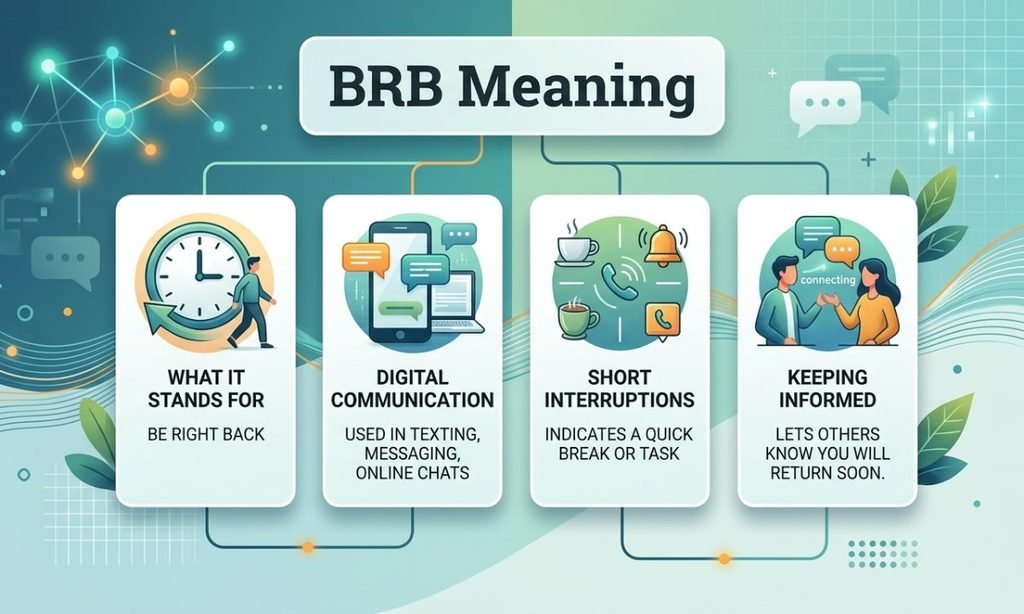
BRB stands for “be right back.” It’s a short way of telling someone you’re stepping away from a conversation for a little while, but you’ll return soon.
People use it in texting, group chats, video calls, online gaming, and social media comments. It signals two things at once: you’re leaving the conversation, and you’re not ghosting anyone — you’re coming back.
Here’s the simple breakdown:
| Letter | Stands For |
| B | Be |
| R | Right |
| B | Back |
That’s really all there is to it. No hidden meaning, no complicated backstory. It’s one of the most straightforward pieces of internet shorthand out there, which is probably why it has stuck around for decades while trendier slang has come and gone.
What makes BRB genuinely useful, though, isn’t just the definition — it’s the social function it serves. Texting and chat apps don’t give you the visual cues you’d get in person. If someone walks away from you mid-conversation in real life, you can see them leave and reasonably guess they’re coming back. Online, there’s no such visual. BRB fills that gap. It’s a tiny piece of digital body language.
For a broader look at how informal language and slang develop, Merriam-Webster’s explanation of slang is a useful reference.
Where Did BRB Come From?
BRB is older than most people think. It didn’t start on TikTok or Instagram — it goes back to the early days of the internet, when people chatted through IRC (Internet Relay Chat) and later AOL Instant Messenger (AIM) in the 1990s.
Back then, typing was slow, internet connections dropped constantly, and chat rooms moved fast. If you needed to grab a snack, answer the door, or deal with a dial-up disconnect, you typed “brb” so people knew you weren’t abandoning the conversation.
AIM basically built a whole culture around away messages, and BRB was one of the essential building blocks of that culture, right alongside abbreviations like LOL, TTYL, and the ever-dramatic “ttfn” (ta-ta for now). An entire generation grew up crafting elaborate away messages with song lyrics and inside jokes, but the practical, everyday phrase that actually got used the most was the simple “brb.”
What’s interesting is how well it survived the shift from desktop chat rooms to smartphones. Most 90s-era chat slang either disappeared or became a punchline. BRB didn’t. It moved smoothly from AIM to MSN Messenger, then to texting, then to Facebook Messenger, and now it lives comfortably in iMessage, WhatsApp, Discord, and Slack. Few pieces of internet shorthand have that kind of staying power, and it’s a good sign of just how useful the phrase actually is.
How to Use BRB in Texts and Online Chat
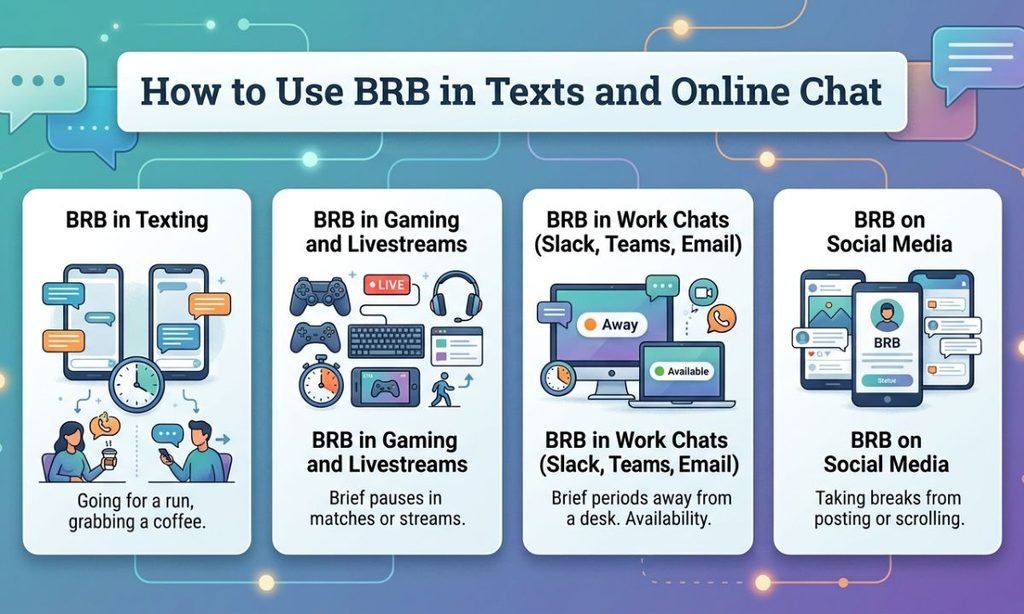
The brb meaning stays the same everywhere, but how you use it shifts a little depending on the platform and who you’re talking to.
BRB in Texting
In a normal text conversation, BRB is casual and quick. You don’t need to explain why you’re stepping away — the point is just to let the other person know a reply is coming, just not immediately.
Example:
You: omg wait my mom is calling me, brb
Friend: okay np, I’ll be here
It works well when a conversation is active and you don’t want the other person to think you’re ignoring them. It’s especially handy in the middle of a fast back-and-forth, where silence for even a few minutes might otherwise seem like the conversation just died out.
BRB in Gaming and Livestreams
Gamers use BRB constantly, especially during multiplayer matches or livestreams. If a player needs to pause, grab water, or deal with a lag spike, typing “brb” in the chat keeps teammates informed without stopping the whole game.
Example:
Player1: brb, bathroom break
Player2: bet, we’ll hold the point
Streamers also use it on screen during breaks so viewers know the stream hasn’t ended — it’s just paused for a minute. Many streamers even have a dedicated “brb” screen with a countdown timer or looping animation, because viewers tend to click away if they think a stream has simply crashed.
In competitive gaming culture specifically, BRB carries a bit more weight than in casual texting. Teams often expect a quick heads-up before someone steps away, since an unannounced absence during a ranked match can cost the whole team. So while the phrase is casual, the etiquette around it in gaming spaces is actually fairly structured.
BRB in Work Chats (Slack, Teams, Email)
This is where things get trickier. BRB is fine in casual internal chats between coworkers you’re friendly with, especially in fast-moving Slack threads. But it’s generally too informal for:
- Emails
- Messages to clients
- Communication with your manager (unless your workplace culture is very casual)
- Formal meeting notes or written reports
Better alternatives for professional settings:
- “One moment, please.”
- “I’ll step away briefly and be right back.”
- “Give me a few minutes, I’ll follow up shortly.”
- “Stepping away — back in five.”
If your workplace culture leans casual — think startups, creative teams, or remote-first companies — a quick “brb” in Slack is usually completely normal. Read the room before you use it with someone senior or in writing that could get forwarded around. A safe rule of thumb: if the message could end up screenshotted and sent to your boss’s boss, skip the abbreviation.
BRB on Social Media
BRB also shows up outside of direct conversations, especially in comments and captions. Someone might comment “brb, watching this on repeat” under a video, or caption a story “brb, getting coffee before this meeting.” In these cases, it’s not really announcing an absence from a conversation — it’s more of a casual, relatable way to narrate what someone’s about to do. The meaning bends slightly here, but it still carries that same lighthearted, “give me a second” energy.
If you’re exploring other unusual phrases and internet slang, you can also check out our guide to what Tralalero Tralala means for another example of how online language can spread and evolve.
BRB Examples in Real Conversations
Seeing BRB used in different contexts makes the meaning click faster than any definition can. Here are some realistic examples:
| Situation | Example Message |
| Texting a friend | “brb, doorbell’s ringing” |
| Group chat | “brb everyone, phone’s dying, gonna grab my charger” |
| Online gaming | “brb, gotta requeue” |
| Video call | “Sorry, brb — my dog needs out” |
| Slack (casual team) | “brb, grabbing coffee ☕” |
| Social media comment | “brb watching this whole video again” |
| Discord voice chat | “brb, someone’s at the door” |
| Dating app chat | “brb, my roommate needs something real quick” |
Notice how BRB almost always pairs naturally with a quick reason. You don’t have to include one, but it softens the message and shows you’re not just vanishing without explanation. A bare “brb” with no context can occasionally read as a little cold, especially with someone you don’t know that well yet — adding even three or four words of explanation makes it feel warmer.
BRB vs. Similar Chat Abbreviations
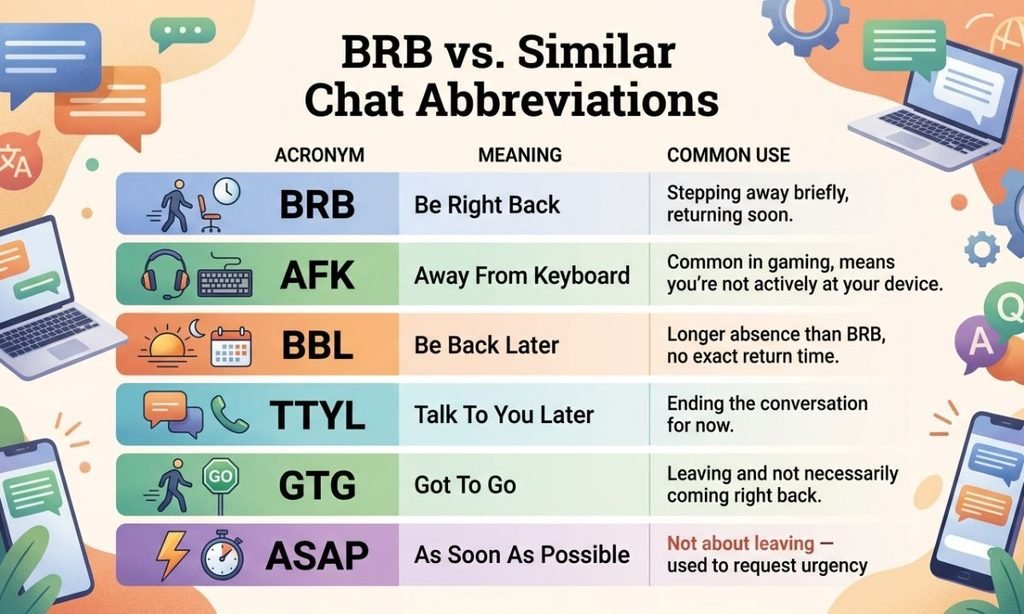
BRB often gets grouped with other texting shorthand, but each one means something a little different. Mixing them up is a common mistake, so here’s a clear side-by-side comparison.
| Acronym | Meaning | Common Use | Tone |
| BRB | Be Right Back | Stepping away briefly, returning soon | Casual, friendly |
| AFK | Away From Keyboard | Common in gaming, means you’re not actively at your device | Casual |
| BBL | Be Back Later | Longer absence than BRB, no exact return time | Casual |
| TTYL | Talk To You Later | Ending the conversation for now | Casual, closing |
| GTG | Got To Go | Leaving and not necessarily coming right back | Casual, abrupt |
| ASAP | As Soon As Possible | Not about leaving — used to request urgency | Neutral to formal |
The biggest distinction to remember: BRB implies a short, active break, while BBL and TTYL usually signal you’re stepping away for longer or wrapping up the conversation altogether. AFK is nearly identical to BRB but leans more toward gaming and voice-chat culture specifically.
It helps to think of these abbreviations on a kind of timeline. GTG and TTYL usually mean the conversation is done for now. BBL sits in the middle — you’re gone for a while, but you’ll circle back eventually. BRB sits at the short end of that spectrum: minutes, not hours. Understanding where each one falls on that scale helps you pick the right one and avoid confusing the person you’re chatting with.
When Not to Use BRB
Even though BRB feels harmless, there are a few situations where it can land the wrong way.
Avoid using BRB when:
- You’re messaging someone you don’t know well in a formal context
- The conversation is already tense or serious — a casual abbreviation can feel dismissive
- You’re not actually planning to come back soon (this one especially annoys people)
- You’re writing a formal email or business proposal
- Someone just shared bad news or something vulnerable and you need to step away
Think of BRB as a promise, not just a filler phrase. If you say “brb” and then don’t respond for six hours, it can feel like a mini letdown, especially in an active conversation where the other person was expecting a quick reply. This is sometimes called “brb-ing and ghosting,” and it’s one of the more common minor annoyances people bring up about modern texting etiquette.
Common Mistakes People Make With BRB
A few small habits can make BRB feel more annoying than helpful. Watch out for these:
- Overusing it. Typing “brb” every two minutes in a single conversation gets old fast. If you’re constantly interrupted, it’s fine to just say so once instead of repeating the abbreviation over and over.
- Using it, then disappearing for hours. This breaks trust in casual chat etiquette. If you know you’ll be gone a while, “bbl” or a short explanation works better.
- Using it in the wrong tone of conversation. If someone just shared something emotional or important, jumping in with “brb” can feel careless, even if that’s not your intention.
- Forgetting to actually come back. This sounds obvious, but it’s the single biggest complaint people have about BRB. If you say it, follow through.
- Using it as an excuse to avoid a topic. Some people say “brb” specifically to dodge an uncomfortable question, then take an unusually long time to “come back.” Most people can tell when this is happening, and it tends to damage trust more than just being upfront.
A little self-awareness about timing and context goes a long way. The abbreviation itself isn’t the problem — it’s how and when people use it.
Does BRB Vary Across Generations?
One thing worth noting: BRB doesn’t get used quite the same way across every age group. Millennials, who grew up with AIM and early texting, tend to treat it almost like a formal notice — a real signal that they’re stepping away and will return. Gen Z, who grew up with read receipts, typing indicators, and near-constant connectivity, sometimes uses BRB more loosely, almost as a placeholder phrase rather than a literal promise.
Older generations, including many Gen X and Baby Boomer texters, tend to use BRB less often overall, sometimes preferring to just go quiet and reply whenever they’re free, without announcing the gap. None of these approaches is wrong — they’re just different texting habits shaped by how each generation first learned to chat online.
Other Ways People Interpret BRB
While “be right back” is the meaning used more than 99% of the time, BRB has occasionally been used as shorthand in a few niche contexts, like usernames, brand names, or inside jokes specific to certain online communities. These are rare and don’t reflect the standard, widely recognized definition. If you see “brb” in a normal conversation, texting thread, or chat app, “be right back” is virtually always what’s meant.
Final Thoughts
At its core, the brb meaning hasn’t changed much since the days of AOL chat rooms — it’s still just a quick, friendly way to say “hang on, I’ll be right back.” What has changed is where and how often we use it, from gaming lobbies to Slack channels to group texts with friends.
Used well, BRB keeps conversations flowing naturally instead of leaving people wondering if you vanished mid-chat. Used carelessly, it can come across as flaky or too casual for the moment. The difference usually comes down to context: know your audience, keep your word about coming back, and save it for the situations where a little informality actually fits.
Next time you type those three letters, you’ll know exactly where they came from, how they’ve traveled across three decades of internet culture, and exactly how to use them right.
FAQs
What does BRB mean in texting?
BRB stands for “be right back.” It means someone is stepping away from the conversation for a short time but plans to return soon. It’s one of the most common abbreviations used in texting and online chat.
What does BRB mean from a girl or guy?
BRB means the same thing regardless of who sends it — “be right back.” It’s not gender-specific slang and doesn’t carry a hidden or flirty meaning on its own. Context around the message matters more than the abbreviation itself.
Is BRB rude to say?
No, BRB is not rude in casual conversations, texting, or gaming chats. It can feel dismissive if used during a serious or emotional conversation, so it’s best saved for lighter moments. Actually following through and coming back also matters.
What’s the difference between BRB and AFK?
BRB (“be right back”) is common across texting and general chat, while AFK (“away from keyboard”) is used mostly in gaming and voice chat. Both signal a short absence, but AFK specifically means you’re away from your device.
What does BRB mean on Snapchat or Instagram?
On Snapchat and Instagram, BRB carries the same meaning as everywhere else — “be right back.” People typically use it in DMs, comments, or story captions to say they’ll respond or return shortly.
Is BRB still used in 2026?
Yes, BRB is still widely used today across texting, Slack, Discord, gaming, and livestreams. It has remained popular since the 1990s and continues to work well in fast-paced digital conversations.
What can I say instead of BRB?
You can use alternatives like “one sec,” “give me a minute,” or “back shortly” for a similar casual tone. For professional settings, phrases like “I’ll step away briefly” or “one moment, please” work better than BRB.
Does BRB mean the same thing as BBL?
No, BRB implies a short break of a few minutes, while BBL (“be back later”) suggests a longer absence. Use BRB for quick pauses and BBL when you’ll be away for an extended period.
