

You post a photo of your new puppy, and within a minute a friend replies with a single word: “awe.” No punctuation, no explanation, maybe a heart. That one word is the whole awe meaning in text, and it feels good to receive even if you can’t say exactly why.
People search for it because it looks like internet shorthand but doesn’t act like it. It isn’t LOL or BRB, and it doesn’t seem to stand for anything. It also gets mixed up with “aw” and “aww,” so a lot of readers wonder whether it’s a compliment, a sympathy sound, or something else. You’ll see it in text messages, Instagram comments, TikTok replies, Snapchat chats, and WhatsApp threads.
This guide explains what the word means, where it came from, and how it differs from similar terms. You’ll also get plenty of real-style examples and some ready-to-use replies.
Awe in a text is a short, warm reaction that shows wonder, admiration, amazement, or emotional appreciation. People send it when something is cute, sweet, touching, or impressive, like a puppy photo or a kind gesture. It is not an acronym, and it usually reads as positive.
What Does Awe Mean in Text and Chat?
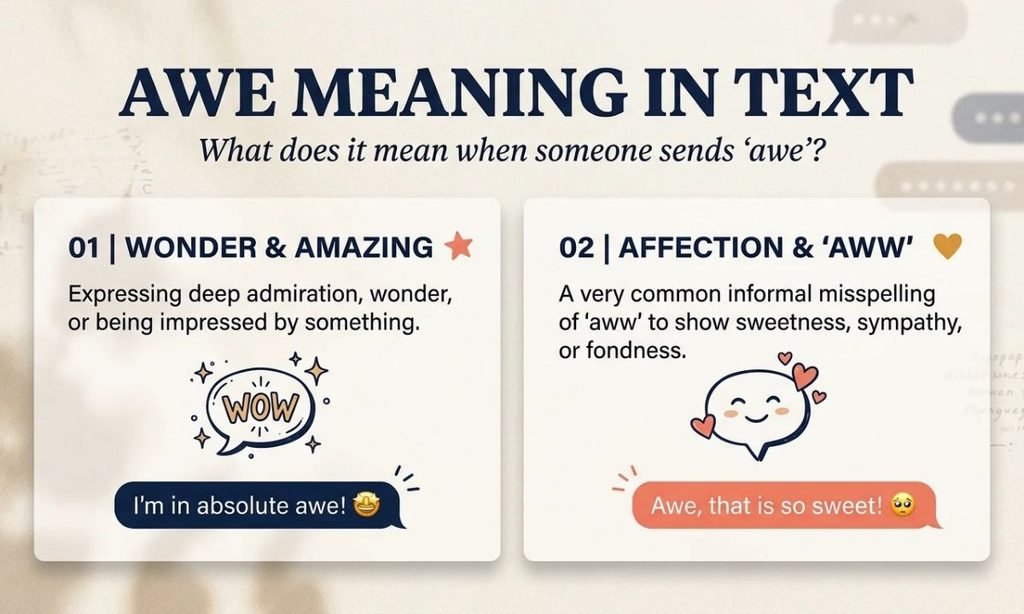
Awe meaning in text comes down to a small burst of warmth. Someone types “awe” when a friend shares something sweet, and what they’re really saying is that it landed. It packs a feeling of wonder, admiration, amazement, or emotional appreciation into one word.
Here’s a quick example. A friend writes, “I surprised my mom with a vacation.” You reply, “Awe, that’s so sweet! ❤️” You aren’t describing anything. You’re showing you were touched, and the reply carries appreciation, kindness, and warmth at once.
People reach for it when something is cute, beautiful, or impressive, or when someone has pulled off an achievement or done something kind. In texting it usually stands alone, with no full sentence around it. That’s the same awe meaning in chat you’ll see in comment sections: admiration wrapped in a soft tone.
The word can also lean toward surprise. Sometimes it sits closer to “wow” or “amazing,” when whatever you’re looking at is unexpected or genuinely impressive. The core is still emotional.
It also isn’t a coded shortcut. Slang abbreviations like LOL or BRB squeeze a phrase into a few letters. Nothing has been shortened here. The sender is simply reacting, and the word does the job.
Awe or Aww? Clearing Up a Common Mix-Up
Most explainers skip this part. The word people type is often really a spelling of “aww,” the little sympathetic sound you make at a puppy photo. The dictionary word “awe” means reverent wonder. In practice the two have blurred, so a text that says “awe” can mean either one, and context tells you which.
Traditionally, “aw” expresses sympathy or affection. “Aw, that’s so cute” is a classic. “Awe” refers to wonder or admiration, as in “I looked at the mountains in awe.” The two sound similar, which is why online users swap them constantly.
Since so many people use them interchangeably in casual chats, I wouldn’t correct anyone. If a friend texts “awe” under your dog’s photo, you know exactly what they meant. Save the distinction for writing where spelling counts.
Is Awe an Acronym? What It Stands For
There’s no full form. People keep asking what it stands for, and the answer is nothing. It isn’t an acronym, and it does not officially stand for any phrase.
That surprises people because so many internet abbreviations and bits of internet slang are built from initials. Awe is a regular word, a traditional English word that has been around for centuries. I’ve watched people assume it’s texting shorthand, probably because it shows up so often in social media conversations.
| Term | Short meaning |
| Awe | A feeling of wonder, admiration, amazement, or emotional appreciation |
The short meaning is the same as the long one. Its popularity as a text reaction came later, once texting made it a fast way to respond to something nice. The word itself predates texting and social media by a long way.
If you’re curious how a real texting acronym works, compare it with IDGAF meaning in text. That one is built from initials and can sound harsh, while awe is a plain, gentle word.
Where Does Awe Come From? Origin and History
Awe has a long and slightly tangled history. According to Etymonline, the word entered English around 1300 with a sense of fear or terror, and it traces back to a Scandinavian source such as Old Norse. Old English had a related word for fear too. The exact first known use is hard to pin to one date. Over the centuries, that dread slowly shifted toward respectful fear and then toward wonder and admiration.
For centuries, in literature and spoken language, it described what a person felt facing nature, art, religion, or anything extraordinary. Examples from history usually look like this:
- Standing before a huge mountain range
- Looking at a magnificent cathedral
- Witnessing a breathtaking sunset
- Feeling inspired by an extraordinary event
Those are powerful experiences that make you go quiet. That older meaning explains why awe still sounds heavier than “cute.” It points to respect and a deep emotional feeling, not just a smile.
Over time the meaning expanded into everyday language. Today, in a much more casual way, people express the same core feeling at a smaller scale online. A photo or a kind word gets appreciation and emotional warmth. Same feeling, lower stakes.
How the two spellings got tangled is harder to say. The interjection “aw” is a separate sound, and nobody can date the mix exactly. My own guess, from watching how people type, is that spelling by ear did most of the work.
The rise of digital communication did the rest. Informal texting rewards short words, and people reaching for a way to show emotional reactions quickly landed on this one. It became more common in online culture through chat messages, cute videos, emotional stories, and surprising content. It’s popular now across social media platforms.
How People Use Awe in Everyday Conversations

In general usage, people type “awe” when a friend shares good news, a photo, or a kind gesture. I’ve seen it answer a baby video, a romantic gesture, and an inspiring moment, sometimes in the same hour in the same group chat. It can signal warmth, happiness, or something heart-touching, and it can also mean you’re amazed.
Its emotional nature is the point. It works as emotional shorthand, built for casual conversations where nobody wants to write a paragraph.
Texting Examples
Here’s the kind of thing that lands in my messages all the time:
- “Awe, that’s adorable!”
- “Awe, thank you so much.”
- “Awe, you remembered my birthday!”
- “Awe, that’s the cutest puppy ever.”
Social Media Examples
Comments follow the same pattern:
- “Awe ❤️”
- “Awe, this made my day.”
- “Awe, what a beautiful family.”
- “Awe, that’s so wholesome.”
Everyday Situations
The situations are predictable. Someone receives a thoughtful gift, sees baby photos, hears a touching story, or watches a heartwarming video. Across all of them the word carries a positive, emotional tone that’s hard to fake, which is partly why people trust it. You can usually tell when a friend means it.
Is Awe Formal or Informal?
Informal communication is where it lives. In business emails, academic writing, or professional discussions, it’s rarely used as a standalone expression. Nobody sends it to a client. People write full sentences instead, like “I am amazed” or “That is impressive.”
So it isn’t a formal word, and I’d keep it out of anything with a signature block. In messaging apps like WhatsApp it’s widely used and often paired with emojis like 😍 or 😮. As texting slang goes, it’s gentle.
The meaning depends on context. The tone you read into it should come from the conversation, who’s talking, and what just got shared. It’s expressive without being loud, a quick emotional expression in a single word.
Is Awe Rude?
No. Awe is generally considered positive and polite. It signals kindness, warmth, or appreciation. The tone can shift with context, but it’s rarely read as rude, and I’ve almost never seen anyone use it sarcastically.
Awe Meaning Across WhatsApp, Instagram, TikTok, and Snapchat
The core meaning doesn’t change between apps, but the habits do. Awe is commonly used for cuteness and sentiment, and often shows up in replies and other emotional reactions to posts.
On WhatsApp, awe tends to be personal. It often signals gratitude, affection, or emotional support, a response to a message that meant something. “Awe, thank you for checking on me” is what I’d expect from a friend after a rough week.
On Instagram, awe is common in captions and comments, showing admiration or emotional appreciation. People often write it under pet photos, family pictures, aesthetic posts, and relationship posts. “Awe, you two are adorable together!” is typical, and it’s sweet rather than flirty.
TikTok
On TikTok, awe lands under videos that are funny, sweet, or emotional. I notice it most under inspiring content, cute animal clips, and heartwarming stories. “Awe, this video made me smile” fits right in.
Snapchat
On Snapchat, awe is more private. It’s usually a reply to snaps from friends and often involves a selfie, a cute photo, or a thoughtful message. It usually expresses affection, appreciation, or admiration, and “Awe, you look amazing!” is a pretty standard reaction.
What Does Awe Mean From a Girl or a Guy?
People love to read gender into a short text, so here’s the plain version. When a girl says awe, she’s often showing affection or admiration, or just finding something cute. The exact meaning depends on the conversation, and it shouldn’t be treated as romantic interest by default.
When a guy uses it, he’s typically showing appreciation, warmth, or emotional support. Like anyone else, he may simply be reacting to something sweet, impressive, or meaningful. The word itself doesn’t change with who sends it.
Real Chat Examples of Awe
Real messages teach more than definitions. Here are some realistic ones, the kind where nobody wants to type much:
- “Awe 😍 that puppy is so cute!”
- “Awe, that was such a sweet message.”
- “Awe, I didn’t expect that surprise!”
- “Awe 🥺 this video is so emotional.”
- “Awe, your puppy is so adorable! 🐶😂”
- “Awe, thank you for remembering my graduation 😊”
- “Awe, that’s one of the sweetest things I’ve heard ❤️”
- “Awe, your grandparents look so happy together 🥰”
- “Awe, this video completely made my day 😄”
- “Awe, you didn’t have to do that for me 😊”
- “Awe, your little sister is so cute 😂”
- “Awe, that sunset photo is beautiful 🌅”
- “Awe, congratulations on getting the job! 🎉”
- “Awe, that’s such a thoughtful gift ❤️”
- “Awe, I can’t believe you planned all that 🤔”
- “Awe, this story is so heartwarming 😊”
Look at the pattern. Some replies answer a photo, some answer a message, and some react to something unexpected. The 🥺 examples show the softer, teary side. A few add congratulations, and others thank someone for remembering or planning something.
In every case, the word carries the feeling and the rest of the sentence names the cause. The emoji does a lot of the tone work too, so an awe with 🥰 and an awe with 🤔 read very differently.
Other Meanings of Awe in Different Fields

Outside texting, the broader meanings go deeper, though the central idea stays the same: admiration and wonder.
| Field | Meaning |
| Psychology | A powerful emotional response to something vast or extraordinary |
| Literature | Deep wonder and admiration |
| Religion | Reverence toward a higher power |
| Everyday speech | Amazement or appreciation |
| Social media | A cute, sweet, touching, or impressive reaction |
Texting simply lowers the volume and adds affection.
Some other fields are mostly dead ends. Awe is not a medical abbreviation, though “AW” is sometimes read as airway by people in clinical settings, and that’s where the confused readings come from. Physics has no direct scientific meaning for it.
In technology, you might see it loosely applied to UI reactions, like a tap or sticker that gives emotional feedback. That’s informal use rather than a technical term. If you run into it in one of these fields and the meaning isn’t obvious, check the surrounding text.
Common Mistakes and Misconceptions About Awe
A few mix-ups come up again and again.
Mixing it up with “aw.” The biggest one. They sound alike but aren’t exactly the same, as covered above.
Thinking it’s a slang abbreviation or acronym. It isn’t. There’s no hidden phrase behind it, and it isn’t short for anything.
Assuming it always means sadness. That idea comes from the 🥺 emoji sometimes sitting beside it. Happiness, admiration, and surprise are just as common.
Believing it belongs in formal language. It’s mainly used in casual communication, and it sits wrong in a formal register. Treat it as an emotional expression, not a word with a rulebook.
Thinking it’s always romantic. Not necessarily. Someone can say it about a pet, a child, a kind gesture, or an achievement without any romantic meaning. If you misread it as flirting, you’ll end up reading too much into a friend’s plain reaction.
Awe vs. Aw, Wow, OMG, and Other Similar Terms
Awe has relatives, and each one does a slightly different job.
| Term | Meaning | Usage |
| Awe | Wonder and admiration | General texting |
| Aw | Sympathy or affection | Casual chats |
| Wow | Surprise or amazement | Universal |
| Amazing | Strong approval | Social media |
| Adorable | Extremely cute | Pets, babies |
| Impressive | Respect and admiration | Achievements |
| Wholesome | Heartwarming and positive | Online culture |
| Cute | Pleasant and lovable | Informal conversations |
| Incredible | Extraordinary | Strong reactions |
Two more are worth knowing. “OMG cute” and “So sweet” are more specific. They name the emotion outright and add appreciation. Each of these alternatives has a slightly different temperature, and which one you pick says something small about the mood.
Why Awe Feels Different
The difference is softness. “Wow” reacts to the size of something, and “OMG” reacts to the jolt, whether that’s shock or excitement. Awe is a gentler, heartfelt reaction, often affectionate. It signals emotional connection more than a verdict.
That makes it unique among emotional expressions. When I get one, I read it as “that landed with me,” not “that was shocking” or “that was big.” It’s also warmer than “wow,” which is mostly about surprise.
How to Reply When Someone Says Awe
The right reply depends on the situation and the emotional tone. If someone sends “awe” after you share a photo, a light answer works: “Aww thanks 😊”. If it was something cute, match the mood with “I know right, it’s so cute!” After a joke or a small win, “Haha glad you liked it!” does the job. Don’t overthink it. A thank you, a laugh, or a short acknowledgment is enough.
Beyond those, I sort replies roughly by how well I know the person.
Casual Replies
- “Thanks!”
- “Glad you liked it.”
- “I appreciate that.”
- “Haha, thank you!”
Friendly Replies
These go warmer and return the encouragement and support the other person offered.
- “You’re so kind!”
- “That means a lot.”
- “I’m happy you think so.”
- “Thanks for saying that.”
Funny Replies
These suit people who joke with you, if you’re the type.
- “I know, I’m pretty adorable. 😎”
- “I’ll take that compliment!”
- “Mission accomplished. 😂”
- “My cuteness strikes again.”
Formal Replies
These are for the rare case where awe comes from a colleague or someone senior. Any of them keeps things polite without sounding stiff.
- “Thank you for your kind words.”
- “I truly appreciate your support.”
- “That’s very thoughtful of you.”
- “Thank you for the encouragement.”
Awe on Dating Apps
On dating apps, awe is a small green light. It’s a friendly response to sweet messages, photos, or thoughtful gestures. It adds softness and positivity without committing to much, and it can build an emotional connection quickly.
That fits modern digital communication, where one simple word can express emotion fast. Just don’t read a romantic promise into it. A friendly “awe” is often just that.
Is Awe Still Popular?
Yes, awe remains widely used online. It keeps appearing in Instagram comments, TikTok reactions, Snapchat messages, WhatsApp chats, and Facebook posts. Those look like the growing areas as far as I can tell, though I can’t give you a number.
Common users include teenagers, young adults, social media creators, and the friends and family members who comment on their posts.
Part of the reason is flexibility. One word covers heartfelt feelings, emotional depth, and a quick nod of appreciation. People like short expressions that communicate emotion quickly, and awe is simple, positive, and versatile. It suits a fast-paced digital world where nobody has time for long replies.
Compared with formal abbreviations or slang shortcuts, it’s easy to type and hard to misuse. That’s a big part of why it has lasted. It’s a simple yet powerful expression that doesn’t need decoding.
Quick Facts About Awe

| Factor | Details |
| Meaning | Wonder, admiration, amazement, appreciation |
| Category | English word |
| Tone | Positive and emotional |
| Usage platform | WhatsApp, Instagram, TikTok, Snapchat, Facebook |
| Popularity | High |
| Formal/Informal | Both, depending on context, though informal is far more likely |
| Common emotion | Admiration and warmth |
| Acronym? | No |
Understanding Awe Meaning in Text
Understanding awe meaning in text gets easy once you know the context. Often confused with “aw,” the word has a deeper historical meaning built on wonder and respect, and that history is why it still feels warmer than most online reactions. Whether someone is reacting to a cute pet, a photo, a thoughtful gesture, or a personal achievement, the message is usually positive and encouraging.
If you know how to respond naturally, you’ll follow online conversations faster and spend less time second-guessing a single word. Next time someone sends one, take it as it comes: a sweet, short sign that you did something right.
FAQs
What does awe mean in text?
Awe in text is a short, warm reaction that shows wonder, admiration, or emotional appreciation. People send it when something is cute, sweet, touching, or impressive. It usually reads as positive.
Is awe an acronym?
No, awe is not an acronym. It does not stand for any phrase. It is a regular English word that has existed for centuries and predates texting.
What is the difference between awe and aw?
“Aw” traditionally shows sympathy or affection, as in “Aw, that’s so cute.” “Awe” refers to wonder or admiration. In casual texting, many people use them interchangeably.
What does awe mean on Instagram?
On Instagram, awe shows admiration or emotional appreciation. People often leave it under pet photos, family pictures, relationship posts, and inspiring content. It is usually a friendly, supportive comment.
What does awe mean on Snapchat?
On Snapchat, awe usually expresses affection or appreciation. It often replies to selfies, cute photos, or thoughtful messages. The tone is typically private and friendly.
What does awe mean on TikTok?
On TikTok, awe appears under emotional, sweet, or heartwarming videos. Viewers use it to show they were moved or charmed. It also fits cute animal clips and inspiring content.
What does awe mean from a girl?
When a girl says awe, she is often showing affection or admiration, or finding something cute. The meaning depends on the conversation. It should not be read as romantic interest by default.
What does awe mean from a guy?
From a guy, awe typically signals appreciation, warmth, or emotional support. He may simply be reacting to something sweet or impressive. The word does not change meaning based on who sends it.
Does awe mean someone likes you?
Not necessarily. Awe is a friendly reaction people use for pets, kids, gifts, and achievements. Check the context and the rest of the conversation before assuming romantic interest.
Is awe rude or negative?
No, awe is generally positive and polite. It conveys kindness, warmth, or appreciation. It is rarely read as rude, though tone can shift slightly with context.
How do you reply when someone texts awe?
Keep it simple. Try “Thanks!”, “Glad you liked it,” or “That means a lot.” For a playful tone, “I’ll take that compliment!” works well.
Is awe formal or informal?
Awe is mostly informal. It fits chats, comments, and messaging apps. In business emails or professional writing, use full sentences like “That is impressive” instead.
Is awe the same as wow?
Not exactly. “Wow” mainly shows surprise or amazement. “Awe” is softer and warmer, often carrying affection or emotional connection.
Where does the word awe come from?
Awe comes from Old English and has been used for hundreds of years. It once leaned toward fear or dread before shifting to respectful wonder. The exact first use is hard to date.
Why do people say awe online?
People say awe because it is short, easy to type, and quickly conveys emotion. It works across WhatsApp, Instagram, TikTok, and Snapchat. One word does the job of a full sentence.
Is awe still popular in 2026?
Yes, awe is still widely used online. It appears often in Instagram comments, TikTok reactions, Snapchat messages, and WhatsApp chats. Teenagers, young adults, and creators use it most.
