

You’re organizing a weekend trip, and a friend replies, “Departure time: TBD.” Nothing’s cancelled and nothing’s confirmed, so what do you do? That’s the TBD meaning in text in a nutshell: the plan is real, but one detail hasn’t been settled.
People search for this abbreviation because it shows up in so many places at once. It sits in work emails, school notices, TikTok captions, and group chats, and it looks a lot like other short codes such as TBA and TBC. That’s where the mix-ups start.
This guide covers what TBD means, how people use it on different platforms, and how to reply when someone sends it. You’ll also see where it came from, when to avoid it, and how it differs from similar abbreviations.
TBD stands for “To Be Decided” and sometimes “To Be Determined.” In a text, it means a decision hasn’t been made yet and the final answer is coming later. The plan or event still exists. One detail is just open. It’s a neutral abbreviation used for schedules, plans, and deadlines.
What Is the TBD Meaning in Text Messages?
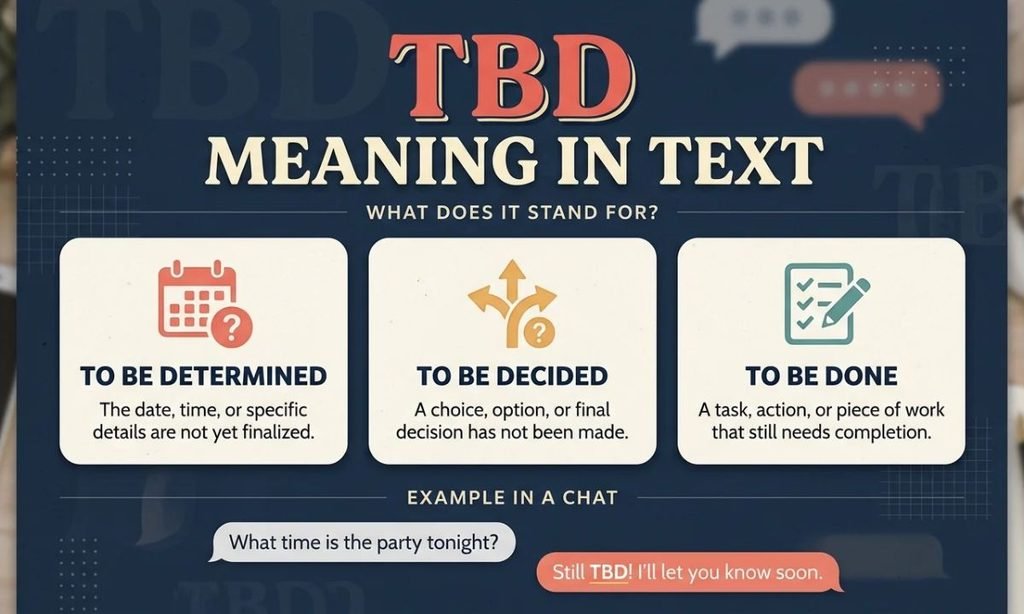
TBD is an abbreviation, and you could call it slang only in the loosest sense. Think of it as a placeholder. It holds a spot in a sentence while the real answer is still pending.
If a coworker writes “Meeting time: TBD,” the meeting is happening. Nobody has the exact time yet. The message isn’t empty, and it isn’t confirmed either.
Putting TBD in place of a guess is the honest move. The writer admits the information is incomplete and still in progress, which keeps people from acting on a wrong detail or spreading misinformation. It’s the same as saying, “I know this needs an answer, and I don’t have one yet.”
Why a Placeholder Works Better Than a Guess
Planning rarely arrives all at once. Schedules fill in gradually, and a plan with honest gaps stays clear and organized. A plan with made-up entries causes confusion the moment the confirmed version shows up.
Businesses, schools, organizations, and individuals all lean on this. TBD also covers the case where the answer is truly unknown to everyone, including the person writing. Once things are finalized, the label comes off. Anything marked TBD gets decided later, and good scheduling means going back to fill it in.
TBD in Texting and Social Media
Online, the meaning stays the same, but the feel changes. TBD becomes casual and flexible, a quick way to say “not sure yet” across chats and other platforms. Nobody has to write a long explanation, and people share details as soon as they have them.
TBD in Private Texts
Among friends, TBD means the decision isn’t final. Text “Dinner time TBD” and the other person knows dinner will happen and the exact time will come later. Meeting times, travel plans, and weekend events get the same treatment.
One word replaces a full sentence of hedging. It captures the uncertainty without a long back-and-forth. Whoever sends it usually has a plan, just not a finished one.
TBD on Social Media Posts
Creators and organizers use TBD in captions, posters, and event promotions to share early information before everything is confirmed. “Venue: TBD” tells followers the location is coming soon.
Small event pages often post a date and mark every other item TBD. Then they roll out updates over the next few weeks. That keeps the details moving without promising anything false.
Where People Use It, Platform by Platform
It turns up wherever people make plans, across apps and platforms every day.
- TikTok: captions and comments, usually something like “posting part 2, date TBD.”
- Instagram: bios and stories, often for a new project launch date.
- Snapchat: chats about a party location.
- WhatsApp: group chats where people organize events.
- SMS: everyday texts about an exam schedule or a dinner time.
The common thread is simple. The topic is still unclear, the writer will confirm later, and TBD is a practical way to say so without a paragraph of explanation.
Who Uses TBD?
Nearly everyone does. Gen Z didn’t invent it, but they use it constantly in group chats, online communities, and planning discussions. Teens, students, and college students lean on it for event planning and social media captions.
Adults use it too, especially at work, where it’s a normal part of scheduling. The platforms overlap heavily: TikTok, WhatsApp, Snapchat, Instagram, email, and school apps. Different age groups use it for the same reason, which is incomplete plans or details that aren’t confirmed yet.
The tone stays neutral and practical. It isn’t emotional, and it isn’t slang-heavy. It’s a planning term that fits modern digital communication and works the same way in casual conversation.
Real Chat Examples of TBD
Here’s how it sounds in real conversations. These are realistic examples, not scripts from any one app.
- A friend asks what time the meeting is. The answer is just “TBD,” and the first person says to let them know when it’s fixed.
- Someone asks about hanging out tomorrow and hears that the location is TBD. They send a thumbs up.
- A test date that’s “still TBD” gets a “lucky you.”
- Movie night: “Maybe, time TBD,” answered with “I’m in either way.”
- Someone asks about the plan for Friday and hears that everything is TBD. The reply: “Classic.”
- Someone asks when a video is going up. The answer is TBD, followed by a joke about not taking forever.
- “It’s TBD, waiting on others.”
- A message about a deadline reads, “Teacher said TBD,” which is confusing.
- A road trip date sits at “TBD for now” while the group agrees to decide soon.
- Someone asking about the game hears “Time TBD” and says they’ll keep their schedule open.
Notice what each one asks of you. Mostly it’s patience. You wait for the plan, the date, the time, or the final word.
How to Reply When Someone Says “TBD”
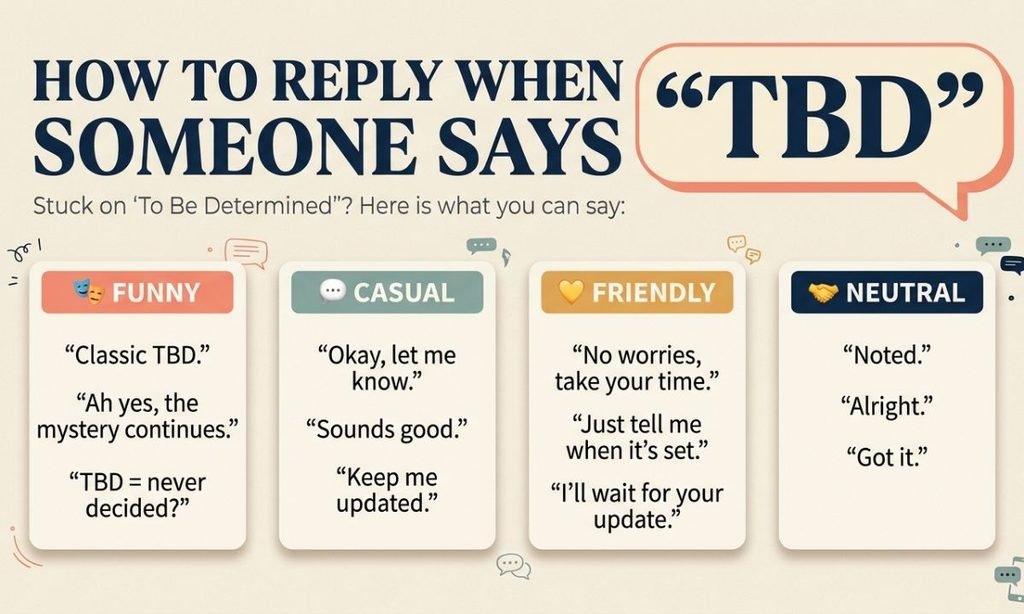
Underneath, TBD means “I don’t know yet.” Your reply depends on the tone you want.
| Tone | Reply Ideas |
| Funny | “Classic TBD,” “Ah yes, the mystery continues,” “TBD = never decided?” |
| Casual | “Okay, let me know,” “Sounds good,” “Keep me updated” |
| Friendly | “No worries, take your time,” “Just tell me when it’s set,” “I’ll wait for your update” |
| Neutral | “Noted,” “Alright,” “Got it” |
The neutral group is what works best at work. Short and calm fits almost everywhere.
How TBD Shows Up in Everyday Life
At Work
The workplace is where TBD appears most. Managers drop it into emails, presentations, and project plans. Professionals use it in planning documents when one cell is still open. A team email might list the meeting time as TBD, and everyone understands the meeting is on.
In business documents, it often works as a project placeholder for information that isn’t finalized. Look at the usual spots: schedules, agendas, budgets, and launch plans.
At School
Students and teachers use it too. A school event notice may show the venue as TBD. Assignment deadlines sometimes sit at TBD until the teacher decides.
With Friends
In daily texting, friends use it for meetups and weekend plans. A group chat might hold three TBDs at once and still feel perfectly clear.
Platforms differ, but the setup is always the same. Information is coming later, and everyone quietly agrees on expectations until it arrives. Event timing is the classic case.
A Quick Scenario
Say you’re planning a school event with friends. You start a group chat and go through the details. The date is clear, but the venue isn’t. Someone writes, “Venue is TBD.”
That one line tells everyone the plan exists and is settled in most respects, with a single gap left. It keeps the planning simple, with no long explanations needed.
TBD Examples in Sentences
Here are natural examples you’d actually hear:
- The interview time is TBD until the manager confirms.
- Our trip date is TBD while everyone checks availability.
- Match schedule is TBD because of weather conditions.
- Assignment deadline is TBD for now.
- Project launch date stays TBD until final approval.
- Dinner location is TBD, so we’ll pick later.
Each one has the same shape: an event or schedule, plus one open detail. That’s why TBD fits so easily into everyday communication.
Other Meanings of TBD
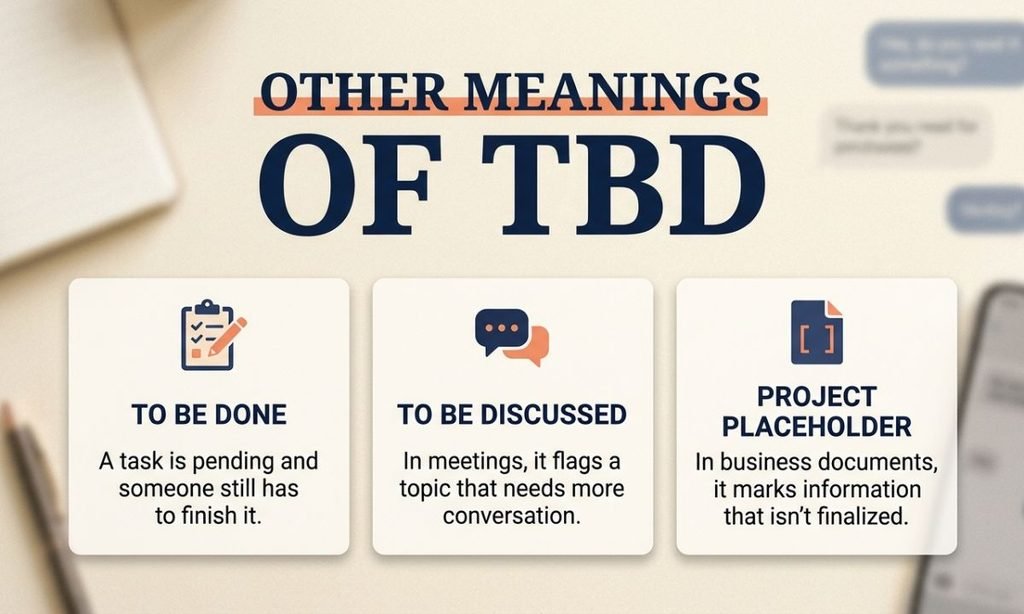
TBD mostly means To Be Decided or To Be Determined, but context can shift it.
- To Be Done: a task is pending and someone still has to finish it.
- To Be Discussed: in meetings, it flags a topic that needs more conversation.
- Project placeholder: in business documents, it marks information that isn’t finalized.
These meanings are closely related. Each one points to a final decision pending and details confirmed later. Read the context before you assume which one the writer meant.
The Tone and Intent Behind TBD
TBD is neutral. It carries no emotional meaning and is rarely sarcastic, though a raised-eyebrow emoji can change that. The intent is practical: this is still in planning, so don’t treat it as final.
In business and formal communication, it sounds organized and professional. In casual texting, it’s simply convenient. It stays calm and straightforward, giving people a clear signal about pending decisions without drama. It also heads off uncertainty before it turns into confusion.
Where TBD Came From
TBD didn’t start as internet slang. It comes from formal English and professional use. Organizations needed a fast way to flag incomplete information in corporate documents, meeting schedules, and planning sheets, and abbreviations like this one fit. Even today, the Oxford Advanced Learner’s Dictionary lists TBD as an abbreviation used in notices about events or products, meaning to be decided or determined.
From there it spread into schools, sports schedules, and event planning. As digital communication grew, it moved into emails and online platforms and eventually became part of texting language across the internet.
There’s no verified first use, so treat any exact date you see online as debated at best. What’s clear is the consistent meaning. Across industries and in professional or casual settings, it has barely changed.
It became popular online because it’s short and convenient, and it explains uncertainty quickly. Social media sped that along. Faster communication, shorter messages, and easy abbreviations all helped. That internet influence is why some people file it under mystery slang, but it started somewhere much more formal.
Is TBD Rude or Inappropriate?
No. It’s safe, neutral, and unlikely to offend anyone. It turns up in business emails, event announcements, planning documents, text messages, and school communication all the time. Nobody reads it as inappropriate, and it’s widely accepted and well understood.
Is it formal or informal? Both, depending on the situation. It’s common in workplace communication and equally fine in casual chats. In formal writing, spelling it out as “to be decided” reads better.
The real trouble is overusing it. A TBD that sits in an important schedule for weeks without updates starts to look unprofessional. The schedule feels unclear, and readers who need to plan around it get confused. Pending items need follow-up.
When Not to Use TBD
Skip it when the stakes demand certainty.
- Legal documents and formal contracts: these need final information, and TBD invites confusion.
- Official announcements: they promise finalized details.
- Academic submissions: an open slot can look careless.
- Urgent communication: when immediate decisions are needed, TBD can delay action and cause misunderstanding.
Reserve it for things that are genuinely pending, where the incomplete information will be confirmed.
TBD vs TBA, TBC, and TBAA
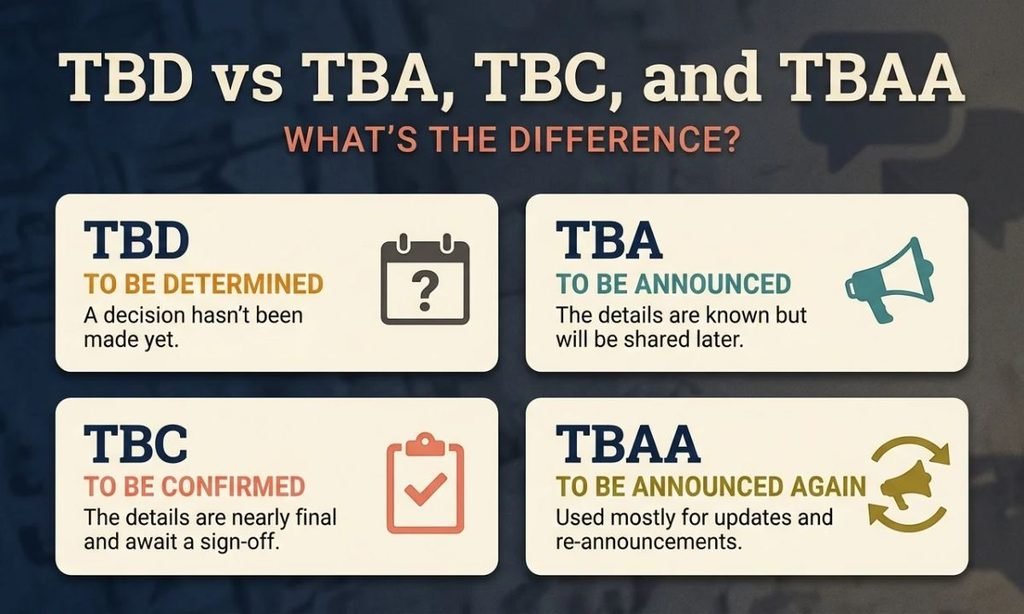
Three cousins show up beside TBD, and mixing them up is a quick route to confusion in schedules and event planning.
- TBA means To Be Announced and covers information shared later.
- TBC means To Be Confirmed. It signals details that are almost finalized and need only a sign-off.
- TBAA means To Be Announced Again. It’s less common and mostly appears in updates and announcements.
The differences come down to what has happened to the decision.
TBD vs TBA
TBD says the decision isn’t made yet. TBA says a decision exists behind the scenes and simply hasn’t been announced. Once it’s announced, the TBA label goes away.
TBD vs TBC
TBD shows uncertainty. TBC shows confirmation pending: the answer exists and someone needs to approve it. A TBC time is usually close to final, while a TBD time may still change completely.
TBD vs TBAA
TBD is about decision-making. TBAA is about announcement updates. If you see TBAA, an announcement already went out and another one is coming.
Quick Comparison Table
| Term | Meaning | Usage | Key Difference |
| TBD | To Be Decided or Determined | Planning, schedules, texting | Decision not made yet |
| TBA | To Be Announced | Events, announcements | Decision made but not shared |
| TBC | To Be Confirmed | Meetings, schedules | Waiting for confirmation |
| TBAA | To Be Announced Again | Updates, announcements | Information repeated |
Treat TBD as a marker for a single detail, then swap it out when the answer is in.
TBD Compared With Other Texting Abbreviations
TBD sits in a family of texting shorthand, and it helps to see how it differs from the others. If you also keep running into other short codes in your chats, our guide to WTH meaning in text covers another one people often mix up.
| Term | Meaning | Type | Usage | Popularity |
| TBD | To Be Decided | Abbreviation | Plans not finalized | High |
| IDK | I Don’t Know | Slang/Acronym | Expressing uncertainty | Very high |
| IDC | I Don’t Care | Slang/Acronym | Showing indifference | High |
| IMO | In My Opinion | Acronym | Sharing opinions | Medium |
| BRB | Be Right Back | Acronym | Leaving temporarily | High |
The useful contrast is with IDK. IDK says the person doesn’t know. TBD says nobody has decided, which is a different thing.
Common Misunderstandings About TBD
Some people file TBD under internet slang. It’s a professional abbreviation that happens to be popular online.
Others treat it as TBA, which is a mistake, as the table above shows. A few read it as a cancellation, but the thing is still on. Does TBD mean “unknown”? Only in the sense that the detail is unknown right now and will be decided later.
The biggest slip is leaving TBD in place after a decision has been made. That delays communication and creates errors and confusion. Correct use means you replace it the moment final information arrives. Using it wrong is easy, and spotting the mistake takes a glance.
Using TBD Well
My rule is simple: use TBD when something isn’t finalized, and take it out when the answer arrives. The TBD meaning in text stays the same whether you’re messaging a friend or filling out a business schedule.
It’s a widely used abbreviation with a neutral tone, and it’s safe from casual texting to professional emails. Used that way, it brings clarity to everyday planning and cuts confusion in announcements and social media posts. The only place to skip it is formal writing, where full words read better.
FAQs
What does TBD mean in text?
TBD stands for “To Be Decided” or “To Be Determined.” It means a decision hasn’t been made yet. The plan still exists, and the final detail will come later.
What does TBD mean on TikTok, Instagram, and Snapchat?
It means the same thing everywhere. Creators and friends use it when a date, time, or location isn’t confirmed. A caption like “part 2, date TBD” just tells you an update is coming.
Is TBD slang or an abbreviation?
It’s an abbreviation that started in business and scheduling language. It became popular in texting because it’s short and clear. Calling it slang is only true in the loosest sense.
Is TBD rude or offensive?
No. It’s neutral and safe in texts, emails, school notices, and social media posts. Nobody reads it as disrespectful.
How do you reply when someone texts “TBD”?
Keep it short. “Okay, let me know,” “Sounds good,” or “Keep me updated” all work. If you want something playful, try “Classic TBD.”
What is the difference between TBD and TBA?
TBD means the decision hasn’t been made yet. TBA means it’s decided but not announced. Once the announcement goes out, TBA disappears.
What is the difference between TBD and TBC?
TBD means the answer is still open and may change completely. TBC means the answer exists and only needs confirmation. A TBC detail is usually close to final.
Does TBD mean the plan is cancelled?
No. TBD means the plan is still on, with one detail missing. Nothing is cancelled unless someone says so.
Is TBD professional enough for work emails?
Yes. Managers and teams use it in schedules, project plans, and meeting invites all the time. Just update it quickly, because a TBD that sits for weeks looks sloppy.
When should you avoid using TBD?
Skip it in legal documents, contracts, official announcements, and urgent messages. These need final information, and an open slot can cause confusion or delays. In formal writing, spell out “to be decided.”
Can TBD mean anything other than “To Be Decided”?
Sometimes. Depending on context, it can mean “To Be Done” for a pending task or “To Be Discussed” for a meeting topic. Check the surrounding message to be sure.
How is TBD different from IDK?
IDK means one person doesn’t know something. TBD means nobody has decided yet. One is about personal knowledge, the other is about an unsettled plan.
