

You send a friend the notes they asked for, and the reply comes back in seconds: “TY!” Two letters, and the message is complete. That tiny exchange is the whole story of TY meaning in text, and you’ll see it in chats, comments, and game lobbies every day.
People still search for it because it shows up in so many forms. You might see “ty” in lowercase, “TY” in capitals, or “Ty” written like a first name. It appears in DMs, group chats, story replies, and live streams, and the short, unexplained look of it makes some readers wonder about tone or hidden meaning.
This guide covers what TY stands for, how its tone shifts, where people use it, and how to reply. You’ll also learn when to type the full words instead, and how TY compares with similar abbreviations.
TY is a texting abbreviation for “thank you.” People use it to show appreciation, gratitude, acknowledgment, or simple politeness in digital chats. It works in lowercase, all caps, or capitalized like a name, and the meaning stays the same. It is informal, so it suits friends and casual chats better than formal messages.
What Does TY Mean in Text?
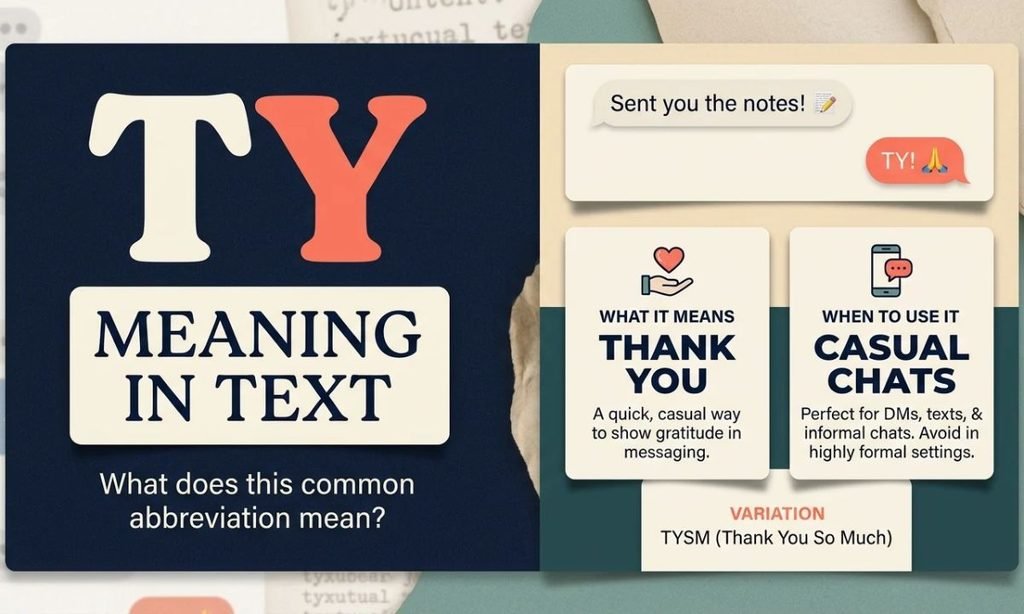
The direct meaning is simple: TY equals “thank you.” It does the same job as the full phrase in two letters.
Say a friend forwards the file you asked for. You reply “TY!” and the matter is settled. The writing is tiny, and the meaning stays whole.
As a slang term, TY is an acronym built from the first letters of two words. Searches like “TY abbreviation meaning,” “TY full form in texting,” or “what does TY mean on Snapchat” all lead to the same answer: gratitude. The definition barely changes from one chat or platform to the next.
Why Fast Typing Made It Stick
Modern messaging favors speed over perfect grammar. Many people shorten “thank you very much” into an abbreviation because it saves time, and the feeling stays positive. “TY for the update” reads about as warm as the long version.
Why People Keep Using It
The reasons are plain. TY is fast, friendly, and casual, and almost everyone understands it, so nobody needs a decoder. Even “Thank you so much for helping me” can feel like effort when you’re in a hurry. Typing “TYSM” is shorter still, and plenty of people reach for that instead.
It takes minimal effort, expresses something positive, and has one clear meaning that works nearly everywhere. A free shortcut like that is hard to give up, which is why searches for this slang term keep coming.
How the Tone of TY Changes
The same two letters can carry three different moods. The letters stay put, and the words, emojis, and punctuation around them do the work.
| Tone | Example | What it signals |
| Friendly | “TY 😊 You’re the best” | Warm, affectionate appreciation |
| Professional | “TY. I’ll review it this afternoon.” | Brief, polite acknowledgment |
| Minimal | “TY.” | Short, possibly flat or detached |
Friendly
Add an emoji or a few extra words and TY gets warm fast. “TY 😊 You’re the best” has real friendliness in it. The warmth comes from what surrounds the letters, and that turns a simple abbreviation into a genuine expression of thanks.
Professional
In work chats, TY can act as a quick acknowledgment. “TY. I’ll review it this afternoon.” confirms receipt and avoids a long reply. In the workplace threads I’ve been part of, it works as a small courtesy that closes a loop. That only holds when the team is relaxed about tone, though.
Minimal
A lone “TY.” can read as short, detached, even cold. The sender may have meant to be polite, but with no emotion and only a period doing the work, the message lands flat. Without context you’re guessing, so tone decides everything here.
Other Things TY Can Mean
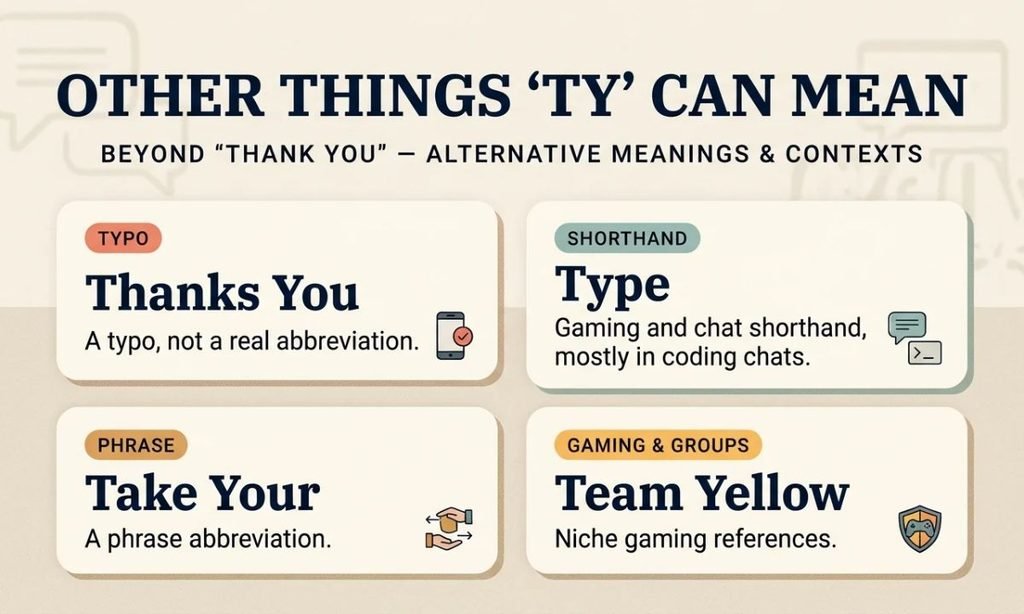
“Thank you” is the main reading, and the others are uncommon. They are listed here so you can recognize them:
| Possible meaning | Where it appears |
| Thanks You | A typo, not a real abbreviation |
| Type | Gaming and chat shorthand, mostly in coding chats |
| Take Your | A phrase abbreviation |
| Team Yellow | Niche gaming references |
All of these are rare and depend on context. Context almost always makes the answer obvious, and the most common texting meaning wins.
So can TY have more than one meaning? Technically, yes. Linguists call the process of choosing between meanings word sense disambiguation, and readers do it automatically. You’ll often see the claim that 99% of online uses mean “thank you.” That matches what I see, though it’s a gut feeling and not a measured figure. Other meanings can appear, but “thank you” dominates online.
Examples of TY You’ll Actually See
Here are a few typical phrases:
- “TY for helping me today.”
- “TY so much!”
- “Got the file, TY.”
- “TY bro, appreciate it.”
Each one is a faster way of saying thanks. In TY meaning in text, the pattern is almost always this one, and real-world usage rarely strays from it.
Where TY Shows Up
Think of TY as shorthand for texting spaces: SMS, iMessage, WhatsApp, Messenger, and Discord. People send it to show appreciation, acknowledge a favor, confirm they received something, keep a conversation moving, or answer politely without writing a full sentence.
Fast mobile communication makes this work. TY sits beside abbreviations like BTW in everyday digital language. A message like “TY for checking on me” feels casual, modern, and efficient while still carrying gratitude.
Text Messages
This is where TY feels most at home. Casual texting is full of it, and “TY for checking on me” is a typical example.
Social Media
On Instagram comments, TikTok replies, Snapchat, X (Twitter), and Facebook messages, TY is almost a reflex. “TY for the follow!” is the classic. Creators answer many people quickly, so short thanks suit the pace.
Gaming
Gamers use TY constantly, especially in lobbies. “TY healer.” “TY for revive.” “gg and ty.” These chat abbreviations double as good manners. In multiplayer games the thanks is often aimed at the whole group: “TY for the carry,” “TY teammate,” “GG TY everyone.”
Online Communities
Forums, Discord servers, and Reddit threads use it too. Communities often close a helpful thread with TY, and the habit carries from one online space to the next.
Across all four, TY is everyday and platform-agnostic. Only the surrounding context changes.
What Does TY Mean on Snapchat, Instagram, WhatsApp, and TikTok?
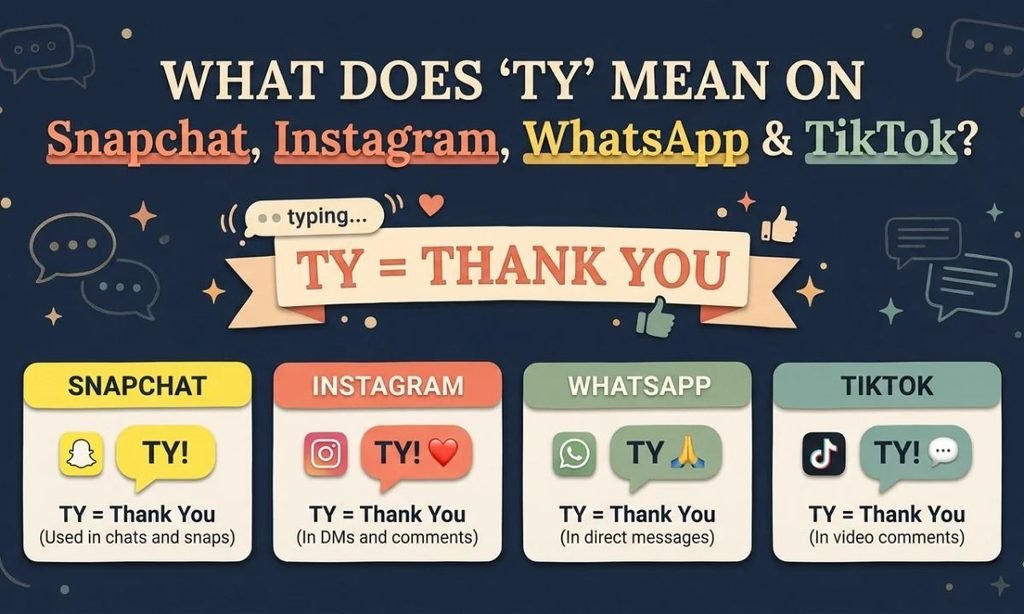
On all four platforms, TY is short for “thank you.” It’s a casual, quick way to show appreciation, whether you’re reacting to a kind message, replying to a compliment, or just saying thanks. The platform barely changes the meaning.
You’ll see it most in DMs, group chats, story replies, and post comments. Nobody sets out to write a formal thank-you in these spaces. The abbreviation fits the pace, and it usually appears right after someone sends you something nice.
Snapchat
On Snapchat, TY often follows a snap, a compliment, or help keeping a streak alive. It fits short replies and Bitmoji chats. “TY for snapping me back!” is the classic, and so is “TY for the laugh, that was hilarious 😂.” It’s casual and friendly, which is the point.
Anyone wondering what “ty” means in text on Instagram can answer it by watching where it appears: replies to DMs, story reactions, and post comments. It’s a brief way to thank someone for kind words, support, or sharing your content. “TY for the sweet comment on my post!” and “TY for sharing my story 💕” are everyday examples.
On WhatsApp, TY works in one-on-one chats and group messages alike. It’s light and informal, a way to say thanks without making a fuss. “TY for adding me to the group!” is common, and so is “TY, I’ll join the call in 5 mins.”
TikTok
TikTok users type TY in replies to comments, especially when someone compliments a video or sends a gift during a live. It’s a short way to acknowledge fans. “TY for the kind words 🙏” and “TY for the gift! Really appreciate it 🥹” are typical. On busy videos, I’ve noticed that creator-fan engagement is mostly a string of tiny thank-yous.
TY in Real Conversations
Friendly, Casual, and Tense Moments
The same letters bend to the mood.
- Friendly: “TY for remembering my birthday.” “TY bestie!” “TY for being there.”
- Casual: “TY lol.” “Okay TY.” “TY got it.”
Even in disagreements it stays polite on the surface. “Fine, TY for clarifying” can sound tense, while “TY, now I understand” is plain relief. In an argument, the context tells you whether the speaker is still being polite, not the letters.
Platform Snapshots
Here are five realistic examples of how TY plays out in different places.
- WhatsApp: Alex writes, “I picked up your package,” and Sam replies, “TY! I’ll grab it later.” It’s quick, efficient appreciation, and it keeps the conversation moving.
- Instagram DM: A follower writes, “Your recommendation helped me,” and the creator answers, “TY! Glad it worked.” The tone is casual and approachable.
- TikTok: A user comments, “This tutorial saved me hours,” and the creator replies, “TY ❤️.” Short replies let creators engage with more people and still show gratitude.
- Creator milestones: “TY for 1K followers!” “TY all for the support.” “TY for sharing.” Support arrives in bulk, so thanks does too.
- Group chat: Friend 1 says, “I booked the restaurant.” Friend 2 writes, “TY!” Friend 3 adds, “TY TY!” Group chats reward fast replies, so abbreviations are especially common there.
TY vs TYSM, THX, and Other Thank-You Abbreviations
TY has plenty of relatives. TY vs TYSM is mostly a difference in enthusiasm. TY is a simple thank you, while TYSM means “thank you so much” and signals stronger gratitude. Compare “TY for the info” with “TYSM for your support!” Pick TYSM when you want a warmer note.
TY vs THX comes down to spelling. TY uses the initials of “thank you,” while THX is a shortened spelling of “thanks.” Both are common, and “TY for helping” and “Thx for helping” mean the same thing.
| Slang | Meaning | Tone or use |
| TY | Thank You | Casual |
| TYSM | Thank You So Much | Warm, friendly |
| THX / THANX | Thanks | Casual, quick |
| TQ / TU | Thank You | Informal |
| TYVM / TQVM / TUVM | Thank You Very Much | Polite, a bit more formal |
| TVM | Thanks Very Much | Polite, slightly formal |
| TIA | Thanks In Advance | Used when requesting something |
| NP | No Problem | Common reply |
| YW | You’re Welcome | Response to TY |
TIA is the one that works before the favor happens, so it suits a polite request. NP and YW are the usual answers, and they often appear together in one chat:
Person 1: “Can you send the notes?”
Person 2: “Sure”
Person 1: “TYSM”
Person 2: “YW”
Other short relatives, like HY, follow the same logic. Together these slang terms form a family of abbreviations with similar jobs, and the table works as a quick comparison.
If TY feels worn out, TU, TQ, TYVM, TQVM, TUVM, TVM, TYSM, Thx, and Thanx are all options. Some are cheerful and some are slightly more formal. NetLingo’s guide to texting acronyms and online abbreviations tracks new ones as they catch on, and it’s a handy place to see how these terms evolve.
Other Common Text Abbreviations Worth Knowing
TY lives among many other chat shorthands. Here are popular ones and when people use them:
| Acronym | Meaning | When to use it |
| BRB | Be Right Back | Stepping away from a chat |
| LOL | Laughing Out Loud | Something funny |
| OMG | Oh My God | Surprise, shock, or excitement |
| SMH | Shaking My Head | Disappointed or annoyed |
| IDC | I Don’t Care | Indifference |
| IDK | I Don’t Know | Unsure |
| ISTG | I Swear To God | Serious or honest emphasis |
| FR | For Real | Confirming you’re not joking |
| TBH | To Be Honest | Sharing honest thoughts |
| IMO / IMHO | In My Opinion / In My Humble Opinion | A personal view |
| WYD | What You Doing | Checking in or starting a conversation |
| TTYL | Talk To You Later | Ending a conversation |
| BFF | Best Friends Forever | Your closest, long-time friend |
These terms make digital chats expressive. Match the vibe: casual with friends, toned down for semi-professional chats. If you keep running into “how about you” style replies, check what HBU means in text before you answer. Skip NVM when you mean thanks, since it’s a different abbreviation with a different job.
How to Respond to “TY” in Texts and Chats
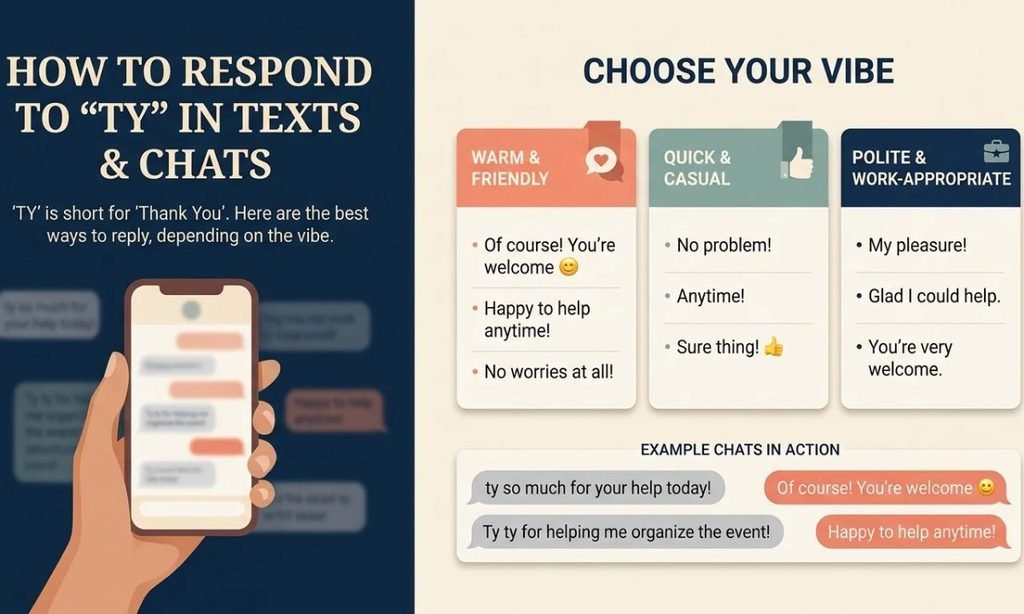
When someone sends TY, they’re expressing gratitude, so a good reply is easy. There are two friendly options and one rule about tone.
Say “You’re Welcome” or a Kind Message
The most natural reply is “You’re welcome,” just as you’d say it face to face. Warm phrases like “Anytime!” or “No problem 😊” work too. On an iPhone, an emoji reaction such as a thumbs up or a heart is a nice touch.
Person A: “ty so much for your help today!”
Person B: “Of course! You’re welcome 😊”
Person A: “Ty ty for helping me organize the event!”
Person B: “Happy to help anytime!”
Reply With Emojis
If you’re rushing, a simple emoji still carries the message. A smile 😊, a heart ❤️, a thumbs up 👍, or a hug 🫂 keeps things positive. In fun chats, add something playful like 💪.
Person A: “Ty for helping me move today!”
Person B: “😊💪”
Person A: “I really appreciate your support. Ty ❤️”
Person B: “❤️🫂”
Keep the Reply Casual
TY fits informal spaces: text messages, DMs, group chats, and social media comments. Match that tone. “Ty for the shoutout on your story!” deserves “No problem at all 😄” and nothing heavier.
How Do You Pronounce TY?
You don’t. TY is made for typing, not speaking. When people read a message aloud or repeat it to someone, they usually say the full phrase, “thank you,” instead of spelling out T-Y. That matches what I hear when friends read their screens out loud.
Where Did TY Come From?
Nobody can point to a first TY, so be skeptical of any tidy origin story. What’s clear is the setting. Early SMS texting had character limits, and abbreviations became normal. Internet chat rooms, AOL, IRC messaging, and gaming communities carried the habit forward, and social media culture kept it alive.
TY survived because it’s simple and universal. It became popular without any campaign, and exactly who typed it first is unknown.
Is TY Rude?
TY is neutral with a polite lean. It isn’t rude or offensive, and the sentiment is positive. Whether it feels appropriate comes down to tone and setting. It is still an informal expression, and in formal or professional settings it may come across as too casual or even a little careless.
Common Misunderstandings
Most mix-ups come from readers focusing on the abbreviation instead of the context. These are the usual ones:
- Assuming TY is rude. Some people read brevity as coldness, but users are usually just typing quickly.
- Assuming TY shows high enthusiasm. It isn’t always warm. Sometimes it’s routine courtesy, not strong emotion.
- Ignoring punctuation clues. The gap between “TY” and “TY…” can completely change the emotional tone.
- Missing sarcasm. TY can occasionally be sarcastic, depending on the conversation around it. Sarcasm is hard to detect even for software, and online expression leans on it.
Is TY Safe for Social Media?
Yes. On TikTok, Snapchat, Instagram, Discord, and WhatsApp, TY is completely safe. It’s non-offensive, positive, and widely accepted, with no hidden harmful meaning in normal use.
When to Use TY and When to Skip It
With a friend, TY is fine. It works for thanking someone for an invite (“TY for the invite”) or a quick fix (“TY, that helped”). It suits casual replies, quick appreciation, online chats, and responding in games.
It gets too casual in some places. Job emails, professional communication, academic messages, and formal requests all call for more. A bare “TY” there feels overly informal. In formal situations, use “Thank you,” “Thank you very much,” or “I appreciate it.”
Specific cases make the rule clearer:
- Professional emails: “TY for interview.” is a miss. Try “Thank you for the interview opportunity.” It takes a few more seconds and removes any doubt.
- Serious or emotional conversations: Full words feel warmer. Instead of “TY,” say “Thank you so much.”
- Formal requests: Use full gratitude and a formal tone, even though TY is fine almost everywhere else.
- Business and customer service messages: A full “Thank you” is more fitting. I’ve seen a one-line TY in a client thread land badly, so I’d rather be safe than sorry.
If TY feels too casual, polished options include “Thanks so much,” “Much appreciated,” and “I appreciate it.” Tools like SMSLocal can help keep bulk business messaging clear and professional while still sounding personal.
What Slang Does to Communication
Slang like TY affects communication in both directions. On the plus side, it makes chats faster and friendlier. It builds casual rapport and matches internet culture.
The downsides are real too. In formal contexts, slang can seem lazy. Older audiences may dislike it, and too much of it can hurt clarity. The risk grows when you can’t read your audience.
TY Across Regions and Generations
Regional and Cultural Usage
TY’s reach is wide, and people recognize it across countries.
- Western culture: TY is extremely common and generally understood across most age groups.
- Asian culture: Younger internet users often know it through gaming, social media, and global online communities.
- Middle Eastern culture: English abbreviations often appear in bilingual digital conversations and on international platforms.
English dominates much of online communication, so TY has global recognition across many cultures.
Generational Differences
Age shapes the style. Gen Z favors fast, lowercase messages with playful variations like “ty,” “tysm,” and “tyyy.” Millennials use TY often but switch between abbreviations and full phrases. Older generations tend to write “Thank you” because it feels traditional and professional, and for them that’s simply habit.
The Practical Takeaway
TY meaning in text is simple: it’s “thank you,” typed fast. Use it in casual chats with friends, in comments, and in games. Switch to the full words in professional, formal, or serious conversations.
The only real way to get TY wrong is a mismatch between the abbreviation and the moment. Keep your audience and tone in mind, and you’ll use it correctly.
FAQs
What does TY mean in text?
TY stands for “thank you.” People type it to show thanks or acknowledge something quickly in chats, comments, and DMs.
What does TY stand for in slang?
In slang, TY is the short form of “thank you.” It works the same in lowercase (“ty”), all caps (“TY”), or capitalized (“Ty”).
Is TY rude in a text message?
No, TY is not rude. It’s casual and polite, though a lone “TY.” with a period can sound short or flat depending on the conversation.
What does TY mean on Snapchat?
On Snapchat, TY means “thank you.” Users send it after a compliment, a snap, or help keeping a streak going.
What does TY mean on Instagram, TikTok, and WhatsApp?
It means “thank you” on all three. You’ll see it in DMs, story replies, post comments, and group chats.
What is the difference between TY and TYSM?
TY is a simple “thank you.” TYSM means “thank you so much” and shows stronger, warmer gratitude.
What is the difference between TY and THX?
Both mean thanks. TY uses the initials of “thank you,” while THX is a shortened spelling of “thanks.”
How do you reply when someone texts TY?
“You’re welcome,” “No problem,” or “Anytime!” all work well. A quick emoji like 😊 or 👍 is also a friendly reply.
Is it okay to use TY in a work email or professional message?
It’s best to skip it in formal emails, job applications, and client messages. Write “Thank you” or “I appreciate it” instead.
Can TY mean something other than thank you?
Rarely. In niche contexts it can mean “type” in coding chats or “Team Yellow” in some gaming references, but “thank you” is by far the most common meaning.
How do you pronounce TY when reading a text out loud?
Most people just say “thank you.” TY is made for typing, so spelling out T-Y aloud is uncommon.
Where did the abbreviation TY come from?
Nobody knows who first used it. It grew out of early SMS character limits and spread through chat rooms, IRC, AOL, and gaming communities.
What are other ways to say thank you in text?
You can use TYSM, TYVM, TVM, THX, TQ, or TIA (“thanks in advance”). For a more polished tone, try “Thanks so much” or “Much appreciated.”
Does TY mean the same thing for Gen Z and older generations?
Yes, the meaning is the same. Gen Z often types it as “ty” or “tysm,” while older users usually prefer writing out “Thank you.”
