

You’ve probably seen it tucked into a caption, dropped in a comment, or scrawled across someone’s Story: LCR. No explanation, no context — just three letters that everyone else seems to already understand.
So what does LCR mean on Instagram? In most cases, it stands for Like, Comment, Reshare — a shorthand call-to-action that creators and everyday users drop into their posts to nudge followers toward engaging with their content. But that’s not the only meaning floating around, and depending on where you spotted it, LCR could mean something entirely different.
This guide breaks down every real definition of LCR you’ll come across on Instagram, where the term came from, how to actually use it, and how to tell which meaning applies to the post you’re looking at.
What Does LCR Mean on Instagram? The Short Answer
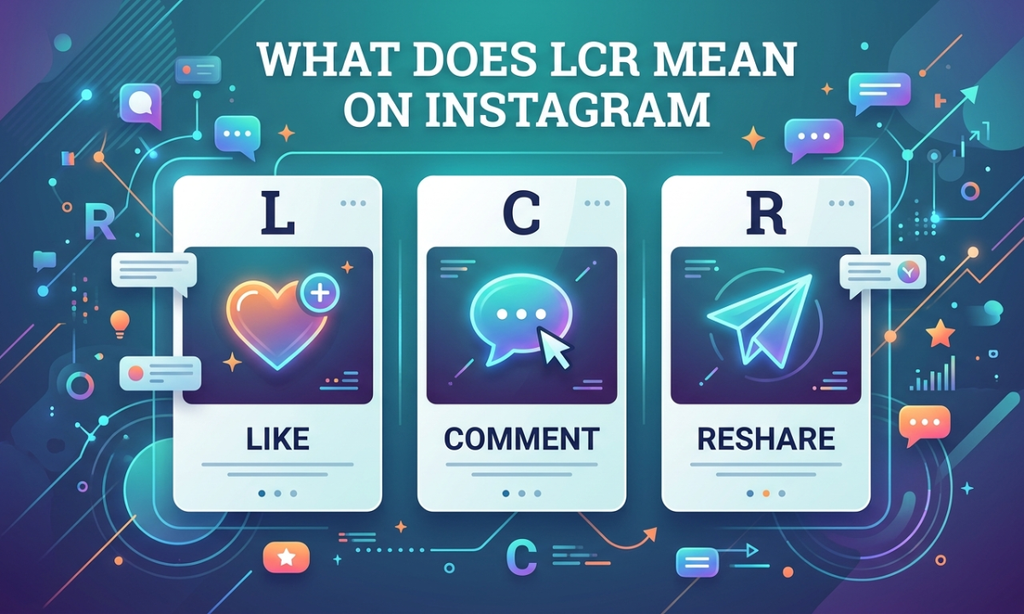
On Instagram, LCR almost always stands for Like, Comment, Reshare. It’s an engagement acronym — a quick way for someone to ask their audience to interact with a post in three specific ways instead of just scrolling past it.
You’ll typically see it in one of these spots:
- At the end of a caption, like “New drop is live 🔥 LCR if you’re in!”
- Written directly on an image or carousel slide
- Dropped in the comments by the poster themselves
- Used as a hashtag, such as #LCR or #LCRforLCR
The logic behind it is simple. Instagram’s algorithm rewards posts that get a lot of interaction early on. A photo that picks up likes, comments, and shares within the first hour tends to get pushed to more people’s feeds and the Explore page. So instead of hoping people engage on their own, creators spell it out: like it, comment on it, reshare it.
Think of LCR as the social media version of “please and thank you.” It’s blunt, but it works — especially for smaller accounts trying to build momentum.
Where the LCR Trend Came From
LCR didn’t originate on Instagram — it borrowed from an older internet habit of asking for engagement in exchange for engagement, sometimes called “engagement pods” or “L4L” (like for like) culture. Facebook groups and early Twitter used similar shorthand for years before Instagram creators picked it up and shortened it further.
As Instagram’s algorithm became more engagement-driven around 2019 and 2020, creators leaned harder into direct calls-to-action. Instead of vague captions hoping for interaction, accounts started explicitly telling followers what to do. LCR became a fast, low-effort way to say “help me out” without writing a full sentence.
It caught on fastest in a few specific corners of Instagram:
- Small business and shop accounts trying to get products in front of more eyes
- Musicians and artists promoting new releases
- Meme and community pages where mutual support is part of the culture
- Influencer and creator networks that trade engagement to boost each other’s reach
Other Meanings of LCR You Might Run Into
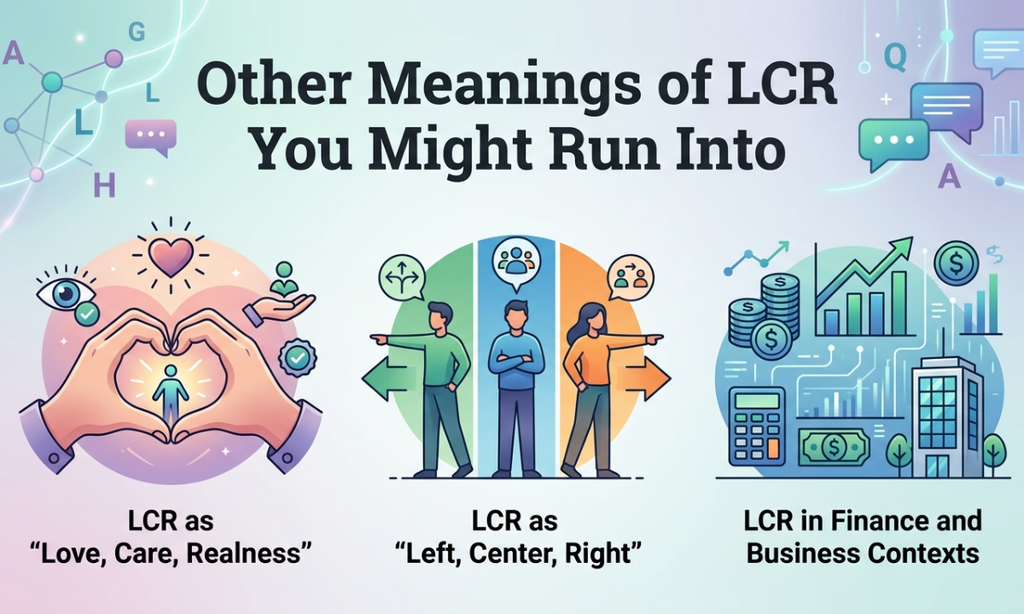
Here’s where it gets a little confusing. LCR isn’t a trademarked term, and different corners of the internet have adapted it to mean different things. If “Like, Comment, Reshare” doesn’t quite fit the context you saw it in, one of these might.
LCR as “Love, Care, Realness”
Some creators, particularly in more personal or wellness-focused spaces, use LCR to mean Love, Care, and Realness. It’s less about boosting a post’s reach and more about a vibe check — a way of saying “I’m sending you good energy” or asking followers to show genuine support rather than just tapping a button.
You’ll usually spot this version in captions about mental health, personal milestones, or relationship content, where the tone is warmer and less transactional than a typical engagement-bait post.
LCR as “Left, Center, Right”
In photo and video editing circles, LCR sometimes refers to Left, Center, Right — a layout or composition style, especially in carousel posts or split-screen edits. A creator might caption a three-slide carousel “LCR edit” to describe how the images are arranged across the frame.
This meaning shows up almost exclusively in editing, design, and photography-focused accounts, so context makes it pretty easy to tell apart from the engagement version.
LCR in Finance and Business Contexts
Outside of social media entirely, LCR is a well-known finance term: Liquidity Coverage Ratio. It’s a regulatory measure banks use to show they hold enough easily-sellable assets to survive a short-term cash crunch. If you see LCR mentioned on a finance influencer’s Instagram post or in a business account’s caption, this is almost certainly what they mean — nothing to do with likes or comments at all.
Quick Comparison Table
| Acronym Meaning | Common Use | Typical Platform Context | Tone |
| Like, Comment, Reshare | Asking followers to engage with a post | Captions, Stories, comments, hashtags | Casual, promotional |
| Love, Care, Realness | Expressing support or authenticity | Personal or wellness captions | Warm, sincere |
| Left, Center, Right | Describing a photo/video layout | Editing and design accounts | Technical, neutral |
| Liquidity Coverage Ratio | A bank’s short-term cash reserve requirement | Finance and business posts | Formal, professional |
If you’re scrolling your average feed, the odds are overwhelmingly in favor of “Like, Comment, Reshare.” That’s the version worth understanding in depth.
How People Actually Use LCR on Instagram
LCR shows up in a handful of predictable spots. Once you know what to look for, you’ll start noticing it everywhere.
In Captions
This is the most common placement. Creators fold LCR right into the sentence, usually near the end of the caption after they’ve made their pitch.
Example caption:
“Finally launched the summer collection 🌊 Which piece is your favorite? Drop a comment and LCR to help a small business out 💛”
In Comments
Sometimes the original poster — or their friends — will comment “LCR” directly under the post as a visible nudge for others to follow suit. It works a bit like social proof: if people see others engaging, they’re more likely to join in.
As a Hashtag
You’ll also see it used as #LCR, #LCR4LCR, or #LikeCommentReshare, particularly in engagement-pod communities where members agree to interact with each other’s posts to boost visibility for everyone involved.
In Direct Messages
Some creators send LCR requests directly to followers or fellow creators, asking for support on a specific post launch. This is common around product drops, giveaways, or time-sensitive content like a limited Story.
Sample Text and DM Examples
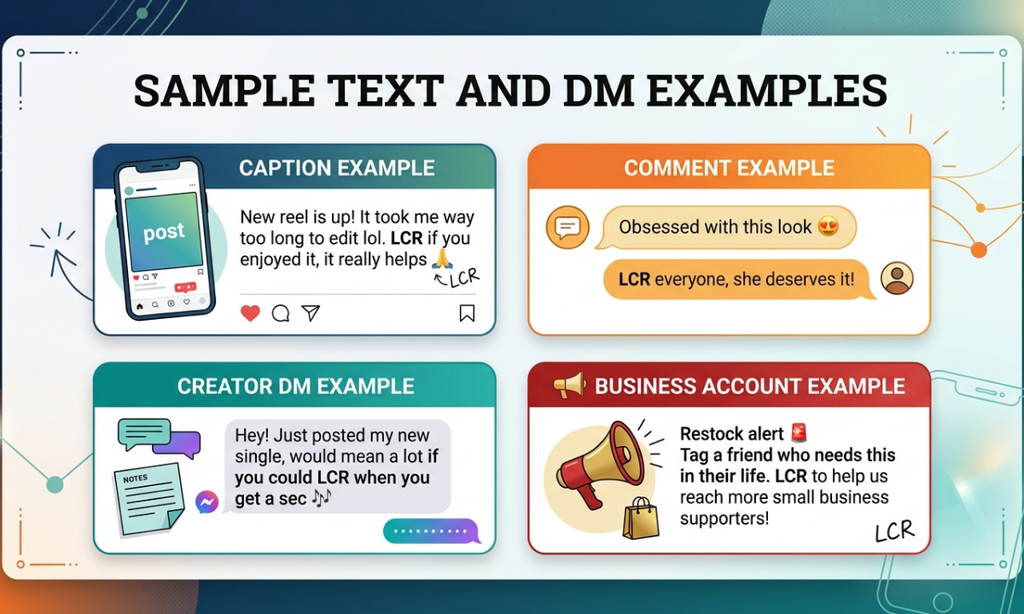
Seeing LCR in context makes it much easier to recognize. Here are a few realistic examples of how it shows up in actual messages:
Caption example:
“New reel is up! It took me way too long to edit lol. LCR if you enjoyed it, it really helps 🙏”
Comment example:
“Obsessed with this look 😍 LCR everyone, she deserves it!”
DM example between creators:
“Hey! Just posted my new single, would mean a lot if you could LCR when you get a sec 🎶”
Business account example:
“Restock alert 🚨 Tag a friend who needs this in their life. LCR to help us reach more small business supporters!”
Notice the pattern: LCR almost always appears alongside a friendly, low-pressure ask. It’s rarely demanding — it’s more of a polite reminder that engagement helps the creator, and it takes the reader two seconds to give it.
Why LCR Matters for Instagram’s Algorithm
To understand why LCR became so common, it helps to know a bit about how Instagram decides what to show people.
Instagram’s ranking system leans heavily on signals like:
- Speed of engagement — how quickly a post gets likes and comments after going live
- Depth of interaction — comments and shares typically carry more weight than a simple like
- Reshares — when someone shares a post to their Story or sends it to a friend, Instagram treats that as a strong signal of quality
- Watch time and saves — for video content especially, these matter more each year
LCR directly targets three of the platform’s most important ranking signals in one short phrase. That’s exactly why it stuck around. A single comment saying “LCR” is a small ask, but multiplied across hundreds of followers, it can genuinely shift how far a post travels.
According to Instagram’s official information about how its ranking works, Instagram uses different signals to determine which content appears in places such as Feed, Stories, Explore, and Reels.
Should You Use LCR in Your Own Posts?
If you’re a creator, small business owner, or anyone trying to grow an Instagram presence, using LCR can be a low-effort way to boost engagement — but it works best when it feels natural rather than forced.
It tends to work well when:
- You have an engaged, supportive community already
- You’re launching something specific (a product, song, video, or announcement)
- The ask fits the tone of your caption instead of feeling tacked on
- You genuinely want feedback, not just numbers
It tends to fall flat when:
- It’s used on every single post, which can come across as desperate or spammy
- Your audience doesn’t know what it means and skips right past it
- It’s the only substance in the caption, with nothing else to engage with
A good rule of thumb: use LCR as a light nudge, not a demand. “LCR if you’re feeling it” reads a lot better than “LIKE COMMENT RESHARE NOW.”
LCR vs. Other Instagram Engagement Acronyms
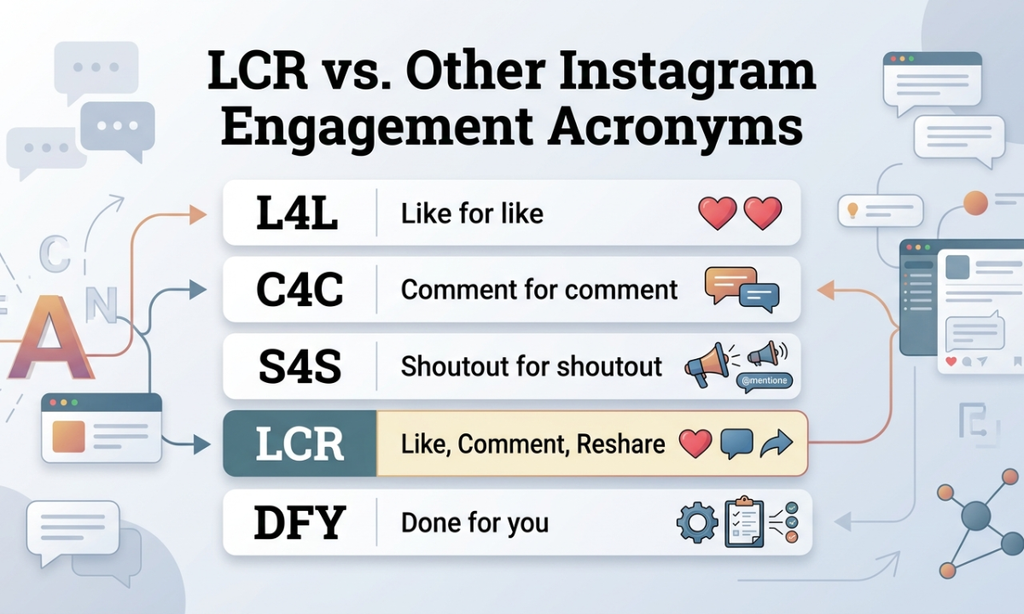
LCR isn’t the only shorthand floating around Instagram captions. It helps to know how it compares to a few similar terms you might run into. For example, if you’ve seen the term IFY and weren’t sure what it meant, you can check this guide on IFY meaning in texting and social media.
| Term | Meaning | How It Differs From LCR |
| L4L | Like for like | A trade — you like mine, I like yours |
| C4C | Comment for comment | Focused only on comments, not likes or shares |
| S4S | Shoutout for shoutout | Accounts promote each other, not a single post |
| LCR | Like, Comment, Reshare | Asks for three actions on one specific post |
| DFY | Done for you | Unrelated to engagement — refers to a completed service or task |
LCR stands out because it’s the only one of these that bundles three distinct actions into a single request rather than proposing a one-for-one trade.
Final Thoughts
So, what does LCR mean on Instagram? Nine times out of ten, it’s a friendly shorthand for Like, Comment, Reshare — a quick way for creators to ask their audience to engage with a post instead of just scrolling past it. It’s become part of the everyday language of Instagram captions, comments, and DMs, especially among small creators, artists, and businesses trying to grow their reach.
Just keep the context in mind. If you spot LCR on an editing account, it might mean a left-center-right layout. On a wellness page, it could mean love, care, and realness. And on a finance account, it almost certainly has nothing to do with social media at all.
Next time you see those three letters pop up in your feed, you’ll know exactly what someone’s asking for — and whether it’s worth the two seconds it takes to give it.
FAQs
What does LCR mean on Instagram?
LCR stands for “Like, Comment, Reshare.” It’s a common call-to-action creators use to ask followers to engage with a post in those three specific ways.
What does LCR mean in a text message?
In texts, LCR usually carries the same meaning as on Instagram — Like, Comment, Reshare — though some people use it as “Love, Care, Realness” in more personal conversations.
Is LCR the same as L4L on Instagram?
No. L4L (like for like) is a one-for-one trade between two accounts, while LCR asks for three different actions — a like, a comment, and a reshare — on a single post.
Why do people comment LCR on Instagram posts?
Commenting LCR encourages other viewers to engage with the post too, which helps boost visibility since Instagram’s algorithm favors posts with fast, high engagement.
What does LCR mean on a carousel post?
On editing and design accounts, LCR can refer to “Left, Center, Right,” describing how images or elements are arranged across a carousel or split-screen layout.
Does using LCR actually help your Instagram reach?
Yes, in a small but real way. Likes, comments, and reshares are strong ranking signals, so asking for all three at once can genuinely improve a post’s visibility.
What’s the difference between LCR and DM4DM on Instagram?
LCR asks for public engagement on a post, while DM4DM refers to a private trade of direct messages between accounts, usually to boost message-based engagement metrics.
Is LCR only used by influencers and businesses?
No, everyday users use it too. It’s common in personal posts, community pages, and even friend groups asking each other to support a specific photo or reel.
